
Introduction
“Success is the sum of small efforts, repeated day in and day out.”
William James
Leadership coaching for executives turns those small daily efforts into consistent, strategic behavior. It is a focused partnership that helps leaders close the gap between what they know good leadership should look like and how they actually show up, especially when AI, data and remote teams add pressure. When we combine ICF PCC-level rigor with smart AI support, that partnership becomes both high quality and scalable.
Many organizations invest heavily in leadership programs, yet see old habits return once the slide deck closes. According to Harvard Business Review, around 60 to 70 percent of digital transformations fail — a pattern so persistent it has been called a statistical constant, as explored in research on Digital Transformation Failure: 2026 — and leadership behavior is a major factor. Training alone rarely rewires habits under stress.
In this article, I share how leadership coaching works, why it matters more than ever, and how an ICF PCC-aligned approach raises the bar. I also show how our iAvva AI hybrid model blends human coaching with an AI coach app to support thousands of leaders in five minutes a day. If you want leadership behavior that matches your AI and digital ambitions, keep reading.
Key Takeaways
For busy HR leaders, CLOs, executives and IT partners, these are the headlines before we go deeper.
Why Leadership Coaching Is Now a Strategic Imperative
Leadership coaching gives executives a safe space to test decisions, reframe pressure and align with strategy. It supports the human side of AI and digital change, where culture and habit usually decide success. Without it, even strong strategies and large budgets often fail to land in daily behavior.The Difference an ICF PCC-Certified Approach Makes
ICF PCC-level practice brings clear ethics, structured contracting and high coaching skill into every engagement. That means better questions, clearer goals and more reliable behavior change across your senior population. HR and CLOs gain confidence that coaching quality will not depend on individual style alone.How Hybrid Human + AI Coaching Scales High-Quality Development
A hybrid model pairs deep 1:1 coaching with AI micro-support between sessions. Leaders get daily nudges, reflection prompts and habit tracking in only five minutes. This pattern makes behavior change stick while keeping costs reasonable across global teams.Measurable Outcomes HR, CLOs, and C‑Suites Can Actually Track
Modern leadership coaching links goals to 360 feedback, engagement scores and real business outcomes. With platforms like iAvva AI, People teams see de-identified trends, completion rates and OKR progress in real time. That data makes it easier to defend and expand budgets.Where iAvva AI Fits in Your Leadership Development Architecture
iAvva AI sits alongside your existing programs as a coaching backbone for all levels. Executives access ICF PCC-aligned coaches, while the app supports daily growth for managers and emerging leaders. One integrated approach connects personal change with enterprise strategy.
What Is Leadership Coaching And Why Does It Matter For Executives?
Leadership coaching for executives is a structured, goal-focused relationship that improves how leaders think, decide and act on the job. It goes beyond teaching concepts and turns real situations into learning moments, with accountability built in. For organizations, it becomes a strategic capability that supports digital and AI agendas, not just a perk for a few.
Executives face constant pressure to deliver near-term results while also steering AI and digital transformation programs. Research from IDC projects global digital transformation spending will reach 3.4 trillion dollars by 2026, yet many programs stall because leaders struggle to shift habits and culture — with analysts estimating Genpact and HFS Research have identified as much as $18 trillion in enterprise value currently trapped by AI readiness gaps alone. Leadership coaching gives them space and structure to make those shifts real.
Defining Leadership Coaching Vs. Training, Mentoring, And Therapy
Leadership coaching is a collaborative process where a trained coach helps a leader define goals, reflect on behavior and design new actions. The focus stays on current and future performance, rather than on teaching content or unpacking deep clinical issues. The coach uses questions, feedback and experiments so the leader finds their own answers and practices new habits.
Training, mentoring and therapy can still be valuable, but they serve different needs:
- Training spreads knowledge to groups.
- Mentoring shares experience from someone who has walked a similar path.
- Therapy, when needed, supports mental health and past experiences.
Mixing them up creates confusion and frustration.
Here is a simple comparison that many HR and CLOs use when they brief sponsors.
| Approach | Main Focus | Typical Format | Best Use Case |
|---|---|---|---|
| Leadership Coaching | Behavior and mindset on the job | 1:1 or small group | Upgrading current leadership impact |
| Training | Knowledge and skills | Workshops or e-learning | Teaching shared frameworks and tools |
| Mentoring | Career and political guidance | Senior with junior | Navigating a path inside a function or firm |
| Therapy | Mental health and past experiences | Licensed clinician | Treating emotional or psychological concerns |
In leadership coaching, reflection, challenge and accountability come together around live work. That clarity helps HR and procurement teams choose the right kind of support, set budgets wisely and explain expectations to sponsors.
Why Leadership Coaching Has Become Mission-Critical
Leadership coaching has become mission-critical because technology change now moves faster than most human habits. Digital and AI programs demand new ways of thinking, deciding and collaborating, yet leaders often rely on old patterns that once worked well. Coaching offers a confidential space to test new behaviors before they show up in board meetings or town halls.
Studies show that roughly two thirds of large change efforts fail, mainly because of culture and leadership, not tools — a finding examined in depth in Fortune’s analysis of We found the real reason 70% of transformations fail, drawing on BCG behavioral science research. At the same time, Gallup reports that most remote-capable employees prefer hybrid work, which adds complexity around trust, inclusion and communication. Executives carry the weight of these shifts every day.
Leadership coaching supports the modern mandate to perform and transform at the same time. A strong coach helps leaders interpret 360 feedback, handle stakeholder pressure and build inclusive, AI-ready teams. Platforms like iAvva AI extend that support through micro-coaching prompts, so learning continues in the flow of daily work rather than waiting for the next offsite.
How Does An ICF PCC-Certified Approach Improve Leadership Coaching Outcomes?
An ICF PCC-certified approach to leadership coaching brings clear standards, ethics and skill requirements into every engagement. It signals to HR and executives that coaches meet rigorous criteria for training hours, supervision and real client experience. That structure raises the chances that coaching leads to lasting behavior change, not just pleasant conversations.
For organizations under cost and time pressure, this matters a lot. According to the International Coaching Federation, companies that use professional coaching often report improved performance, engagement and goal attainment, with most recouping their investment — a pattern that has remained statistically consistent for over a decade, as documented in research on The Seventy Percent: Why IT transformation has remained statistically difficult for twelve years. PCC-level practice helps those gains show up more consistently across different leaders and regions.
What Is ICF PCC Certification And Why Should Executives Care?
The International Coaching Federation (ICF) is a main global body that sets standards for professional coaching education and ethics. Its PCC level sits in the middle of three tiers and requires extensive coach-specific training, at least 500 hours of coaching experience and regular supervision. Coaches also agree to a code of ethics that protects client confidentiality and clear boundaries.
For executives, this means their coach knows how to:
- Contract well with multiple stakeholders
- Ask powerful questions instead of offering quick advice
- Manage complex dynamics inside organizations
PCC-level coaches are trained to set goals that connect personal growth with business outcomes, rather than focusing only on feelings or generic guidance. They can handle sensitive topics like succession, board relations and derailment risks with skill.
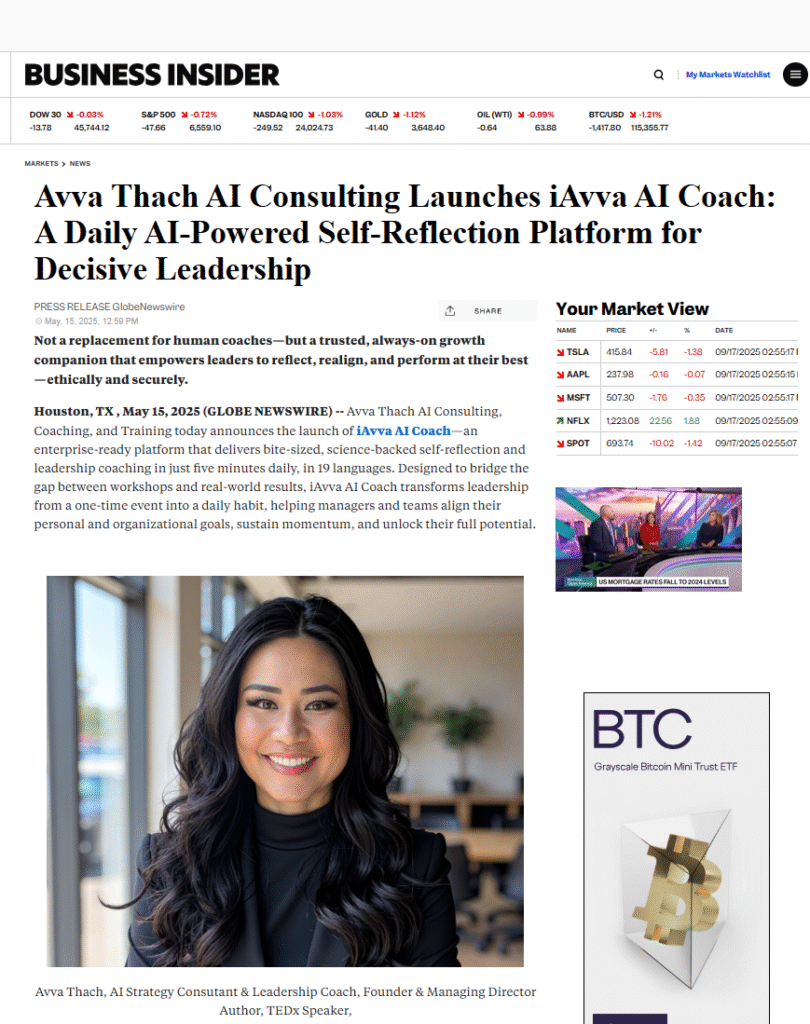
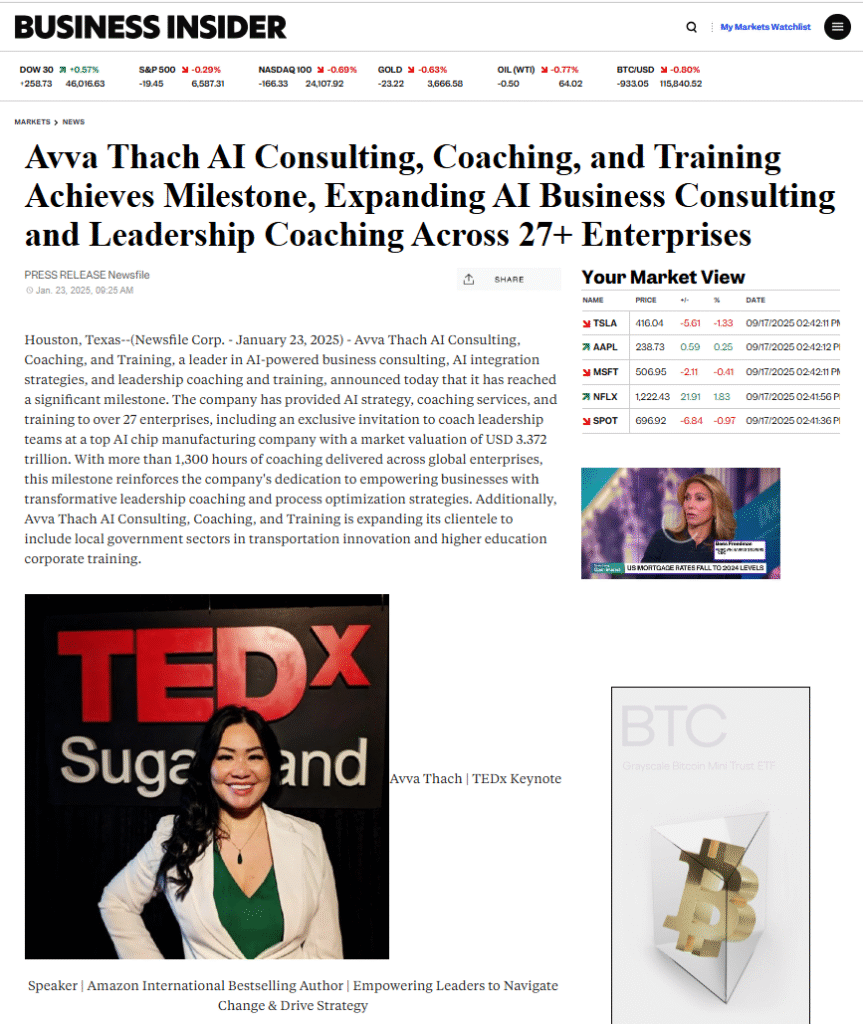
At iAvva AI, our human-led coaching is grounded in ICF PCC standards and practice. We combine that rigor with Avva Thach’s two decades of leadership coaching and consulting across 68 enterprises, including large programs at Accenture and PayPal. The result is a level of reliability that HR and CLOs can trust for senior leaders.
Inside-Out And Outside-In: The Dual Lens Of High-Quality Executive Coaching
High-quality leadership coaching looks both inside the leader and outside at the system they operate in.
The inside-out lens focuses on:
- Values and motives
- Identity and leadership narrative
- Emotional triggers under pressure
When executives understand what drives them under stress, they can respond more thoughtfully instead of reacting on autopilot.
The outside-in lens looks at:
- Role demands and performance expectations
- Strategy and market context
- Culture and stakeholder expectations
Frameworks from Korn Ferry and the Center for Creative Leadership highlight how effective coaching ties development goals to real business outcomes. This might include faster cross-functional decisions, better engagement scores or smoother digital program delivery.
ICF PCC-level coaches blend both lenses using an assessment–challenge–support rhythm. They use tools like 360 feedback to ground insights in data, challenge unhelpful assumptions and then support experiments that fit the leader’s context. For executives leading AI agendas, this dual view strengthens both inner resilience and outer strategic impact.
As CCL often notes, “Leadership is a process, not a position.” Coaching helps leaders work that process with greater awareness and intention.
Which Leadership Challenges Can Executive Coaching Help C‑Suite And Senior Leaders Address?
Leadership coaching speaks directly to the hardest challenges senior leaders face, especially in AI and digital transformation. It gives them a sounding board for high-stakes decisions, a mirror for blind spots and a practice field for new behaviors. When used well, it protects both personal wellbeing and enterprise results.
C‑suite leaders are asked to hit demanding numbers, lead culture change and stay visible to board members and media. Middle layers demand direction, while technical teams need air cover to experiment with AI and automation. Without structured support, even seasoned executives can slip into firefighting, over-control or quiet exhaustion.
Core Executive Use Cases For Leadership Coaching
Some of the most common executive use cases include:
Leading AI and Digital Programs
Running large digital or AI programs with big price tags and public commitments. Coaching helps executives balance ambition with realistic pacing, talk openly about risks and bring cross-functional teams along. It also supports them when projects hit setbacks, so they do not revert to blame.Stepping Into Bigger Roles
Moving from VP to C‑suite or taking a global P&L. Coaching gives leaders space to rethink how they spend time, who they must influence and which habits no longer serve them. Many discover that what brought them success as experts now limits them as enterprise leaders.Managing Stakeholder Relationships
Repairing or strengthening relationships with boards, regulators, large clients or activist shareholders. In a confidential setting, they can rehearse messages, test responses and explore how their presence affects trust.Handling Inner Pressure
Addressing private struggles such as imposter thoughts, burnout or decision fatigue, which often stay hidden until performance dips. A skilled coach normalizes these issues while keeping the focus on constructive action.
Individual And Organizational Outcomes You Can Expect
At an individual level, leadership coaching usually increases:
- Self-awareness about triggers, strengths and impact
- Emotional regulation in high-pressure situations
- Decision quality and strategic thinking
CCL’s evaluation data show that most leaders who complete coaching report higher effectiveness and better relationships with their teams and peers (Center for Creative Leadership). They also describe greater resilience when facing pressure.
For the organization, well-governed coaching:
- Builds a stronger leadership pipeline
- Reduces derailment risk during key promotions
- Stabilizes AI and digital programs that span many quarters
Measurable indicators include changes in 360 feedback, engagement scores, retention of key talent and delivery against OKRs. At iAvva AI, our analytics dashboards connect coaching themes and progress with these kinds of metrics in de-identified form. That link helps HR, CLOs and the C‑suite move the coaching conversation from “nice to have” to clear business value.
Peter Drucker famously said, “What gets measured gets managed.” Applying that mindset to coaching turns soft leadership work into visible performance gains.
What Does An Effective Leadership Coaching Journey Look Like From Start To Finish?
An effective leadership coaching journey follows a clear arc, from contracting and assessment through to closure and sustainment. When every coach follows a shared structure, HR and executives know what to expect, how to support it and how to measure progress. ICF PCC standards and leading institutes like CCL align closely on this pattern.
Seeing coaching as a repeatable process, rather than a loose set of chats, also helps with scale. It becomes easier to brief sponsors, choose the right duration and gather the right data at the right time. That structure is exactly what we mirror when we design programs at iAvva AI.
From Contracting To Completion: The Six Stages Of Executive Coaching
You can think of a well-run coaching engagement as six connected stages:
Contracting And Goal Alignment
Alignment among the leader, their manager or sponsor and HR or People Ops. In this conversation, everyone agrees on purpose, focus areas, confidentiality limits and success measures. For example, a goal might be to improve cross-functional decision speed or rebuild trust with a key team.Assessment And Discovery
Use tools such as 360 feedback, psychometrics and stakeholder interviews. The coach helps the leader interpret the data, sort signal from noise and notice patterns. This evidence base keeps coaching grounded in reality rather than opinion.Insight And Goal Refinement
The leader chooses two to four clear development goals linked to strategy. These goals are specific, measurable and connected to real work, not abstract traits.Action Planning And Experiments
Goals are turned into concrete action plans and real-world experiments tied to upcoming meetings or projects. Small tests help the leader try new behavior with manageable risk.Ongoing Coaching And Practice
A cycle of sessions, reflection, challenge and between-session practice that builds new habits. Coaches hold leaders accountable while encouraging honest learning.Review, Closure And Sustainment
Everyone looks at progress against baseline and plans how to sustain gains. Some organizations repeat key assessments or do short sponsor check-ins for this step.
A similar six-stage flow shapes our human-led work at iAvva AI, so leaders across 68 enterprises have a consistent experience.
The Role Of Micro-Reflection, Neuroscience, And Positive Psychology In Behavior Change
Behavior change in leadership coaching rests on how the brain wires and rewires habits over time. Neuroscience research, summarized by the American Psychological Association, shows that repeated small actions create new neural pathways. Short, frequent reflection after real events is often more effective than rare, long reviews.
Positive psychology adds a second pillar by focusing on strengths, meaning and realistic optimism, and research confirms that coaching leadership operates through both affective and cognitive mechanisms — as demonstrated in a recent study published in Frontiers | How coaching leadership works in organizational settings. Work from the University of Pennsylvania highlights how noticing successes and values improves resilience and performance. Coaching that blends honest challenge with strength spotting helps leaders grow without shame or denial.
Self-regulation also has a strong base in both neuroscience and psychology, and recent research shows that Goal-focused leaders as coaches: how the interaction of goal-focused leadership and coaching behavior enhances employee work engagement — confirming that leaders who coach with clear goals improve both their own regulation and team motivation. Leaders who can notice their emotional state, pause and choose a response make better decisions under pressure. iAvva AI brings these ideas to life through five-minute daily prompts in our coach app, so reflection and self-regulation become regular habits, not rare events.
Tip: Encourage leaders to jot down three short reflections after key meetings: “What did I try? What happened? What will I keep or change next time?” Over time, this simple habit compounds into significant growth.
How Does iAvva AI Combine Human And AI Leadership Coaching For ICF PCC-Level Results At Scale?
iAvva AI combines human leadership coaching with AI micro-support so enterprises can serve many leaders without lowering quality. We pair experienced, ICF PCC-aligned coaches with a multilingual app that guides five-minute reflections each day. This model gives executives depth when needed and gentle, constant reinforcement between sessions.
Many organizations face the same problem: classic 1:1 coaching works, but it reaches only a few senior people and is hard to measure. AI-only apps feel scalable, yet leaders miss the nuance and trust of a skilled human. Our approach bridges that gap for HR, CLOs and IT leaders who need both reach and depth.
Inside The iAvva AI Coach App: Daily Micro-Coaching For Busy Leaders
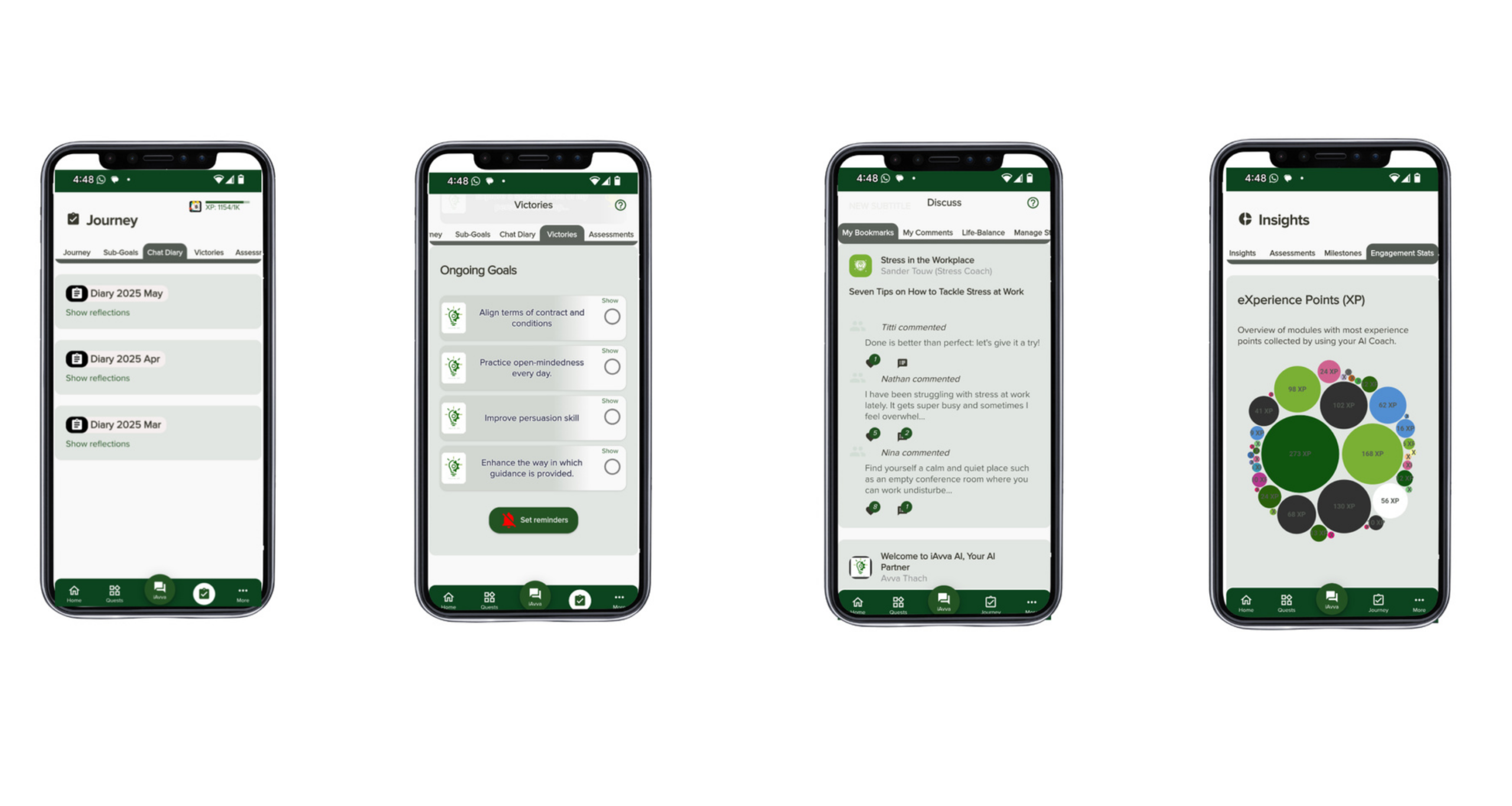
The iAvva AI Coach app is a five-minute self-reflection space built for real executive schedules. Leaders answer a small set of coaching questions each day, through text or audio, on Web, iOS or Android. Prompts draw on neuroscience, positive psychology and ICF principles, so every micro-session supports sound behavior change.
Key features include:
- Daily coaching prompts tailored to leadership themes
- 19 supported languages, helping global teams engage in their native language
- Neurodiversity-friendly design, such as clear layouts and flexible input modes
- Web and mobile access, supporting leaders on the move
Distributed organizations use this to support leaders in North America, Europe and Asia without building separate programs. This breadth matters as more firms run AI and digital programs across time zones.
For HR and IT, security and privacy stay front of mind. Our architecture is encrypted and GDPR-compliant, and we work closely with enterprise InfoSec teams during onboarding. Early users report higher focus, self-awareness and productivity after consistent app use, confirming what behavior science suggests about daily reflection.
Hybrid Human + AI Coaching: Best Of Both Worlds For Enterprises
In our hybrid approach, AI handles the rhythm while human coaches handle the depth:
- Human coaches run focused 1:1 or group sessions on strategy, politics and emotion-heavy topics.
- The app nudges leaders between sessions to apply insights, notice patterns and log small wins or setbacks.
This blend solves several long-standing problems for HR and CLOs:
- It creates a shared methodology across executive coaching, manager support and emerging leader development, instead of a patchwork of vendors.
- It provides real-time, de-identified data on engagement and themes through iAvva AI analytics dashboards.
- It supports scaled rollouts without losing the personal feel leaders expect from coaching.
For IT leaders, one integrated platform reduces the burden of managing many separate tools. iAvva AI was validated through acceptance into the Techstars accelerator, which tested our product-market fit and technical strength. That external view, combined with Avva Thach’s 1,400-plus coaching hours, gives enterprises confidence that this model is ready for scale.
How Can HR Directors And CLOs Integrate Leadership Coaching Into Enterprise Talent Systems?
HR Directors and CLOs gain the most from leadership coaching when it sits inside a wider talent and learning system. Instead of treating coaching as a private benefit, they align it with competency models, succession plans and OKRs. That way, every coaching dollar supports both individual growth and enterprise outcomes.
Integration also reduces duplication and confusion. When assessments, leadership programs and coaching share a framework, data flows more easily and leaders hear consistent messages. At iAvva AI, we often start by mapping coaching goals to the existing leadership model so nothing feels bolted on.
Designing A Tiered Coaching Architecture Across The Organization
A tiered coaching architecture helps you decide who receives which kind of support and when:
Tier 1: C‑Suite And Enterprise-Critical Leaders
Deep 1:1 human coaching, supported by AI micro-reflection in the app. Best suited for roles that carry public and cultural weight.Tier 2: Senior And Mid-Level Leaders
Virtual coaching plus integrated support in leadership programs. For example, a director in a digital transformation academy might meet a coach before and after each module, while using iAvva AI between modules. That pattern helps learning stick while keeping budgets stable.Tier 3: Emerging Leaders And Frontline Managers
Group coaching, peer circles and AI-guided journeys help them build core coaching skills and inclusive leadership habits early.
iAvva AI supports all three tiers through one platform, while your HR team aligns tiers with high-potential pools, succession plans and major AI or digital initiatives.
Recommendation: Map coaching access to career stages and critical roles, not just job titles. This keeps support focused where it has the greatest impact.
Governance, Measurement, And OKR Alignment For Coaching ROI
Strong governance around leadership coaching starts with clear policies on:
- Eligibility and triggers (e.g., new executive appointments, ownership of key AI programs)
- Confidentiality boundaries between coach, leader and sponsor
- Provider standards, such as ICF-level credentials and experience
Measurement begins by defining success up front. That might include:
- Behavior changes in 360 results
- Shifts in team engagement and performance
- Retention of key talent
- Delivery against specific OKRs or strategic projects
Research links leadership development tied to strategy with stronger financial performance, and the cost of inaction is stark — analysis of Infrastructure Projects Worth Rs 42 lakh crore running late illustrates how absent leadership accountability at scale translates directly into missed delivery and financial overrun.
iAvva AI analytics dashboards give HR and CLOs de-identified insight into usage, themes and progress against goals. Our OKR alignment features help leaders connect their coaching goals with team and enterprise objectives on one screen. Those insights then feed back into program design, helping you refine leadership models and learning paths over time.
What Does Leadership Coaching Look Like In The Age Of AI And Digital Transformation?
Leadership coaching in the AI era focuses on helping leaders combine human judgment with machine intelligence. Executives must understand enough about AI to sponsor it wisely, while still centering ethics, inclusion and long-term trust. Coaching provides a confidential space to explore fears, test narratives and practice new behaviors around these themes.
The context is changing fast. AI is reshaping workflows, roles and customer expectations, and many leaders feel pressure to appear certain while feeling unsure. Coaching gives them permission to be learners again, without losing authority or momentum in front of their teams.
Preparing Change-Ready, AI-Literate Leaders
Change-ready, AI-literate leaders show curiosity, humility and courage in the face of new technology, and evidence confirms that The influence of coaching on employees in the VUCA world demonstrates measurable gains in adaptability and resilience when coaching is applied in volatile, uncertain environments. They ask better questions about data quality, algorithmic bias and human impact, instead of pretending to have all the answers. Leadership coaching helps them build these mindsets and behaviors in real projects.
Executives often need to shift from being functional experts to orchestrators of human plus AI capability. That means:
- Delegating technical detail to specialists
- Sponsoring continuous learning and experimentation
- Holding firm on ethics and risk boundaries
Coaching supports them as they reset their identity and habits for this wider role.
Fear and resistance around AI appear both in leaders and in their teams. Through leadership coaching, executives can process their own concerns, craft honest messages and practice two-way conversations with staff. Our hybrid model at iAvva AI links those reflections directly to daily behavior through micro-prompts, so insights do not stay on the page.
Using AI Thoughtfully Inside The Coaching Ecosystem
Using AI thoughtfully in coaching means amplifying insight without turning development into surveillance. AI can:
- Spot patterns in reflection data
- Suggest timely prompts or resources
- Remind leaders of their own commitments
It should not read private notes for performance ratings or surprise leaders with hidden analysis.
Ethics and privacy matter deeply here. We work with clients to define clear consent and data boundaries before launch, especially for US-based firms with global teams. Our architecture is encrypted and GDPR-compliant, and analytics stay at an aggregated level for HR and People Ops.
Research from MIT Sloan Management Review shows that organizations gain more from AI when they build trust and transparency into its use. iAvva AI follows that insight by keeping leader data private while still giving executives and HR useful, anonymized trends. This balance lets AI support leadership coaching without eroding psychological safety.
As MIT researchers note, “Trust is the currency of the human–AI relationship.” The same is true for human–coach relationships, especially when AI sits in the middle.
How Do You Choose The Right Leadership Coaching Partner For Your Organization?
Choosing a leadership coaching partner is a high-stakes decision for HR, CLOs and the C‑suite. The wrong choice wastes budget, frustrates leaders and confuses your talent strategy. The right partner brings consistent quality, strong ethics and clear measurement, aligned with your AI and digital goals.
Buying coaching now often means picking between freelance marketplaces, traditional consulting firms and AI platforms. Each path brings benefits and risks. Our view at iAvva AI is that enterprises need managed quality plus smart technology, not a loose collection of untested coaches.
Criteria For Evaluating Executive Coaches And Coaching Providers
At the coach level, look for:
- ICF or equivalent certification, ideally at PCC level or higher
- Solid coach-specific training and supervised practice
- Real leadership or organizational experience, so they understand boards, P&L pressure and transformation programs
- Strong listening, direct feedback and calm presence
Sector understanding can also help, especially in regulated fields or complex technical environments. Coaches do not need to be former CIOs to support AI programs, yet they should understand how digital change plays through people, process and governance.
At the provider level, look for a managed network rather than an uncurated marketplace. Firms like CCL and Korn Ferry show how central supervision, selection and measurement raise quality. iAvva AI follows a similar path, backed by Avva Thach’s 20-plus years of coaching and consulting, 1,400 coaching hours and experience across 68 enterprises.
Key Questions To Ask Before You Invest In A Coaching Solution
Before you commit, ask questions in three areas:
Strategy And Outcomes
- How will this coaching support our top three to five business goals (for example, faster AI adoption or stronger cross-functional collaboration)?
- How do you connect coaching design and assessment with those outcomes?
Quality And Consistency
- How do you select, supervise and develop your coaches?
- How do ICF standards appear in day-to-day practice?
- How do you handle contracting, goal alignment and sponsor communication?
Data, Security And Scale
- What data do you collect from coaching and how long do you keep it?
- How do you anonymize information for HR and leaders?
- How will you support C‑suite, mid-level and emerging leaders globally and in multiple languages?
iAvva AI answers these questions through our hybrid human plus AI model, real-time dashboards, multilingual app and enterprise-grade security practices.
To Sum Up
Leadership coaching has moved from a side benefit to a central driver of AI and digital performance. Executives who have a skilled coach think more clearly, lead more humanely and stay aligned with strategy under pressure. Organizations that treat coaching as a system, not a perk, gain stronger pipelines and lower risk in their biggest programs.
ICF PCC-aligned practice raises the standard for what good coaching looks like in your enterprise. It brings reliable contracting, thoughtful questions and clear ethics into every session. When you pair that level of human quality with AI micro-support, behavior change becomes both deeper and more repeatable.
iAvva AI sits exactly at that intersection. Our five-minute daily micro-coaching app, human 1:1 and group coaching, and OKR-linked analytics give HR, CLOs and IT leaders one integrated way to support thousands of leaders. The result is not just more training hours but visible shifts in decisions, relationships and delivery.
If your organization is serious about AI and digital change, coaching cannot sit on the sidelines. Choose a focused cohort, define sharp business outcomes and pilot iAvva AI as part of your leadership architecture. From there, you can scale what works and build a coaching culture that matches your ambitions.
Frequently Asked Questions
Question: What Is The Difference Between Leadership Coaching And Executive Coaching?
Leadership coaching is a broader term for coaching that develops leaders at any level. Executive coaching is a specific form focused on senior leaders who carry enterprise or P&L responsibility. Stakes, visibility and strategic impact are usually higher, so engagements feel more intense. iAvva AI supports both, from emerging managers to C‑suite executives.
Question: How Long Does A Typical Executive Coaching Engagement Last And How Often Are Sessions Held?
A typical executive coaching engagement lasts three to twelve months with sessions every two to four weeks. Duration depends on role complexity, transformation agendas and assessment cycles. Some leaders need shorter sprints around a promotion, while others benefit from longer support. The iAvva AI app keeps growth going daily between and beyond those sessions.
Question: How Can We Measure The ROI Of Leadership Coaching Programs?
You measure leadership coaching ROI by combining behavior and business indicators. Behavior data may include pre and post 360 results, manager ratings and engagement scores. Business data might cover team performance, retention of key talent and delivery on strategic projects. iAvva AI adds de-identified dashboards that show usage, progress and links to OKRs for senior review.
Question: Is AI Coaching Confidential And Safe For Our Leaders To Use?
Yes, AI-supported leadership coaching can be confidential and safe when designed well. Personal reflections stay private, while HR and People Ops only see aggregated trends. Strong platforms use encryption, GDPR-aligned policies and clear consent so leaders know how data is handled. iAvva AI follows these practices while still giving organizations useful insight into impact.
Question: Can Leadership Coaching Support Middle Managers And Emerging Leaders, Not Just Executives?
Yes, leadership coaching is very effective for middle managers and emerging leaders. Supporting them early builds a stronger pipeline, better culture and smoother promotion steps. Digital and AI-powered micro-coaching makes this level of access financially realistic. Many clients use iAvva AI to reach mid-level talent with daily prompts plus targeted group coaching.
Question: How Do We Get Started With iAvva AI Leadership Coaching In Our Organization?
You start by clarifying the business outcomes you want leadership coaching to support, such as AI adoption or faster cross-functional delivery. Next, choose a pilot group, for example digital transformation leaders or a regional executive team, and define success metrics. We then set up the platform, align human coaching engagements and connect with your HR or L&D workflows. From that pilot, we scale what works across your enterprise.













Leave a Reply