





Leading Digital Transformation Consulting Firms That Deliver Results
Introduction
Only about three out of ten digital transformation programs hit their goals. The other seven burn time, money, and goodwill, then stall. When we looked at the data behind those outcomes, one pattern stood out again and again. The organizations that win do not just pick new tools. They work with the right digital transformation consulting firms and build leaders who can guide people through deep change.
The stakes could not be higher. Digital transformation is no longer a side project or a tech refresh. It is how a business stays alive in a market where customers expect instant, personalized service and new digital‑native competitors move fast. For HR Directors, Chief Learning Officers, CIOs, and business leaders, this pressure shows up as constant questions: How do we keep up with AI and automation, redesign work, and still protect people and culture? How do we upskill thousands of employees while running the business?
Most programs do not fail because the software is bad—research on digital transformation in business shows they fail because culture, leadership, and skills do not move at the same speed as the technology. They fail because culture, leadership, and skills do not move at the same speed as the technology. Strategy looks great on a slide, but middle managers remain unconvinced, teams are afraid to change how they work, and there is no daily support to help leaders act differently. That is where the right consulting partners matter, and where leadership development platforms like iAvva AI come in.
This guide pulls together research from firms such as McKinsey, BCG, and others, plus our own experience working with organizations that range from fast‑growing SMBs to global enterprises. We walk through what digital transformation really means, the role of digital transformation consulting firms, the five pillars every serious program must cover, and the six success factors that separate the top 30 percent from the rest. We also profile ten leading partners, including how iAvva AI addresses the human side of change, and share a practical framework to select the right partner for a specific context. By the end, it becomes clear not only which firms can help, but also how to build the leadership and culture that keep change going long after the consultants leave.
Key Takeaways
Only about 30 percent of digital transformation programs achieve their targets, and research shows the main cause is resistance to change, not bad technology. The winners combine clear strategy, strong leadership, and the right digital transformation consulting firms with a serious focus on people and culture. Treating leadership growth as optional leaves a huge blind spot that shows up later as stalled adoption and fatigue.
Six factors show up in nearly every successful program: a clear, integrated strategy, visible commitment from leaders at all levels, putting the best people in key roles, agile governance, continuous measurement, and a business‑led technology platform. When any one of these is missing, risk goes up fast, no matter how strong the tools look on paper.
Every complete program rests on five pillars that work together rather than in isolation: customer experience, operational agility, business model change, digital technology strategy, and change management with culture at the center. Many companies over‑invest in platforms while under‑investing in change management, which is why the benefits fade after the first wave.
Leading digital transformation consulting firms tend to blend three lenses. They bring consulting discipline for strategy, agency‑style creativity for customer and employee experiences, and start‑up agility for quick experiments. The best partners help clients build internal capabilities and leadership strength instead of creating dependence on outside experts.
Leadership development is the thread that ties all of this together. Platforms such as iAvva AI, which link daily leadership habits to OKRs and provide real‑time analytics for HR and L&D, make it possible to grow thousands of leaders during a program. This continuous support makes culture change real instead of a slogan and keeps momentum going after the project plan ends.
What Is Digital Transformation and Why Does It Matter?
When we talk about digital transformation, we mean more than moving a process into an app or buying a new platform. True digital transformation is the deep integration of digital tools, data, and ways of working into every part of a business. It changes how value is created, how teams work, how leaders make decisions, and how customers experience the brand. It reaches into strategy, structure, culture, and daily habits.
It helps to separate digital transformation from simple digitization. Scanning paper forms into PDFs or installing an online portal is digitization. The process is faster, but the basic model is the same. Digital transformation, by contrast, rethinks the process itself. For example, instead of just scanning loan forms, a bank might build a data‑driven credit model, an end‑to‑end mobile flow, and real‑time status updates that change how customers and staff behave.
We see three dimensions that always show up in a serious transformation:
- Technology foundation – cloud, data platforms, AI, and automation that support new ways of working.
- Business model change – for example, moving from one‑off product sales to subscriptions or digital platforms.
- Culture shift – leaders and teams move toward agility, experimentation, and continuous learning rather than long, rigid cycles.
This culture shift is the hardest part. Digital transformation is not a one‑time program with a neat end date. It is a mindset that says, “We keep learning, testing, and adjusting as the market shifts.” That means feedback loops, fast decisions, and room for teams to try new ideas without fear. It also means leadership habits must change, from top executives to first‑line managers, which is why daily coaching and reflection play such an important role.
Why does all this matter so much now? Customer expectations keep rising as people compare every experience to the smoothest app on their phone. New entrants, often born with cloud, data, and AI at their core, move quickly into markets that were once protected. At the same time, technology shifts such as generative AI and automation change what work even looks like. Standing still is the fastest way to fall behind.
Yet many companies still struggle to apply digital tools at real scale. They might have pilot projects that look promising, but the impact remains stuck in a few teams. Others invest heavily in platforms, then discover that old processes, slow decisions, and risk‑averse culture cancel out the benefits. Surveys from multiple firms show that while most executives say digital transformation is a top priority, only a minority feel they are effective at it.
The link to business outcomes is direct. When done well, digital transformation helps organizations respond faster to market shifts, create better customer and employee experiences, improve decision quality, and reduce waste. It can open new revenue streams, shorten time‑to‑market, and raise margins. When done poorly, it drains resources and creates change fatigue, making the next effort even harder.
Most of all, digital transformation matters because it is about people. Technology can automate tasks and provide insight, but humans still decide what to build, how to serve customers, and where to focus. That is why we put so much weight on leadership and workforce capability. Without leaders who can guide teams through change, even the best digital transformation consulting firms and the strongest platforms will fall short.
The Strategic Role of Digital Transformation Consulting Firms
If digital transformation touches technology, business models, and culture, it is fair to ask why a company cannot just handle it alone. The reason many do not is that change at this scale crosses internal boundaries that rarely talk to each other. HR, IT, finance, operations, and business units all have their own pressures and language. Digital transformation consulting firms step in as strategic partners who bring these parts together around shared outcomes.
At their best, these firms help leaders craft a clear vision for the future and then break that vision into practical steps. They begin with a frank assessment of digital maturity across people, processes, data, and tools. They look at leadership behaviors, talent gaps, customer experience, and technology debt. From there, they build a roadmap that links digital moves to business goals, such as revenue growth, cost savings, or customer retention.
The scope of work often spans several areas. Consulting teams may redesign end‑to‑end customer experiences, re‑engineer processes for speed and quality, and shape the target operating model. They may select and implement new platforms, design data and AI use cases, and set up new performance dashboards. Alongside that, they support change management, communications, and training so that people can actually work in the new way.
One major strength of leading firms is the way they combine different skills. They bring consulting discipline for strategy and financial impact. They bring agency‑style creative talent for customer and employee experience design. They add start‑up style product thinking and agile delivery for quick testing and learning. This mix helps them move beyond reports into real products, processes, and behaviors that teams can touch.
Over the past decade, we have seen consulting move from classic advisory to more integrated, hands‑on models. Instead of leaving a slide deck and stepping away, many digital transformation consulting firms now embed mixed teams with clients. These teams might include industry experts, data scientists, engineers, designers, and change specialists working side by side with client staff. The aim is not only to deliver results but also to build internal capabilities that outlive the project.
Industry knowledge also matters a great deal. A retail bank has very different regulatory, customer, and technology needs than a manufacturer or a hospital system. Firms that have worked across many clients in one sector bring pattern recognition. They know which ideas tend to work, which ones fail often, and where the hidden risks sit. At the same time, they can cross‑pollinate ideas from other industries, such as applying e‑commerce thinking to B2B sales.
Another reason companies turn to outside partners is speed and risk reduction. Experienced firms have playbooks for digital transformation, along with tested methods for prioritizing use cases, setting up agile teams, and measuring value. This reduces trial and error. They can often see early signs of trouble, such as weak sponsorship or over‑ambitious scope, because they have seen similar patterns many times.
The best partners avoid risky “big bang” moves where everything changes at once. Instead, they favor incremental waves. They start with a small set of high‑impact cases to prove value and build momentum. They then expand to more areas, using early lessons to fine‑tune the approach. This way, budget and energy flow toward what works, and leaders can make informed choices about where to scale and where to stop.
For HR Directors, CLOs, and People Operations leaders, the most helpful firms are those that do not treat human capability as an afterthought. They design leadership development, coaching, and upskilling into the core of the program, not as a separate track. That is where platforms such as iAvva AI, used alongside a consulting firm, can help by turning leadership growth into a daily habit instead of a once‑a‑year event.
The Five Core Pillars of Comprehensive Digital Transformation
When we look across successful programs, five pillars appear again and again: customer experience, operational agility, business model change, digital technology strategy, and change management with culture at the center. Think of these pillars as a checklist. If a digital transformation touches only one or two of them, the program is at risk. If it touches all five in a balanced way, the odds of lasting impact go up sharply.
We use this framework as a diagnostic tool with clients. It helps leaders see where they are strong and where gaps sit. It also helps evaluate digital transformation consulting firms. Any serious partner should be able to speak clearly about how they support each pillar, not just the technology stack.
Customer Experience: Designing for Delight and Loyalty
Customer experience sits at the heart of most digital programs. This pillar is about placing customers at the center of decisions and designing interactions that feel simple, personal, and smooth. It covers every touchpoint, from first contact to service and renewal, across web, mobile, call center, and in‑person channels.
Leading firms use data and research to understand real customer behavior rather than relying on guesses. They study what customers do, where they get stuck, and what they value most. Then they combine that insight with design practices to create experiences that remove friction and feel intuitive. Human‑centered design methods, such as interviews, observation, and rapid prototypes, help teams test ideas early before they scale.
Research shows that nearly half of global executives rate customer experience as extremely important to business success, yet only a small share feel their company is very effective at it. This gap is where digital transformation consulting firms can help. They bring experience designing digital products and services across sectors and can spot missed opportunities, such as inconsistent branding, confusing flows, or slow service hand‑offs.
Better customer experience is not just “nice to have.” It drives real business results. Well‑designed experiences increase conversion rates, average order value, and customer lifetime value. They also reduce support costs, as fewer customers need help to complete tasks. When marketing, sales, and service teams share one view of the customer and work from the same data, they can line up messages and offers in a way that builds trust and loyalty.
Operational Agility and Process Transformation
Operational agility is the ability to sense changes and respond quickly without months of internal struggle. This pillar focuses on re‑thinking how work flows across the organization. Many companies still rely on legacy processes and systems that slow decisions, cause rework, and frustrate employees.
Digital transformation consulting firms often start by mapping key processes end to end. They look for delays, manual steps, and points where information gets stuck. Then they redesign these flows using automation, better workflow tools, and clearer rules on who decides what. The aim is to reduce cycle times, cut errors, and free people to focus on higher‑value tasks.
Agile methods play a big role here, not just in IT but across functions. Instead of long projects that run for a year before anyone sees results, teams work in short cycles. They release small improvements, measure impact, and adjust. This way of working demands cross‑functional teams where operations, tech, and business experts sit together, rather than throwing work over walls.
The benefits show up in many ways—for example, Digital World Class® Procurement teams demonstrate how operational excellence drives measurable returns on digital investments. Faster processes mean quicker time‑to‑market and better customer responsiveness. Clearer workflows and fewer manual tasks improve employee experience and reduce burnout. Cost savings emerge from less waste and fewer errors. The main challenge is that legacy systems and old habits often resist change, which brings us back to the need for strong sponsorship and thoughtful change support.
Business Model Innovation
Business model innovation is about rethinking how a company creates, delivers, and captures value. Digital tools make new models possible that would have been hard or impossible before. For example, many firms shift from one‑time product sales to subscription services, platforms, or data‑driven offerings.
Consulting partners help leaders explore questions such as who the ideal customer is, what problems they care most about, and what digital channels or offerings could meet those needs. They often support experiments in areas like digital marketplaces, usage‑based pricing, or partnerships that extend reach. In many cases, digitizing sales and service channels is a first step, opening access to new markets or segments.
One big concern leaders have is cannibalizing existing revenue streams. A new digital offer might compete with a legacy product in the short term. Thoughtful design and staging are needed to manage that risk. This is where outside advisors bring perspective, drawing on examples from other firms that have made similar shifts.
When business model innovation works, it can open new revenue streams, smooth out cyclical demand, and deepen customer ties. It can also change what skills and structures the organization needs, which means HR and L&D must be involved from the very start. Digital transformation consulting firms that understand both strategy and people can help make those links visible.
Digital Technology Strategy and Platform Development
The technology pillar is about building a foundation that supports current needs and can grow with the business. Rather than one big monolithic system, many leading firms design a Data and Digital Platform (DDP). This platform brings together data, services, and applications in a modular way, so new capabilities can be added without starting from scratch each time.
Key building blocks often include a data lake or data hub where information from across the company comes together in usable form. APIs make it possible for different systems to talk to each other. Microservices break large applications into smaller parts that can be updated independently. Cloud infrastructure provides flexibility and scale without large upfront hardware purchases.
Emerging technologies such as AI, machine learning, and the Internet of Things sit on top of this base. Rather than chasing every new trend, effective technology strategies tie these tools to clear business needs. For example, AI might be used to predict equipment failure in a factory, personalize offers in retail, or support better staffing decisions in a call center.
A key lesson from past projects is that technology strategy must be led by the business, not just by IT. Business leaders define the outcomes they want, such as faster onboarding, fewer errors, or new revenue lines. Technology teams then select and shape platforms to meet those goals. Security, privacy, and governance remain non‑negotiable, especially when handling customer or employee data.
Change Management and Culture Transformation
Change management is the pillar that often gets the least budget and does the most damage when ignored. This area deals with the human side of digital transformation, from mindsets and behaviors to skills and morale. Research consistently points to resistance to change and cultural inertia as the single biggest obstacles to success.
“Culture eats strategy for breakfast.”
— Peter Drucker
Effective change work goes far beyond sending emails about a new system. It starts with a clear, honest case for change that connects the program to the real pressures the business faces. Leaders need to explain not just what will change, but why it matters and how it affects different roles. People want to know what this means for their day‑to‑day work and their future.
Skill gaps are another major issue. Digital transformation demands new capabilities in data literacy, collaboration, problem solving, and use of new tools. One‑off training sessions rarely stick. Instead, continuous learning programs, coaching, and on‑the‑job practice are needed. This is where platforms like iAvva AI can support HR and L&D teams by making leadership reflection and habit building part of the daily flow.
Psychological safety plays a key role. Teams need to feel safe trying new ways of working, raising issues, and sharing ideas without fear of blame. Consulting partners can design structures and rituals that support this, but leaders must model the behavior. When culture change is treated as “soft stuff” that can wait, the technical side may go live on time, but adoption lags and old habits return.
Six Critical Success Factors for Digital Transformation
Across hundreds of studies and many real‑world programs, six factors show up again and again in the 30 percent of digital transformations that reach or exceed their goals. Think of these as the guardrails for every program and as a checklist for evaluating digital transformation consulting firms. When all six are present, the odds of real impact go up sharply. When one or more are missing, risk rises quickly.
These factors are:
- A clear integrated strategy
- Leadership commitment from the top through the middle
- Putting the best people in key roles
- An agile governance mindset
- Rigorous monitoring and measurement
- A business‑led technology and data platform
We use them both to design programs and to diagnose why past efforts stalled. They also offer a shared language for HR, IT, and business leaders to discuss where support is needed.
Craft a Clear, Integrated Strategy With Measurable Goals
Every serious digital effort needs a strategy that says, in simple terms, what success looks like and how to reach it. This does not mean a huge document that sits on a shelf. It means a sharp vision, a small set of measurable goals, and a roadmap that links digital moves to business outcomes. When we say integrated, we mean that this strategy lines up across business units, functions, and regions rather than each area running its own side projects.
A strong strategy usually includes:
- A concise vision statement
- A handful of strategic objectives tied to outcomes such as revenue growth, margin improvement, or higher customer satisfaction
- A phased roadmap showing which use cases come first, what capabilities must be in place, and how value will be tracked
This gives leaders a way to say “yes” or “not now” to new ideas based on clear criteria.
Many failing programs share the same pattern. They collect a long wish list of digital projects, spread budget thinly, and never build enough depth in any area to see real impact. Without a shared picture of where the company is headed, teams optimize locally. Digital transformation consulting firms can help by turning broad ambitions into a small number of sequenced, high‑impact steps and by linking each step to numbers that matter to the board.
Most of all, strategy must stay current. Markets shift, technology moves, and learning from early waves should feed back into the plan. We treat strategy as a living document that guides choices about where to invest, where to stop, and what to change.
Secure Leadership Commitment From the Top Through the Middle
Visible, steady commitment from senior leaders is non‑negotiable for digital transformation. When the CEO and executive team show up, talk about the program in business terms, and make time for key decisions, people notice. They see that this is not “just another project” but central to the future of the company. That sense of priority affects how managers allocate time, talent, and budget.
Leadership commitment shows up in several ways. Senior leaders set clear expectations for what will change and why. They remove obstacles, such as clashing priorities or outdated policies. They invest in their own learning so they can ask better questions about data, technology, and new ways of working. They also model desired behaviors, such as openness to feedback and willingness to test and learn.
Middle managers are just as important. They translate strategy into daily work and influence how teams feel about the change. If middle managers are skeptical or left out of planning, even the most inspiring executive speeches will not reach the front line. Digital transformation consulting firms that understand this work hard to involve middle management early, build their skills, and give them the tools to lead change in their areas.
Keeping commitment strong over several years is not easy. Competing priorities, leadership turnover, and early setbacks can sap energy. Good governance routines, regular progress reviews, and honest communication about what is and is not working all help maintain focus. Leadership also has a key role in building psychological safety so teams feel able to raise issues rather than hiding problems.
Put the Best People in the Right Places
Digital transformation is often treated as extra work piled on top of day jobs. In successful programs, the opposite is true. The organization assigns some of its best people to central roles and treats those roles as career‑building assignments. This sends a clear signal about the importance of the effort and raises the quality of thinking and execution.
The ideal transformation team blends deep digital skills with strong knowledge of the business. Data scientists, designers, product managers, and engineers work alongside seasoned leaders from operations, finance, HR, and front‑line units. Together, they understand both what is technically possible and what will work in the real context of customers, regulators, and employees.
When transformation teams are staffed only with whoever is free, programs struggle. Key decisions take longer. Stakeholders doubt the seriousness of the effort. In some cases, the same people are expected to keep all their old responsibilities and drive major change at the same time, which leads to burnout and shallow execution. We encourage clients to free up high‑potential leaders for these roles and to recognize that move in performance and promotion decisions.
Digital transformation consulting firms help by identifying skill gaps and designing hiring, upskilling, and selective contracting strategies. Some capabilities, such as core data architecture or AI model design, may be more efficient to source externally at first. Others, such as product ownership or digital leadership, must live inside the organization. Transformation is not just about changing systems. It is also a chance to develop the next wave of leaders.
Adopt an Agile Governance Mindset Throughout the Organization
Agile is often discussed as a method for software teams, but the heart of agile is a mindset and a way of making decisions. In digital transformation, governance that keeps the old slow habits in place can crush agile delivery, even if teams use the right tools. An agile governance mindset resets how decisions are made, how progress is tracked, and how risk is managed.
In practice, this means shorter decision cycles. Instead of waiting a month for a steering committee to approve a change, key decisions happen weekly. Leaders agree upfront on the boundaries within which teams can act and on the thresholds that require escalation. This keeps work moving while still managing risk. Approval processes are simplified so teams spend more time building and less time chasing signatures.
Culture matters here as well. Agile governance encourages cross‑functional collaboration, experimentation, and learning from both wins and missteps. Rather than punishing every failed test, leaders ask what was learned and how it will shape the next step. Digital transformation consulting firms often help set up structures such as product councils or outcome‑focused portfolios that keep attention on value, not just activity.
Crucially, agile governance brings business and technology leaders together. Joint ownership of products, platforms, and outcomes replaces the old model where IT “serves” the business. Measures of success shift from on‑time, on‑budget delivery to impact on the customer, the process, or the P&L. This style of governance works best when the operating model moves away from rigid silos and toward teams organized around customer needs or business capabilities.
Monitor and Measure Transformation Progress Rigorously
What gets measured gets managed. In digital transformation, measurement is not just a reporting task. It is how leaders learn what is working, adjust course, and make a case for continued investment. Companies that track progress carefully against clear, quantified goals have a major edge over those that do not.
“You cannot manage what you do not measure.”
— Often attributed to Peter Drucker
Effective measurement starts with a baseline. Before major changes roll out, leaders need a clear view of current performance on key metrics such as customer satisfaction, cycle times, error rates, digital adoption, and employee experience. From there, they define target values and time frames. They also identify indicators of capability growth, such as the number of trained product owners or agile teams delivering on their goals.
Traditional metrics, like project completion dates, are not enough. New KPIs might include customer digital engagement, speed of new feature releases, usage of AI recommendations, or participation in leadership development platforms such as iAvva AI. These show whether digital capabilities are actually being used and adding value. Digital transformation consulting firms often bring frameworks for setting up such measurement systems and for linking them to financial outcomes.
Regular review rhythms are vital. Monthly or quarterly sessions where cross‑functional leaders review data, discuss insights, and agree actions keep the program on track. When data shows that a particular use case is not delivering as hoped, leaders can decide whether to adjust, pause, or stop. Sharing progress broadly, including both wins and setbacks, builds trust and helps teams see how their efforts fit into the bigger picture.
Create a Business-Led Technology and Data Platform
Many stalled programs share a common story. IT invests in major platforms, but the business does not change behavior or see much value. A business‑led technology and data platform flips that script. Here, business leaders define the problems to solve and the outcomes to reach. Technology teams then design and build a platform that supports those outcomes and can flex as needs shift.
A modern Data and Digital Platform often uses modular components. Microservices allow each capability to evolve at its own pace. APIs connect internal systems and external partners. A data lake or central hub brings together information from across the enterprise in a usable form. Built on cloud infrastructure, this platform can scale up or down as demand changes and makes it easier to roll out new services to different regions or units.
The real power of such a platform lies in access to data. When teams across marketing, operations, finance, and HR can see a shared, trusted view of data, they can make better decisions faster. They can also build AI and analytics use cases without months of custom plumbing each time. At the same time, strong guardrails for security, privacy, and data governance protect customers and the business.
Digital transformation consulting firms help design and prioritize platform features with business impact in mind. They push back when a design adds complexity without clear value. They also help balance the desire for innovation with the need for stability and compliance. When this balance is right, the platform becomes a launchpad for continuous improvement rather than a one‑off IT project.
Top 10 Leading Digital Transformation Consulting Firms
No single firm is the perfect fit for every organization. The right choice depends on size, industry, goals, and culture. That said, some players stand out for their depth, track record, and ability to deliver real results. Below, we highlight ten leading digital transformation consulting firms. We focus on how each approaches change, where they shine, and what kind of client they tend to serve best.
We place iAvva AI first, not because it competes with all the large full‑service firms, but because it addresses the most common cause of failure. It builds the leadership muscles needed to make any digital program stick. The other nine have strong capabilities across strategy, technology, and implementation and are often most effective when paired with strong internal leadership development support.
Snapshot of Leading Digital Transformation Partners
| Firm | Primary Strengths | Typical Focus Areas | Ideal Client Profile |
|---|---|---|---|
| iAvva AI | Daily leadership reflection, analytics for HR/L&D | Culture and leadership during digital change | SMBs and enterprises needing scalable leader growth |
| McKinsey Digital | Strategy plus execution at scale | Enterprise roadmaps, operating models, value tracking | Large organizations running multi‑year programs |
| BCG | Innovation and new growth | New digital businesses, AI and analytics | Firms seeking new growth engines, not just efficiency |
| Accenture | Large‑scale technology build and run | ERP/CRM, cloud, CX platforms, managed services | Enterprises modernizing complex, global environments |
| Deloitte Digital | Customer and employee experience with industry depth | CX design, analytics, digital operating models | Regulated and industry‑specific organizations |
| KPMG | Data, analytics, and risk‑aware change | Data strategy, governance, finance and automation | Firms with strong regulatory and assurance needs |
| IBM Services | AI and hybrid cloud for complex legacy estates | Hybrid cloud, AI use cases, application modernization | Enterprises with heavy legacy systems and tech debt |
| Capgemini | Business and technology services with strong European base | Intelligent industry, cloud, process modernization | European and industrial firms seeking end‑to‑end support |
| PwC Digital | Financial and governance insight combined with digital work | Data, automation, workforce change, risk | Organizations under close board and regulator scrutiny |
| Cognizant | Digital engineering and application development | Custom apps, cloud‑native builds, IoT | Firms needing strong build capacity and run‑time support |
1. iAvva AI: Empowering Leaders for Sustainable Transformation Success
Research shows that about 70 percent of digital transformations fall short, and the most common reasons are cultural resistance and weak change leadership. That is exactly the space where iAvva AI focuses. Rather than trying to be another broad consulting house, it specializes in the human side of digital change, building the decisive, ethical, and adaptive leaders who keep programs on track.
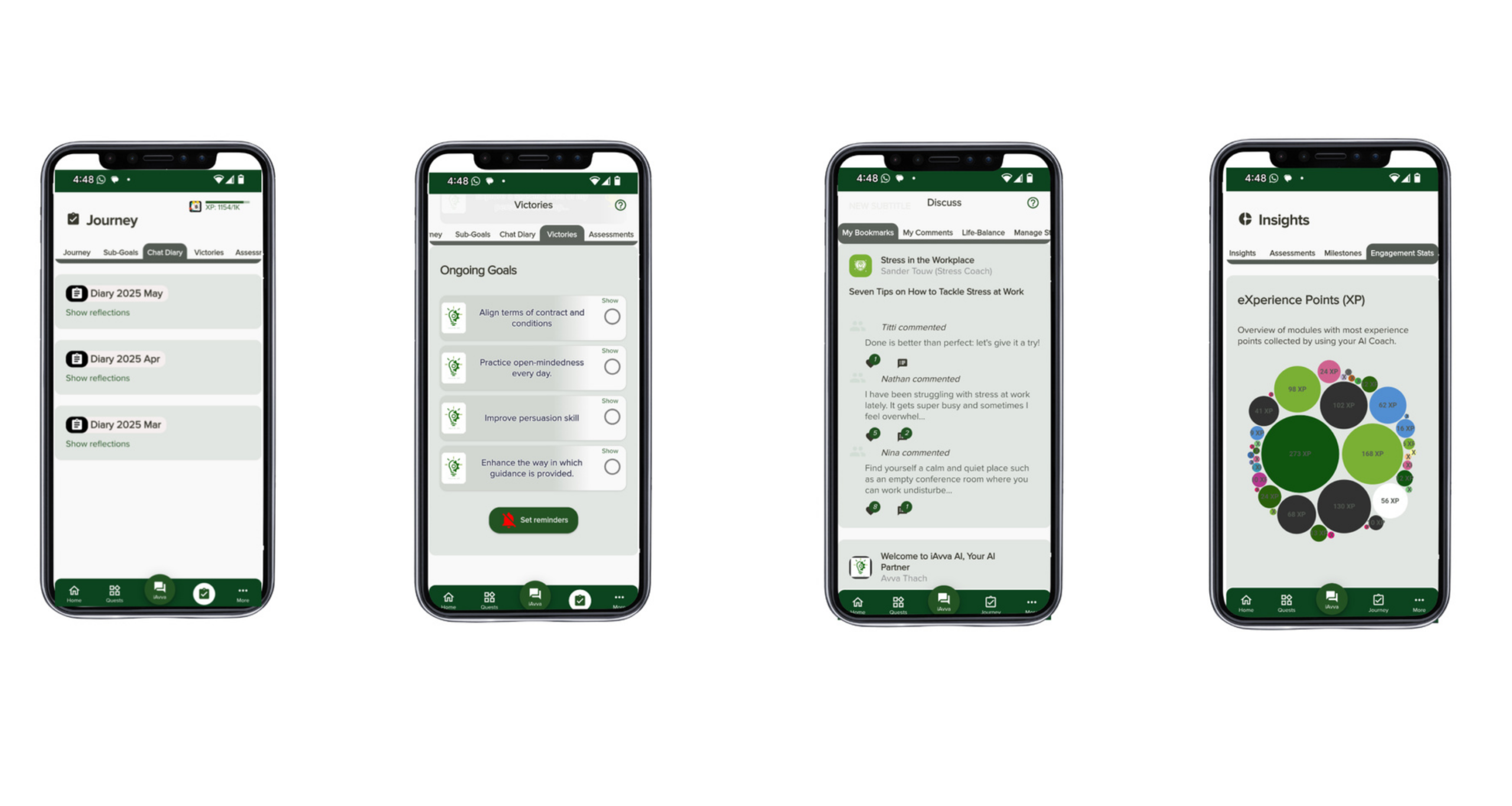
The core offering is the iAvva AI Coach app, a five‑minute, multilingual self‑reflection experience that fits into a leader’s daily rhythm. Available on web, iOS, and Android, it supports 19 languages, which makes it suitable for global workforces. The app delivers small daily prompts grounded in neuroscience, positive psychology, and ICF coaching principles. These questions help leaders slow down, notice their thinking, and make better choices about focus, priorities, and behavior.
The app works as an always‑on growth companion rather than a replacement for human coaches. Traditional leadership programs often run as intense workshops followed by long gaps with little support. In contrast, iAvva AI provides continuous nudges and reflective space that turn good intentions into daily habits. The design supports different learning styles, with both audio and text options and a neurodiversity‑friendly interface that reduces cognitive overload.
One of the features HR and L&D leaders value most is strategic alignment. Inside the platform, individual goals can be linked directly to company OKRs and key change themes. This means that when a leader reflects on their week, they are not just thinking about abstract skills. They are connecting their actions to clear business outcomes such as customer satisfaction, cycle time reduction, or innovation goals. This tight link between personal growth and business metrics is rare and powerful.
Data is another strength. iAvva AI offers real‑time dashboards for HR, L&D, and People Operations teams. These show engagement levels, reflection trends, and growth patterns across teams and regions without exposing personal content. That means leaders of the program can track participation, spot pockets of resistance or stress, and adjust support. It also gives them solid data to share with the C‑suite about the impact of leadership development during digital transformation.
In practice, organizations use iAvva AI to address several common challenges. They need leaders who can guide teams through uncertainty, talk honestly about change, and stay focused under pressure. They want to support thousands of managers across time zones without heavy travel and classroom costs. They want leadership development that does not sit apart from the business but flows straight into how people run teams, projects, and change efforts.
Early adopters report strong gains in focus, self‑awareness, and productivity among leaders who use the app regularly. These are the capabilities needed to navigate complex digital change, align cross‑functional teams, and keep energy high. Because engagement rates stay high week after week, the effect is not a short‑term boost but a steady shift in how leaders think and act.
iAvva AI is designed for organizations that already know technology and strategy are not enough. Ideal clients are SMBs and enterprises with 50 to 5,000 employees who are in the middle of a digital program or planning one. They often have external consulting partners or strong internal digital teams. What they lack is a scalable, measurable way to grow leaders at the same pace as the rest of the change. With strong security, encryption, and GDPR‑compliant data practices, iAvva AI fits well even in regulated environments.
For all these reasons, iAvva AI sits at the top of this list. Most digital transformation consulting firms touch leadership development only at the edges. iAvva AI treats it as the foundation. When leaders grow daily, the rest of the program has a far better chance of lasting success.
2. McKinsey Digital: Integrated Strategy and Execution at Enterprise Scale
McKinsey Digital sits at the intersection of classic strategy consulting and modern technology delivery. It draws on McKinsey’s long history of shaping business strategy and combines that with deep digital, analytics, and design capabilities. For large enterprises wanting a partner from boardroom vision through to implementation, this blend is a strong match.
Their teams usually begin with a detailed assessment of digital maturity across customer experience, operations, business model, technology, and culture. They then help leaders set bold but realistic targets and build integrated roadmaps. McKinsey’s proprietary tools for value tracking and initiative prioritization give leaders a structured way to focus on the highest‑impact moves and to adjust as new data comes in.
McKinsey Digital covers all five pillars of transformation, from designing end‑to‑end customer experiences to modernizing platforms and setting up new operating models. They place strong emphasis on capability building through academies, coaching, and learn‑by‑doing projects. This helps clients avoid over‑reliance on external experts. Industry depth is particularly strong in financial services, retail, healthcare, and industrial sectors.
The firm also invests heavily in research and thought leadership, such as articles on transformation success rates and the six factors that double the odds of success. Ideal clients are large organizations seeking a full‑service partner for multi‑year, complex programs, and who are ready for a significant time and budget commitment. Pricing is at the premium end, which suits enterprises that view digital transformation as a top strategic priority.
3. Boston Consulting Group (BCG): Innovation-Driven Digital Transformation
Boston Consulting Group approaches digital transformation with a strong focus on innovation and new growth. BCG combines strategic thinking with digital and analytics skills to help clients rethink how they compete and grow. For leaders who want more than incremental improvements and are ready to revisit their business model, BCG is a strong candidate.
BCG’s digital practice includes several specialist units. BCG Digital Ventures works with clients to create and launch new digital businesses, often spinning up start‑up‑style teams that move quickly from idea to minimum viable product. BCG GAMMA focuses on advanced analytics and AI, helping companies use data to make smarter decisions and create personalized experiences.
Human‑centered design and customer insight run through their approach. BCG often starts by mapping customer needs and pain points, then works backward to design services, processes, and supporting technology. Agile delivery methods and cross‑functional teams help them move from strategy to working products faster than traditional project models.
BCG’s industry reach covers consumer goods, technology, healthcare, and financial services, among others. They invest in AI and emerging technology capabilities but keep the emphasis on measurable business impact rather than novelty. Ideal clients are organizations seeking a partner to help them imagine and build new growth engines, not just digitize existing processes. These clients must be willing to test bold ideas and accept that some experiments may not succeed.
4. Accenture: End-to-End Technology Implementation and Managed Services
Accenture is known for its ability to deliver large‑scale technology programs and then run and evolve them over time. It combines strategy, consulting, digital design, technology implementation, and operations under one roof. For organizations that need to modernize complex systems and keep them running, Accenture’s reach and depth are a key draw.
The firm’s digital work often centers on selecting and implementing major platforms such as ERP, CRM, and marketing systems, and then integrating them with existing environments. Accenture Interactive focuses on customer experience and marketing transformation, bringing creative and design talent to complement the technology side. Their consultants often work closely with client teams to redesign processes and operating models around new tools.
Accenture has close relationships with major technology providers including Salesforce, SAP, Adobe, Microsoft, AWS, and others. This gives them access to best practices, accelerators, and pre‑built components that can shorten timelines. Their global delivery network allows for follow‑the‑sun development and support, which can help manage costs for long programs.
The firm invests in areas like AI, cloud, and IoT and has built industry‑specific offerings in sectors such as banking, telecoms, and manufacturing. Ideal clients are large organizations needing a partner that can handle both the design and the heavy lifting of implementation and managed services. Some clients may find the scale of Accenture makes it feel less personal, so it is important to clarify team structure and points of contact upfront.
5. Deloitte Digital: Industry-Focused Digital Strategy and Customer Experience
Deloitte Digital combines creative agency skills with Deloitte’s broader consulting and technology services. This mix positions them well for clients that want strong customer experience design backed by solid strategy, analytics, and implementation. Their work often spans marketing, sales, service, and product design.
One of Deloitte Digital’s strengths is its industry focus. The firm has dedicated digital practices for major sectors such as financial services, healthcare, consumer goods, and public sector. This means teams understand the specific regulatory, customer, and operational issues in each industry. They use that knowledge to shape realistic roadmaps and to avoid common traps.
On the capability side, Deloitte Digital offers service design, human‑centered product development, analytics and AI support, and cloud transformation. They also implement enterprise platforms from major vendors and help redesign operating models and organizational structures around digital channels. Their frameworks for digital maturity assessment and strategy development give clients a structured way to plan.
Access to Deloitte’s wider services in risk, cybersecurity, tax, and audit adds value for clients dealing with complex compliance and financial questions. Ideal clients include regulated organizations that need industry‑specific insight and a partner comfortable working with boards and regulators. Because Deloitte is large, experiences can vary by office and team, so due diligence on the specific delivery team is recommended.
6. KPMG Digital Ignition: Data-Driven Transformation With Risk and Compliance Focus
KPMG’s Digital Ignition and related practices focus on data‑driven change, analytics, and strong risk management. For organizations where trust, compliance, and assurance are central, KPMG brings a helpful blend of digital and risk skills. Their heritage in audit and advisory informs a careful approach to controls and governance in digital programs.
KPMG works with clients to build enterprise data strategies, data governance models, and analytics platforms. They help define how data will be collected, stored, and used, including roles, responsibilities, and control mechanisms. This is especially important in sectors such as banking, insurance, healthcare, and life sciences, where regulators look closely at data practices.
Beyond data, KPMG supports ERP and finance transformations, intelligent automation, and customer experience improvements. Their teams consider how new digital capabilities affect risk, controls, and reporting. They also offer cybersecurity and privacy services that can be woven into digital programs rather than treated as separate streams.
Access to KPMG’s broader capabilities in audit, tax, and risk can help clients build strong financial cases for investment and satisfy internal and external stakeholders. Ideal clients are organizations with high regulatory exposure that want to modernize while keeping a sharp eye on risk. Some may see KPMG as more conservative than some pure‑play digital firms, which can be a strength or a limitation depending on goals.
7. IBM Services: AI and Hybrid Cloud Infrastructure Transformation
IBM Services brings deep technology expertise, especially in AI and hybrid cloud, to digital transformation. The company’s heritage in hardware and software, combined with its consulting arm, positions it well for enterprises with complex legacy environments seeking to modernize without business disruption.
IBM helps clients design and run hybrid cloud architectures that combine on‑premises systems with public and private cloud. This is valuable for industries where certain workloads must stay in specific locations for legal or performance reasons. They also assist with application modernization, API strategies, and integration of new digital services with existing core systems.
AI is another focus area, with IBM’s Watson platform and related tools used for tasks such as natural language processing, prediction, and automation. IBM works with clients to identify use cases where AI can improve decision making, customer engagement, or internal processes while keeping ethics and governance in view.
IBM Services also covers digital workplace transformation, collaboration tools, and managed services. Their industry platforms support sectors such as banking, telecoms, and government. Ideal clients are large enterprises with significant technology debt and a need for careful, staged modernization. In some cases, clients pair IBM with other firms that bring more emphasis on strategy or change management to round out the effort.
8. Capgemini: Business and Technology Transformation With Strong European Presence
Capgemini offers end‑to‑end business and technology services, with a particularly strong presence in Europe and growing operations elsewhere. The firm supports clients from strategy through implementation and managed services, making it a full‑cycle partner for digital programs.
Capgemini Invent, the firm’s design and innovation arm, brings design thinking, customer research, and digital strategy capabilities. This is complemented by engineering and technology teams who build and run platforms, applications, and infrastructure. The company’s focus on intelligent industry uses data, AI, and IoT to modernize manufacturing, automotive, and engineering sectors.
Cloud migration, infrastructure management, and business process services form another key area. Capgemini helps clients move to cloud, modernize networks, and automate back‑office work. Their customer experience and marketing practices design and run digital channels, content, and personalization programs.
Partnerships with major technology vendors across cloud, data, and enterprise software extend their reach. Capgemini’s Applied Innovation Exchange provides spaces where clients and Capgemini teams can co‑create and test new ideas. Ideal clients include European enterprises and industrial companies seeking a partner familiar with their markets and operations. Outside Europe, some organizations may be less familiar with the brand but still find strong capabilities.
9. PwC Digital Services: Trust-Based Transformation With Financial Acumen
PwC Digital Services builds on the firm’s reputation as a trusted advisor in audit and tax to support clients through digital change. One of PwC’s core strengths is its ability to link digital investments to clear financial cases and to build confidence among boards, investors, and regulators.
PwC works across data and analytics, AI, automation, customer experience, and cloud transformation. Their teams help clients design and implement digital products, services, and platforms while integrating cybersecurity and privacy from the start. This is especially important in financial services and other sectors where data misuse or breaches carry high cost.
Workforce transformation is another strong area. PwC supports clients as they redesign roles, reskill employees, and plan for the future of work. This often includes new learning programs, change management support, and metrics to track adoption and impact. Their analytics and reporting experience helps clients measure value and communicate it clearly.
Access to PwC’s wider practice areas allows for holistic support on deals, tax structure, and risk management around digital moves. Ideal clients include financial services firms and other organizations that need both digital capability and strong financial and governance insight. Because consulting is one part of PwC’s broader business, clients should confirm the specific digital team’s experience with similar programs.
10. Cognizant: Application Development and Digital Engineering Expertise
Cognizant is known for its digital engineering, application development, and IT services. It is a strong choice for organizations that have a clear digital direction and need a capable partner to build and run the applications and platforms that support it.
Cognizant’s teams help modernize legacy applications, move workloads to cloud‑native architectures, and build custom digital products. Their engineers and developers work with agile methods to deliver new features quickly and to iterate based on user feedback. This makes Cognizant a good match for execution‑heavy programs where speed and quality of build are central.
The firm also invests in IoT and digital engineering for connected products and services. This is valuable for manufacturers, healthcare device makers, and other companies where physical products now include embedded software and data. Cognizant’s data and AI practice supports analytics platforms, data lakes, and intelligent automation across industries.
With a large global delivery network, Cognizant can provide cost‑effective development and support, often combining onshore leadership with nearshore and offshore delivery. Their consulting arm adds strategy and advisory, though many clients still use another firm for high‑level strategy and rely on Cognizant for execution. Ideal clients are mid‑size to large organizations seeking a strong build partner and who have or can secure separate support for change management and leadership development.
How to Select the Right Digital Transformation Consulting Partner
Choosing among digital transformation consulting firms is one of the most important decisions leaders will make during a program. The right partner can speed up progress, help avoid common traps, and build internal skills. The wrong one can drain resources, confuse teams, and delay impact. Rather than asking which firm is “best” in general, it helps to ask which firm is best for a specific situation, culture, and goal set.
We suggest starting with a clear view of internal needs and readiness. That includes understanding the scope of change, current digital maturity, and the strength of leadership and skills. From there, it is easier to evaluate potential partners on their capabilities, track record, and fit. In many cases, a combination of partners works well, such as a large consulting firm for technology and process change plus iAvva AI to support leadership growth across the workforce.
Assess Your Transformation Scope and Starting Point
Before sending out RFPs or taking vendor meetings, it pays to step back and get clear on what is needed—firms like DMI: Digital Transformation Services offer frameworks for assessing your starting point and defining scope. Many selection mistakes happen because teams rush to choose a partner before they share a common picture of the program. We encourage leaders to start with a simple but honest self‑assessment:
- Scope: Is this an enterprise‑wide program that touches most functions, or a focused initiative around customer experience, operations, or a single business unit?
- Maturity: Are most processes still manual and siloed, or has the organization already moved far along with digital channels, automation, and data?
- Drivers: Are you seeking new revenue streams, cost reduction, better customer experience, or a response to new competitors?
- Capacity: Do you have strong product owners, change managers, and digital talent in‑house, or will you need a partner to supply more hands for execution?
Finally, be honest about readiness. How committed is the leadership team? How open is the culture to change? What is the budget and time frame? Are HR and L&D prepared to support the people side with platforms such as iAvva AI? Clear answers here will guide which consulting partner is the best fit.
Evaluate Core Consulting Capabilities and Approach
Once the scope and starting point are clear, it becomes easier to evaluate digital transformation consulting firms. Beyond big brand names, the real question is whether a firm can cover the right mix of pillars and move from talk to results. A structured set of criteria keeps the focus on fit rather than marketing gloss.
Start by checking coverage across the five pillars. Ask for concrete examples of work in customer experience, operations, business model change, technology platforms, and change management. Many firms are strong on technology and strategy but lighter on culture and skills. If culture is a known weak spot internally, that gap matters. In such cases, pairing a consulting firm with a leadership platform like iAvva AI can balance the equation.
Next, look at the balance between strategy and execution. Some firms excel at diagnostic work and high‑level plans but rely heavily on clients or other partners for delivery. Others are strong builders but bring less depth in business strategy. Clarify what you want. If you already have clear direction, an execution‑focused partner may suffice. If direction is less defined, a firm with proven strategic strength is vital.
Technology depth and partnerships are another area to probe. Ask which platforms and vendors the firm works with most often and how they decide when to recommend them. Look at their transformation methodology. Is it clear, repeatable, and flexible to your context? Ask how they measure value during the program, not just at the end, and how they handle adjustments when assumptions change.
Finally, review their approach to change management and capability building. Do they work side by side with client teams, transfer skills, and support internal leaders? Or do they keep knowledge inside their own teams? Programs that build internal skills, with tools like iAvva AI supporting leadership growth, leave the organization stronger long after the engagement ends.
Review Track Record and Client Success Stories
Past performance does not guarantee future results, but it is one of the best indicators available. When assessing digital transformation consulting firms, look beyond glossy case studies to the details behind them. Specifics about scope, scale, and outcomes matter far more than high‑level claims.
Ask for case examples that match your industry, size, and type of transformation. If you are a regional bank, stories from global banks may still help but should be interpreted with care. Look for numbers such as revenue uplift, cost savings, cycle‑time reductions, or satisfaction gains rather than vague statements about improved performance.
Client references are invaluable. Speak directly with leaders who have worked with the firm. Ask what worked well and what did not. Probe how the firm handled setbacks or changes in scope. A strong partner will be open about challenges and how they addressed them rather than painting a flawless picture.
Also explore how durable the results have been. Some programs look good at launch, then fade as old habits return. Ask how the firm helped clients keep momentum after the initial wave and how they supported internal capability building. Client retention and repeat work can be a positive signal, as can independent recognition from analyst firms, though those should not be the only basis for choice.
Assess Cultural Fit and Working Style
Digital transformation is not a short engagement. It is a multi‑year effort that asks for close partnership between your team and the consulting firm. Even the most capable partner will struggle if the working relationship is poor. That is why cultural fit and style matter as much as credentials.
Pay attention to how firm representatives listen and respond during early conversations. Do they take time to understand your context, or do they push a standard playbook? Do they speak in plain language that your leaders and managers relate to, or do they rely heavily on jargon? A collaborative, transparent style usually leads to better outcomes than a top‑down, prescriptive one.
Ask about team composition and who will actually do the work. Many firms send senior people to pitch but staff projects mainly with junior staff. There is nothing wrong with a mix of experience levels, but clarity about roles matters. Check how the firm approaches knowledge transfer. Do they plan to teach and coach your teams, or mainly deliver work themselves?
Flexibility is another important factor. Programs never go exactly to plan. A good partner adjusts methods and pace based on what is working. During discussions, explore how they deal with changes in scope, leadership shifts, or new priorities. Finally, consider how they view your role. The best partners see you as a co‑leader in the work, not as a passive recipient. They welcome strong internal voices, including HR and L&D, and are open to combining their services with tools like iAvva AI to support leadership and culture.
Conclusion
Digital transformation is hard, but it is not random. The data shows clear patterns in what works. Organizations that succeed line up a sharp strategy, committed leaders, top talent in key roles, agile governance, strong measurement, and a business‑led technology platform. They also treat people, culture, and leadership as central rather than secondary concerns.
Digital transformation consulting firms can be powerful allies in this work. They bring pattern recognition, proven methods, and the extra capacity needed to design and build new capabilities. Yet even the best partner cannot carry the effort alone. Internal leaders must own the vision, model new behaviors, and guide teams through the discomfort of change. That is why continuous leadership development is so important.
Platforms such as iAvva AI fill a gap that many programs overlook. By giving thousands of leaders a simple, daily way to reflect, align with OKRs, and grow, they make culture change concrete. HR, L&D, and People Operations teams gain data to steer their support. Digital programs gain leaders who can keep momentum steady even when projects get tough.
As you consider digital transformation consulting firms, start with clarity on what your organization really needs and where it stands today. Use the five pillars and six success factors as a lens to spot strengths and gaps, both in your own house and in potential partners. Then choose a mix of consulting and leadership development support that fits your context. When technology, strategy, and human capability move together, digital transformation stops being a gamble and becomes a disciplined path to better performance.
FAQs
What Does a Digital Transformation Consulting Firm Actually Do?
A digital transformation consulting firm helps organizations plan and carry out major digital change. This usually includes assessing current digital maturity, shaping strategy and roadmaps, redesigning customer and employee experiences, modernizing processes and technology, and supporting change management. The best firms also help build internal skills so the organization can keep improving after the engagement.
How Is Digital Transformation Different From Simple IT Projects?
IT projects often focus on specific tools or systems, such as replacing an ERP or rolling out a new app. Digital transformation is wider. It links technology moves to business model change, culture, and ways of working. It affects how teams are organized, how decisions are made, and how value is created for customers and employees. Technology is vital, but it is one part of a broader shift.
Why Do So Many Digital Transformations Fail?
Many programs fail because they underestimate people and culture. Leaders may invest heavily in platforms but spend little on leadership development, communication, and skills. Strategy can also be unclear or fragmented, making it hard to focus effort. Weak measurement, slow decision making, and lack of top‑to‑middle leadership commitment add further risk. When these areas are addressed, success rates rise sharply.
Where Does Leadership Development Fit Into Digital Transformation?
Leadership development is one of the strongest levers for digital success. Leaders set direction, shape culture, and remove obstacles. Without leaders who can guide teams through change, even great technology will not deliver full value. Platforms such as iAvva AI help by giving leaders daily practice with the mindsets and behaviors needed for digital work and by linking that growth to business goals.
How Should We Choose Between Different Digital Transformation Consulting Firms?
Start by clarifying your scope, goals, and starting point. Then look for firms whose strengths match those needs. Evaluate their coverage across the five pillars, their balance of strategy and execution, and their track record in similar contexts. Pay close attention to cultural fit and working style, since you will be working closely for years. Finally, plan how you will support leadership and culture internally, for example by pairing your chosen firm with a platform like iAvva AI, so that human capability grows alongside technology and process change.














Leave a Reply