



Leadership Mentoring and Coaching: Accelerate Growth Through Guidance
Article Overview
Article Type: How-To Guide
Primary Goal: Show HR and L&D leaders how to design, launch, and measure integrated leadership mentoring and coaching programs that accelerate organizational growth and support AI transformation.
Who is the reader: Senior Vice President of Human Resources, Vice President of Learning and Development, Head of Organizational Development, or Vice President of AI Transformation at small and midsize businesses, evaluating program design and vendor options and preparing budgets and stakeholder buy in for enterprise learning initiatives.
What they know: They understand the basics of leadership development, corporate coaching, and the need for digital transformation. They know about AI at a high level but have limited practical examples of integrating AI into leadership development. They want actionable program design steps, vendor and tool recommendations, measurement frameworks, and sample templates they can adapt quickly.
What are their challenges: Securing executive sponsorship, aligning mentoring and coaching with an AI strategy, closing leadership skill gaps, proving ROI, scaling programs across distributed teams, selecting the right tools such as MentorcliQ, CoachHub, or internal alternatives, and ensuring data privacy and ethics when using AI for development.
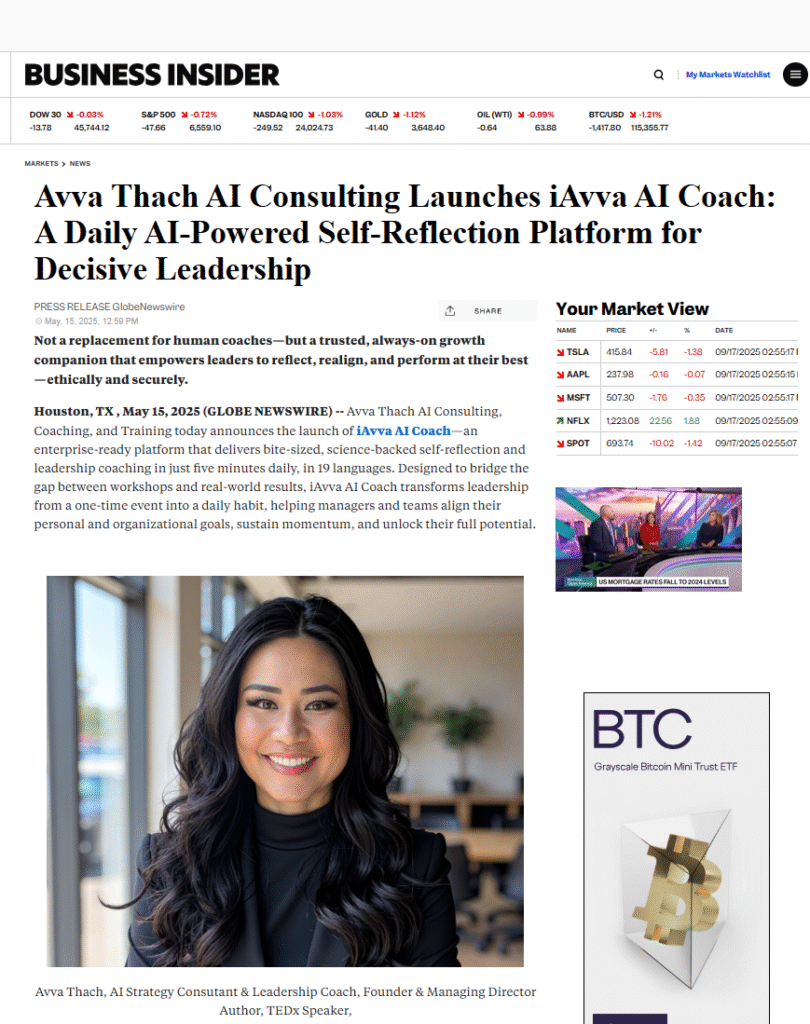
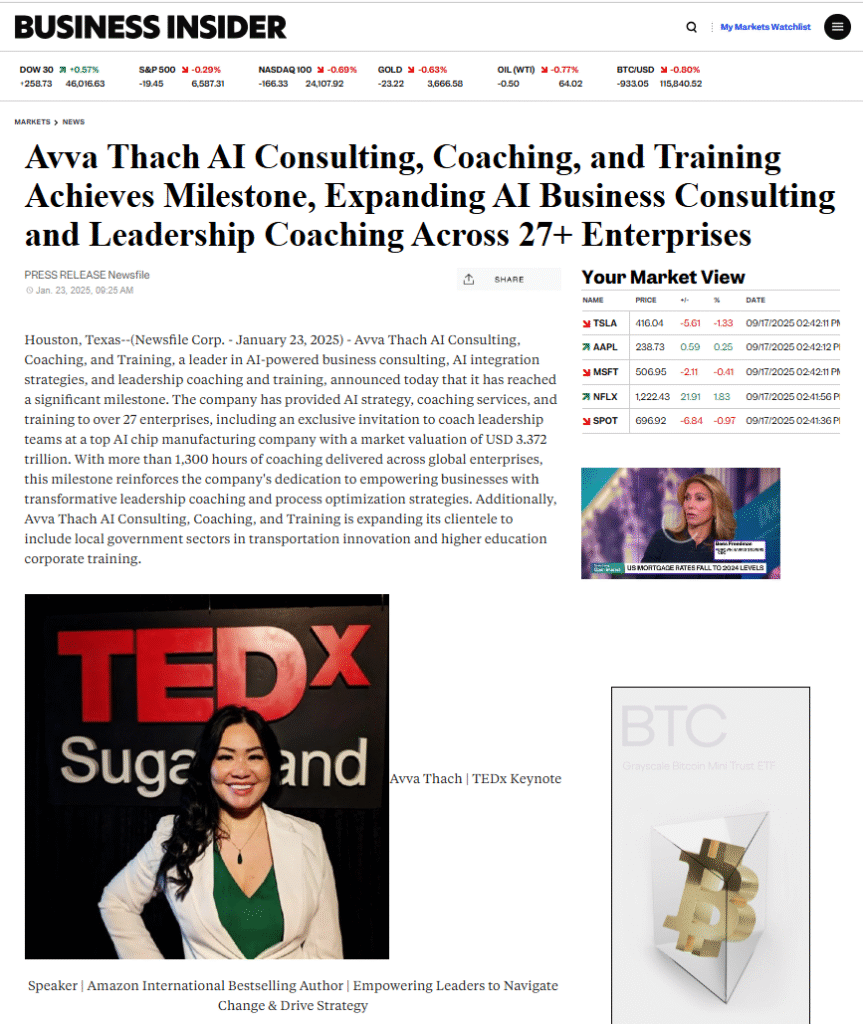
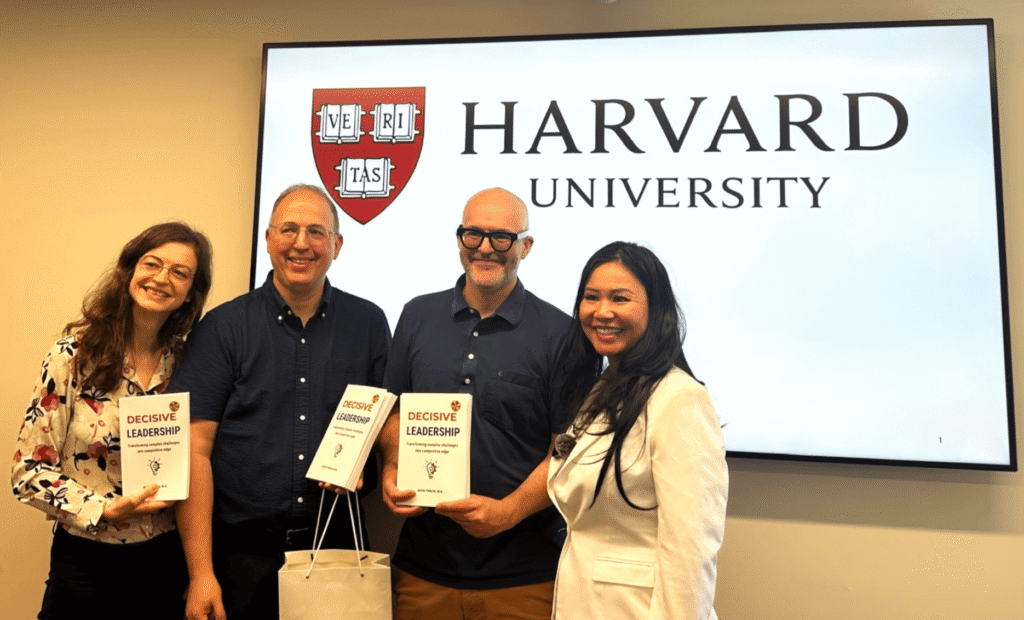
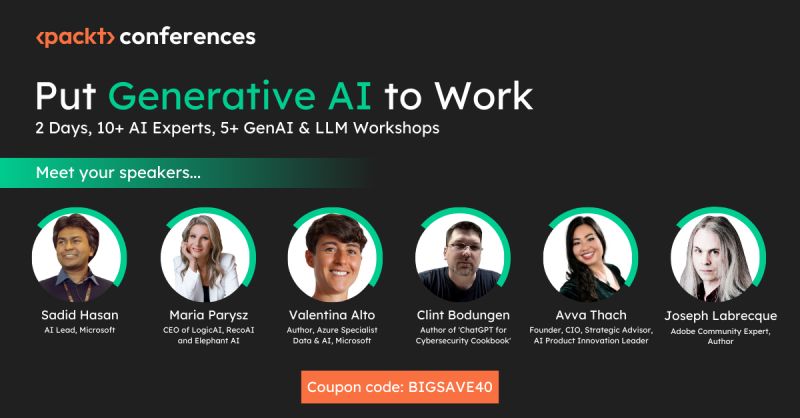
Why the brand is credible on the topic: iAvva AI Consulting led by Avva Thach combines hands on experience in AI strategy, implementation, leadership coaching, and corporate training. Avva Thach has published work including Decisive Leadership, delivered a TEDx talk on inclusive AI conversations, and supported SMBs with measurable transformation through a 3 pillar approach: Customized Consulting, Coaching and Facilitation, and Training and Development. Client testimonials from healthcare, product, and agile transformation leaders support demonstrated outcomes.
Tone of voice: Professional, evidence based, neutral and actionable. Use clear executive language with industry specific terminology where appropriate, prioritize data and frameworks over opinion, and include tactical checklists, sample scripts, and metrics for L&D and HR leaders.
Sources:
- International Data Corporation IDC research on digital transformation prevalence https://www.idc.com
- PwC research on the importance of training and coaching for digital transformation https://www.pwc.com
- Harvard Business Review articles on integrating coaching with strategy and AI enabled change https://hbr.org
- McKinsey research on organizational health and leadership development impact https://www.mckinsey.com
- Association for Talent Development ATD research on coaching outcomes https://www.td.org
Key findings:
- Most companies are actively pursuing digital transformation and require leadership support to realize benefits, as reported by IDC.
- A large majority of organizations view training and coaching as critical to digital transformation success, according to PwC.
- Harvard Business Review analysis indicates that combining coaching with technology adoption increases adoption and cultural alignment.
- McKinsey finds measurable performance improvements when leadership development is aligned with business strategy and operational metrics.
- ATD data shows coaching increases skill transfer and behavioral change when combined with deliberate practice and measurement.
Key points:
- Show how to align mentoring and coaching objectives directly to AI transformation and business KPIs rather than abstract leadership goals.
- Provide step by step program design including stakeholder mapping, cohort selection, curriculum design, mentor selection criteria, and a sample 90 day roadmap.
- Include concrete tools and vendors such as MentorcliQ, CoachHub, BetterUp, Lattice, and 15Five and explain when to use each.
- Deliver a measurement framework with specific KPIs, dashboards, and a simple ROI calculation method using Kirkpatrick and Phillips models.
- Include practical templates: mentor selection rubric, coaching session agenda, ChatGPT prompts for coaching, and a program launch checklist.
Anything to avoid:
- Avoid generic motivational language that lacks actionable next steps and measurable outcomes.
- Avoid unverifiable claims about guaranteed ROI or invented client success stories.
- Avoid overly promotional sales tone for iAvva AI Consulting; instead show real methods iAvva uses and link to client success stories.
- Avoid ignoring ethics and data privacy when recommending AI enabled coaching tools.
- Avoid one size fits all prescriptions; emphasize customization for SMB context and sector differences such as healthcare and technology.
External links:
- https://www.idc.com
- https://www.pwc.com
- https://hbr.org
- https://www.mckinsey.com
- https://www.td.org
Internal links:
- AI Coaching: Transforming Future Leadership Development
- AI Coaching: Transforming Future Leadership Development
- Leadership Coaching Programs for Strategic Leaders
- Top Leadership Coaching Courses for Modern Executives
- Top Leadership Coaching Courses for Modern Executives
Content Brief
Context and writing guidance for the full article. The article shows HR and L&D leaders how to design leadership mentoring and coaching programs that are tightly integrated with AI strategy and operational objectives. Emphasize alignment of development goals to measurable business outcomes such as time to competency, retention, AI adoption rate, cycle time reduction, and revenue improvements. Use an evidence based voice and include referenced research, vendor names, implementation steps, templates, and measurement guidance. Keep paragraphs short for scan ability, use numbered lists and tables where useful, and include 1 90 day program example and 1 scaled program example. Include internal links to relevant iAvva pages and external citations to IDC, PwC, HBR, McKinsey, and ATD. Avoid self promotional language; present iAvva approaches as practical examples backed by client testimonials linked from the media page. Aim for approximately 1,700 to 2,500 words split across sections for depth and SEO.
1. The case for combining leadership mentoring and coaching with AI strategy
- Present research points from IDC, PwC, HBR, and McKinsey that justify investment. Include the specific stats: percentage of companies in digital transformation and the percentage that rate coaching as essential.
- Explain the business outcomes that improved leadership development supports during AI adoption: faster decision cycles, higher adoption rates, improved cross functional collaboration, and reduced change related attrition.
- AI instruction for content: Write 250 350 words summarizing the evidence and business case, include two short bullet point examples showing how weak leadership derailed AI projects and how targeted coaching corrected course.
2. Aligning program objectives to business and AI transformation goals
- Describe a step by step alignment process: define strategic outcomes, map leadership behaviors to outcomes, set measurable KPIs, and secure executive sponsorship.
- Provide a sample mapping table linking business goal to leadership behavior to metric. Example entries: reduce process time by 20 percent -> leader behavior: cross functional collaboration -> metric: average process cycle time and AI model adoption rate.
- AI instruction for content: Generate a 150 200 word walkthrough of a stakeholder mapping exercise and produce a simple mapping table the writer can paste into the article.
3. Program design blueprint and a 90 day pilot roadmap
- Detail core components: cohort selection criteria, mentor recruitment and compensation approach, coach profiles, content cadence, hybrid modalities, and integration with performance reviews.
- Provide a concrete 90 day pilot roadmap with weekly milestones for diagnostics, coaching cycles, mentor matching, mid pilot review, and final evaluation. Include suggested participant load such as one coach per 8 to 12 leaders for individual coaching.
- AI instruction for content: Create a 90 day calendar with weekly activities and a short checklist for launch readiness covering tech setup, data sharing consent, and evaluation plan.
4. Proven coaching and mentoring frameworks for measurable behavior change
- Explain when to use GROW, CLEAR, OSKAR, 70 20 10, mentoring circles, and reverse mentoring for AI literacy. For each framework give a one sentence description and a 3 bullet example use case.
- Provide sample session agendas: 60 minute executive coaching session, 90 minute mentoring circle, 30 minute peer coaching huddle and a template for a first meeting between mentor and mentee.
- AI instruction for content: For each framework produce a 60 100 word example of a coaching script and a 3 line prompt a coach can use to prepare for the session using ChatGPT.
5. Tools and vendors for scaling mentoring and coaching
- List and briefly compare real platforms: MentorcliQ, CoachHub, BetterUp, Mentorloop, Lattice, 15Five, and Together Platform. For each include best fit scenarios, typical pricing model summary, and integration notes with HRIS or LMS.
- Describe how to combine vendor capabilities with internal resources and when to choose external providers versus building an internal program.
- AI instruction for content: Produce a 150 200 word vendor comparison highlighting two short case examples: one using MentorcliQ for structured mentoring and one using CoachHub for executive coaching.
6. Embedding AI in mentoring and coaching ethically and practically
- Show practical AI uses: automated 360 feedback analysis, personalized learning path generation, microlearning using generative AI, coach support via AI prompts, and sentiment analysis for coaching impact.
- Cover data governance and ethics: consent, anonymization, bias mitigation, storage and retention guidance, and vendor due diligence questions HR should ask.
- AI instruction for content: Provide five example ChatGPT prompts HR can use to create tailored coaching exercises for leaders adopting a new AI driven workflow and include privacy checklist items to include in vendor contracts.
7. Measurement framework and calculating ROI
- Present a measurement stack: input metrics, activity metrics, outcome metrics, and business impact metrics. Include examples: coaching hours, promotion rate, employee engagement scores, AI adoption rate, process cycle time, cost savings from automation.
- Explain how to apply Kirkpatrick levels and Phillips ROI model with a simple worked example showing how a 6 month coaching program that reduces process time can be translated into dollar value and ROI.
- AI instruction for content: Generate a sample KPI dashboard layout and a short worked numeric example showing ROI calculation with assumed values for improvement and program cost.
8. Scaling, governance, and sustaining impact
- Outline governance roles: program sponsor, program lead, mentor lead, data steward, and success council. Include a 6 month rollout timeline for scaling from pilot to enterprise.
- Describe sustainability tactics: mentor pipeline development, train the trainer, internal coach certification, continuous learning loops, and integration into performance management.
- AI instruction for content: Produce a concise checklist of five governance actions to include in a program charter and a template for an internal coach certification curriculum.
9. Practical templates and ready to use artifacts
- Deliverable list: mentor selection rubric, coaching session agenda, 90 day pilot calendar, KPI dashboard fields, sample vendor evaluation scorecard, and a ChatGPT prompt bank for coach preparation.
- Include short copy ready templates HR can adapt and paste into internal communications for program launch and for mentor recruitment.
- AI instruction for content: For each template produce a 4 8 line example HR can copy and paste and annotate with fields to customize.
Frequently Asked Questions
How do I link mentoring and coaching objectives to measurable AI adoption metrics?
Map leadership behaviors to adoption outcomes and select KPIs such as AI model usage rate, number of process steps automated, time to complete key tasks, and participant confidence scores to demonstrate the link.
When should we use an external coaching vendor versus building our own internal coaching program?
Use external vendors for speed to scale, executive coaching expertise, and platform features; develop internal programs when you need deep business context, lower per participant cost over time, and cultural embedding.
What privacy and ethics questions should HR ask vendors offering AI enabled coaching tools?
Ask about data storage location, data anonymization, consent workflows, bias mitigation methods, access controls, and the vendor policy for model retraining on customer data.
How can we demonstrate ROI from a six month mentoring and coaching pilot?
Track baseline metrics, measure change in behavior and outcomes such as process time or retention, quantify associated cost savings or revenue impact, and apply a simple Phillips ROI calculation comparing benefits to program costs.
What is an effective participant to coach ratio for leadership coaching in SMBs?
A common effective ratio for individual executive coaching is one coach per 8 to 12 leaders when supplemented with group coaching and mentoring circles to maintain quality and scalability.
How do we prepare mentors for reverse mentoring focused on AI literacy?
Provide mentors with a short prep module on AI fundamentals, clear learning objectives, facilitation scripts, and a shared agenda that emphasizes psychological safety and mutual learning.
Which metrics should appear on a program health dashboard for executives?
Include participation rate, coaching hours delivered, behavior change indicators, AI adoption rate, retention and promotion rates, participant Net Promoter Score, and preliminary dollar value of efficiency gains.














Leave a Reply