



Coaching Types Explained: Which Model Works Best for Executive Development?
As organizations pursue AI-enabled transformations, choosing the right coaching types becomes a strategic lever for executive development. This post compares four widely used models—GROW, CLEAR, Co-Active, and Solution-Focused—highlighting how their structures shape leadership growth, decision speed, and alignment with change programs. You’ll learn a practical decision framework to pick and blend approaches, plus how AI-derived insights can augment human coaching without undermining its effectiveness.
GROW Model
In executive coaching, the GROW model provides a disciplined structure: Goals, the current Reality, exploring Options, and locking in Will to act. It’s a milestone-driven framework that helps leaders translate strategy into concrete actions during AI-enabled transformation.
Executive-level fit: use GROW when you need clarity and traceable progress. It’s particularly valuable in digital initiatives where you must link outcomes to measurable milestones, risk controls, and accountable owners. But it can feel constraining if you over-index on process at the expense of adaptive learning.
In complex AI transformations, the strength of GROW is in providing a shared language that surfaces progress against specific checkpoints. The limitation is that it can become a checkbox, dampening deeper exploration of governance, culture, and unintended consequences unless you intentionally weave in reflective dialogue and data-informed Reality findings.
- Step 1 – Set Goals: Define outcomes and metrics tied to AI transformation; lock in a 90-day or quarterly target with a clear owner.
- Step 2 – Assess Reality: Surface data availability, constraints, and current capability; link to dashboards that track milestones.
- Step 3 – Explore Options: Generate a short, diverse set of strategic moves, including quick wins and longer bets.
- Step 4 – Will and Way Forward: Agree on commitments, schedules, and a method for progress review; set a follow-up coaching window.
Example use case: A Fortune 500 executive used GROW to drive a 30 percent reduction in AI model cycle times over 12 weeks. The coach and leader defined the goal, mapped current bottlenecks, brainstormed three alternate paths, and settled on a concrete action plan with weekly check-ins.
AI augmentation with GROW: leverage AI-enabled diagnostics to inform Reality and to surface Options. Data dashboards can highlight pattern shifts in performance, while the coach keeps the human-led dialogue at the center. This approach preserves human judgment while widening the evidence base and, for grounding, reference practical perspectives from sources like Harvard Business Review on executive coaching.
Takeaway: Use GROW when you need clear alignment between intent and outcome, but pair it with curiosity and data-backed Reality to keep transformation adaptive.
CLEAR Model
CLEAR centers the coaching relationship on a living contract that couples intent with accountability. It unfolds through five stages—Contracting, Listening, Exploring, Action, Review—each designed to keep executives aligned with organizational priorities while preserving psychological safety for honest exploration. In practice, this means the coach and client explicitly agree on outcomes, keep a feedback loop open, and revisit commitments as priorities shift in the digital transformation era. The result is a disciplined, iterative conversation that can adapt without dissolving the coaching alliance.
Executive-level fit: CLEAR shines when leadership work must weave personal development into broader organizational contracts. It suits programs where stakeholders require ongoing feedback, transparent progress, and alignment with governance cycles. If your transformation depends on cross-functional buy-in and rapid re-prioritization, CLEAR provides the cadence to stay connected while you experiment.
Strengths and limitations: The biggest strength is clarity and accountability; the contract acts as a compass and a quarterly checkpoint. The trade-off is that contracting can feel formal or bureaucratic if treated as a one-time event, which slows momentum in fast-moving AI programs. Deep exploratory learning can be slower than other approaches, so plan for a shorter horizon on capability growth rather than trying to solve everything at once.
Implementation considerations and a sample coaching workflow: At the start of a CLEAR engagement, set a lightweight contract that defines outcomes, timelines, and success metrics; then practice active listening to surface constraints and opportunities; explore options with a bias toward practical experiments; take concrete actions through micro-commitments; close with a brief review to capture learning and adjust the contract. A typical arc follows contracting, listening, exploring, acting, then reviewing progress against the contract, with the next cycle scheduled at a practical interval.
AI augmentation and real-world use: AI can support CLEAR by providing progress dashboards, sentiment indicators from sessions, and trend flags that trigger contract re-openings. But the coach remains the interpreter of meaning, guiding ethics and interpersonal impact. Tie the contract to AI-enabled metrics such as cycle time, cross-team handoffs, and feature adoption, then review these indicators at each session to stay grounded in business value.
Real-world use case: In a mid-market fintech, CLEAR was used to align product leadership with risk and compliance peers. They established re-contracts every six weeks, which kept priorities transparent and reduced handoff friction. Within three cycles, time-to-market for three major features improved while governance cycles tightened.
Takeaway: Start with CLEAR when ongoing alignment and accountability are non-negotiable for AI-enabled transformation; keep contracting lightweight and revisitable, and let the review cadence drive adaptation.
Co-Active Coaching
Co-Active Coaching is a holistic, relationship-centered approach that treats the leader as a whole person, not a bundle of skills. It emphasizes awareness, values, and impact, with the coach acting as a curious partner rather than a taskmaster. In practice, it focuses on how a leader shows up in relationships, teams, and the organization, not just on achieving KPI milestones.
Unlike more structured models, Co-Active leans into the dance between identity work and behavior. This makes it powerful for transformation, but progress can feel less tangible in the short term. You need seasoned coaches who can hold space, challenge assumptions, and surface constraints that quietly shape decisions. For organizations new to this style, start with a narrow scope—one leadership domain and a 4–6 week cycle—before broadening.
Concrete use case: A regional healthcare system partnered with Co-Active coaching for its top clinicians to align personal leadership values with patient-centered care. Over six months, clinicians reported more authentic communication with frontline staff and stronger cross-functional collaboration, which correlated with faster escalation of safety concerns and improved patient experience scores. This is an example of identity-driven leadership catalyzing operational outcomes, not just behavior change. For executives exploring related pathways, see leadership coaching courses for executives.
A common misreading is treating Co-Active as soft coaching that lacks rigor. In reality it requires a disciplined contracting approach, clear boundaries, and accountability. To capture impact without eroding the coaching relationship, pair it with a lightweight measurement framework focusing on qualitative shifts plus a small set of observable leadership behaviors.
Practical deployment steps: 1) Create a value-centered coaching contract tied to organizational goals; 2) Align sessions with a small number of high-leverage leadership behaviors; 3) Use a blended cadence of exploratory sessions and periodic progress reviews; 4) Integrate AI-assisted insights to surface patterns in communication and collaboration while preserving the human-dialogue core. For practical partner resources, see Vet Coaching & Consulting Partners for Your Business.
Solution-Focused Coaching
Solution-Focused Coaching concentrates conversations on concrete outcomes and practical next steps. It shines when executives need momentum during AI-enabled transformations, delivering progress in tight cycles rather than lengthy analysis. The core is identifying exceptions to the current way of working, imagining a preferred future, and scripting the smallest viable steps to get there.
Executive fit and limits: it suits fast-moving initiatives and can generate visible wins with limited disruption. It is less suited for deep identity work, long-term culture change, or situations where the root causes aren’t yet understood. In those cases you risk chasing surface symptoms instead of systemic improvements.
- Step 1: Define the outcome — agree on a specific, measurable result with a tight horizon and clear success criteria.
- Step 2: Map exceptions — surface deviations from the norm that reveal what’s working and what isn’t, rather than starting from problems.
- Step 3: Design next steps — craft 2-3 concrete actions, assign owners, and set due dates that align with sprint cycles.
- Step 4: Track progress — use brief check-ins to confirm movement on outcomes; adjust quickly if signals shift.
- Step 5: Leverage AI insights — bring in dashboards and pattern detection to inform conversations, not to replace the coach’s judgment Vet Coaching & Consulting Partners for Your Business.
In a financial services firm, the head of product used solution-focused prompts to accelerate a risk management rollout. During one coaching session, the leader defined a 90-day milestone, identified two exceptions from the most recent sprint, and committed to two concrete actions with clear owners. The next week, those actions moved the rollout forward while avoiding unnecessary meetings.
One common misread is treating solution-focused coaching as a substitute for strategy work. It works best when paired with a broader capability-building plan; otherwise, leaders chase easy wins while deeper capabilities lag. Practically, guardrails matter: cap the time horizon, tie outcomes to transformation milestones, and use AI-driven signals to flag when conversations drift into problem solving instead of focused, outcome-oriented exploration.
Takeaway: Pilot the model with a bounded scope and a fixed timeline, using AI-assisted diagnostics to surface exceptions and track concrete outcomes; scale only after confirming repeatable, value-generating momentum.
AI-Enhanced Executive Coaching: iAvva’s Integrated Approach
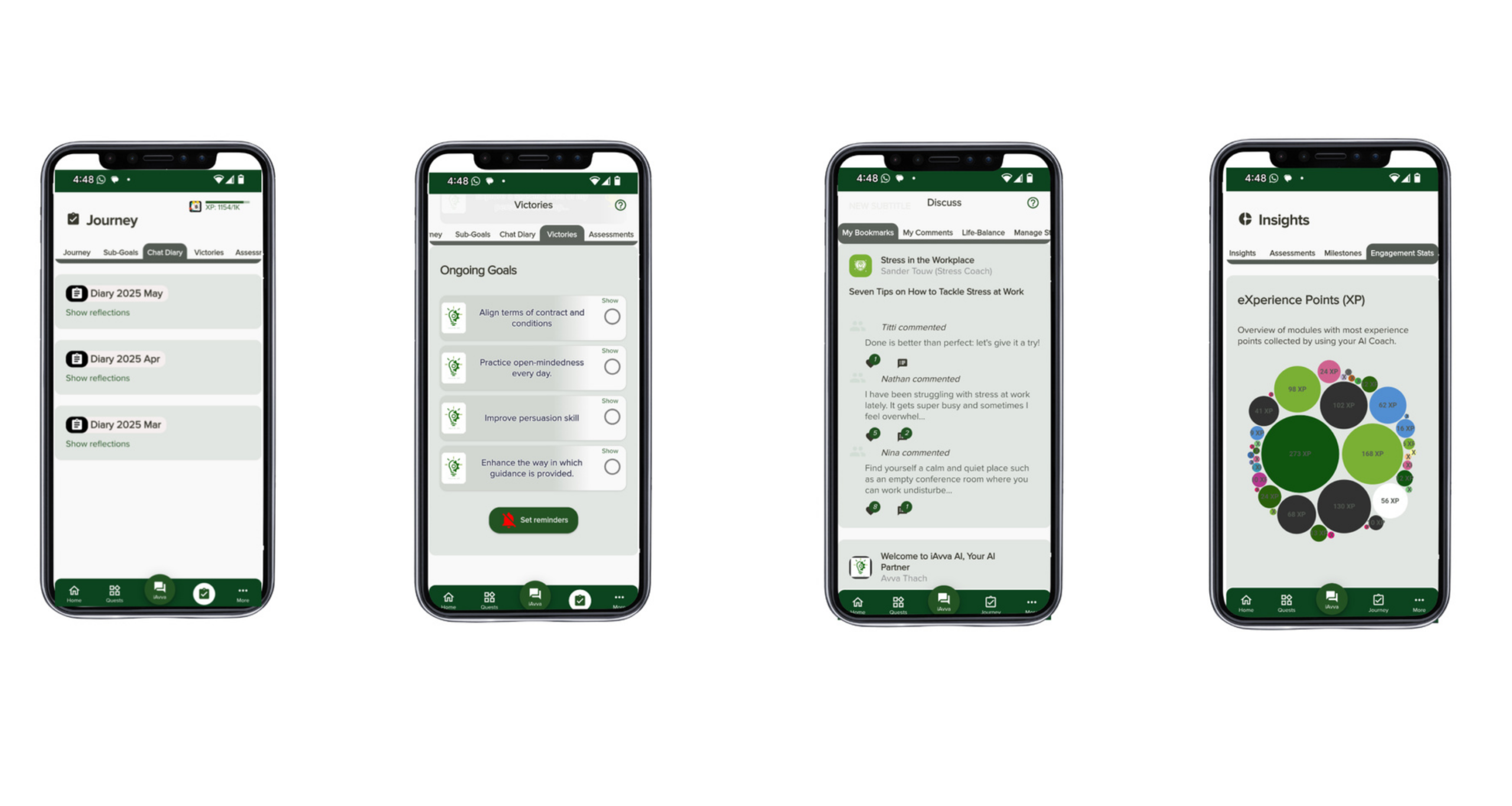
AI-enabled coaching isn’t a bolt-on tool—it’s a scalable, data-informed layer that multiplies the impact of human coaching. iAvva’s integrated approach weaves AI strategy, diagnostics, and leadership coaching into a single program, so executives get candid dialogue plus objective progress signals they can trust during a volatile transformation.
From day one, set data governance and consent boundaries. Collecting patterns from meetings, emails, and performance data is valuable only if you define what gets measured, who owns it, how it will be used, and how dashboards feed coaching conversations. In SMBs, where systems vary, plan the data integration road map and establish escalation paths when data quality dips.
Concrete Example: In a nine‑month transformation, AI analyzes leadership meeting patterns and cross‑functional dashboards to surface collaboration bottlenecks. Coaches use those insights to shape goals around decision speed and stakeholder alignment, framing questions that probe root causes while preserving human judgment.
AI adds scale and precision, but it cannot replace context, tacit knowledge, or political nuance. The risk is chasing dashboards at the expense of developing judgment or misreading intent behind numbers. To avoid this, pair AI diagnostics with seasoned coaches who translate data into probing questions, calibrate for culture, and pace sessions to readiness. Also plan for IT effort, tool overlap, and privacy controls to prevent data silos.
- Baseline assessment: capture leadership maturity across AI strategy alignment and people capabilities.
- AI-enabled diagnostics: integrate behavior and outcome data to form actionable insights.
- Coaching sessions: leverage AI dashboards to inform each session’s focus.
- Progress dashboards and governance: regular reviews with stakeholders and clear, trackable metrics.
Blended implementation outline: start with a pilot around one strategic initiative, then bake AI-enabled diagnostics into monthly coaching cycles. Ensure the coach leads the conversation while AI provides directional signals and concrete data for goal setting. Build a lightweight governance spine with clear roles for HR, IT, and the business sponsor so insights stay practical.
Next considerations: align your data strategy with transformation goals, secure executive sponsorship, and establish a lean governance model so AI insights remain actionable and safe.
Choosing the Right Model for Your Organization
In practice, the best coaching model is the one that unlocks speed without sacrificing rigor. Start with five decision factors: executive readiness, culture and political climate, transformation complexity, time availability, and how you’ll measure impact. Treat coaching types as a toolkit; anchor with one model and layer others as the situation evolves. If you pretend there’s a single superior model for all contexts, you’ll lose executive engagement and slow progress.
- Assess readiness and culture: capture visibility into change appetite, sponsor alignment, and decision rights through quick diagnostics and leadership interviews.
- Select an anchor model: map findings to common patterns—high-velocity initiatives align with Solution-Focused; leadership identity and values lean toward Co-Active; governance and milestones suit GROW; rapid metric cycles fit CLEAR.
- Tailor contracts and cadence: specify coaching goals, session length, and the data inputs from AI diagnostics that will drive conversations.
- Pilot with discipline: run a time-bound pilot (typically 6–12 weeks) with a small cohort; use dashboards to track progress and adjust the approach as needed.
- Scale with governance: codify a playbook, broaden cohorts, and ensure sponsors continue to reinforce objectives and measurement.
Be mindful of common traps. Don’t force a single model across a broad program or underfund the reflection executives need to translate learning into action. Blended approaches work, but they demand disciplined contracts, shared language, and a simple measurement framework. Without that, conversations stay nice without delivering durable outcomes.
Example in practice: a mid-market software firm undergoing an AI-enabled transformation anchors on a Solution-Focused approach to drive two cross-functional initiatives. They run 6-week cycles with AI-assisted diagnostics surfacing exceptions and progress signals, then adjust goals at each review. After a 3-month pilot, cross-functional decision speed improves and initiative alignment gains are observable in performance metrics.














Leave a Reply