


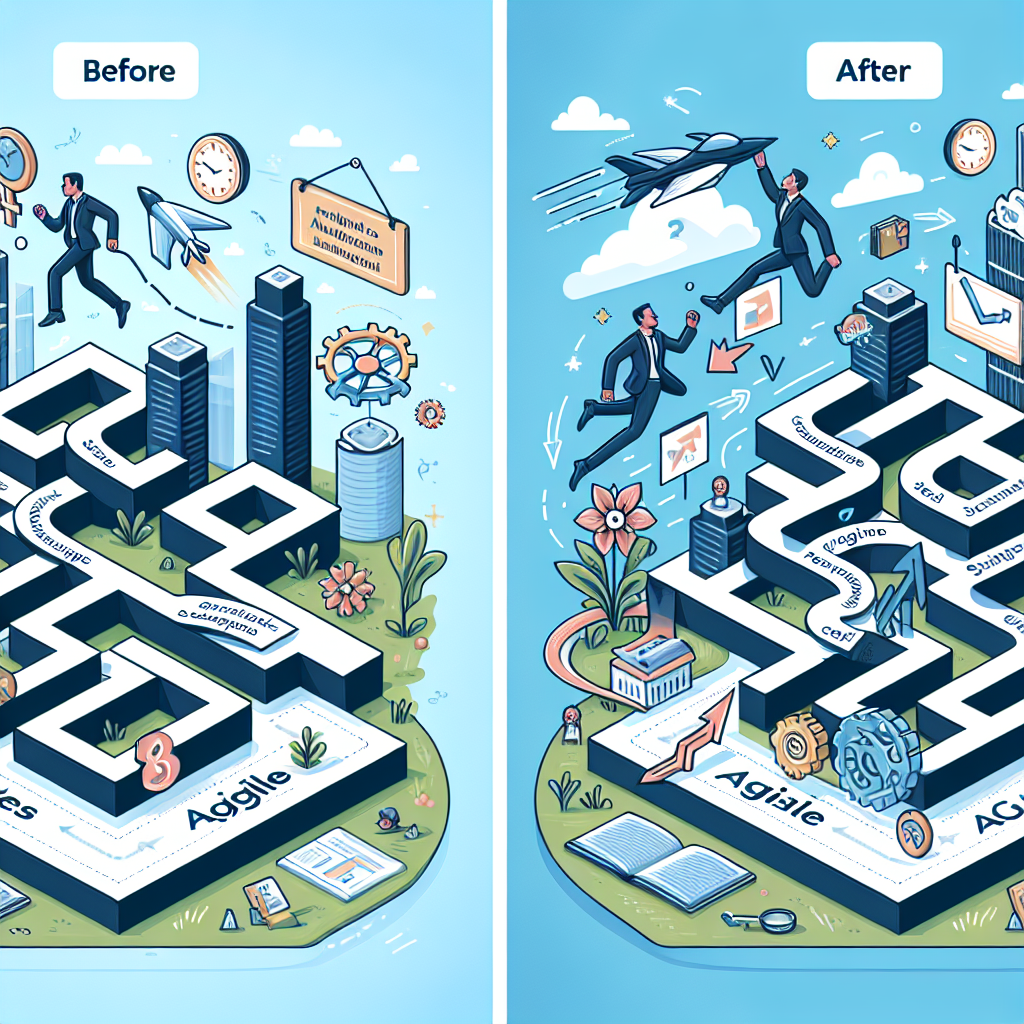
How Agile Transforms SMBs: Real Examples and a Roadmap to Faster Delivery
Article Overview
Article Type: How-To Guide
Primary Goal: Show HR and L&D leaders and heads of organizational development how to adopt and scale agile in small and midsize businesses, using concrete examples and a step by step roadmap that speeds delivery, improves cross functional collaboration, and integrates AI to sustain gains.
Who is the reader: Senior Vice President of Human Resources, Vice President of Learning and Development, Head of Organizational Development, or Vice President of AI Transformation at an SMB or midmarket company. Typically responsible for talent, training, organizational change, or digital transformation and evaluating programs to accelerate delivery and productivity.
What they know: They understand basic agile terminology such as Scrum and Kanban, have seen pilots or heard case studies, and know the high level benefits of iterative delivery. They do not have a clear, repeatable implementation plan for company wide adoption or for integrating AI into agile workflows and need concrete examples, measurable KPIs, and a practical timeline.
What are their challenges: They face siloed teams and cultural resistance, limited training budgets, uncertain governance for iterative delivery, lack of consistent metrics across teams, difficulty linking team level changes to business outcomes, and the need to upskill people quickly to use AI driven tooling while maintaining regulatory or quality constraints.
Why the brand is credible on the topic: iAvva AI Consulting and Avva Thach bring deep, practical experience in agile transformation, AI strategy, leadership coaching, and corporate training. Avva has led SAFe and product owner training, coached product and engineering teams at organizations such as SolutionsIQ and Accenture, delivered executive coaching for transformation leaders, and produced public content including a TEDx talk and books on decisive leadership. The firm combines hands on agile facilitation with AI implementation experience to help SMBs achieve measurable delivery improvements.
Tone of voice: Professional, factual, and accessible. Use industry specific terms without jargon overload. Neutral and objective with an emphasis on actionable steps, evidence, and practical templates. Prioritize clarity for senior HR and L&D decision makers looking for implementation plans and training pathways.
Sources:
- International Data Corporation IDC digital transformation coverage and market briefs at idc.com
- PwC reports on upskilling and training as a factor in digital transformation at pwc.com
- Harvard Business Review articles on AI and leadership and transformation at hbr.org
- Digital.ai State of Agile Report 2023 and 2024 at stateofagile.com
- McKinsey article The five trademarks of agile organizations at mckinsey.com
Key findings:
- Most organizations are actively pursuing digital transformation and require new operating models to realize investments, aligning with IDC findings on broad digital transformation adoption.
- Effective training and coaching are critical to realize transformation outcomes, supported by PwC research showing a strong correlation between training investment and transformation success.
- Combining AI strategies with leadership development amplifies transformation effectiveness, consistent with HBR analysis on the importance of leadership adaptation for AI era changes.
- Agile adoption remains the most cited approach for increasing speed to market and responsiveness, while common barriers include lack of skills, leadership alignment, and measurement, per State of Agile findings.
- High performing agile transformations emphasize leadership sponsorship, a clear operating model, focused pilots, continuous measurement, and capability building as described by McKinsey.
Key points:
- Concrete, repeatable roadmap that SMBs can execute in 6 to 16 weeks for an initial agile pilot and expansion plan
- Real examples that illustrate practices and trade offs: GitLab, Buffer, Basecamp, and iAvva AI Consulting client engagements as implementation examples
- Clear set of metrics and measurement practices that link team level outcomes to business impact including lead time, cycle time, deployment frequency, and employee engagement
- Practical guidance on integrating AI into agile workflows for backlog refinement, test automation, release prediction, and decision support
- Training and governance recommendations for HR and L&D decision makers to operationalize skill development and sustain change
Anything to avoid:
- High level fluff without concrete actions, timelines, or roles
- Overpromising specific numeric outcomes without attribution or client consent
- Religious advocacy for one framework only; instead present fit for purpose guidance
- Heavy promotional language that reads like sales collateral instead of practical guidance
- Complex enterprise scale frameworks presented without adaptation guidance for SMB constraints
External links:
- https://stateofagile.com
- https://www.mckinsey.com/business-functions/organization/our-insights/the-five-trademarks-of-agile-organizations
- https://hbr.org
- https://www.pwc.com
- https://www.idc.com
Internal links:
- Master Business Agility: Thrive in an AI-Driven World
- Master Business Agility: Thrive in an AI-Driven World
- Ensuring Ethical AI: A Crucial Imperative
- AI Leadership & Ethical Development: Navigating OpenAI’s Cash Burn in 2025
- Accelerating AI Adoption in Organizations
Content Brief
Purpose and approach guidance for the article. Explain that the article will combine actionable how to steps, concrete SMB examples, and a practical roadmap for HR, L&D, and transformation leaders to implement agile and accelerate delivery. Emphasize pragmatic tone: explain trade offs, provide measurable KPIs, and include AI integration points that support delivery. Recommend examples be specific, use short case narratives rather than marketing copy, and prioritize templates and checklists HR and L&D can adopt. Keep language precise for executive readers and include calls to action directing readers to iAvva AI Consulting services and contact, while avoiding salesy language.
Why agile matters for SMBs now and how AI changes the equation
- Market and organizational pressures that make speed and adaptability a competitive advantage for SMBs
- How agile reduces cycle time and improves customer feedback loops in lean organizations
- Where AI augments agile work: backlog prioritization, test automation, release analytics, and operational optimization
- Trade offs SMBs must consider: resource allocation, cultural change, and minimal viable governance
Real example 1 GitLab: remote first, handbook driven iterative delivery
- What GitLab changed: public handbook, asynchronous workflows, small autonomous teams
- Tactics that SMBs can replicate: written workflows, incremental feature flags, Git based CI/CD pipelines
- Practical outcome themes: faster coordination across distributed teams and clearer role accountability
Real example 2 Buffer: small teams, transparent processes, continuous improvement
- Key Buffer practices relevant to SMBs: small cross functional teams, transparent metrics, frequent retrospectives
- How HR and L&D support measured learning and capability building in Buffer style teams
- Actionable takeaways: run short experiments on cadence and learning investments
Real example 3 Basecamp and shape up: structured cycles for constrained resources
- Why Shape Up matters for SMBs: fixed cycle lengths, no backlogs that grow forever, scoped bets
- When to choose Shape Up versus Scrum or Kanban based on team size and product maturity
- How to operationalize: pitch scopes, hill charts, and dedicated cycle teams
Real example 4 iAvva AI Consulting: coaching, AI integration, and capability building
- How Avva Thach structures engagements: align leadership, run focused pilots, combine coaching with hands on AI strategy and implementation
- Typical deliverables HR and L&D can expect: training modules, role based coaching, and governance playbooks
- Client results themes: faster decision cycles, improved cross functional collaboration, and uplift in team capability
A practical roadmap to faster delivery for SMBs: an 8 to 16 week plan
- Phase 1 Assess and Align 1 to 2 weeks: leadership alignment workshop, capability and process audit, target metrics
- Phase 2 Pilot design 1 to 2 weeks: identify pilot team, define scope, choose cadence and tooling
- Phase 3 Skill building and tooling 2 to 4 weeks: role training for product owners, scrum masters, engineers, and ops; configure CI/CD, feature flags, and monitoring
- Phase 4 Execute pilot 4 to 8 weeks: run iterations, collect metrics, run retrospectives, iterate on definition of done
- Phase 5 Scale and sustain 2 to 8 weeks: expand to adjacent teams, embed governance, establish continuous learning and AI augmentation
Roles, ceremonies, and lightweight governance adapted for SMBs
- Recommended roles and role splits for small teams: product owner responsibilities combined with business stakeholder cadence, part time scrum master or coach, cross functional contributors
- Ceremony cadence suggestions: two week iterations or continuous Kanban flow with weekly planning and biweekly retrospectives
- Lightweight governance pattern: playbooks for prioritization, change approval for releases, and guardrails for compliance and security
Metrics, tooling, and AI integration to measure faster delivery
- Primary metrics to track: lead time, cycle time, throughput, deployment frequency, mean time to restore, customer satisfaction, and employee engagement
- Recommended tooling stack for SMBs: Jira or Trello for work tracking, GitLab or GitHub for source and CI/CD, CircleCI or GitHub Actions for automation, LaunchDarkly for feature flags, Sentry or Datadog for monitoring, Miro and Notion for collaboration
- AI augmentation examples: GPT assisted backlog refinement, automated test generation, predictive release risk scoring, and anomaly detection in production telemetry
Common pitfalls and corrective actions
- Pitfall 1 Leadership buys in but does not provide time or resources for training. Fix: allocate protected learning time and link training to measurable outcomes
- Pitfall 2 Tooling before process. Fix: define workflow and metrics first, then select minimal tooling that supports them
- Pitfall 3 Cargo cult agile where ceremonies exist but outcomes do not change. Fix: focus on measurable delivery outcomes and technical health
- Pitfall 4 Ignoring technical debt and architecture. Fix: plan capacity for refactoring and automated tests
- Pitfall 5 Overcentralized governance that slows teams. Fix: create clear guardrails and delegate day to day decisions to teams
Implementation checklist and recommended training modules for HR and L&D
- Checklist items: leadership alignment session, pilot charter, defined KPIs, training schedule, tooling configuration, coaching cadence, and measurement dashboard
- Suggested training modules: agile foundations for leaders, product owner outcomes workshop, technical agile engineering practices, agile facilitation and retro training, AI literacy for product teams
- Suggested vendors and partners: iAvva AI Consulting for combined AI and agile coaching, Scrum Alliance accredited courses, Digital.ai materials for assessment, vendor onboarding with GitLab or GitHub
Frequently Asked Questions
How long does it take an SMB to see measurable delivery improvements after starting an agile pilot
Many SMBs see process and visibility improvements within 6 to 12 weeks from a focused pilot, while measurable delivery KPIs such as reduced lead time often take two to four sprints to stabilize.
Can we implement agile without hiring an external coach
Yes, but external coaching accelerates adoption and avoids common pitfalls; for organizations with limited internal agile experience a coach for the first two to three pilots is highly recommended.
Which agile framework should an SMB choose
Choose by fit: Scrum or Kanban for team level work, Shape Up for constrained product teams, and avoid full enterprise frameworks unless scaling beyond 150 to 250 people.
How should HR and L&D measure the success of an agile transformation
Combine delivery KPIs such as lead time and deployment frequency with people metrics like employee engagement, role competency assessments, and time to proficiency for key roles.
How can AI be safely integrated into agile workflows
Start with low risk augmentation such as automated test generation, backlog summarization, and release risk scoring while applying human in the loop review, data governance, and privacy controls.
What budget and resourcing level should we expect for an initial pilot
A focused pilot can run on a modest budget that covers 6 to 12 hours per week of coaching, tooling configuration, and dedicated training sessions; align budgets to target outcomes and expected time to value.
How do we manage regulatory or compliance requirements within agile cycles
Embed compliance as acceptance criteria, include compliance stakeholders in definition of done, and automate evidence collection where possible using CI/CD and audit trails.
How Agile Transforms SMBs: Real Examples and a Roadmap to Faster Delivery
…” }, { “@type”: “FAQPage”, “@id”: “#faq”, “mainEntity”: [ { “@type”: “Question”, “name”: “How long does it take an SMB to see measurable delivery improvements after starting an agile pilot?”, “acceptedAnswer”: { “@type”: “Answer”, “text”: “
Many SMBs see process and visibility improvements within 6 to 12 weeks from a focused pilot, while measurable delivery KPIs such as reduced lead time often take two to four sprints to stabilize.
” } }, { “@type”: “Question”, “name”: “Can we implement agile without hiring an external coach?”, “acceptedAnswer”: { “@type”: “Answer”, “text”: “
Yes, but external coaching accelerates adoption and avoids common pitfalls; for organizations with limited internal agile experience a coach for the first two to three pilots is highly recommended.
” } }, { “@type”: “Question”, “name”: “Which agile framework should an SMB choose?”, “acceptedAnswer”: { “@type”: “Answer”, “text”: “
Choose by fit: Scrum or Kanban for team level work, Shape Up for constrained product teams, and avoid full enterprise frameworks unless scaling beyond 150 to 250 people.
” } }, { “@type”:”Question”, “name”:”How should HR and L&D measure the success of an agile transformation?”, “acceptablenwer”:{ “@type”:”Answer”,”text”:”
Combine delivery KPIs such as lead time and deployment frequency with people metrics like employee engagement, role competency assessments, and time to proficiency for key roles.
” } }, { “@tpe”:”Question”, “name”:”How can AI be safely integrated into agile workflows?”, “acceptableasnwer”:{ “@tpe”:”Anser”,”text”:”
Start with low risk augmentation such as automated test generation, backlog summarization, and release risk scoring while applying human in the loop review, data governance, and privacy controls.
“} }, { “@tpe”:”Queston”, “name”:”What budget and resourcing level should we expect for an initial pilot?”, “acceptableasnwer”:{ “@tpe”:”Anser”,”text”:”
A focused pilot can run on a modest budget that covers 6 to 12 hours per week of coaching, tooling configuration, and dedicated training sessions; align budgets to target outcomes and expected time to value.
“} }, { “@tpe”:”Queston”, “name”:”How do we manage regulatory or compliance requirements within agile cycles?”, “acceptableasnwer”:{ “@tpe”:”Anser”,”text”:”
Embed compliance as acceptance criteria, include compliance stakeholders in definition of done, and automate evidence collection where possible using CI/CD and audit trails.
“} } ] }, { “@/context”:””, “@/graph”:[ { “@/tye”:””, “@/id”:””, “@/mainEntiy”:[ { “@/typ”:””, “@/nam”:””, “@/accptedAnsw”:[ { “@/tye”:””, “@/txt”:[ “” ] } ] } ] } ] }, { “&:&&&&&&&&:&&&&&:&:” :[“&”], “&:”:[“&”] }], “{:{:{:{:::{:::{}}}}}”: “”}















Leave a Reply