








Firmus and Nvidia’s Indonesia Project Shows How the AI Infrastructure Market Is Splitting Beyond the Hyperscalers
Introduction
For years, the dominant story in AI infrastructure has centered on hyperscalers. Microsoft, Google, Amazon, and a handful of giant cloud operators have seemed like the inevitable winners in the race to own the compute layer behind advanced AI. But a new project from Firmus and Nvidia suggests the market may be evolving in a more complicated direction.
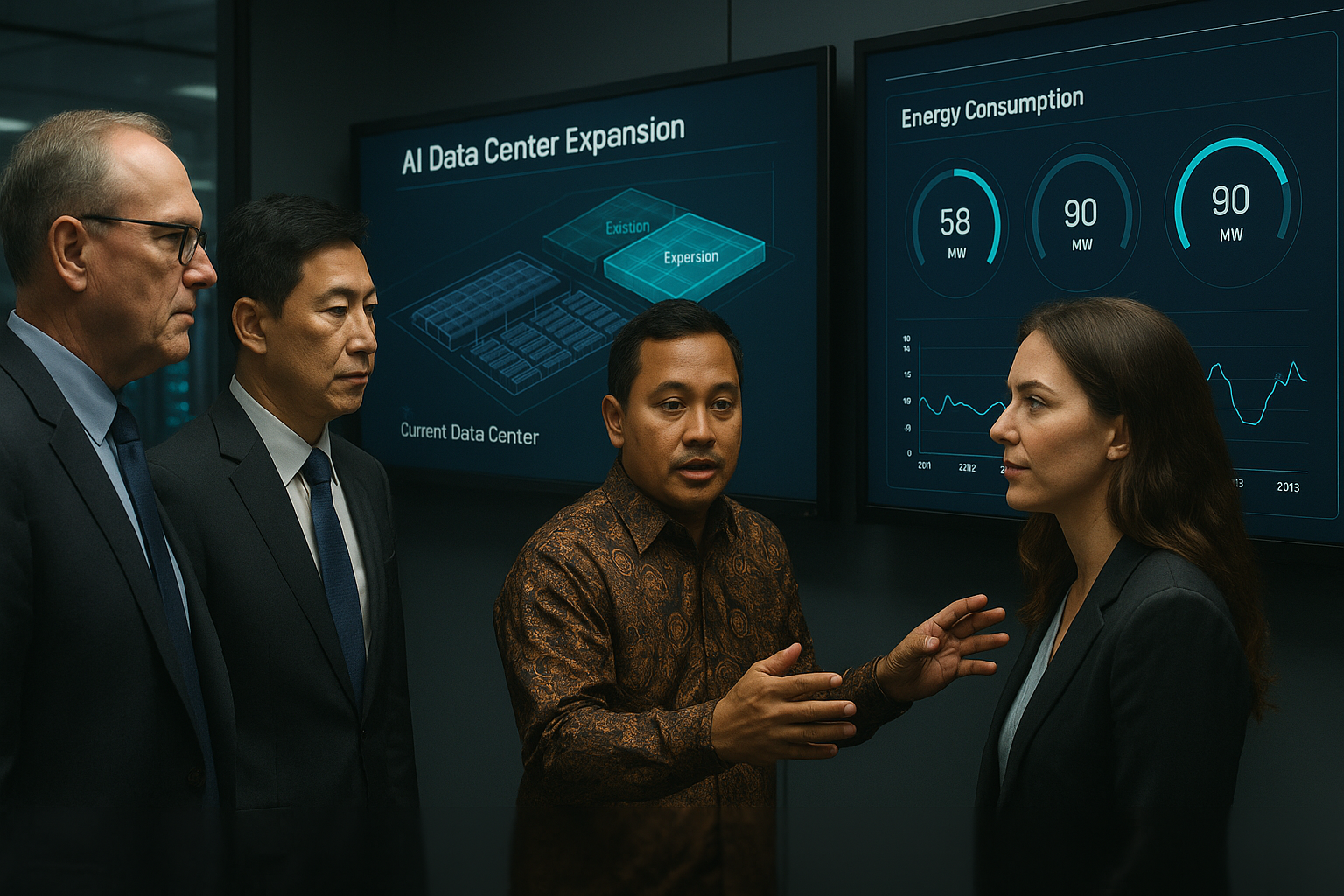
Firmus said it is building a major data center project in Batam, Indonesia, with at least 170,000 advanced Nvidia chips, including Grace Blackwell and Vera Rubin systems. What makes the deal especially noteworthy is not just the scale. It is the commercial structure. Nvidia is reportedly set to earn a revenue share based on chip usage and provide credit support, while the facility is designed specifically for AI-native customers rather than hyperscalers.
At iAvva AI Consulting, we see this as an important signal. The AI infrastructure market is beginning to fragment into new strategic layers, and some of the most interesting opportunities may sit outside the traditional cloud giants.
The next phase of AI infrastructure may not belong only to the biggest clouds. It may also belong to the players building specialized capacity for AI-native demand.
Key Takeaways
- Firmus and Nvidia’s Indonesia project signals a new commercial model for AI infrastructure, with Nvidia sharing in usage-based revenue.
- The project is aimed at AI-native companies, not hyperscalers such as Microsoft, Google, and Amazon.
- This suggests the AI compute market is splitting into more specialized layers with new regional and vertical opportunities.
- Nvidia is not just selling chips. It is increasingly shaping financing, infrastructure design, and downstream market participation.
- For business leaders, this is a sign that AI capacity strategy may become more diverse, less centralized, and more competitive than many expected.
Why This Deal Matters
Most AI infrastructure headlines focus on giant cloud operators and sovereign-scale projects. This deal matters because it introduces a different pattern. Instead of selling into a hyperscaler and walking away, Nvidia appears to be participating more directly in the economics of the project.
That is a meaningful shift. A revenue-share model tied to usage gives Nvidia a deeper interest in how the capacity is consumed, who buys it, and how efficiently the platform operates. It also suggests that Nvidia sees enough demand outside the hyperscaler channel to justify more creative and involved commercial structures.
Firmus, meanwhile, gets more than hardware. It gets strategic support, financing help, and the credibility that comes with a deeper Nvidia relationship. That could be a major advantage in a market where capital intensity and infrastructure complexity are becoming enormous barriers to entry.
Why Excluding Hyperscalers Is So Interesting
One of the most striking aspects of the project is that its customer base is meant to exclude hyperscalers. Instead, the target market is AI-native companies, including model builders, robotics firms, life sciences startups, and AI software platforms.
That matters because it implies a belief that there is enough demand from these newer firms to fill major capacity quickly without relying on the usual cloud giants. In fact, the reported capacity sold out within weeks.
If that holds, it suggests a new truth about the market. AI infrastructure demand is no longer just top-down from the biggest technology companies. It is also bottom-up from a rising class of AI-native firms that need serious compute but may want alternatives to the dominant cloud stack.
| Old Compute Narrative | Emerging Compute Narrative | Strategic Implication |
|---|---|---|
| Hyperscalers dominate AI capacity | Specialized providers serve AI-native firms | Market becomes less centralized |
| Nvidia mainly sells chips | Nvidia shares in project economics | Vendor role expands beyond hardware |
| Regional sites are support assets | Regional sites become strategic AI hubs | Geography matters more in compute competition |
Nvidia Is Expanding Its Role in the Value Chain
Nvidia’s role here is worth watching closely. It is already the most important supplier in the AI hardware stack, but this deal suggests the company is also moving deeper into infrastructure enablement and financial alignment.
That could make Nvidia even more powerful. If it not only supplies the chips, but also helps shape financing, cooling design, deployment efficiency, and revenue participation, it becomes harder to separate Nvidia from the business model of the AI infrastructure itself.
This is one reason we have emphasized in articles like our analysis of the inference market and our look at how frontier labs are responding to scale pressure that the AI race is increasingly about ecosystem control, not just model quality.
Why Indonesia and the Asia-Pacific Region Matter
The geographic angle matters too. Batam, Indonesia, is not just a construction site. It is part of a broader shift in where AI infrastructure may expand next. The Asia-Pacific region has strong demand growth, strategic proximity to emerging AI markets, and room for regional operators that can compete on efficiency, specialization, or customer focus.
Firmus itself positions as a neocloud for the region, and that identity is important. If AI-native customers want more tailored infrastructure relationships, lower-friction access, or non-hyperscaler partnerships, regional operators could become more relevant than many expected.
What This Means for Business Leaders
For executives, the main lesson is that the AI compute market may become more differentiated than the old cloud market. That creates both risk and opportunity.
On the risk side, infrastructure choices may get more complex. Buyers may need to weigh cost, performance, vendor dependence, regional availability, and ecosystem fit more carefully. On the opportunity side, the rise of non-hyperscaler capacity means businesses may gain more options for where and how to run AI workloads.
That matters especially for organizations building products where AI is not just a feature, but a core operating layer. The more strategic the compute need, the more important it becomes to understand who controls the stack beneath it.
Conclusion
Firmus and Nvidia’s Indonesia project is not just another data center announcement. It is a glimpse into how the AI infrastructure market may be restructuring. The deal points to a future where hyperscalers are still powerful, but no longer the only obvious route for serious AI capacity.
If regional operators, AI-native customers, and infrastructure partners like Nvidia can build viable alternatives, then the next phase of AI growth may be more distributed and more strategically diverse than the market once assumed.
FAQs
Why is this project different from a normal Nvidia infrastructure deal?
Because Nvidia is not only supplying hardware. It is also reportedly sharing in revenue tied to usage and helping support the project financially.
Why does excluding hyperscalers matter?
It suggests there is enough demand from AI-native firms to support major infrastructure projects outside the biggest cloud platforms.
Why is this important for the AI market?
It shows the compute layer may be splitting into more specialized channels, creating new options and new competitive dynamics.
What should business leaders watch next?
They should watch whether more regional operators adopt similar models and whether AI-native customers increasingly seek alternatives to the hyperscaler stack.
Related reading: SambaNova’s $10 Billion Valuation Push, DeepSeek’s $7.4 Billion Fundraise, Global Advertising No Longer Fits Neatly Inside National Economies, and The Information.

















Leave a Reply