
Introduction
“Success is the sum of small efforts, repeated day in and day out.” – Robert Collier
Leadership growth works the same way: small, steady actions shape big outcomes. Many leaders feel they are guessing through constant change, AI disruption, and hybrid teams. That pressure drains confidence, especially when every decision seems to carry higher stakes.
AI coaching gives leaders a daily partner that listens, asks smart questions, and connects growth directly to real work. When we talk about AI coaching for leaders, we mean structured, conversational support built on coaching science and large language models, not a random chatbot. In this article, you will see how this approach meets modern leadership demands, how it fits into your development strategy, and how iAvva AI turns AI strategy into measured behavior change across organizations.
If stronger leadership and calmer decisions sound useful, the next sections walk through clear steps, examples, and safeguards so you can move from curiosity to confident action. If you lead HR, learning, technology, or a business unit, you will see how to use these tools safely and at scale.
Key Takeaways
How AI Coaching Expands Leadership Development Beyond The C Suite
AI coaching brings one‑to‑one style support to far more people than only senior executives. Middle managers and high potentials gain regular space to think and plan. That wider reach builds a stronger bench and a shared language about growth.Why Hybrid Human Plus AI Coaching Delivers Measurable Behavior Change
Daily AI micro coaching keeps leaders practicing skills between workshops and sessions. Human coaches then focus on deeper themes instead of basic reminders. Together, this mix supports clear goals, reinforced habits, and trackable progress.What HR And CLOs Must Demand From Ethical AI Coaching Platforms
HR and learning leaders need providers that follow International Coaching Federation standards and strong privacy rules. That means clear consent, safe boundaries, and honest language about limits. These expectations protect employees while giving sponsors data they can trust.How iAvva AI Aligns Leadership Growth With Business Outcomes
iAvva AI links every coaching theme with objective and key result progress. Five‑minute daily prompts keep leaders moving while dashboards reveal engagement and common patterns. That connection lets HR, IT, and finance teams stand behind the investment.Practical First Steps To Pilot AI Coaching In Your Organization
You will see a roadmap for choosing use cases and pilot groups. Simple design choices reduce risk and build support with leaders and employees. By the end, you can sketch a focused pilot that fits your culture.
What Is AI Coaching And Why Does It Matter For Today’s Leaders?
AI coaching for leaders means using conversational artificial intelligence to guide ongoing reflection, planning, and action toward real goals. For organizations facing AI disruption and hybrid work, this kind of support turns constant pressure into daily learning instead of burnout.
Defining AI Coaching In Plain Language
At its core, AI coaching is a relationship between a leader and an intelligent system that learns from each interaction. The system uses large language models to pose thoughtful questions, mirror back patterns, and suggest experiments linked to the leader’s goals. Conversations build over time, so the AI remembers context instead of starting from zero each day.
That is very different from generic AI assistants or static e‑learning. A general chatbot answers one‑off questions without tracking progress or applying a coaching method. Training content delivers information, while AI coaching focuses on awareness, decisions, and small behavior shifts in real meetings and conversations.
Professional bodies such as the International Coaching Federation (ICF) describe coaching as partnering with clients in a thought‑provoking process that inspires them to maximize potential. ICF’s Artificial Intelligence Coaching Framework applies the same ideas of trust, presence, and client agenda to digital systems. iAvva AI designs prompts so the AI asks open questions and supports reflection instead of pushing advice or hidden employer goals.
“Coaching is about creating awareness, responsibility, and self‑belief.” – John Whitmore
AI coaching tools that respect this principle of awareness over advice stay closer to real coaching practice.
Why AI Coaching Is Rising Now In Enterprises
AI coaching is growing because demand for quality coaching far exceeds the number of experienced human coaches. Many companies can offer one‑to‑one support only to a small group of senior executives, leaving first‑line and middle managers on their own. Research cited by the International Coaching Federation shows that coaching use is still heavily concentrated at higher levels.
At the same time, digital programs, AI adoption, and hybrid work increase both complexity and stress for leaders. A study from Harvard Business Review reports that more than half of large transformation efforts fail, often because leaders and teams do not shift behavior fast enough. Leaders need just‑in‑time support between workshops, not a single training week each year.
Recent advances in large language models from organizations such as OpenAI, Google, and Anthropic now make conversational, coaching‑style interactions possible at scale, and practical guides such as AI for Coaches: The Complete Guide offer a clear overview of how these tools are being applied in real coaching businesses today. According to McKinsey, a majority of employees in many countries have some remote work option, which makes always‑on digital support even more relevant. AI coaching gives global teams fast access to grounded guidance in the flow of work.
How AI Coaching Transforms Leadership Behavior And Confidence
AI coaching changes leadership behavior by turning insights into small, repeatable actions leaders practice each day. This steady rhythm builds confidence because leaders see themselves handling real situations with more clarity and intention.
From Insight To Habit – The Neuroscience Of Micro Coaching
Neuroscience suggests that the brain changes more through frequent, small repetitions than rare, intense bursts of effort. Traditional workshops feel inspiring for a day, yet most leaders forget key ideas within weeks. Research highlighted by the NeuroLeadership Institute shows that spaced practice and reflection improve long‑term retention. Micro coaching fits this pattern by prompting leaders to pause for a few minutes almost every day.
In those short sessions, AI coaching can:
- Ask about recent situations, emotions, and choices.
- Invite the leader to name options for next time.
- Encourage quick experiments and follow‑up reflection.
That mix of attention, emotion, and intention helps lay down new neural connections. Positive psychology also points out that noticing small wins builds motivation more reliably than focusing only on gaps. When a leader tracks progress, confidence grows from evidence, not wishful thinking.
Because the AI sees patterns over many entries, it can reflect themes a busy person might miss. For example, it may notice a leader gives clear feedback to peers but softens too much with direct reports. This gentle mirror helps convert insights into practical habits that show up in conversations, meetings, and decisions.
Real-World Leadership Scenarios AI Coaching Can Support
AI coaching becomes most useful when it meets leaders in specific, sometimes tense situations. Instead of talking about change in the abstract, it prepares people for the exact conversation or decision in front of them. Here are examples of how this support looks in daily work:
Difficult performance conversations
An AI coach can help a manager clarify the message, separate facts from stories, and choose respectful language. It can suggest open questions that invite dialogue instead of defensiveness.Cross‑functional influence and stakeholder expectations
Leaders can describe key players, interests, and possible tensions, then ask the AI to generate scenarios and talking points. Rehearsing these options in writing reduces anxiety before high‑stakes meetings.Imposter feelings in new or expanded roles
AI coaching invites leaders to surface strengths, past wins, and realistic growth areas without harsh self‑judgment. Short reframing exercises help people move from self‑doubt to grounded action.Manager as coach in one‑to‑ones
Before a regular check‑in, the AI can suggest questions that build ownership, not dependence. Over time, managers shift from status updates to development‑focused conversations.Leading through AI and tech change
Leaders can explore how to explain AI initiatives, handle employee worries, and set realistic expectations with teams and stakeholders.
Where AI Coaching Fits In Your Leadership Development Strategy
AI coaching for leaders works best when it sits inside a clear leadership development system, not as a random app on the side. When HR, learning teams, and business leaders place it alongside programs and human coaching, the whole system becomes more connected and practical.
Blending Human And AI Coaching Across Leadership Levels
Blending human and AI coaching across levels lets you match support to both risk and budget. Early‑career employees gain guided development without long queues, while senior leaders still receive deep one‑to‑one attention. By designing this ladder on purpose, you avoid overspending at the top and neglecting the middle.
A simple way to view the mix is by leader segment. Here is one pattern we see across many clients:
| Leader Group | Main Support Approach | AI Coaching Focus | Human Coaching Focus |
|---|---|---|---|
| Emerging leaders and high potentials | Mostly AI coaching with some group sessions | Build core habits, confidence, and clarity about role expectations | Group coaching to explore identity, values, and peer learning |
| Middle managers | Balanced blend of AI and periodic one‑to‑one sessions | Day‑to‑day people issues, feedback scripts, and accountability | Conflict patterns, change leadership, and political dynamics |
| Senior executives | Human coaching at the center with AI in support | Reflection prompts and real‑time prep for key moments | Strategy, culture shifts, complex relationships, and board‑level stakes |
This model expands coaching far beyond the top few percent of leaders while keeping expert humans focused where nuance, emotion, and power dynamics matter most.
“The function of leadership is to produce more leaders, not more followers.” – Ralph Nader
AI makes it financially and logistically possible to support many more future leaders across the organization.
Integrating AI Coaching With Programs, Academies, And Onboarding
AI coaching also acts as a connector across existing leadership programs, academies, and onboarding paths, and simulation-based approaches explored in ARPG+: a simulation-based study of real-time coaching for educational LLM prompting demonstrate how AI coaching can be embedded into structured learning environments for greater impact. Instead of treating each course as a stand‑alone event, you can use the same AI companion before, during, and after key milestones. That continuity helps leaders apply ideas from programs like inclusive leadership or coaching skills back on the job.
A simple integration pattern looks like this:
Before a program
The AI coach asks about current challenges and goals so facilitators receive anonymized themes from the cohort. This shapes content and case studies.During the program
Participants use the coach to reflect on exercises, capture insights, and plan experiments between modules. Micro prompts keep learning practical.After the program
Daily or weekly nudges follow up on commitments, ask what was tried, and encourage honest review of what worked. This builds accountability.
Research shared by the Association for Talent Development notes that without spaced reinforcement, people quickly lose much of what they learn in workshops. By pairing AI coaching with your existing academies, you turn events into the starting point of longer practice rather than the finish line.
iAvva AI – A Human-Centered AI Coaching System For Confident Leaders
iAvva AI offers an AI coaching system designed from the start for busy leaders, not generic chat users. By combining five‑minute daily micro coaching, experienced human coaches, and AI‑focused consulting, iAvva AI supports both the human and technical sides of leadership growth.
Inside The iAvva AI Coach – Five-Minute Daily Micro Coaching At Scale
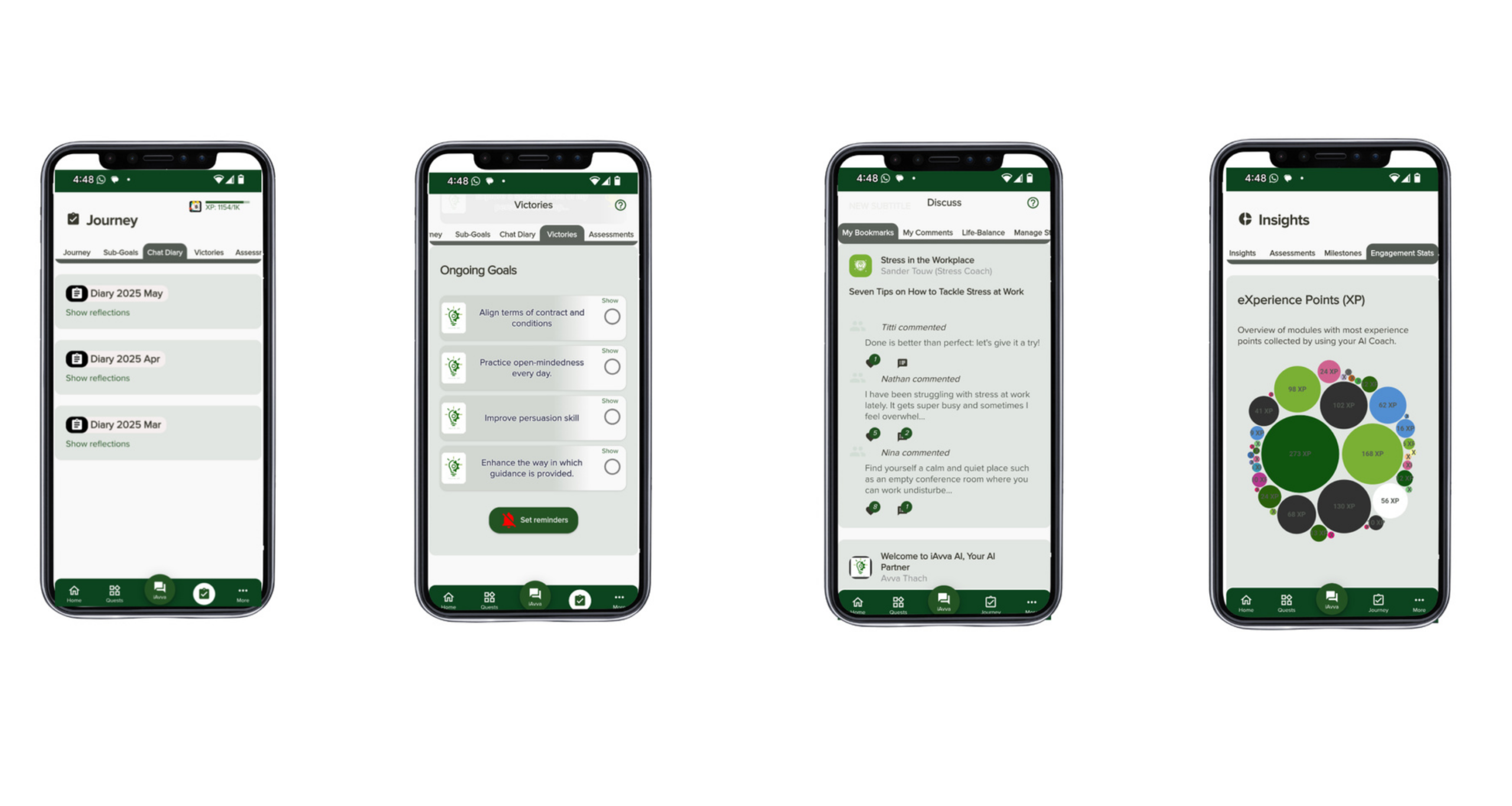
The iAvva AI Coach gives each leader a five‑minute daily space to think instead of react. Prompts draw on neuroscience, positive psychology, and ICF‑aligned coaching methods to ask short, sharp questions. Over time, this rhythm creates a habit of pausing, scanning options, and choosing actions that fit both values and strategy.
Leaders can interact in two main modes:
- Coach mode – The system leans on questions and reflection so the user generates their own answers.
- Mentor mode – It offers more direct suggestions and examples drawn from leadership research and the founder’s long coaching and consulting experience.
In both cases, conversations connect back to agreed goals and business objectives, so each interaction contributes to measurable behavior change.
For HR and people teams, iAvva AI provides analytics dashboards that show engagement levels, hot themes, and progress trends without exposing personal details. The platform supports nineteen languages across web, iOS, and Android, with text and audio options that work well for neurodiverse users. Enterprise‑grade encryption and full GDPR alignment keep coaching data private while still giving sponsors the insight they need.
Hybrid Human Plus AI – Extending Coaching Impact Across The Enterprise
Technology alone cannot address imposter feelings, executive presence, or cross‑cultural tension, so iAvva AI pairs the platform with experienced human coaches. These coaches have delivered more than one thousand four hundred hours of one‑to‑one and group coaching across industries, supporting leaders through promotion, conflict, and high‑stakes visibility. Topics span systemic bias, leadership isolation, and the personal side of AI and automation.
iAvva AI also offers an AI‑defined IT project management certification and related training programs. These programs close the gap many companies feel between bold AI strategy decks and the daily habits of project teams. Leaders learn how to:
- Frame AI initiatives in terms business partners understand.
- Ask better questions of vendors and technical teams.
- Keep AI projects aligned with outcomes the business cares about.
According to Harvard Business Review, well over half of digital change efforts miss their goals, often due to leadership and people challenges. The founder’s background at Accenture on programs worth more than twenty‑two billion dollars, combined with acceptance into the Techstars accelerator, signals that iAvva AI speaks both enterprise and startup languages. Clients from organizations such as PayPal and national energy companies bring that trust into their own leadership pipelines.
“Change before you have to.” – Jack Welch
AI coaching, especially through platforms like iAvva AI, helps leaders change early and often, not just when pressure peaks.
What Should Ethical, High-Quality AI Coaching Look Like In Your Organization?
Ethical AI coaching for leaders must protect privacy, respect boundaries, and align with established coaching standards. When HR, IT, and business sponsors start from shared principles, they reduce risk and increase trust across the workforce.
Using ICF AI Coaching Standards As Your Due-Diligence Checklist
The International Coaching Federation created an Artificial Intelligence Coaching Framework so organizations can tell the difference between real coaching and generic advice bots. This framework extends ICF Core Competencies such as building trust, maintaining presence, and evoking awareness into AI‑mediated settings. When you design or buy tools that respect these ideas, you protect both employees and the coaching profession.
In practice, that means asking vendors direct questions about:
- Transparency – Are users clear when they interact with AI versus a human?
- Consent – Do people agree to what is recorded and how it may be reused?
- Data boundaries – Can coaching content flow into performance systems, and if so, how?
ICF guidance on acceptable use also stresses that AI systems must stay within coaching scope and avoid mental health, legal, or medical advice.
ICF offers a practical guide and self‑scoring worksheet that HR, learning, and IT teams can use together. During vendor reviews, you can score options on factors such as ethics, client protection, explainability, and governance. This structured view makes it easier to defend your choice to executives, regulators, and employees.
Human-Centered And Inclusive Design Requirements
Ethical AI coaching also depends on how the experience is designed. Human‑centered AI research from places like Stanford Human Centered Artificial Intelligence reminds us to consider not only direct users but also their teams and communities. When a leader changes a habit, their peers, reports, and family all feel the ripple effects.
Inclusive design starts with diverse voices in discovery, prototyping, and testing. Studies from the MIT Media Lab show that AI systems can perform far worse for some demographic groups when training data is narrow or biased. For coaching tools, that means testing language, tone, and scenarios with people across:
- Regions and cultures
- Gender identities and ages
- Neurotypes and work styles
Organizations also need guardrails that prevent misuse. Coaching data should never become a back door for hidden performance monitoring without explicit, informed consent. Clear choices about language, accessibility options, and data sharing turn AI coaching into a source of psychological safety rather than a new reason for employees to worry.
“Trust is built with consistency.” – Lincoln Chafee
Consistent, transparent data practices are what make AI coaching feel safe rather than intrusive.
Benefits And Risks Of AI Coaching For Key Stakeholders
AI coaching affects almost every group in a modern organization, from the boardroom to the help desk. Understanding both benefits and risks for each stakeholder helps you design programs that create value without unpleasant surprises.
Stakeholder-Level Benefits – From C Suite To Individual Contributors
Different groups experience AI coaching in different ways. Here is how value often shows up across the main audiences involved in leadership development:
Organizations and C‑suite
For sponsors, AI coaching scales development beyond a small executive circle. It lowers cost per leader while keeping messaging and core leadership expectations consistent across regions. Aggregated, anonymized data highlights capability gaps and culture issues so investments land where they matter most.HR, learning, and People Operations teams
These groups gain a live view of how leaders are applying frameworks taught in programs. AI coaching reinforces competencies between formal events, increasing learning transfer. Dashboards make it easier to show return on budget to finance partners and senior leaders.Managers and people leaders
Frontline and middle managers receive on‑demand practice for tough scenarios such as feedback, delegation, or performance conversations. They can rehearse messages and get suggestions without fear of judgment. According to Gallup, managers influence around seventy percent of employee engagement, so better support for them pays off quickly.Individual contributors and early‑career talent
Employees who rarely receive coaching finally get a safe space to explore strengths, values, and career options. They can ask questions they might hesitate to raise with a boss. Over time, this builds confidence and a stronger internal talent pipeline.IT managers and directors
For technology leaders, AI coaching platforms create a controlled, secure alternative to unsanctioned tools. Integration with identity systems, HR platforms, and collaboration suites lets them apply existing security and compliance standards. Partnering with HR on these programs positions IT as a strategic enabler, not only a risk gate.
Managing Risks – Ethics, Privacy, And Boundaries
Alongside these benefits, leaders must handle clear risks with care. The biggest worries often relate to confidentiality, misuse of data, bias in AI models, and confusion between coaching and clinical support. Addressing these early keeps trust high.
Key risk‑management practices include:
Separate development and performance data
Development data should stay apart from formal performance evaluation except where someone gives explicit, informed consent. Policies need to spell out what is recorded, who can view individual records, and when data is aggregated or anonymized. Regulations such as GDPR and the California Consumer Privacy Act expect this level of clarity – and employees do as well.Monitor for bias and cultural mismatch
Teams should regularly review outputs for patterns of bias or unhelpful framing. If some groups receive less useful prompts or examples, designers and vendors must adjust training data and guardrails.Clear escalation paths
Sensitive topics such as trauma, discrimination, or self‑harm should route to human professionals instead of being handled by AI alone. AI coaching must stay within leadership, behavior, and work‑related scope.Position AI as co‑pilot, not driver
Emphasize that AI coaching supports, but does not replace, human judgment. Training leaders to question, adapt, and sometimes ignore AI suggestions keeps their own empathy, listening, and critical thinking skills sharp.
Tip: During rollout, publish a short “AI Coaching User Charter” that summarizes rights, data use, and escalation options in plain language.
How To Implement AI Coaching In Your Organization With Confidence
Implementing AI coaching for leaders does not have to feel like a giant leap. With a clear strategy, thoughtful pilot, and shared governance, you can test value quickly while protecting people and data.
Designing Your AI Coaching Strategy And Pilot
Start by naming the main outcomes you want from AI coaching. Common goals include:
- Expanding coaching access
- Supporting digital and AI‑related change
- Improving manager capability
- Reducing burnout and decision fatigue
It helps to prioritize one or two so the pilot has a sharp focus.
Next, choose target populations that feel both important and safe for experimentation. Many organizations begin with:
- First‑line managers
- Change champions
- Under‑served groups who rarely see coaching budgets
Define clear enrollment criteria so people understand why they were chosen.
Then, pick a short list of use cases such as feedback conversations, delegation, or new‑leader onboarding. Decide up front how you will measure success using a mix of:
- Engagement data (frequency, duration of use)
- Pulse surveys on confidence and clarity
- Observable behavior shifts through 180/360 feedback or manager input
Spending a few hours on this design work avoids months of debate later.
When you select a partner such as iAvva AI, look for:
- Alignment with ICF standards
- Strong security credentials and privacy controls
- Hybrid human plus AI options
- Dashboards tied to objectives and key results (OKRs)
Research from IDC estimates that companies invest trillions in digital initiatives, so linking coaching metrics with those programs can unlock real budget and attention.
Governance, Data Policies, And Scaling Up
Once a pilot proves value, governance keeps growth safe and coordinated. Form a small group with HR, learning, IT, and Legal to:
- Oversee AI coaching tools and approve new use cases
- Review risk, ethics, and bias reports
- Align coaching tools with any wider AI or data‑ethics boards already in place
Data policies should cover:
- Consent language and user rights
- Storage location and retention periods
- Access control and anonymization rules
Participants need simple explanations of what the system can see, such as goals, journal entries, or selected HR fields. Standards from bodies like NIST on AI risk management can guide these choices.
Training matters as much as technology. Offer short sessions for managers, internal coaches, and employees on:
- How to work with AI coaching
- When to escalate to humans
- How to give feedback about the experience
Honest two‑way communication lowers rumors and resistance.
As you scale from one cohort to many, gradually add regions, business units, and languages rather than flipping a switch everywhere at once. Platforms like iAvva AI supply analytics on engagement, hot themes, and links to OKRs so you can refine programs based on evidence instead of instinct.
Putting It All Together
AI coaching for leaders has moved from experiment to practical tool for organizations that want confident, human‑centered leadership in an AI‑rich workplace. When you combine thoughtful technology, ethical standards, and real human support, development becomes both scalable and personal.
Conclusion
Robert Collier’s reminder that success comes from small, repeated efforts captures the spirit of AI coaching. Five minutes of reflection a day may not sound dramatic, yet across hundreds or thousands of leaders the effect is profound. Conversations become clearer, decisions calmer, and change efforts more resilient.
The most sustainable approach blends AI micro coaching with skilled human coaches and a strong learning architecture. Standards from the International Coaching Federation and insights from human‑centered AI research give HR, learning teams, IT, and executives a clear compass. With those anchors, platforms like iAvva AI can stretch coaching access without turning development into surveillance or a quick novelty.
If you are exploring how to support leaders through AI and digital change, this is a good moment to sketch a small pilot. Start with one population and a clear goal, choose a partner committed to ethics and measurable outcomes, and learn fast. Your leaders gain confidence now, and your organization builds muscles it will rely on for years.
“The best way to predict the future is to create it.” – Peter Drucker
AI coaching helps your leaders create that future with intention, not reaction.
Frequently Asked Questions
Question: How Is AI Coaching Different From Using A General AI Assistant Like ChatGPT For Advice?
AI coaching differs from general AI assistants because it is built around an ongoing, goal‑based relationship. A tool like ChatGPT gives one‑off answers and does not track your progress or apply coaching methods. Purpose‑built platforms follow standards such as ICF competencies, add guardrails, and integrate with enterprise security. iAvva AI, for example, ties each session to defined goals and safe data practices.
Question: Can AI Coaching Really Build Leadership Confidence And Executive Presence?
Yes, AI coaching can strengthen confidence and presence when leaders use it regularly. Daily reflection on recent meetings, body language, and word choice helps people see patterns and test new behaviors. Practice scenarios reduce anxiety before key presentations or hard conversations. Many iAvva AI users report feeling calmer and more prepared in high‑visibility moments after only a few weeks.
Question: Is AI Coaching Suitable For Frontline Managers And Not Just Senior Executives?
AI coaching is well suited to frontline and middle managers. These leaders handle most day‑to‑day people issues yet rarely receive personal coaching budgets. Short, on‑demand sessions fit between shifts or customer calls and cover topics such as giving feedback, delegating, or handling conflict. iAvva AI’s five‑minute format works especially well for busy supervisors.
Question: How Do We Measure The ROI Of AI Coaching Programs?
Organizations measure AI coaching ROI by linking usage and behavior change to existing objectives and key results. Useful indicators include engagement with prompts, self‑reported progress, 360 feedback, promotion rates, and retention for target groups. Platforms like iAvva AI provide dashboards that connect themes with business metrics. Combining numbers with stories from leaders creates a fuller picture for executives.
Question: What Data Does An AI Coaching Platform Typically Use, And Who Can See It?
Most AI coaching platforms use user profiles, stated goals, session transcripts, and sometimes selected HR or learning data. Individual reflections should be visible only to the participant and possibly their human coach. Sponsors receive aggregated, anonymized trends instead of raw transcripts. iAvva AI follows this pattern and uses encryption plus GDPR‑aligned controls to keep data safe.
Question: Will AI Coaching Replace Human Coaches And Internal L&D Teams?
AI coaching is far more likely to complement human coaches and learning teams than replace them. The AI handles micro support, reminders, and pattern‑spotting, while people focus on deep mindset work, group dynamics, and program design. Professional bodies such as the International Coaching Federation frame AI as a partner. In practice, blended ecosystems reach more employees and raise the value of human expertise.












Leave a Reply