




Business Transformation Training: Equip Your Team for Change Management
Article Overview
Article Type: How-To Guide
Primary Goal: Provide HR and L&D leaders a practical, role-specific blueprint to design, launch, and measure business transformation training that embeds change management, AI adoption, and leadership coaching to accelerate transformation outcomes.
Who is the reader: Senior Vice President of Human Resources, Vice President of Learning and Development, Head of Organizational Development, or Vice President of AI Transformation at a small or midsize enterprise, typically in healthcare, technology, professional services, or manufacturing. They are evaluating programs and vendors and preparing to commission a training program to support a strategic transformation or AI adoption initiative.
What they know: They understand their organization is undergoing digital transformation and have baseline knowledge of change management frameworks such as Prosci ADKAR and Kotter, and awareness of AI strategy needs. They do not know how to translate strategy into a prioritized training curriculum, which delivery mix will scale, how to measure learning impact in business terms, or how to align training with transformation KPIs.
What are their challenges: They face cultural resistance and silos, limited training budgets, lack of internal capability to teach AI and transformation skills, difficulty getting executive buy-in for time off for learning, unclear success metrics for training, and pressure to show short term ROI while also enabling long term behavior change.
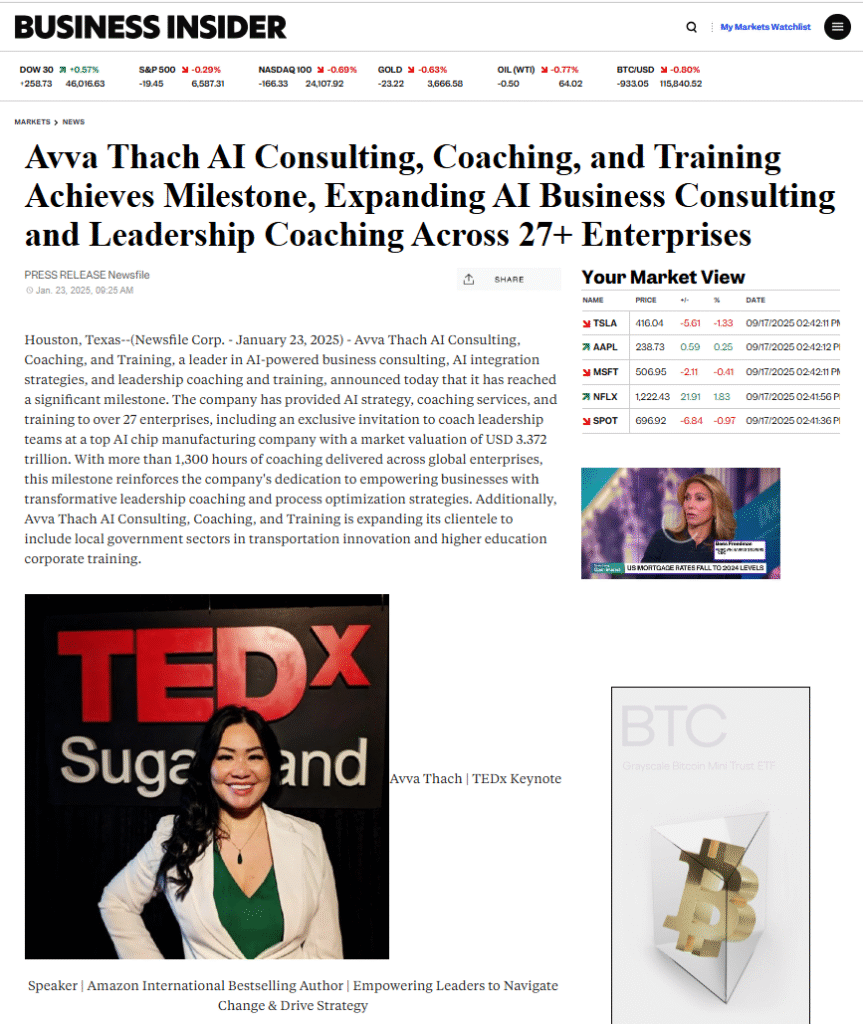
Why the brand is credible on the topic: iAvva AI Consulting combines AI strategy and implementation expertise with leadership coaching and corporate training delivered by Avva Thach, who has experience at SolutionsIQ and Accenture, public speaking credentials including TEDx, and multiple client endorsements from leaders in healthcare, product, and agile transformation. The firm integrates Lean Six Sigma, agile transformation practices, and measurable coaching outcomes, positioning it to design training that aligns AI adoption with human-centered change.
Tone of voice: Professional, objective, and executive-ready. Use data-driven language, avoid hype, use industry terminology where appropriate, and maintain an accessible but authoritative register. Prioritize actionable guidance and prescriptive checklists rather than abstract theory.
Sources:
- International Data Corporation digital transformation coverage at idc.com
- PwC report on training and digital transformation at pwc.com
- Harvard Business Review research on AI adoption and leadership at hbr.org
- Prosci resources on ADKAR and change management at prosci.com
- McKinsey analysis of digital transformation success factors at mckinsey.com
Key findings:
- IDC reports a majority of companies are engaged in digital transformation efforts, indicating urgency for coordinated training and change management
- PwC finds three quarters of companies believe effective training and coaching are essential for digital transformation success, highlighting training as a strategic investment not a compliance activity
- Harvard Business Review research indicates integrating AI strategies with leadership coaching increases transformation effectiveness, which supports blended technical and leadership curricula
- Prosci evidence indicates that structured change management improves adoption rates and speed to benefit, reinforcing the need for role-specific change competencies
- McKinsey and Deloitte analyses show that organizations that pair targeted training with process redesign and strong sponsorship achieve higher ROI and faster scaling of transformation outcomes
Key points:
- Training must map to concrete transformation outcomes and KPIs rather than generic learning hours
- A blended curriculum that pairs change management frameworks, AI literacy for decision makers, and leadership coaching produces measurable adoption
- Pilot, measure, iterate, and scale. Provide a three phase roadmap with pilot, refine, and enterprise roll out steps
- Include role-specific learning paths for executives, middle managers, frontline contributors, and IT, with explicit proficiency targets and assessments
Anything to avoid:
- Avoid generic classroom training that is disconnected from real business processes or transformation milestones
- Avoid technical training alone without parallel change leadership and stakeholder engagement modules
- Avoid long monolithic courses that require multi day attendance without asynchronous or microlearning follow up
- Avoid vague measurement like completions only; do not treat completion rate as primary success metric
External links:
- https://www.idc.com
- https://www.pwc.com
- https://hbr.org
- https://www.prosci.com
- https://www.mckinsey.com
Internal links:
- AI in the Business World: How Technology is Transforming Industries
- Transform Your Leadership: How Executive Coaching Elevates Performance and Innovation | Avva Thach AI Consulting | Process Optimization & AI Strategies
- AI for Leaders: Leveraging Technology to Tackle Complex Business Challenges | Avva Thach AI Consulting | Process Optimization & AI Strategies
- Contact Us | Avva Thach AI Consulting | Process Optimization & AI Strategies
- 6 Practical Applications of AI in Leadership to Unlock Potential and Growth | Avva Thach AI Consulting | Process Optimization & AI Strategies
Content Brief
Guidance for writing the article and what to cover: Explain that the guide will walk HR and L&D leaders through a pragmatic, role aware approach to business transformation training that integrates change management, AI literacy, and leadership coaching. Emphasize practical tools, sample curricula, measurement frameworks, pilot templates, and vendor selection criteria. Use the primary keyword business transformation training strategically in headings and first 100 words, but avoid keyword stuffing. Use data points from IDC, PwC, and HBR to frame urgency and credibility. Target length 1,600 to 2,400 words. Use section headings that can stand alone for skimmers. Include at least one illustrative example of a 90 day pilot and one sample dashboard of KPIs. Include CTA to schedule a discovery call with iAvva AI Consulting and link to services and contact pages. Maintain objective tone, avoid sales language, but include subtle credibility signals such as client endorsements and specific service names like AI strategy, leadership coaching, and Lean Six Sigma.
Why invest in business transformation training now
- Summarize the current landscape using IDC, PwC, and HBR stats. Explain risks of skipping training including low adoption, wasted tech spend, and culture pushback.
- List direct business outcomes tied to training such as reduced time to value for AI projects, 20 to 30 percent process efficiency gains from Lean implementations, and faster adoption measured by license usage or feature adoption. Cite McKinsey and Prosci-level findings where relevant.
- Instruction for writer: Provide 200 to 300 words, open with the primary keyword, include two specific stats, and end with a sentence that segues to the next section on competencies to prioritize.
Define target competencies and role based learning outcomes
- Describe core competency categories: change leadership, AI literacy and governance, process mapping and Lean Six Sigma basics, data driven decision making, agile ways of working, stakeholder engagement and communications, and coaching and feedback skills.
- Provide a matrix example that maps competencies to roles: executive sponsor, middle manager, product owner, data scientist, HR business partner, and frontline staff. For each role list 2 to 3 measurable learning outcomes and proficiency levels (awareness, practitioner, coach).
- Instruction for writer: Produce a visualizable 6 by 3 mapping in prose and include one concrete learning outcome per role. Keep this section 250 to 350 words and include at least one example using the healthcare or product development context.
Curriculum blueprint and module catalog for transformation training
- Provide a modular curriculum with specific modules and short descriptions: Executive Alignment Workshop, Change Management Fundamentals with ADKAR, AI Strategy for Leaders, Data Literacy for Managers, Lean Six Sigma Process Mapping, Agile for Managers, Coaching for Performance, Communication and Stakeholder Mapping, and Embedded On the Job Action Learning.
- For each module include duration (for example 2 hour executive workshop, 3 day instructor led practitioner course, 6 week cohort), delivery format (cohort, microlearning, coaching), assessment type (capstone, quiz, simulated role play), and expected business outcome.
- Instruction for writer: For each module write a 40 to 60 word catalog entry and include which internal stakeholders should own the module. Prioritize modules that combine technical AI understanding with human centered change.
Delivery modalities and learning technology choices
- Recommend a blended learning mix with target proportions for most SMB transformations: 30 percent cohort instructor led, 30 percent coaching and facilitated action learning, 20 percent microlearning and assessments, 20 percent simulations and tools practice.
- Recommend specific tools and platforms for delivery and engagement: Degreed or Cornerstone for learning experience platform, Docebo for LMS, Miro or Mural for workshops, Kahoot or Mentimeter for engagement, Zoom or Microsoft Teams for live sessions, and use of AI coaching tools such as ChatGPT or Anthropic Claude for practice scenarios.
- Instruction for writer: Provide guidance on when to use live facilitation versus asynchronous learning, include a sample weekly learning plan for a 6 week cohort, and recommend vendor selection criteria focusing on analytics, single sign on, and integration with HRIS.
Measuring learning impact and tying training to transformation KPIs
- Define a measurement framework that links learning to behavior and business outcomes: Kirkpatrick levels plus added measures such as adoption rate, time to competency, process cycle time, error rate, customer satisfaction, and revenue or cost impact.
- Offer sample KPIs and targets for a 90 day and 6 month horizon: for example 60 percent manager adoption of new AI enabled process within 90 days, 25 percent reduction in process cycle time by 6 months, and qualitative improvements in stakeholder sentiment measured by pulse surveys.
- Instruction for writer: Include example dashboard fields, recommended survey instruments like Culture Amp or Qualtrics, and explain how to run an A B pilot and present results to executives. Keep this section 250 to 350 words with a short table like description of KPIs and targets.
Pilot design and phased roll out roadmap
- Provide a practical 3 month pilot design template: objectives, target cohort selection (for example 25 middle managers from product and operations), training cadence, coach assignment, measurement plan, and governance structure including executive sponsor and steering committee.
- Outline phased roll out stages: discovery and alignment, pilot, refine and embed, enterprise scale. Include checklist items, required internal roles (L and D owner, HRBP, IT lead, executive sponsor), and estimated budget ranges for an SMB pilot.
- Instruction for writer: Give a week by week Gantt style narrative for the 90 day pilot, list decision gates, and recommend go no go criteria for scaling.
Example client scenario using iAvva AI Consulting approach
- Create a realistic client scenario for a mid market healthcare provider adopting an AI driven patient triage system. Describe baseline challenges: data silos, manager resistance, and lack of AI literacy.
- Show how iAvva blends AI strategy, Lean Six Sigma process redesign, leadership coaching, and targeted training to achieve outcomes. Provide concrete results to aim for such as 40 percent reduction in triage turnaround time, 50 percent increase in clinician adoption of the AI tool within 6 months, and improved patient satisfaction scores.
- Instruction for writer: Frame this as an anonymized case example aligned with iAvva services. Provide a 90 day plan snapshot, learning modules deployed, coaching cadence, and sample before after metrics. Keep this section 300 to 400 words and include client type, not client personal data.
Common pitfalls and mitigation strategies
- List common pitfalls such as lack of executive sponsorship, underpowered middle manager training, training delivered too late in the transformation, and no measurement plan.
- Provide mitigation tactics including executive alignment workshops, manager as coach modules, sequencing training before major rollout milestones, integrating learning into performance goals, and automated progress dashboards.
- Instruction for writer: Provide concise action oriented bullets and at least one quick checklist managers can use to validate readiness prior to launch.
Frequently Asked Questions
How long does a transformation training program take to show measurable business impact
Most organizations see early behavioral shifts and adoption signals within 60 to 90 days after a targeted pilot; measurable process or financial outcomes typically appear within 3 to 6 months when training is paired with process redesign and executive sponsorship.
Which roles should be prioritized for training in an AI enabled transformation
Prioritize executive sponsors for alignment, middle managers to translate strategy into day to day practices, product owners and analysts for technical adoption, and HR or L and D for sustainment and measurement.
Can small and midsize businesses run effective transformation training with limited budgets
Yes. Focus on high impact pilots, cohort based learning for cross functional groups, blended microlearning to reduce time away from work, and leverage internal subject matter experts with external facilitation for coaching.
How should we measure manager capability after training
Use competency assessments, 360 feedback focused on coaching behaviors, percentage of team members hitting new process milestones, and direct observation or simulation scores tied to target behaviors.
What is the role of leadership coaching in transformation training
Leadership coaching accelerates adoption by translating executive intent into pragmatic behaviors, increasing accountability, and helping leaders model new ways of working which drives downstream employee engagement.
Which change management framework is best to include in training
Prosci ADKAR is widely used for individual adoption and pairs well with Kotter for sponsorship and governance; choose the framework that aligns with existing organizational practices and governance.
How do we incorporate AI literacy without overwhelming non technical staff
Use role specific, outcome oriented modules that teach practical AI concepts tied to decision points, include simple governance checklists, and use hands on simulations with real or synthetic data to build confidence.
Business Transformation Training: Equip Your Team for Change Management
Article Overview
Article Type: How-To Guide
Primary Goal: Provide HR and L&D leaders a practical, role-specific blueprint to design, launch, and measure business transformation training that embeds change management, AI adoption, and leadership coaching to accelerate transformation outcomes.
“, “url”: “https://iavva.ai/business-transformation-training-change-management” }, { “@type”: “FAQPage”, “mainEntity”: [ { “@type”: “Question”, “name”: “How long does a transformation training program take to show measurable business impact?”, “acceptedAnswer”: { “@type”: “Answer”, “text”: “
Most organizations see early behavioral shifts and adoption signals within 60 to 90 days after a targeted pilot; measurable process or financial outcomes typically appear within 3 to 6 months when training is paired with process redesign and executive sponsorship.
” } }, { “@type”: “Question”, “name”: “Which roles should be prioritized for training in an AI enabled transformation?”, “acceptedAnswer”: { “@type”: “Answer”, “text”: “
Prioritize executive sponsors for alignment, middle managers to translate strategy into day to day practices, product owners and analysts for technical adoption, and HR or L and D for sustainment and measurement.
” } }, { “@type”: “Question”, “name”: “Can small and midsize businesses run effective transformation training with limited budgets?”, “acceptedAnswer”: { “@type”: “Answer”, “text”: “
Yes. Focus on high impact pilots, cohort based learning for cross functional groups, blended microlearning to reduce time away from work, and leverage internal subject matter experts with external facilitation for coaching.
” } }, { “@type”:”Question”, “name”:”How should we measure manager capability after training?”, “acceptedAnswer”:{ “@type”:”Answer”, “text”:”
Use competency assessments, 360 feedback focused on coaching behaviors, percentage of team members hitting new process milestones, and direct observation or simulation scores tied to target behaviors.
” } }, { “@type”:”Question”, “name”:”What is the role of leadership coaching in transformation training?”, “acceptedAnswer”:{ “@type”:”Answer”, “text”:”
Leadership coaching accelerates adoption by translating executive intent into pragmatic behaviors, increasing accountability, and helping leaders model new ways of working which drives downstream employee engagement.
” } }, { “@type”:”Question”, “name”:”Which change management framework is best to include in training?”, “acceptedAnswer”:{ “@type”:”Answer”, “text”:”
Prosci ADKAR is widely used for individual adoption and pairs well with Kotter for sponsorship and governance; choose the framework that aligns with existing organizational practices and governance.
” } }, { “@type”:”Question”, “name”:”How do we incorporate AI literacy without overwhelming non technical staff?”, “acceptedAnswer”:{ “@type”:”Answer”,
“”
:{“text”:
“” } } } ] } ] }















Leave a Reply