




Avva Thach Consulting Review: Client Outcomes, Services, and When to Engage the Firm
This avva review gives HR and L&D leaders a practical, evidence-based assessment of Avva Thach Consulting and iAvva AI Consulting. It outlines core services—AI strategy and implementation, leadership coaching, and workforce skilling—maps those services to measurable client outcomes and KPIs, and lays out common engagement models, timelines, and procurement questions. If you are weighing a boutique that combines coaching with hands-on AI delivery, the decision signals, risks, and vendor checklist here will help you brief stakeholders and choose when to engage the firm.
Firm snapshot and practitioner credentials
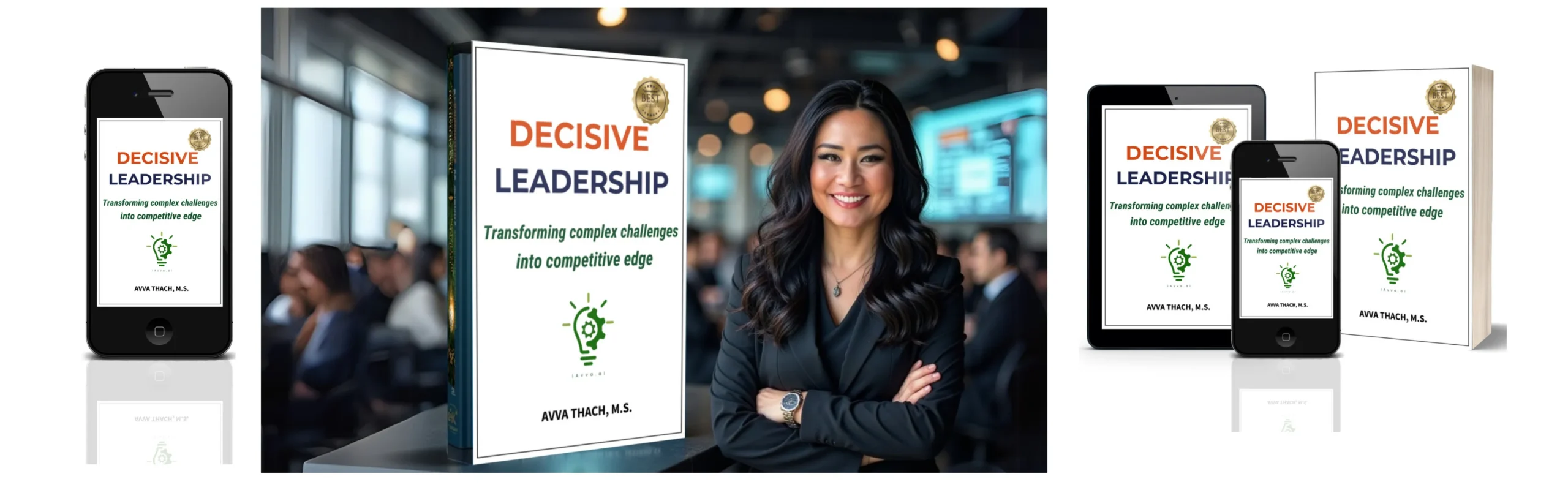
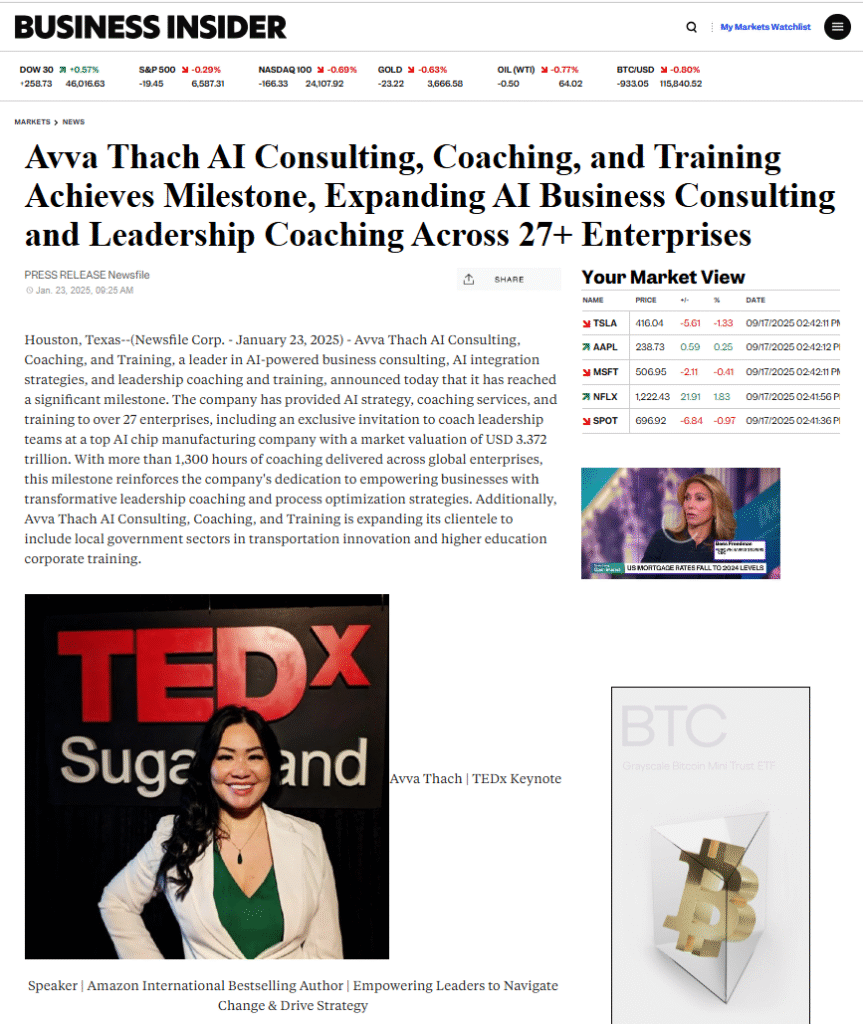
Topline: Avva Thach Consulting combines practical AI delivery with executive coaching rather than delivering each separately. Founder Avva Thach authored Decisive Leadership, gave a TEDx talk, and lists prior experience at SolutionsIQ and Accenture; these are the concrete credentials you should verify when evaluating talent fit. See the firm profile on the About and Media pages for source material.
Key credentials and differentiators
- Founder background: author of Decisive Leadership and TEDx speaker, practical coaching experience with executive clients
- Large-firm pedigree: prior roles at SolutionsIQ and Accenture signal exposure to scaled delivery models and governance frameworks
- Methodology mix: combined Lean Six Sigma, Agile/SAFe facilitation, and human-centered design used alongside hands-on AI toolchain work
- Practical focus: positions include AI strategy, pilot builds, MLOps handoff, and cohort-based leadership programs targeting product and engineering teams
- Sector familiarity: repeated engagements referenced in healthcare, product engineering, and business transformation contexts
Practical tradeoff: boutique firms that pair coaching with implementation shorten the feedback loop between leaders and delivery teams, but they also have a smaller bench than global firms. That matters if you need simultaneous multi-region rollouts or deep sector compliance teams; if your priority is rapid adoption and behavior change, the boutique model usually wins. For evidence that leadership plus technical support improves adoption see research at Harvard Business Review.
Concrete example: Avva worked with a healthcare product engineering group to move an AI triage pilot toward production readiness. The engagement combined a two-month strategy sprint, cohort coaching for product owners to redesign workflows, and an MLOps handoff plan so the internal platform team could operate the model after go-live. That sequence — strategy, behavior change, operational handoff — is the firm pattern you should expect.
What to verify in procurement: request bios for the specific practitioners who will deliver your work, sample deliverables (roadmap, pilot architecture, coaching curriculum), and references that match your industry and scale. Do not accept broad claims of AI expertise without seeing a past pilot artifact or an MLOps transition plan; those are the items that separate talk from delivery.
Services and methodologies detailed
Direct point: Avva Thach Consulting packages strategy, hands-on delivery, and leadership coaching into tight, outcome‑oriented sprints rather than separate advisory and training engagements. That matters because the firm designs interventions so leaders change behavior while engineers hand off production artifacts.
AI strategy — what you actually get
Scope and artifacts: Typical work includes discovery workshops, prioritized use‑case maps, basic ROI modelling, a data readiness checklist, and a recommended toolchain. Deliverables are a one‑page roadmap, a prioritized backlog of pilot candidates, and an execution playbook tied to governance checkpoints.
Methods and timeline: Avva blends Design Thinking for problem framing, Lean methods for process baselining, and Agile sprints for rapid validation. Expect a 4–6 week sprint for a strategy engagement when stakeholders are available. Ask for explicit assumptions about data access in the SOW.
Implementation and automation — from pilot to handoff
What they build: Deliverables typically include a pilot model or automation script, validation notes, an MLOps transition plan, and an operations runbook. Tool choices vary by client: LangChain and OpenAI for LLM prototypes, Azure ML or AWS SageMaker for model lifecycle, and RPA tooling where process automation fits.
Practical limitation: If your data is messy or access is slow, pilots spend most of their budget on engineering plumbing. Avva’s pragmatic approach reduces this risk, but you must budget client engineering time for data mapping and test environments — otherwise timelines slip.
Concrete example: Avva ran a 12‑week pilot with a financial product team to validate an anomaly detection workflow. The engagement combined a two‑week discovery, six weeks of model and automation prototype, and a final four‑week MLOps handoff that produced an operations runbook and a staged deployment plan for the platform team.
Leadership coaching and workforce skilling
Format and outcomes: Coaching includes one‑on‑one executive sessions, cohort workshops for product owners, and facilitated ceremonies to change decision rhythms. Training is delivered as live workshops plus short on‑demand modules and task‑based assignments designed to be reinforced by managers.
Tradeoff to consider: These human‑centered programs increase adoption, but they require a manager enforcement plan. Without manager accountability and short on‑the‑job tasks, completion rates don’t translate into changed behavior in most organizations.
- Common cross‑cutting deliverables: one‑page roadmap, pilot artifact with validation notes, MLOps handoff plan, coaching syllabus, and manager reinforcement checklist
- Typical timelines: strategy sprint (4–6 weeks), pilot (8–16 weeks), leadership cohort (90 days)
- Example toolchain choices:
OpenAIfor prototyping,LangChainfor orchestration,Azure MLorAWS SageMakerfor production models, UiPath for RPA where needed
Key constraint: the engagement succeeds only if the client commits engineering time for data work and managers commit to behavior reinforcement; without both, pilots remain prototypes.
Client outcomes and evidence
Direct assessment: Public evidence for Avva Thach Consulting is primarily qualitative — practitioner bios, client testimonials on the iAvva site, and described artifacts — not public, auditable case studies with third‑party verified metrics. That does not invalidate the work; it does mean procurement should treat testimonials as directional signals rather than proof of repeatable KPIs.
What to expect in practice: When Avva engagements succeed you will see two linked outcomes: operational artifacts delivered (prioritized roadmap, pilot prototype, MLOps handoff) and behavior change among leaders (new decision rhythms, manager enforcement of workflows). One without the other is the usual failure mode: a neat prototype that never changes day‑to‑day behavior, or coaching that never feeds product decisions.
| KPI | What it shows / illustrative expectation (ask for client confirmation) |
|---|---|
| Time to first deployed pilot | Shortlist to pilot deployment in 8–16 weeks for well‑scoped use cases (illustrative; validate on your data access assumptions) |
| Manager adoption metrics | Percentage of managers using the new workflow in weekly reviews within 90 days — a leading indicator of sustained change |
| Operational handoff completeness | Presence of an MLOps runbook, test data, and staging plan handed to platform teams at close of pilot |
| Business outcome linkage | Clear mapping from pilot to one measurable business metric (reduced cycle time, cost per transaction, or improved CSAT) — ask for baseline and target |
Practical limitation and tradeoff: Testimonials emphasize leadership shifts and improved clarity — those are real but subject to selection bias. Boutique firms rarely publish failed pilots or partially delivered MLOps transitions. Your mitigation is simple: require artifacts (roadmap, prototype repo or architecture diagram, MLOps runbook) and a reference call with a client who matches your scale and industry. See the firm profile and service descriptions on the iAvva services page.
Concrete example: From public testimonials and described deliverables, Avva often couples a 4–6 week strategy sprint with a subsequent pilot and a 60–90 day coaching cadence. A typical application is automating a recurring operational decision (for example, customer triage) where the engagement produces a prioritized pilot, manager checklists to change escalation rules, and an MLOps handoff so the platform team can operate the model post‑pilot.
Judgment you need to make: Positive feedback on coaching does not equal scalable AI delivery. If your priority is behavioral adoption tied to a single product line, Avva’s integrated model is strong. If you require simultaneous global rollouts or multiple, concurrent production pipelines, require a named delivery plan for scale or pair Avva with a larger systems integrator.
Next consideration: Use the requested artifacts and reference answers to convert qualitative testimonials into a short checklist of measurable acceptance criteria for your SOW — do that before finalizing budget or timeline assumptions.
When to engage Avva Thach Consulting
Short answer: engage Avva when you need a single partner to move a specific AI pilot into regular use by changing leader behavior and operational practices at the same time. Avva’s model is built around combining practical AI delivery with executive coaching, so the firm adds most value where adoption risk is behavioral or process‑related rather than purely algorithmic. See the firm service descriptions on the iAvva services page for how offerings map to outcomes.
Priority engagement triggers
- Stalled pilots with adoption risk: you have a working prototype but low uptake because managers or product owners haven’t changed routines or decision checkpoints. Avva focuses on aligning governance and manager behaviors to force a pilot out of prototype mode.
- Need to upskill and operationalize together: your L&D and platform teams both need targeted skilling so an initial model can be handed off to internal ops. Choose Avva when you want training aligned to a concrete production artifact rather than generic AI literacy.
- Tight time-to-value for a single product line: when the objective is measurable impact for one domain (customer support, claims triage, or product prioritization) and you prefer a boutique that can pivot quickly to coaching and facilitation.
Consideration / trade-off: Avva is not optimized for parallel global rollouts or extremely deep regulatory compliance programs without a larger integrator partner. If your program requires many concurrent teams, multiple country compliance approvals, or an extensive vendor ecosystem, plan for Avva to lead a segment of work and provide a named escalation pathway for scale.
Concrete example: A midmarket retailer hired Avva to turn a knowledge‑assistant prototype into a day‑to‑day tool for contact center supervisors. Avva delivered a focused discovery, coached supervisors on new escalation rules, and produced an operations checklist and handoff plan so the platform team could run the assistant. The outcome was an operational playbook and manager checkpoints that turned experimental use into repeatable practice.
Procurement signals to use in shortlisting: ask for evidence that the firm enforced manager accountability in prior engagements (how they measured manager compliance), request a sample coaching syllabus tied to a live artifact, and verify their standard data‑handling checklist and any third‑party security attestations. These checks are more revealing than generic references about being pleasant to work with.
Judgment call: pick Avva when behavioral barriers are the primary risk and you want a rapid, coach‑led path to operational handoff. If technical scale or regulatory breadth is the dominant risk, use Avva for a phased role and pair with a larger systems integrator for rollout.
Engagement models, timelines, and procurement questions
Immediate point: picking the wrong engagement model is the single fastest way to blow budget and stall adoption. The choice should be driven by where the real risk sits — data readiness, managerial adoption, or platform scale — not by which vendor sounds most senior.
Engagement archetypes and how risk shifts
Archetype 1: Focused strategy sprint. Short, time‑boxed work to prioritize use cases and produce a one‑page execution plan. Low delivery risk but high follow‑through risk: you get clarity quickly, but the client must commit engineering and managerial hours to realize value.
Archetype 2: Pilot + handoff retainer. Vendor builds a working prototype and delivers an explicit operations artifact for your platform team. This is where Avva typically provides most value because it couples technical deliverables with coaching — you should expect this to run roughly 8 to 14 weeks depending on data access and test environments.
Archetype 3: Coaching‑first cadence. A dominant coaching engagement that sequences technical work later. Use this when leadership behavior is the binding constraint and you plan to source engineering separately or later.
Tradeoff to plan for: fixed‑price SOWs keep spend predictable but encourage tight scoping and change orders; time‑and‑materials buys flexibility but requires active vendor management to avoid scope creep. In practice, mix a fixed price for discovery and a capped T&M for pilots, with clear acceptance criteria for each phase.
SOW line items buyers should insist on
- Named deliverables: one‑page roadmap, prototype artifact with architecture diagram, and MLOps runbook with test data locations
- Client time commitments: explicit weekly hours for platform engineers and for managers who will run reinforcement sessions
- Acceptance tests: pass/fail criteria for handoff (deployment checklist, monitoring hooks, roll‑back plan)
- Knowledge transfer: scheduled sessions, handover materials, and a 30/60/90 day support window
Concrete example: A VP of L&D ran a pilot engagement to operationalize a contact‑center knowledge assistant. The SOW split the work: a three‑week discovery (deliverable: prioritized backlog), eight weeks of prototype work (deliverable: prototype repo and validation notes), and four weeks of MLOps handoff (deliverable: runbook and staged deployment plan). Avva bundled a 90‑day coaching cadence that taught supervisors to use the assistant and enforced manager checkpoints in weekly reviews.
Practical procurement checklist — 12 vendor vetting prompts
- Who will actually do the work? Provide CVs for named practitioners and their billable day rates
- Show a redacted prototype or architecture diagram from a comparable engagement
- Describe the MLOps handoff deliverable in operational terms (tests, monitoring, runbook)
- How do you measure manager adoption and who owns that metric post‑engagement?
- What client data access is required and what is the expected timeline to get it?
- Security and compliance: what attestations or controls do you bring for PII or regulated data?
- Escalation path for production issues — who is on call after handoff?
- IP and code ownership: what is transferred versus licensed?
- Pricing model and change order mechanics for scope changes
- References: ask for one client with similar scale and one with similar industry
- How will training be reinforced by managers? Ask for a sample reinforcement plan
- What measurable acceptance criteria do you propose for a go/no‑go decision?
Non‑negotiable: require a named MLOps runbook and a schedule of manager reinforcement activities in the SOW before you sign.
Final judgment: use a sprint + pilot retainer when you need both deliverables and behavior change fast; use coaching‑first if behavior is the primary blocker and you have engineering capacity later. For procurement, prioritize named artifacts and client commitments over vendor charisma — those items determine whether a pilot becomes production.
How Avva compares to alternatives
Direct assessment: This avva review separates two buying decisions: choose a partner to change leader behavior and operational habits quickly, or choose one to manage global, multi‑team rollouts. Avva Thach Consulting consistently beats larger firms on speed, coach‑led adoption, and a tightly bound pilot→handoff sequence. It underperforms when the primary requirement is scale, deep regulatory coverage, or simultaneous multi‑region delivery.
Practical tradeoff: Boutiques like Avva trade bench depth for agility. That means faster alignment workshops and more hands‑on coaching per engagement, but you should expect a smaller pool of practitioners for parallel workstreams and limited in‑house legal/compliance teams. If your governance or regulatory burden is heavy, plan either to supplement Avva with a specialist or to reserve more time for vendor coordination.
| Partner type | Where it wins | Typical compromises |
|---|---|---|
| Avva Thach Consulting (boutique) | Faster leader coaching tied to a single pilot; tight MLOps handoff; high responsiveness for scope tweaks | Smaller delivery bench; limited multi‑country program management; may need partner for deep compliance |
| Large consultancies (Accenture, Deloitte, McKinsey) | Program scale, multi‑country rollout, industry compliance teams, and procurement comfort for large RFIs | Higher cost and slower pivoting; weaker in continuous hands‑on coaching for product teams |
| Specialized AI boutiques/shops (Slalom‑like, DataRobot PS) | Strong technical pipelines, quicker production engineering than generalists, and focused platform expertise | Variable coaching depth; may require explicit change management design to secure adoption |
Concrete example: A midmarket insurer wanted to move a claims triage prototype into daily use for one line of business. Avva paired a focused engineering pilot with cohort coaching for claims supervisors and delivered a runbook the platform team could operate within three months. Had the insurer required simultaneous rollouts across five countries with local legal signoffs, a large systems integrator would have been the pragmatic choice instead.
What buyers commonly misunderstand: Organizations assume boutique equals tactical and large firm equals strategic. In practice, strategy and rapid organizational change are not exclusive to scale. Avva’s strength is turning strategy into manager practices quickly. The real question is whether you value rapid behavior change in a bounded scope more than a single‑vendor promise to cover every regulatory corner globally.
If your primary risk is managers not changing routines, a boutique that combines coaching and delivery is the higher‑probability path to value. If your risk is regulatory breadth or concurrent program scale, layer Avva under a larger integrator.
Next consideration: If you want to dig deeper into specific service alignment and artifacts, compare Avva’s sample deliverables on the iAvva services page with the product and compliance requirements of your program — that comparison will tell you whether to buy Avva as the lead or as a focused execution partner.
Risks, limitations, and mitigation strategies
Direct point: The most common failure mode is not a bad model, it is a set of execution dependencies that are unacknowledged up front. Expect the engagement to hinge on three practical vulnerabilities: data access and quality, sustained manager participation, and the vendor having enough delivery depth to cover turnover or parallel workstreams.
Risk-mitigation pairs you can contract against
- Data immaturity — Mitigation: require a scoped data stabilization sprint that produces a catalog of required fields, transformation scripts, and a signed client commitment for sandbox access. Validate in 60 90 days: working test dataset loaded into staging and at least one automated data quality check running.
- Manager disengagement — Mitigation: embed manager deliverables into the SOW such as weekly enforcement checkpoints and micro assignments for direct reports. Validate in 60 90 days: evidence of manager‑led review notes and completion of at least two on the job assignments tied to the pilot.
- Single‑point vendor dependency — Mitigation: insist on named backups and a documented ramp plan that includes short cross training sessions for your platform team. Validate in 60 90 days: an internal engineer can run the deployment checklist in staging with vendor observation.
- Tool fetish over outcome — Mitigation: use outcome based acceptance tests in each phase rather than specifying an exclusive technology. Validate in 60 90 days: acceptance criteria executed and signed off, not a tool inventory.
- Vendor lock and IP ambiguity — Mitigation: define deliverable ownership, exportable artifacts, and a transition timeline with deliverable handoffs. Validate in 60 90 days: repositories, runbooks, and training recordings transferred to your control account.
Practical tradeoff: Contractually forcing these mitigations buys clarity but costs time during procurement and upfront client effort. That is intentional. Small delays in signature are cheaper than a prototype that cannot be sustained because no one owns the operational work.
Concrete example: A telecommunications operations group engaged the firm to automate rerouting decisions. Early work showed messy event streams and thin supervisor participation. The vendor ran a two week data hardening slice, the client committed three supervisors to weekly reinforcement sessions, and the engagement produced a deployable staging pipeline plus a manager checklist. Within 75 days the platform team could replay events in staging and supervisors reported using the new escalation flow in daily standups.
Judgment you should make: If your procurement process routinely accepts open ended statements of work or rewards vendors for iterative scope expansion, you will lose the benefits of a boutique coach-delivery model. Prefer fixed, gated phases with measurable acceptance gates for scope containment and to preserve the behavioral focus that delivers adoption.
Non negotiable: contractually defined handoff artifacts and measurable manager accountability metrics are the single best protection against pilots that stall after the vendor departs.
Practical next steps and evaluation checklist
Start with two commitments: reserve the manager hours that will enforce adoption and define the single acceptance metric that decides success. Without both, even a well‑executed pilot usually stalls.
Checklist overview: below are ten actionable items HR or L&D leaders should complete before shortlisting Avva Thach Consulting or any boutique that couples coaching with delivery. Each item includes a recommended owner and a realistic timebox so your procurement memo can be explicit.
1. Business alignment and single acceptance metric — Owner: Sponsor (SVP HR/L&D) — Timebox: 3 days. Define one measurable outcome (for example, 20 percent reduction in average decision time or 30 percent increase in manager use of a new workflow within 90 days). This must be board‑level clear.
2. Data readiness snapshot — Owner: IT/Platform Lead — Timebox: 5 business days. A one‑page statement of available datasets, sample access method, and estimated cleanup work. Treat the snapshot as a gating artifact for any pilot pricing.
3. Budget range and contingency assumptions — Owner: Procurement — Timebox: 1 week. State the core budget for a 4–12 week sprint and a contingency band for data or scope surprises. Don’t let vendors define acceptable overrun implicitly.
4. Reference verification plan — Owner: Project Lead — Timebox: 4 days. Request two references with similar scale and one deliverable artifact to inspect. Ask references specifically about manager enforcement after 90 days.
5. Pilot scope with explicit handoff deliverable — Owner: Product Owner — Timebox: 3 days. Name the artifact you want at close (for example, MLOpsrunbookv1, exported prototype repo, and a deployment checklist). No handoff name, no deal.
6. Coaching cadence and reinforcement plan — Owner: L&D Lead — Timebox: 5 days. Get a sample coaching syllabus and the manager reinforcement checklist that will be used in weekly reviews.
7. IP, code, and access terms — Owner: Legal — Timebox: 7 days. Define what is transferred, what is licensed, and the timeline for repository exports and credentials handed to your control account.
8. Security and compliance attestations — Owner: Security/Compliance — Timebox: 5 days. Require specific controls for PII, any relevant certifications, and an explicit data handling procedure for staging and test data.
9. Post‑handoff support and escalation — Owner: IT/Platform Lead — Timebox: 4 days. Specify a 30/60/90 support window, on‑call escalation contacts, and the conditions that trigger vendor support.
10. Decision RACI and go/no‑go timeline — Owner: Program Manager — Timebox: 2 days. Map who approves each gate (discovery, pilot start, production handoff) and set the go/no‑go dates tied to the acceptance metric.
Concrete example: A talent acquisition team defined a 90‑day acceptance metric: 40 percent of hiring managers adopt an AI screening flag in weekly debriefs. They provided a data snapshot of ATS exports, reserved two hiring managers for coaching, and required the vendor to deliver an exported prototype and an operations checklist. That structure turned a proof of concept into a sustained process within three months.
Important tradeoff: insisting on these artifacts slows procurement by days to weeks but prevents the far more common and expensive failure of an orphaned prototype. If speed is the top priority, accept a narrowly scoped sprint with the same gating deliverables rather than no gates at all.
Sample email subjects and a compact RACI
Sample subject lines: Request for pilot artifacts — Avva Thach Consulting; Shortlist prep: acceptance metric and manager hours for AI pilot
| Role | Primary responsibility |
|---|---|
| Sponsor (SVP HR/L&D) | Set acceptance metric; approve budget |
| Project Lead | Coordinate references; run go/no‑go gates |
| IT/Platform Lead | Provide data snapshot; own staging handoff |
| L&D Lead | Approve coaching syllabus; enforce manager reinforcement |
| Procurement/Legal | Negotiate IP and support terms |
Non‑negotiable: a named handoff artifact and reserved manager hours must appear in the SOW before work begins.















Leave a Reply