



Introduction: Why We Can’t Afford To Wait On AI Strategy At Work
Imagine walking into the office one morning and realizing half the team quietly uses AI every day, while the official “AI program” is still stuck in a slide deck. That is what AI strategy at work feels like right now. The technology is already here, employees are experimenting, yet only about 1% of organizations can honestly say AI is deeply wired into how they work.
When I talk about an AI strategy at work, I am not talking about buying a few licenses for a chatbot or adding “AI” to a product pitch. I mean a clear, practical plan for how AI changes value creation, decision‑making, roles, and leadership behavior—backed by governance, skills, and measurement. Right now, 92% of companies plan to increase AI investment, but returns are uneven because leadership, not technology, is the real bottleneck.
Employees are ahead of executives in many organizations, as recent research on artificial intelligence adoption and organizational readiness shows. They use generative AI tools to draft emails, build slides, analyze data, and plan meetings, often without training or guardrails. Leaders worry about risk and reputation but underestimate how ready people are to learn and use AI in safe, smart ways. That gap is where things break: no clear direction, scattered pilots, conflicting tools, and anxious conversations about “jobs vs AI” with no solid plan.
For HR Directors, CLOs, L&D teams, the C‑suite, IT leaders, and ambitious professionals, the challenge splits into two parts:
- Strategic: deciding where AI actually changes the business model, offerings, and operating model.
- Human: preparing leaders, teams, and culture to work with AI—using it as a partner that increases what people can do, instead of a force they fear or ignore.
This is where I place iAvva AI. I see it as an AI‑native leadership and workforce development platform that makes AI strategy real through daily leadership habit change. The iAvva AI Coach App uses neuroscience, positive psychology, and ICF coaching principles to guide five‑minute reflections that connect AI, leadership, and business outcomes.
By the end of this article, I will walk through what an effective AI strategy at work looks like, why employees are more ready than many leaders assume, which business areas gain most value today, and the six foundational elements every organization needs. I will also show how iAvva AI can act as the backbone for this shift, and outline a 12–24 month roadmap to move from scattered experiments to measured impact.
Key Takeaways
- An effective AI strategy at work is a leadership and culture priority, not just a technology project, because decisions about ambition, ethics, and operating model sit with people, not tools.
- There is a large gap between AI’s potential and current maturity; only a small share of organizations have AI fully integrated into workflows and value creation.
- Employees are far more familiar and comfortable with AI than many leaders think, which means there is unused permission space to move faster with the right training and guardrails.
- A strong AI strategy at work rests on six elements: a business‑led roadmap, AI‑ready talent, a cross‑functional operating model, modern architecture, solid data foundations, and clear activation and scaling practices.
- AI‑enabled leadership development, powered by platforms such as iAvva AI Coach, becomes the backbone for adoption by turning strategy into daily habits across hundreds or thousands of managers.
- Any organization can follow a phased 12–24 month roadmap: assess and align, design and pilot with governance, then scale, embed, and optimize across functions and geographies.
- Done well, AI strategy at work improves productivity, engagement, time‑to‑competency, and alignment with OKRs, while protecting ethics, inclusion, and psychological safety.
“AI won’t replace managers, but managers who use AI will replace those who don’t.”
What Is An AI Strategy At Work And Why It Matters Now
When I say AI strategy at work, I mean a clear, integrated plan for how AI reshapes work, roles, value creation, and leadership across the organization. It covers business goals, use cases, governance, skills, operating model, and measurement. It is the difference between “some teams use AI tools” and “our company runs on AI‑informed decisions and AI‑augmented workflows.”
Buying AI tools is easy. Having an AI strategy at work means I can answer questions like:
- Where does AI drive revenue?
- Where does it reduce cost or risk?
- What skills do different roles need?
- How do we govern model use?
- How do we know whether this is working?
Tool adoption without that plan looks like random pilots, shadow AI use, and confusing messages about what is allowed.
The context is shifting fast. Generative AI and large language models no longer just autocomplete text. They can reason, plan steps, draft strategies, generate code, and act as thought partners on complex questions. That moves AI from back‑office automation to front‑line support for leaders and knowledge workers. At the same time, most organizations still report modest and patchy ROI, even as they expect far higher value in the next few years.
The real constraint now is not the capability of models. It is leadership alignment, governance, and capability building. Employees are already experimenting, often for 30% or more of their workload, while leaders underestimate this and do not provide direction. Without a clear AI strategy at work, people guess what is safe, and risk grows.
My view, and iAvva AI’s philosophy, is that AI should increase human superagency—Reid Hoffman’s term for people whose impact grows because AI extends what they can think and do. That means designing AI strategy as both value design and human development. I want leaders who can use AI to think better, decide better, and lead with more empathy, not just managers who sign off on technology budgets.
Core Concepts: From AI Noise To Practical AI Strategy At Work
Many leaders feel they “should know more” about AI, yet they do not need to become engineers. What they need is enough clarity to ask good questions, design credible plans, and challenge vendors or internal teams when needed. I anchor this in a few basic concepts.
Artificial intelligence is simply software that performs tasks we once thought required human intelligence, such as language understanding or pattern recognition. Machine learning refers to systems that improve performance by learning from data, and deep learning uses layered neural networks to handle complex inputs like images or long text. Generative AI, powered by large language models, can create new text, code, images, and more, based on patterns learned from huge datasets.
Recent advances include reasoning AI, where models show stepwise thinking, and agentic AI, where software agents can plan and act across tools under human‑set goals—developments that are reshaping the future of work with AI agents across diverse organizational contexts. Multimodal models can handle text, images, audio, and video in a single system, and real‑time voice interaction lets people “talk” to AI as if they were talking to a coach or colleague.
For strategy, one key distinction is between deterministic and probabilistic systems:
- Deterministic systems give the same result every time from the same input, which is useful for strict rules and compliance.
- Probabilistic AI, like LLMs, gives the most likely answer based on patterns. That is powerful for judgment and creativity, but it needs human review and clear guardrails.
Data quality and architecture matter more than a flashy interface, because poor data leads to weak insights, no matter how clever the model looks.
Where this becomes practical for leadership is when AI stops being just a search box and starts acting like a thinking partner. With tools like iAvva AI Coach, AI can prompt leaders to reflect, explore trade‑offs, and rehearse tough conversations. Instead of passively reading about AI, leaders can actively practice decisions with an AI partner that asks coaching‑style questions guided by neuroscience and ICF coaching standards.
“The greatest value of a picture is when it forces us to notice what we never expected to see.” – John Tukey
AI, used well, does the same for patterns in our work and leadership.
The New Reality: Employees Are Ready, Leadership Is Behind
Across many organizations, the story is the same. When I look at the data, employees know more about AI and use it more often than executives guess. Surveys show that almost all employees have at least some familiarity with generative AI tools, and a meaningful share already use them for a big part of their daily tasks. Yet leaders often think only a tiny fraction of staff work that way.
This gap matters because it creates a hidden permission space. Employees expect to use AI more in the coming year and ask for training, better tools, and clear rules. When leadership assumes employees are not ready or not interested, it slows everything down and pushes experimentation into the shadows. That is how shadow AI grows—unapproved tools, unknown data flows, and no guidance.
People’s attitudes toward AI tend to fall into four groups:
- Bloomers – optimistic and want to help build responsible AI practices.
- Zoomers – enthusiastic and push for rapid rollout.
- Gloomers – uneasy but still use AI when they trust the guardrails.
- Doomers – deeply skeptical about AI’s impact but often still experiment privately.
Most staff fall in the first three groups, and even many skeptics will use AI if they feel heard and protected.
There is also a clear generational pattern. Many managers in the 35–44 age range report high familiarity with AI and strong comfort using it at work. They are already answering questions from their teams and recommending tools that solve real problems. In practice, they act as informal AI coaches, even though no one gave them that title.
I see a big opportunity here for HR, CLOs, and L&D leaders. Instead of seeing employees as blockers, we can recognize they are ready. With the right mix of policies, training, and support, we can direct that energy toward safe, high‑value use. Platforms like iAvva AI help by giving managers and rising leaders daily micro‑reflection and coaching prompts about leading AI‑augmented teams, handling ethics concerns, and responding to different archetypes in their teams.
Where AI Delivers Value At Work Today (And Where It Doesn’t Yet)
To make sound choices about AI strategy at work, I like to group use cases into three levels. At the base are localized use cases, where AI boosts productivity on specific tasks. Above that are domain‑level transformations, where AI reshapes whole functions like customer service or HR. At the top are systemic shifts that change entire industries or markets.
Localized use cases are often the easiest place to start. I see AI adding quick value in:
- Smart search and summarization across policies, reports, and knowledge bases.
- Drafting communications, refining job descriptions, and turning rough notes into clear documents.
- Recruiting support, where AI extracts skills from resumes and creates structured interview guides.
- People management, where AI helps organize feedback and draft more balanced performance comments, with strong controls against bias.
Domain‑level transformations require more data, design, and change management, but the payoff is bigger. For example:
- Sales and marketing teams can use AI for personalized content, smarter targeting, and real‑time coaching based on call transcripts.
- Customer service can blend human agents with AI agents that handle routine requests end‑to‑end.
- Software teams can use AI to write, test, and refactor code.
- HR and People Ops can apply AI for workforce planning, skill mapping, and adaptive learning paths.
Systemic changes show up in areas like healthcare, where AI helps discover drugs and personalize treatment, or education, where AI tutors adapt to each learner—trends examined in Microsoft’s New Future of Work research exploring AI’s transformative impact across industries. These take longer but set the direction of travel. For many SMBs, the near‑term opening is to use AI to out‑perform larger players in service, personalization, and leadership development.
One underused area of value is people and leadership. Many budgets focus on customer or tech use cases, while AI‑powered L&D and coaching stay on the sidelines. That is a missed chance because AI‑enabled leadership development shifts how decisions get made, how fast new ways of working spread, and how tightly teams align to OKRs. iAvva AI sits exactly in this space by turning AI into a daily leadership practice tool that supports both localized behavior changes and broader domain‑level shifts in how leadership works.
Six Foundational Elements Of A Strong AI Strategy At Work
When I look across leading frameworks, the same six building blocks keep appearing. A strong AI strategy at work needs a business‑led roadmap, AI‑ready talent, a cross‑functional operating model, modern architecture, strong data foundations, and a plan for activation and scaling. Across all six, leadership and culture are the threads that hold things together.
1. Business‑Led AI Roadmap: Starting With Value, Not Tools
A business‑led roadmap starts with clear outcomes, not technology features. I first ask which metrics matter most:
- Revenue growth
- Margin improvement
- Risk reduction
- Customer experience
- Talent outcomes
Once that is clear, I scan for the spots where AI could move those needles within a realistic time frame.
I find it useful to frame use cases in three buckets:
- Now: quick wins like document summarization and AI drafting support.
- Next: function‑level shifts such as AI‑assisted sales coaching or AI‑driven workforce planning.
- Beyond: longer‑term bets like new AI‑enabled products or service models.
Common pitfalls show up when teams chase shiny tools, launch isolated pilots with no P&L owner, or build an AI lab that never connects to core operations. A strong roadmap:
- Assigns each use case a clear business owner.
- Defines expected value.
- Links to existing OKRs.
For a CHRO or CLO, that might mean focusing on AI‑powered leadership development, AI‑driven skills intelligence, and AI‑assisted recruiting as early pillars.
2. Talent For An AI‑Native Workforce
An AI‑native workforce does not mean everyone is a data scientist. I break roles into four groups:
- Baseline users – understand safe, everyday AI use.
- Power users – design prompts and workflows to get more from tools.
- Builders – create and integrate AI systems.
- Leaders – set direction, manage risk, and help teams work well with AI.
Across all groups, certain human skills rise in importance:
- Critical thinking and problem framing
- Ethical reasoning and bias awareness
- Collaboration with AI agents and humans
- Communication about AI’s role and limits
The question “What should we ask the model, and how do we judge its answer?” becomes as important as the model itself.
Most organizations cannot hire their way out of this; they need to build skills from within while adding a smaller set of AI specialists. iAvva AI supports this by giving leaders scalable, multilingual micro‑coaching around AI fluency, ethical leadership, and change communication. Because it runs in 19 languages and works in audio or text, it fits a broad range of learning styles and locations.
3. Operating Model: Cross‑Functional, Agile, And Human‑Centered
AI strategy at work breaks when it lives only in IT or only in HR. I see better results when organizations form cross‑functional pods that include:
- Business owners
- HR or People Ops
- L&D
- IT and data
- Legal or risk
These pods define problems, design AI‑enabled workflows, pilot quickly, and learn from results in short cycles.
Agile rhythms help here. Instead of multi‑year projects, teams move through define–pilot–measure–scale–retire loops. In each loop, they involve frontline employees in testing and feedback, so tools match real work. This human‑centered approach raises adoption and surfaces ethics issues earlier, before systems roll out widely.
4. Technology Architecture: Modular, Secure, And AI‑Ready
Non‑technical leaders do not need to design architectures, but they do need to understand a few choices. Key questions include:
- Which core AI platforms and integration layers will we standardize on?
- How will tools share data safely and consistently?
- Which mix of cloud, on‑prem, or hybrid best fits our risk and cost profile?
Modularity matters because AI is changing fast. I look for architectures that let teams switch models or add new agent frameworks without re‑building everything. Observability is also key—logs and dashboards that show performance, errors, and patterns of use, so teams can tune systems and respond to issues.
5. Data And AI Foundations
AI runs on data, and most organizations do not have one neat “data lake.” They have scattered data in HRIS, CRM, ERP, LMS, and collaboration tools. A realistic AI strategy at work starts from this messy reality. It sets standards for:
- Data quality and validation
- Access control and permissions
- Common definitions and taxonomies
- Clear stewardship roles in each domain
For people data, I am especially careful. Privacy and security by design are non‑negotiable when AI touches HR processes, performance insights, or learning analytics. That includes role‑based access, encryption, and clear consent rules. Platforms like iAvva AI bake this in with GDPR‑compliant design and encrypted handling of reflection data.
6. Activation And Scaling: From Pilots To Everyday Work
Many companies get stuck in “pilot land.” To move past that, I tie each AI use case to specific KPIs from the start, track impact, and decide in advance what levels justify scale. Then I work with HR, L&D, and operations to weave AI into:
- Standard operating procedures
- Performance expectations
- Management routines and rituals
So usage is not optional or random.
Change management is where a lot of value gets lost. I focus on:
- Clear communication about why and how AI is used
- Credible champions in each function
- Ongoing training instead of one‑off town halls
An always‑on platform like iAvva AI helps because it nudges leaders daily, reinforces new behaviors, and offers analytics on engagement and growth. That way, the “people side” of activation runs in parallel with the tech side.
Balancing Speed And Safety: Governance, Ethics, And Trust
When I talk with executives, one tension comes up again and again. They feel pressure to move faster on AI because competitors are already experimenting, but they also worry about security, bias, and brand risk. At the same time, employees see real risks and want strong guardrails, yet they trust their own employer more than outside players to handle AI responsibly.
This mix tells me two things:
- Going slow by default is risky because others are learning faster and employees are already using tools on their own.
- Moving fast without governance is just as risky because one incident can damage trust that took years to build.
The goal is not maximum speed or maximum caution on their own; it is thoughtful speed with clear structures.
Employees list cybersecurity, inaccurate outputs, privacy, intellectual property, job loss, and fairness among their top concerns. Many of these can be managed if leaders invest in the right mix of policies, benchmarks, monitoring, and training. HR, L&D, IT, legal, and risk all have a voice here, and none can carry it alone.
Designing Fit‑For‑Purpose AI Governance
I start by setting up an AI council or steering committee, not as a symbolic group, but as a real decision forum. This group includes:
- Business executives
- HR or People Ops leaders
- L&D
- IT and data leaders
- Legal
- Risk or compliance
Together, they define how AI projects get proposed, approved, and reviewed.
A useful step is to classify AI use cases by impact and risk. For example:
- Low‑risk tools (e.g., internal writing assistants that never touch sensitive data) follow a lightweight approval path.
- Higher‑risk systems (e.g., AI supporting hiring or lending decisions) need stricter checks, formal testing, and mandatory human review.
The council sets thresholds for when human oversight is mandatory and who holds final accountability.
Clear accountability also means knowing who must act if something goes wrong. I want escalation paths for incidents, whether that is an output that appears biased or a suspected data leak. When people know who owns what, governance stops feeling vague and starts feeling like real support.
Benchmarks, Monitoring, And Responsible Use Policies
Benchmarks and monitoring turn principles into practice. I look at three groups of metrics:
- Performance metrics: accuracy, relevance, user satisfaction.
- Operational metrics: latency, uptime, cost.
- Ethical metrics: fairness, bias indicators, explainability.
Many organizations focus on the first two and under‑weight the third, which is where trust can suffer.
Continuous monitoring is just as important as initial testing. Models drift, user behavior shifts, and new regulations appear. Having alerts and regular reviews helps teams catch issues early. It also helps them spot new opportunities as data on usage and impact grows.
Responsible use policies translate governance into day‑to‑day guidance. I prefer simple, clear language that covers:
- What employees can and cannot share with AI tools
- Where AI is encouraged
- Where AI is off‑limits
- How to report questionable outputs or misuse
That feedback is vital to keep systems honest and aligned.
Human‑Centered Ethics: Fairness, Inclusion, And Psychological Safety
Ethics is not just about compliance; it is about how people feel about AI at work. I push for diversity in design and testing teams so that different perspectives shape both use cases and safeguards. This reduces blind spots and makes it more likely that bias and harm are spotted early.
For high‑stakes HR uses, such as hiring, promotion, or performance insights, explainability is non‑negotiable. People deserve to know how decisions are made and where AI fits into that process. I always recommend a human in the loop for these areas and clear documentation that employees can understand.
Psychological safety matters because AI touches identity and job security. Leaders need to create spaces where employees can ask questions, share fears, and try AI tools without worrying that a mistake will follow them forever. iAvva AI helps here by guiding leaders through micro‑reflections on power, bias, and impact, and by holding those reflections privately in an encrypted, GDPR‑compliant way. That mix of ethical framing and privacy‑first design supports more honest self‑inquiry.
“Trust arrives on foot and leaves on horseback.”
Thoughtful AI governance keeps that horse in the stable.
Human‑Centered AI: Designing Workflows And Experiences Around People
Every strong AI strategy at work remembers one simple fact: work is done by people, for people. If AI tools ignore how people think, feel, and collaborate, adoption stalls, even if the business case looks great on paper. Human‑centered AI means involving employees in design, being transparent about what systems do, and framing AI as a helper, not a silent judge.
When AI frees people from repetitive, low‑value tasks, it opens space for deeper work: coaching, creative problem‑solving, client relationships, and innovation. But it also changes roles and identity. A sales rep whose calls are now recorded and analyzed by AI might worry about constant judgment. An engineer whose code gets auto‑generated might wonder how their skill will be valued. These feelings must be addressed, not brushed aside.
Strong change stories matter. Leaders need to explain why AI is being introduced, how it connects to values and strategy, and what support exists for learning new skills. They also need to show, through their own behavior, that AI is a tool they use thoughtfully, not a stick they use to pressure teams.
Co‑Creating AI With The Workforce
One of the most effective ways I have seen to build trust is to invite employees into the design process. That can mean:
- Workshops where staff map their workflows and share pain points before any tools are chosen.
- Pilots where a small group tries an AI assistant, gives candid feedback, and helps shape the next version.
- Regular listening sessions and surveys focused specifically on AI experience.
Feedback loops are essential. AI systems should not be frozen; they should learn from human input. In technical terms, this is similar to reinforcement learning from human feedback, but in practice, it looks like listening tours, surveys, and design reviews where Bloomers and Zoomers suggest new uses, while Gloomers and Doomers highlight risks or edge cases. Both contributions strengthen the final system.
I like to use Bloomers and Zoomers as co‑design partners and early champions, because they are excited and curious. At the same time, I invite Gloomers and Doomers into governance forums, so skeptics can help stress‑test plans. When employees see their fingerprints on the tools they use, adoption feels less like something being done to them and more like something they helped build.
Protecting Agency And Well‑Being In An AI‑Rich Workplace
AI can easily tip into surveillance if not handled with care. I am wary of tools that track every click, every keystroke, or every facial expression without clear purpose or consent. That kind of monitoring might increase pressure, harm mental health, and erode trust. A healthy AI strategy at work sets boundaries around data collection and use, especially for performance and behavior tracking.
Tools should reduce cognitive overload, not increase it. If employees spend more time wrestling with AI interfaces than doing their work, something is wrong. Thoughtful design looks for:
- Simple flows with minimal friction
- Clear explanations of what AI does and why
- Controls that are easy to use and override
It also respects that people need downtime and cannot be “on” for AI feedback at every moment.
This is where micro‑reflection and self‑coaching become powerful. The iAvva AI Coach App invites leaders to pause for just five minutes a day to reflect on choices, emotions, and interactions. It guides them to process stress, think about how they are introducing AI to their teams, and build resilience. That small daily act helps protect agency, as leaders feel they are steering their own growth rather than being constantly judged by silent systems.
Inclusion, Accessibility, And Global Diversity
AI strategy at work needs to include everyone, across languages, abilities, and cultures. If a tool only works well in one language or assumes one communication style, it will leave many behind. I look for experiences that:
- Support both audio and text
- Consider neurodivergent needs
- Adapt to different reading or processing speeds
- Use clear, accessible language
Global organizations also face varied regulations and cultural expectations about technology and privacy. A one‑size‑fits‑all rollout rarely works. Instead, I aim for shared global principles with room for local adaptation. That can mean different examples in training content, different timing for rollouts, or extra guardrails in regions with stricter rules.
iAvva AI was built with this in mind. It operates in 19 languages and offers both voice and text reflection modes. The interface is designed with neurodiversity in mind, avoiding clutter and heavy sensory loads. That makes it usable for a broad, global workforce and supports more equal access to leadership development, regardless of where someone sits or how they prefer to learn.
Role‑Specific AI Strategy At Work: What Each Leader Needs To Do
AI strategy at work looks different depending on where someone sits in the organization. HR and CLOs think about talent and culture. C‑suite leaders focus on ambition and outcomes. L&D teams design learning. IT leaders manage platforms and security. Individual professionals consider their own growth, and People Ops teams connect all of this across geographies. I find it far more useful to spell out these differences than to pretend one plan fits everyone.
HR Directors And Chief Learning Officers: Orchestrating Workforce Change
As an HR Director or CLO, I see you as the architect of an AI‑ready people strategy. That starts with mapping how AI affects roles across functions:
- Which tasks get automated?
- Which tasks expand?
- Which new roles appear?
From there, you can identify skill gaps and design reskilling or upskilling paths instead of reacting when roles shift.
Leadership competency models also need an update. AI fluency, data‑informed thinking, and ethical decision‑making should sit alongside classic capabilities like communication and collaboration. You can move from one‑off programs to continuous capability ecosystems that blend formal learning, coaching, and daily reinforcement.
This is where iAvva AI fits tightly. The platform acts as a scalable, always‑on coach that reaches many leaders at once, without losing personalization. It helps each leader align personal growth with business OKRs and people metrics, so development is never “nice to have” and always tied back to strategy.
C‑Suite Executives And SMB Leaders: Setting Ambition And Owning Outcomes
As a C‑suite leader or SMB executive, your main job is to set ambition and own outcomes. You decide whether AI is mainly a way to improve current efficiency or a tool to rethink products, services, and business models. Neither is wrong, but each asks for different investments and risk tolerance.
You also choose where to start. I suggest picking three to five high‑value AI initiatives that tie directly to strategy and can show progress within a year. Give each:
- Clear executive ownership
- Defined success criteria
- Enough funding to do more than basic pilots
You can use platforms like iAvva AI not just for “training others” but for your own practice. When executives model daily AI use, reflect on their decisions, and talk openly about what they are learning, it signals that AI is part of how the organization thinks, not just a project for the tech team.
Learning And Development Professionals: Embedding AI Into Every Learning Journey
For L&D professionals, AI is both a topic and a toolkit. You need to help people learn about AI and learn with AI. That means blending foundational AI literacy with practical experiences where learners use AI in their own work context. Purely abstract AI courses with no workflow tie‑in rarely stick.
AI can help you:
- Personalize learning paths
- Generate course assets and practice scenarios
- Run leadership simulations where AI plays a direct report or customer
- Teach meta‑skills such as prompt craft and critical review of AI outputs
By partnering with iAvva AI, you add another layer. The platform delivers micro‑learning and reflections in the flow of daily work, not just in classrooms. It lets you connect leadership learning to real outcomes like engagement and performance, using its analytics to see which themes are landing and where to adjust.
IT Managers And Directors: Enabling Secure, Scalable AI Adoption
As an IT Manager or Director, you are the bridge between business ambition and technical reality. Your role is to:
- Standardize on safe, effective AI platforms
- Manage integrations with HRIS, LMS, CRM, and collaboration tools
- Guard against shadow IT and data exfiltration
Security and privacy sit at the core of your work. You set policies for public vs private model use, define rules for data redaction and access, and implement data‑loss prevention and monitoring. AI usage logs and incident response plans become part of your standard toolkit.
Collaborating with HR and L&D is key. When new AI tools roll out, you can work together to embed capability building into the rollout plan, so people know how to use tools effectively and safely from day one, instead of learning through risky trial and error.
Individual Professionals And Early Adopters: Building Personal AI Superagency
If you are an individual professional or early adopter, AI strategy at work starts with your own habits. I suggest listing the 20–30% of your tasks that are repetitive, pattern‑based, or writing heavy. Those are prime candidates for AI support today. Offloading them gives you time to focus on deeper analysis, relationships, and learning.
Use AI for planning, problem‑solving, and communication, not only for quick drafting. Ask for multiple options, request critiques of your own ideas, and use AI to explore scenarios. Over time, you become a local AI champion, sharing prompts that work, explaining pitfalls, and giving your team a head start.
The iAvva AI Coach can support your personal growth by guiding daily reflections around leadership, ethics, and AI use. Five minutes a day spent thinking carefully about how you use AI and how you show up as a leader can compound into real superagency over months and years.
Enterprise People Operations Teams: Managing Distributed, Global AI Adoption
People Operations teams that manage global, distributed workforces have a special role. You sit at the intersection of policy, culture, and practice across regions. AI strategy at work must feel consistent in its principles but flexible in its local implementation.
You can:
- Set global standards around fairness, transparency, privacy, and human oversight.
- Allow local teams to pick use cases and training styles that fit their context.
- Monitor adoption and sentiment across regions to spot where extra support is needed.
iAvva AI’s multilingual, analytics‑driven platform gives you a practical tool here. You can deploy it across time zones, track engagement by cohort or region, and tailor interventions where usage or growth lags. That data helps you keep AI adoption aligned with both local realities and global strategy.
iAvva AI As The Backbone Of An AI Strategy At Work
All the strategy in the world does not matter if it never changes what leaders do each day. That is why I see platforms like iAvva AI as the backbone of AI strategy at work. They sit at the “last mile” of change, where vision meets behavior.
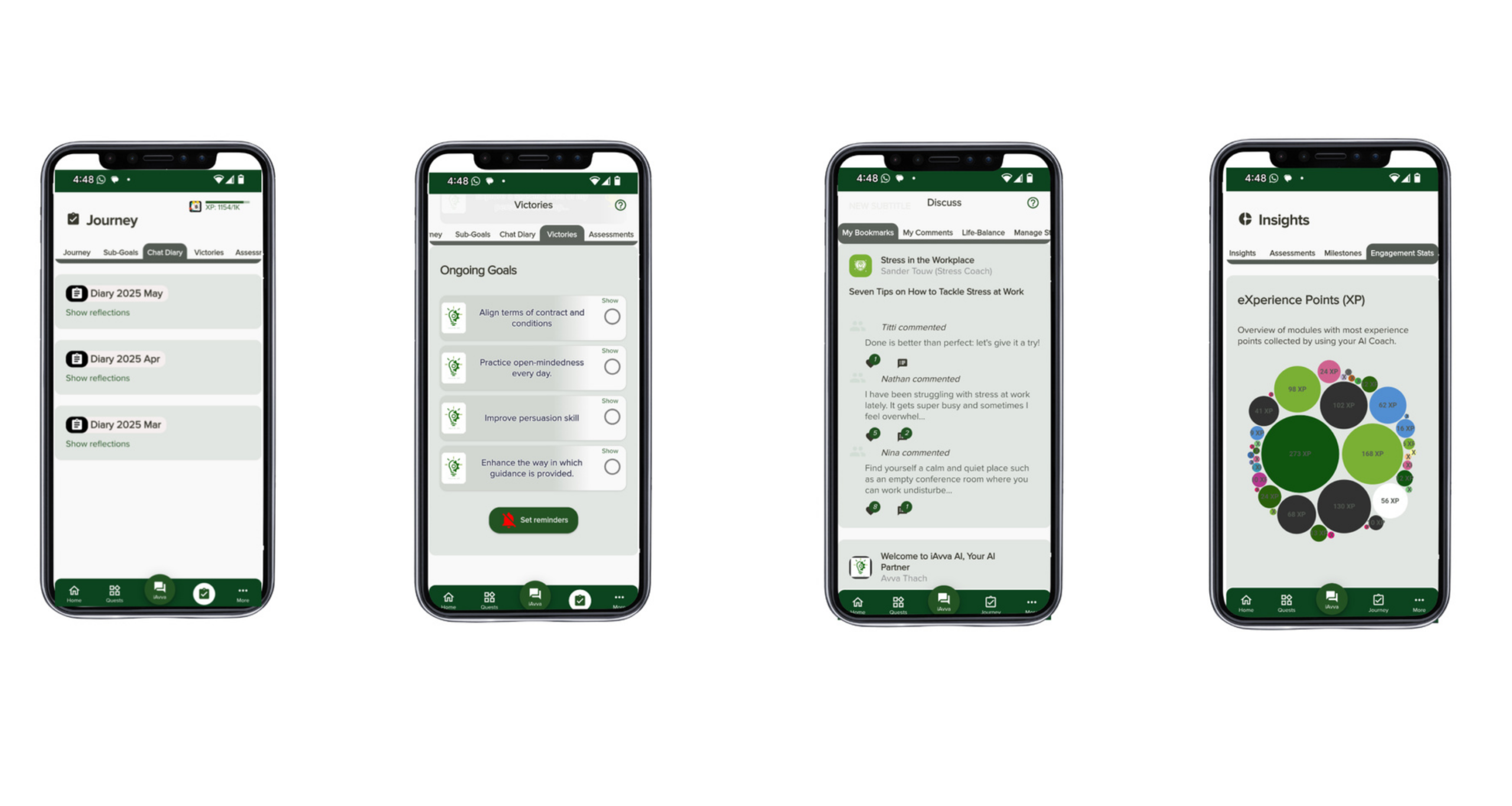
The iAvva AI Coach App is built as a five‑minute, always‑on self‑reflection companion for leaders. It runs on web, iOS, and Android, in 19 languages, with both audio and text modes. Under the hood, it weaves neuroscience, positive psychology, and ICF coaching principles into prompts that help leaders notice patterns, make better choices, and align more closely with organizational goals.
Turning Strategy Into Daily Leadership Habits
Many change efforts fail because they stop at slides and workshops. People attend a strategy session, nod along, and then go back to old habits. I treat this “last mile” as the hardest part. Without daily practice, even the best AI roadmap fades into background noise.
iAvva AI tackles this gap through guided reflections that connect high‑level strategy to small, concrete actions. Each day, leaders receive prompts that ask them to think about their goals, their team’s needs, and how AI could support both. The system nudges them to:
- Align choices with company OKRs
- Explore ethical dilemmas
- Practice inclusive leadership
- Examine how AI is affecting their team’s workload
Reflection themes might include how to introduce AI to a sceptical team, how to balance data with human intuition, or how to respond when AI reveals a bias in an existing process. Over time, leaders build a habit of pausing before reacting, checking their assumptions, and making decisions that support both performance and well‑being. That habit is the real engine of sustainable change.
Scalable, Inclusive, And Secure Leadership Development
Traditional executive coaching is powerful but hard to scale, especially across global organizations or SMBs with limited budgets. What I like about iAvva AI is how it carries coaching‑style support to many leaders at once while still feeling personal and flexible. It meets people where they are, in their language and on their devices, and does not require them to fit into one time zone or learning style.
Because it works in 19 languages and offers both audio and text, leaders can interact in the way that feels natural and accessible to them. The design is friendly to neurodivergent users, with a focus on clarity and manageable steps rather than overwhelming dashboards or dense text. That widens the pool of leaders who can benefit.
On the security side, the platform is built with privacy in mind. Data is encrypted, and practices follow GDPR standards. Reflections are not used to micromanage or surveil individuals; instead, they power personal insight and, at an aggregate level, help organizations see patterns without exposing any one person. That is the kind of design that respects both growth and dignity.
Measurable Impact: From Self‑Awareness To Business Outcomes
Leadership development often struggles with the question “Did this work?” iAvva AI approaches this by combining personal experience with aggregate analytics. Early users report better focus, stronger self‑awareness, and higher productivity, which are good signs on the human side.
For organizations, the platform’s dashboards can track:
- Engagement rates
- Reflection frequency
- Themes that show up across cohorts
HR and L&D teams can look at this data alongside business metrics such as manager effectiveness scores, time‑to‑competency for new leaders, engagement results, or progress toward OKRs. When reflection themes shift in line with strategy, and business outcomes move in the same direction, the case for ROI grows stronger.
The analytics stay at a pattern level, not a surveillance level. That means you can walk into a C‑suite meeting with data about how leadership mindsets are changing, without putting any one person on the spot. That evidence helps you secure support for further investment in AI‑enabled leadership and broader AI strategy at work.
A Practical Roadmap To Implement An AI Strategy At Work In 12–24 Months
Having a clear roadmap turns AI strategy at work from a vague ambition into a plan with dates and owners. I like to think in three phases over 12–24 months. The first phase focuses on assessment and alignment. The second on design, pilots, and governance. The third on scaling, embedding, and ongoing improvement.
These phases are not rigid; they can overlap. But they give structure and help avoid the trap of endless pilots or rushed, ungoverned rollouts. Along the way, tools like iAvva AI support leaders in staying aligned, sharing insights, and building the habits that keep the roadmap alive.
Phase 1: Assess And Align (Months 0–3)
In the first few months, I focus on understanding where the organization stands. That includes a readiness assessment across:
- Technology
- Data
- Culture
- Skills
I want a clear picture of which systems exist, how clean and accessible data is, and how people feel about AI. This might involve surveys, interviews, and quick audits of existing tools.
Mapping employee sentiment archetypes and actual AI usage helps show the gap between perception and reality:
- Are Bloomers and Zoomers already active?
- Where do Gloomers and Doomers cluster?
- Which functions seem nervous, and which are excited?
This view informs both communication and training plans.
Next, I help form a cross‑functional AI council and align senior leaders on ambition and priority domains. Together, we agree on where AI should focus first and what “good” looks like. During this phase, we can also identify initial leadership cohorts—often millennial managers or high‑potential leaders—to start working with AI‑enabled development tools such as iAvva AI.
Phase 2: Design, Pilot, And Govern (Months 3–9)
With alignment in place, I move to design and pilots. Here we select three to five high‑value use cases across business and people domains. That might include:
- A customer‑facing AI agent
- An AI‑assisted sales copilot
- An AI‑powered leadership development path
Each use case gets a defined owner, expected value, and simple success metrics.
Co‑design with end users is central during this phase. Pods bring together business staff, HR, L&D, IT, and risk to map workflows, build prototypes, and test in real settings. At the same time, the AI council sets governance rules, drafts responsible use policies, and chooses benchmarks and monitoring tools.
iAvva AI Coach can roll out to pilot leadership cohorts at this stage. Leaders use daily reflections to process their experience with AI pilots, surface adoption barriers, and practice new communication habits. The insights from those reflections, viewed in aggregate, help refine both tools and change strategies, creating a feedback loop between behavior and design.
Phase 3: Scale, Embed, And Optimize (Months 9–24)
Once some pilots show clear value and acceptable risk, I shift toward scaling and embedding. That means rolling proven use cases to more functions, regions, or customer segments, while keeping a tight focus on metrics. It also means updating:
- Standard operating procedures
- KPIs and scorecards
- Performance and promotion frameworks
So AI‑enabled ways of working become the default, not the exception.
AI literacy programs expand during this phase, moving from early adopters to wider employee groups. Managers receive support on leading AI‑augmented teams, and employees gain clear guidance on safe and effective use. L&D weaves AI topics and tools into most development programs, not just stand‑alone AI courses.
Throughout, I use data from iAvva AI to refine leadership curricula, spot cultural bottlenecks, and demonstrate ROI. For example, if reflections show recurring anxiety in a specific function, HR and People Ops can respond with targeted communication or extra coaching. If engagement with leadership prompts stays high and business metrics improve, that strengthens the case for continued investment.
“You do not rise to the level of your goals. You fall to the level of your systems.” – James Clear
AI strategy at work becomes real when systems and daily habits support it.
Conclusion
AI strategy at work is no longer something a few innovators discuss on the side. It sits at the heart of how organizations create value, lead people, and compete. The technology has moved quickly, but the deeper work now lies with leadership, culture, and operating models. Employees are ready and, in many cases, already using AI more than executives know. What lags is clear direction, aligned ambition, and the daily habits that bring strategy to life.
A strong AI strategy at work rests on six foundations: a business‑led roadmap, AI‑ready talent, a cross‑functional operating model, modern architecture, solid data, and careful activation and scaling. It also recognizes that different roles hold different pieces of the puzzle, from HR and CLOs who shape workforce strategy, to IT leaders who secure the platforms, to individual professionals who build their own superagency.
For me, the most important idea is that AI should extend human agency, not push it aside. When leaders use AI to think more clearly, act more ethically, and support their teams with more empathy, AI amplifies what makes organizations strong. That kind of shift does not happen from a single workshop. It comes from many small, repeated moments of reflection, choice, and learning.
If you are an HR leader, CLO, C‑suite executive, L&D professional, or People Ops owner, the next step can be simple. Consider piloting the iAvva AI Coach App with a group of leaders, alongside your early AI initiatives. Use it to support daily leadership habits, gather insight on adoption barriers, and tie personal growth to your OKRs. From there, you can expand with confidence, using real data and lived experience to guide your AI strategy at work.
FAQs
What Is The Difference Between An AI Strategy At Work And Simply Using AI Tools?
An AI strategy at work is a holistic plan for how AI supports business goals, roles, and culture. It covers which use cases matter most, how they connect to OKRs, what governance and risk controls apply, how teams are organized, which skills people need, and how progress is measured. Simply using AI tools means individual teams or people experiment in isolation, often without shared standards or clear outcomes. With iAvva AI, I focus on translating strategy into daily leadership behavior, so AI use is aligned with values and long‑term goals rather than random tool use.
How Can HR And L&D Leaders Start Building AI Capabilities Without Overwhelming Employees?
I suggest starting with tiered AI literacy that matches roles:
- Give everyone simple, practical basics on safe use.
- Offer deeper paths for managers, power users, and technical staff.
- Use micro‑learning, short videos, and in‑flow nudges instead of long, one‑off bootcamps.
Begin with high‑value, low‑risk use cases so people see real benefit quickly. With iAvva AI, five‑minute daily reflections act as gentle, ongoing practice, helping leaders build confidence and skill without adding heavy time pressure.
How Do We Ensure AI At Work Is Used Ethically And Doesn’t Harm Trust Or Equity?
Ethical AI use starts with strong governance structures, such as an AI council that includes business, HR, IT, legal, and risk. From there, I recommend:
- Clear risk assessments for each use case
- Fairness and bias checks, especially for HR or financial decisions
- Explainability requirements for high‑stakes uses
- Co‑design with diverse employee groups
- Transparent communication about data use
iAvva AI is built on neuroscience, positive psychology, and ICF coaching principles, and it follows privacy‑first, GDPR‑compliant design, which supports ethical reflection and development without turning personal growth into surveillance.
Can Small And Mid‑Sized Businesses Realistically Build An AI Strategy At Work?
Yes, SMBs can do this, and they often have an advantage because they move faster with less bureaucracy. A lean AI strategy at work for an SMB might focus on:
- A handful of high‑value use cases
- A simple governance setup
- Targeted leadership development and AI literacy
Instead of building complex systems from scratch, SMBs can partner with platforms like iAvva AI to cover leadership and learning needs, and concentrate internal effort on the few AI capabilities that differentiate their business.
How Do We Measure The ROI Of AI‑Enabled Leadership Development And Coaching?
To measure ROI, I look at both people metrics and business metrics. On the people side, that includes:
- Manager effectiveness scores
- Engagement results
- Retention of key talent
- Time‑to‑competency for new leaders
On the business side, I track productivity, quality, decision speed, and adoption of AI tools. iAvva AI’s dashboards show engagement with reflections and growth patterns across cohorts, which can be linked to outcomes such as OKR progress or performance improvements. Running controlled pilots with before‑and‑after baselines makes it easier to show how AI‑enabled leadership development contributes to measurable gains.













Leave a Reply