




Introduction: Rethinking Productivity And Leadership In The Age Of AI
There is a quiet moment many leaders know well. The inbox is full, dashboards are glowing, AI copilots are suggesting drafts everywhere—and yet it is not clear whether anything that matters is actually moving. That tension sits at the heart of AI productivity. The tools promise more output. The real question is whether they help us think and lead better.
Everywhere, AI assistants are writing emails, summarizing meetings, drafting job descriptions, and answering policy questions. Vendors claim double‑digit productivity gains. Some studies do show 14–30% improvements for well‑designed customer support or coding use cases. Others, like a large Danish study, see only a few percent of time saved across whole workweeks, with many workers actually spending more time rechecking AI output. The gap between AI stories and lived experience is wide.
That is why the real competitive edge is no longer “who has access to AI.” The edge lies in who has leaders and teams that know how to think with AI. In this article, I treat AI productivity as sustainable performance improvement per unit of human effort that does not erode skills, ethics, or resilience. At four levels—task, workflow, role or team, and whole organization—thinking quality becomes the multiplier. The higher you go, the more leadership judgment matters.
For HR Directors, CLOs, C‑suite executives, IT leaders, People Ops, and ambitious professionals, this means a shift from “Which tools should we roll out?” to “How do we design thinking, systems, and culture so AI actually helps us?” Throughout the article, I draw on current research and practice and I introduce iAvva AI, our AI coaching platform that turns this into a daily five‑minute habit. By the end, you will have clear mental models, practical routines, and a concrete roadmap to build leaders who can think clearly—and act wisely—with AI at their side.
Key Takeaways
- AI productivity is not about doing more tasks faster; it is about redesigning how people think, decide, and learn with AI as a partner at task, workflow, role, and organizational levels.
- Organizations that thrive treat AI as a growth companion for leadership and strategic thinking, not as a substitute for human judgment or a shortcut to headcount cuts.
- Real productivity gains appear when AI is woven into end‑to‑end workflows, roles, and operating models, not only in isolated “time saved” anecdotes around drafting or summarizing.
- The core meta‑skills for this era are critical thinking, systems thinking, reflective practice, ethical reasoning, and the ability to collaborate with both humans and AI.
- Without deliberate thinking habits, AI creates workslop—polished but low‑value output that clogs systems, hides rework, and increases burnout.
- iAvva AI’s five‑minute daily coach model turns neuroscience, ICF coaching principles, and Lean thinking into simple, repeatable reflection routines that support better decisions and leadership behavior.
- An AI‑ready culture comes from combining clear AI use cases, strong guardrails, and scalable reflection practices that help leaders examine how they use AI and what outcomes they actually create.
“AI won’t replace managers, but managers who know how to think with AI will replace those who do not.”
What Is AI Productivity—And Why It Demands A New Way Of Thinking
When I talk with HR and business leaders about AI productivity, many start with a simple idea: output per hour goes up as AI drafts, summarizes, or automates. That is a narrow slice of the picture. For leadership audiences, AI productivity is better framed as sustained improvement in business results, per unit of human effort, capital, or time, without degrading skills, ethics, or long‑term health of the organization.
It helps to think in four layers:
- At the task level, AI writes emails, summarizes meetings, extracts data from PDFs, or suggests code.
- At the workflow level, it stitches tasks into flows—candidate screening to offer, ticket intake to resolution, request to approval.
- At the role and team level, work itself shifts: managers spend less time on “work about work” and more time on coaching and decisions.
- At the organizational level, AI changes margins, innovation pace, internal mobility, and culture. Thinking demands grow as you move up each layer.
Research shows sharp contrasts. Some focused use cases show impressive uplifts, such as a 14% productivity gain for AI‑supported customer service agents or a 30% drop in handle time with chatbot augmentation. Studies examining how generative AI can make professionals more productive have found similar patterns across different domains, with results varying significantly based on implementation quality and task characteristics. In other contexts, like the Danish study across 25,000 workers, self‑reported AI time savings netted to roughly 2–3% of total hours, and a quarter of workers spent more time than before on tasks touched by AI. Recent research measuring the impact of early-2025 AI on developer productivity confirms these mixed results, finding that actual productivity gains depend heavily on task type, skill level, and organizational support systems. The tools were present; system‑level thinking was not.
Hidden costs also matter. Every AI output carries oversight, validation, and integration work. Leaders must redesign processes, manage resistance, upgrade skills, and watch for bias, privacy issues, and reputation risk. Cognitive load can rise as people face more options, more prompts, and more “almost finished” drafts. In this environment, the quality of thinking—sense‑making, prioritization, reflection—becomes the main amplifier for AI productivity.
Leadership, then, sits in a charged space. We are redesigning work, identity, and ethics at the same time. The question shifts from “What can AI do?” to “What should humans and AI do together, and how do we keep our people thoughtful, ethical, and resilient while performance improves?”
How AI Is Changing Work—From Tasks To Whole Organizations
Across organizations, AI already appears in many daily moments, often in subtle ways. I see four levels where this change plays out, and each level calls for different thinking skills from leaders and teams.
- At the task level, AI handles email drafting, meeting summaries, transcription, data entry, and basic analysis. This is where tools like writing copilots, transcription apps, and chat assistants live.
- At the workflow level, AI chains tasks into flows in HR, procurement, onboarding, support, and IT operations. Examples include “ask HR” or “ask procurement” agents, or automated onboarding journeys that create accounts, schedule training, and collect feedback.
- At the role and team level, AI reshapes what work feels like. Recruiters spend less time sorting resumes and more time with hiring managers and candidates. Managers have meeting analytics that reveal speaking patterns and sentiment. Engineers work with code assistants. Teams must renegotiate what counts as contribution when AI drafts or plans many artifacts.
- At the organizational level, AI influences margins, service levels, innovation, and employee experience. It can support 24/7 service, faster cycle times, more localized content, and deeper analytics. It can also create fragmentation if different teams choose their own tools without shared standards or governance. The biggest value potential sits at this level, but so does the greatest need for thoughtful trade‑offs, ethics, and change leadership.
When leaders fail to think systemically, they end up with “islands of automation.” Different departments buy separate tools; knowledge bases diverge; employees receive conflicting answers from different bots; data is duplicated; line managers do not know which metrics really matter. As a result, AI adoption appears high but impact stays patchy. For People leaders, this is not an IT side‑project any more. AI choices shape role design, career paths, engagement, inclusion, and learning needs across the workforce.
Where AI Productivity Comes From: Capabilities And Tool Categories
To think clearly about AI productivity, it helps to map capabilities rather than brand names. Most gains draw on a small set of abilities, including:
- Pattern recognition at scale across text, images, and signals.
- Language understanding and generation through large language models.
- Prediction and recommendation on structured data.
- Orchestration through AI agents that trigger actions across systems.
- Generative media for text, images, audio, or video.
These capabilities appear in recognizable tool families:
- Writing and communication assistants that help improve clarity, tone, and drafting for emails, documents, and chat.
- Meeting and knowledge‑capture tools that record, transcribe, and summarize conversations, and often extract decisions and actions.
- Automation layers that connect systems so AI can route tickets, trigger approvals, or kick off workflows.
- Domain‑specific tools centered on areas like customer service, data analysis, software development, finance, or legal work.
I find it useful to distinguish assistants, agents, and platforms:
- Assistants mostly respond to prompts inside existing tools.
- Agents act on behalf of a person across systems, with some degree of autonomy and guardrails.
- Platforms provide shared services—models, governance, integrations—that many teams can build on.
This distinction matters because the design of work, risk controls, and skills needed are very different for each type.
All of this sits on top of core business systems: HRIS, LMS, CRM, ERP, collaboration tools, and data warehouses. AI productivity emerges when leaders think about how these layers interact, not when they treat each AI app as a separate gadget.
Adoption Versus Impact: Why Many AI Initiatives Underperform
Almost every executive report now says some version of “Most companies use AI.” Surveys show very high adoption rates—around nine out of ten US companies say they use generative AI somewhere. Yet many also report unclear ROI, abandoned pilots, and serious concerns about quality. This gap between enthusiasm and actual impact is common.
Patterns repeat:
- Initiatives start from tools, not from clearly defined problems or constraints.
- Teams roll out chatbots or copilots without clear use cases, baselines, or success metrics.
- No one specifies what work will stop once AI arrives, so time savings are absorbed back into busywork.
- Change management and skill‑building get little attention; people either ignore the tools or use them in shallow ways.
For AI productivity to be real, three elements must align:
- Capabilities – the technology must fit the task.
- Contexts – workflows, data, and governance must support safe and useful use.
- Cognition – people must know how to think, decide, and learn with AI in the mix.
When any one of these is weak, even impressive tools do not translate into better performance or stronger leadership.
As Peter Drucker reminded us, “There is nothing so useless as doing efficiently that which should not be done at all.” AI can make this mistake faster if leaders do not rethink what truly matters.
The New Cognitive Skills Leaders Need To Thrive With AI
For many years, “learning how to think” sounded like a philosophical topic rather than a strategic one. With AI woven into work, it becomes a business requirement. AI can generate content and options at scale, but it cannot tell an organization what it should value, where it should focus, or which trade‑offs are acceptable. That is leadership work, and it rests on specific thinking skills.
Five cognitive capabilities stand out:
- Critical thinking and healthy skepticism – treating AI as an input, not a verdict.
- Systems thinking and second‑order thinking – seeing how AI changes flows and incentives, not just tasks.
- Reflective practice and self‑awareness – using each AI interaction to become sharper, not more dependent.
- Ethical and values‑based reasoning – guiding decisions around fairness, privacy, and long‑term trust.
- Collaborative intelligence – helping humans and AI work together well, keeping accountability where it belongs.
Each of these skills shows up differently across the four layers of AI productivity. At the task level, critical thinking matters for checking outputs. At the workflow level, systems thinking helps leaders avoid local optimizations that harm other teams. At the role and team level, reflective practice helps managers redesign their time. At the organizational level, ethics and collaborative intelligence become central to culture, governance, and long‑term strategy.
Critical Thinking: Treating AI As A Junior Analyst, Not An Oracle
Current language models can write smooth paragraphs and detailed lists, yet research shows that “reasoning” variants still introduce subtle errors at high rates. In some tests, more than half of their answers contain factual or logical mistakes. The danger is that the output sounds confident, so people relax their attention just when they need it most.
It helps to treat AI like a smart but inexperienced analyst. That means:
- Asking for sources and explanations when possible, especially in regulated or high‑risk areas.
- Favoring setups where the AI works over trusted internal documents, not just the open internet.
- Triangulating answers with domain knowledge, peer input, or alternative data.
Simple checklists support this habit. Before accepting AI‑generated work, ask:
- “What seems missing here?”
- “What assumptions does this argument make?”
- “If this were wrong, who would be harmed?”
HR and L&D teams can build these habits into learning content and practice sessions, so critiquing AI outputs becomes as natural as reviewing a draft from a new colleague.
Systems Thinking: Seeing Beyond Single Tasks To Whole Workflows
Many AI pilots start with a single task, such as summarizing performance feedback or suggesting learning resources. On its own, that can look helpful. Yet every process—hiring, customer escalation, incident response—has many steps and handoffs. Changing one step without seeing the rest often shifts problems elsewhere instead of solving them.
Consider a hiring process:
- AI helps recruiters screen resumes faster, so the shortlist grows.
- Interview scheduling and hiring manager availability remain the same.
- Bottlenecks just move downstream and candidates wait longer.
In support, a chatbot might speed ticket intake, only to overwhelm human agents if routing and knowledge bases are not updated. Systems thinking means tracing how AI changes volume, timing, and behaviors across the whole flow.
This way of thinking also supports better prioritization. Instead of chasing many small automations, leaders can focus on a few end‑to‑end workflows where AI can compress lead time, improve quality, and reduce rework together. For example, reworking the entire performance review process so AI summarizes inputs while managers spend more time in honest conversations can raise both efficiency and trust.
Reflective Practice: Turning AI Use Into Learning, Not Dependency
Neuroscience and coaching research point to a clear insight: reflection strengthens learning. Short, regular moments of looking back help the brain connect actions, emotions, and outcomes. Over time, this builds stronger pathways for self‑regulation, pattern recognition, and better decisions. With AI in the mix, reflection decides whether tools teach us—or train us to switch off.
If people mindlessly accept AI drafts, their own skills can decay. Writing, analysis, and decision‑making muscles weaken. On the other hand, if they pause to ask “Where did AI help?”, “Where did I improve the output?”, and “What will I do differently next time?”, each AI use becomes a learning rep. Micro‑reflection—just five minutes a day—is often enough to shift habits over weeks.
Useful prompts include:
- “Where did AI genuinely improve my work today?”
- “Where did it tempt me to shortcut thinking?”
- “What is one thing I will adjust in my next similar task?”
This is exactly the behavior space where iAvva AI operates, turning those questions into a guided daily practice that fits into busy schedules.
Ethics And Values: Guardrails For AI‑Driven Productivity
Every AI productivity decision sits on ethical ground, even when it looks operational. Data privacy, bias in HR recommendations, opaque scoring, and pressure to use AI for cost cutting can all clash with stated values. Thinking well here means more than knowing policies; it means practicing practical ethics under time pressure.
Leaders often weigh speed, cost, fairness, and experience without naming those trade‑offs. A simple test is, “Would I be comfortable explaining this AI‑supported decision to the person affected, to a regulator, or in a public forum?” If the answer feels shaky, that is a sign to slow down and rethink. It may call for more human review, different data, or a different objective.
People leaders play an important role here. They can:
- Co‑create AI principles with IT and Legal.
- Embed those principles into leadership programs.
- Share stories of both good and poor practice.
When ethics is treated as a daily skill rather than an annual workshop, it becomes a natural part of AI productivity thinking.
The Dark Side Of AI Productivity: Myths, Workslop, And Mis‑Measurement
For all the promise of AI productivity, there are serious traps. One of the biggest is workslop—content and activity created by AI that looks like work but carries little or no value. Long threads of generic marketing posts, unread reports, or auto‑generated documents that nobody uses all fall into this category. They increase noise, create extra review work, and drain attention.
Research also pushes back on rosy claims. Large surveys often show that self‑reported time savings from AI add up to a few percent of total working hours at best, once spread across tasks. Analysis examining recent employment effects of artificial intelligence reveals that while some sectors show productivity improvements, the broader labor market impact remains complex and highly variable across industries and job functions. The Danish study found that about a quarter of AI users ended up spending more time on their tasks, due to checking and adjusting outputs. Macro productivity growth has not yet shown a clear AI‑driven spike. The idea that AI alone will produce a new “golden age” for productivity is, at best, unproven.
Five myths cause real problems:
- More AI‑generated output automatically equals higher productivity.
- Employees who use AI tools are automatically more valuable, regardless of how they use them.
- Organizations can safely cut headcount as soon as they deploy AI, without careful role redesign and reskilling plans.
- Ethics and governance just slow teams down instead of protecting long‑term value.
- Any productivity gain is good, even if it relies on surveillance, de‑skilling, or burnout.
Mis‑measurement feeds these myths. When leaders count the number of AI‑written emails or documents but do not track whether those artifacts change decisions or outcomes, they mistake volume for value. When they rely only on “hours saved” estimates without checking for rework, error rates, customer impact, or employee experience, they risk fooling themselves. A more honest approach starts by defining what meaningful productivity means in a given context—better quality, faster learning, improved decisions, lower burnout—and then measuring against that.
“Not everything that can be counted counts, and not everything that counts can be counted.” – William Bruce Cameron
How To Recognize And Eliminate Workslop
Workslop is often visible if leaders know what to look for. Signals include:
- Content with no clear audience or use: reports nobody opens, documents nobody follows, decks that are remade from scratch.
- Repeated complaints from downstream teams about AI‑generated materials being vague, inaccurate, or hard to trust.
- A sense of being “busier than ever” even as more tasks are automated.
I like to run simple audits:
- Sample AI‑generated emails, reports, or knowledge articles from different teams.
- For each piece, ask, “Who uses this?”, “What decision or action does it support?”, and “What happens if we simply stop creating this?”
- If nobody can answer, that artifact is a strong candidate for deletion or redesign.
This exercise often reveals entire categories of work that add little value but consume time and mental energy.
From there, leaders can:
- Define quality standards for AI output.
- Set review cycles and ownership.
- Make it normal to retire low‑value automations or reports.
They can direct some of the freed capacity into reflection, skill‑building, or cross‑functional projects that tackle real constraints. Over time, this shift replaces workslop with fewer, higher‑value outputs backed by better thinking.
How To Think With AI: Practical Mental Models And Daily Practices
Turning ideas into daily behavior requires simple, repeatable patterns. One approach that works well is a short loop: Frame – Collaborate – Reflect And Refine. This loop keeps both AI and human thinking in play, regardless of the task or function.
- In the Frame step, define the problem, constraints, audience, risks, and success measures. Skipping this step is a common cause of vague prompts and generic AI answers.
- In the Collaborate step, bring AI and humans together with a clear division of labor: what AI drafts or analyzes, what humans check, and where humans must decide.
- In the Reflect And Refine step, look at both the content and the process: how well the outcome met the need, and what to change next time.
This loop applies across many scenarios. Writing an HR policy update, planning a leadership program, analyzing survey results, or preparing for a tough conversation can all follow this pattern. The mindset is consistent: use AI as a partner while keeping humans in charge of framing, values, and final judgment. Short, repeatable practices matter more than big one‑off AI trainings.
Framing Problems: Asking Better Questions Than AI Can Answer
AI responds to prompts; leaders define the prompts’ shape and purpose. Vague questions like “Write a leadership development strategy” invite vague answers. Specific framing leads to more useful output and better thinking.
Before opening an AI tool, state in plain language:
- The goal.
- The audience.
- The constraints.
- The risks and sensitivities.
- How success will be assessed.
For example, instead of asking, “Draft an onboarding plan,” try:
“Create a 30‑day onboarding outline for remote mid‑level engineers in a US‑based SaaS company, focusing on faster time‑to‑productivity and clear expectations with minimal meeting time. Include checkpoints for manager feedback and peer support.”
You can also ask the AI to list options and trade‑offs, not just a single recommendation.
Teams can practice this by taking poorly framed prompts and rewriting them as structured problem statements that include:
- Desired outcome.
- Primary audience.
- Constraints (time, compliance, tools).
- Success metrics.
Over time, this habit improves not only AI interactions, but also how teams talk about work more broadly.
Collaborating With AI: Division Of Labor Between Human And Machine
Once a problem is framed, decide how to split work between AI and people. A simple lens divides contributions into:
- Automation – AI handles routine tasks end‑to‑end.
- Augmentation – AI supports parts of complex tasks.
- Acceleration – AI speeds up analysis or drafting.
- Expansion – AI enables new services, such as multilingual support.
Examples:
- In HR, AI can automate scheduling and FAQ responses; augment managers by summarizing feedback; accelerate policy drafting; and expand support through chatbots in multiple languages.
- In L&D, AI can draft course outlines, propose scenarios, or analyze completion data.
- In IT, AI can suggest code or scan logs for anomalies.
Humans still need to own context, values, relationship work, and final accountability.
It is often helpful to write down process roles:
- What AI is allowed to do alone.
- Where humans must review and approve.
- Which steps remain entirely human.
This clarity supports compliance and reduces confusion. It also reveals when humans are missing from loops where they should be present—for instance, final performance ratings or sensitive employee communications.
Reflect And Refine: Turning Every AI Interaction Into Micro‑Learning
The third step in the loop closes the gap between use and learning. After an AI‑supported task or project, pause briefly and ask what worked and what did not:
- Did AI handle certain parts reliably?
- Where did it fail or introduce risk?
- Did the process help the team focus on what matters, or did it create extra oversight work?
Teams can build short retrospectives into their routines. A weekly “AI wins and misses” check‑in lets everyone share examples and refine prompts, checklists, and guardrails. Shared libraries of effective prompts and typical red flags save time and reduce repeated mistakes. Leadership teams can do deeper reviews after major AI rollouts or experiments.
This is where iAvva AI plays a strong role. By prompting leaders each day to reflect on decisions, use of AI, and alignment with goals, it turns this reflection into a tiny but regular ritual. Over weeks and months, those micro‑learning moments compound into sharper judgment and more thoughtful AI use across the organization.
iAvva AI: Your Always‑On Growth Companion For Thinking In The Age Of AI
Many AI tools focus on doing more work for people—writing, routing, summarizing. iAvva AI focuses on something different: helping people think better, consistently, in a world where AI touches almost every task. It acts as a growth companion for leaders in HR, L&D, IT, and the business, not as another task automation app.
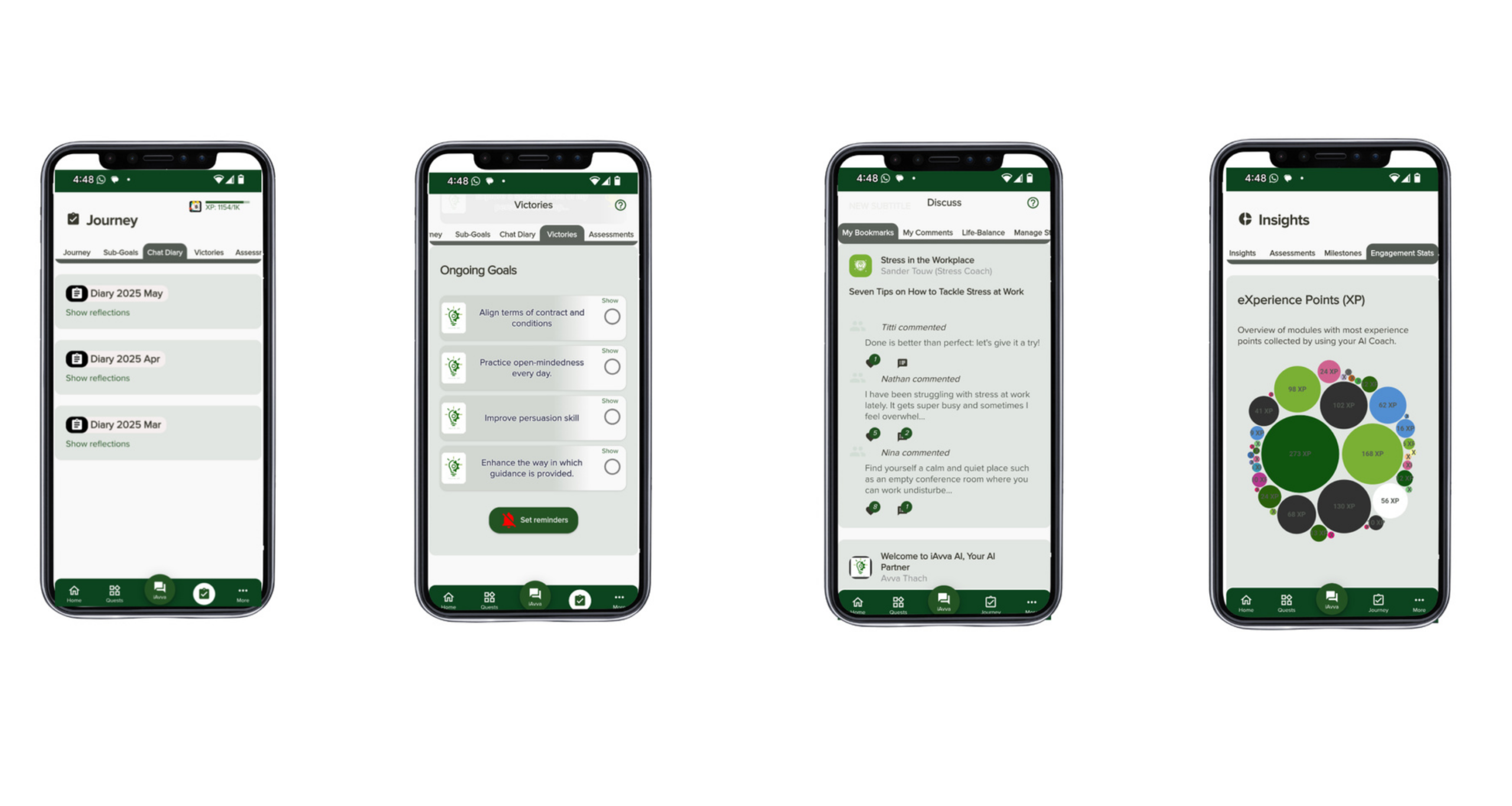
The core iAvva AI Coach app invites leaders into a five‑minute daily reflection. It builds on neuroscience, positive psychology, ICF coaching principles, and Lean thinking. Instead of long modules, it delivers short, focused prompts that nudge leaders to examine decisions, behaviors, and AI use against their goals and values. It works across Web, iOS, and Android, with both text and voice modes, in 19 languages, so distributed and global leaders can use it in the way that suits them best.
Where many platforms stop at content or analytics, iAvva AI connects personal reflection with business outcomes. Leaders can align their reflections with OKRs, track progress on specific leadership habits, and see patterns over time. For HR and L&D, high engagement rates and real‑time dashboards show how often leaders practice reflection and what topics surface most, without exposing personal content. This turns leadership development and AI productivity from one‑off programs into daily behavior.
“We do not learn from experience… we learn from reflecting on experience.” – John Dewey
Daily Reflection For AI‑Era Leadership: How The App Works
A typical day with iAvva AI takes only a few minutes:
- Leaders receive a focused prompt—through the app, browser, or device notifications—that asks them to reflect on a recent situation.
- They respond by typing or speaking, whichever feels more natural.
- Over time, the sequence of prompts builds a rich picture of how they think, decide, and react, without overwhelming them.
Prompts cover themes such as:
- Clarity of priorities and focus.
- Ethical dilemmas and trade‑offs.
- Decisions they made and how they made them.
- Conversations they led.
- Their use of AI tools that day or week.
One day the question might be, “Where did you rely on AI today, and how did that change your decision or outcome?” Another day it might be, “Which assumption about your team did you test or challenge this week?” These questions help leaders notice patterns and experiment with new approaches.
The approach draws on science showing that short, regular reflection strengthens neural pathways linked to self‑awareness, focus, and judgment. Early user feedback often mentions greater clarity, more intentional use of AI tools, and higher personal productivity. Because the practice is short and flexible, busy leaders in SMBs and large enterprises can stick with it much more easily than with long courses.
From Reflection To Measurable Business Impact
Reflection is valuable on its own, yet organizations also need to see impact. iAvva AI connects individual growth to business results by letting leaders tie their reflection themes to specific goals and OKRs. Over time, they can see how consistent reflection lines up with progress on priorities such as:
- Team engagement and retention.
- Project delivery and execution.
- Customer outcomes and satisfaction.
For HR, L&D, and People Ops, anonymized analytics show:
- Engagement with reflection over time.
- Common themes around clarity, decision‑making, and well‑being.
- Shifts in habits across leadership populations.
This data can inform leadership programs, AI training, and support needs without exposing personal stories. For example, if many leaders reflect on uncertainty around AI use in performance conversations, that signals a need for targeted guidance or principles.
Organizations use iAvva AI alongside workshops, coaching, and academies. A leadership program might run an in‑person kick‑off, then rely on daily iAvva AI prompts to keep participants practicing for months. Distributed enterprises can use it to build a shared leadership culture across regions and languages. GDPR‑compliant and encrypted architecture addresses privacy and security expectations, which is especially important when reflection touches on sensitive topics.
Complementing Your AI Stack: iAvva AI + Productivity Tools
Most organizations already have a growing AI stack—copilots in office suites, HR chatbots, customer‑service assistants, automation platforms. These tools focus on what gets done. iAvva AI focuses on how leaders think about what to do, what to automate, and how to lead people through change. In that sense, it sits as a thinking layer on top of operational AI tools.
Simple integration patterns work well:
- When a new AI tool goes live in HR, support, or sales, schedule a short reflection campaign in iAvva AI for managers in that area. Prompts can ask what is working, where quality concerns appear, and how roles are shifting.
- Leadership cohorts can use iAvva AI to debrief experiments with AI in their teams, turning scattered experiences into shared learning.
- Transformation teams can link reflection themes to key initiatives, spotting obstacles early.
By playing this role, iAvva AI becomes a strategic partner to HR, L&D, IT, and C‑suite leaders. It helps prevent AI adoption from becoming a shallow numbers game and positions AI productivity as a combination of smart tools, thoughtful systems, and reflective humans.
Designing An AI‑Ready Organization: From Skills To Culture
Creating an AI‑ready organization is less about buying the right software and more about aligning skills, systems, and culture so AI productivity and human thinking reinforce each other. Think of this through three design layers:
- Skills and roles – what people know and how jobs are shaped.
- Systems and processes – where AI fits in and how work flows.
- Culture and governance – the norms and rules that guide behavior.
On the skills and roles layer, broad AI literacy and meta‑skills are needed across the workforce, with deeper expertise in roles such as AI product owners, data stewards, and automation designers. On the systems and processes layer, leaders must map where AI fits in, redesign work, and decide how humans and AI collaborate. On the culture and governance layer, trust, ethics, psychological safety, and clear rules let people use AI confidently without fear or confusion.
HR and L&D are in a strong position to orchestrate these layers. They sit between strategy, operations, and people and can connect AI programs with leadership development, performance management, and workforce planning. With tools like iAvva AI in the mix, they can also support ongoing reflection rather than one‑time training.
Building AI Literacy And Meta‑Skills At Scale
AI literacy is the new baseline. It does not mean turning everyone into data scientists, but it does mean that employees understand:
- What models like large language systems can and cannot do.
- How hallucinations and subtle errors happen.
- Why data privacy and security matter.
- How to write useful prompts and critique outputs.
On top of this, meta‑skills like critical thinking, systems thinking, reflection, ethical reasoning, and collaboration shape how people actually apply AI.
A practical approach is to weave these topics into existing programs:
- Manager training can include modules on leading teams that use AI daily.
- Leadership journeys can cover decision‑making with AI support, ethical dilemmas, and how to evaluate AI‑driven metrics.
- Onboarding for knowledge workers can include simple AI safety and prompt practice.
After formal sessions, iAvva AI can reinforce learning through targeted prompts. For example, a week after a workshop on AI bias, leaders might receive reflection questions about recent hiring or performance decisions. This kind of follow‑through turns knowledge into habits.
Leadership Behaviors For Human–AI Teams
AI‑enabled teams need leaders who behave differently from traditional command‑and‑control models. They must decide what gets automated, what stays human, and how to blend both. They need to make space for coaching and sense‑making as AI handles routine reporting and drafting. They also need to be transparent about where they use AI in their own work, so that teams learn from real examples.
Concrete behaviors include:
- Regularly asking, “Should this be automated, or is there human value here?”
- Sharing their own AI experiments and mistakes to normalize learning.
- Tracking how much of their time goes into coaching versus administration.
- Discussing AI use openly in team meetings, including risks and boundaries.
Metrics can cover time use, employee feelings of autonomy and trust, and perceived quality of decisions. These indicators give HR and business leaders a shared view of how well human–AI teams are working.
iAvva AI can support these behaviors through daily prompts that nudge leaders to review where they spent their time, which decisions they delegated to AI, and how they communicated about those choices. Over time, that nudging can shift leadership norms more effectively than policy documents alone.
Culture, Trust, And Ethical Guardrails
No AI initiative thrives in a culture of fear. If employees worry that AI tools are mainly about job cuts, surveillance, or performance traps, they will either avoid them or use them defensively. That reduces real productivity and blocks honest learning about what works. An AI‑ready culture puts transparency, fairness, and skill growth at the center.
Key principles include:
- Clear statements about how employee data is used and protected.
- Commitments to reskilling and career mobility where roles change.
- Firm “red lines” such as never using AI as the sole basis for critical HR decisions.
- Simple ways to raise concerns or report problematic AI behavior.
Governance structures like an AI ethics committee—with HR, L&D, IT, Legal, and worker representatives—help turn these principles into practice.
Reflective tools like iAvva AI help surface ethical tensions early. When leaders regularly reflect on trade‑offs and concerns, patterns appear in the aggregate data. HR and executives can then respond with guidance, training, or design changes before trust is damaged.
A Practical Roadmap: How To Start Thinking Differently About AI Productivity
Knowing that thinking matters is one thing; changing how an organization thinks is another. A staged roadmap is useful, especially for HR Directors, CLOs, C‑suite leaders, IT managers, and ambitious professionals who need traction within 90 days.
Stage 1: Clarify Outcomes And Constraints
- Choose three to five high‑impact use cases tied directly to strategy, such as faster onboarding, better leadership feedback, improved customer NPS, or reduced burnout in specific roles.
- For each, define what “good productivity” looks like, including quality, fairness, and experience.
- List constraints such as compliance, data limits, and cultural factors.
Stage 2: Design Human–AI Workflows, Not Just Tool Rollouts
- Map the end‑to‑end process for each use case.
- Decide where AI will act, where humans must review, and where work should stay human.
- Build in reflection checkpoints and simple feedback loops.
- For example, after introducing an AI assistant in HR, plan how managers and employees will report issues and what the review cycle looks like.
Stage 3: Measure Beyond Hours Saved
- Use metrics that cover efficiency, effectiveness, experience, equity, and resilience.
- Set baselines for cycle times, error rates, NPS or CSAT, engagement, burnout indicators, and bias measures.
- Run pilots with clear control groups where possible.
- Watch for rework and hidden costs as carefully as for time savings.
Stage 4: Scale Thinking Habits With iAvva AI
- Integrate daily reflection into leadership routines so that every AI initiative is paired with ongoing learning.
- Use aggregated insights from iAvva AI to refine AI strategy, learning programs, and process design.
- Over time, your organization will not only use AI tools, but also become better at learning from them.
For the first 90 days, a concise checklist helps:
- Decide on two or three pilot workflows.
- Co‑design them with the people who do the work.
- Launch with clear metrics and guardrails.
- In parallel, start a small leadership reflection cohort using iAvva AI.
- After 90 days, review both the hard metrics and the reflection themes, and decide where to expand, refine, or stop.
Conclusion
AI is changing how work gets done, but it does not change the fact that thinking is the main leadership lever. Without upgraded thinking, AI productivity stays shallow. It produces extra content, more dashboards, and sometimes more confusion. Workslop grows; trust erodes; skill gaps widen. With better thinking, the same tools help people focus on what matters, improve decisions, and build healthier organizations.
The leaders and organizations that will do well are those that treat AI as both collaborator and mirror. They use AI to surface options and patterns, and then reflect on what those reveal about their systems and values. They invest in reflection, ethics, and systems design, not only in tool licenses. They treat leadership development and AI literacy as central parts of change, not optional extras.
iAvva AI exists to support exactly that shift. With daily reflection at scale, it helps leaders bring clarity and conscience into their AI use. By tying personal growth to business OKRs, it keeps productivity gains connected to real outcomes. Its secure, multilingual, and neurodiversity‑friendly design makes it suitable for global leadership populations who need a simple way to stay thoughtful amidst constant change.
For organizations, a natural next step is to pilot iAvva AI with a leadership cohort or with the group steering AI adoption. For individuals, a practical move is to start a 30‑day reflection practice on AI use and important decisions—whether through iAvva AI or a personal journal—and track changes in clarity, focus, and impact. In an age shaped by AI, learning to think with care may be the most powerful productivity move any of us can make.
FAQs
What Is The Difference Between AI Productivity And Traditional Productivity?
Traditional productivity usually means more output per unit of input, such as more units per worker hour. AI productivity adds extra dimensions. It includes quality, learning, ethics, and resilience, as well as classic efficiency. AI brings oversight costs, data risks, and shifts in skill needs. Focusing only on speed or volume is risky because it can hide rework, bias, or burnout behind impressive‑looking numbers.
How Can HR And L&D Leaders Measure The Real Impact Of AI On Productivity?
Use multi‑level metrics:
- At task level, track time per task, error rates, and rework.
- At workflow level, measure lead times, throughput, and SLA compliance.
- At role and team level, look at output per FTE, engagement scores, and burnout indicators.
- At organizational level, connect AI changes to revenue, margin, attrition, and fairness measures.
Baselines and pilot‑versus‑control comparisons are vital. Reflection data from tools like iAvva AI can also reveal changes in decision quality, leadership focus, and confidence with AI over time.
Won’t AI Replace The Need For Leadership Development And Coaching?
AI can simulate scenarios, offer feedback, and help leaders practice conversations. It cannot replace human values, accountability, or the subtle relationship work of leadership. As AI takes over more routine tasks, leadership actually becomes more demanding—handling ethics, culture, cross‑functional change, and human motivation. iAvva AI is designed as an augmentation to human coaching. It scales reflective practice between sessions and across more people; it does not replace mentors or sponsors.
How Can Individual Professionals Use AI Without Losing Their Own Skills?
Treat AI as a practice partner and challenger, not as a crutch:
- Decide which core skills you want to keep sharp—like analysis, writing, or strategy—and avoid offloading them completely.
- Use AI to generate options, then critique and improve them yourself.
- Set aside time each day or week to reflect on where AI helped you learn and where it tempted you to shortcut thinking.
Tools like iAvva AI can support that reflection, but even a simple written log can help keep learning ahead of dependency.
Where Should My Organization Start If We Feel Behind On AI?
It is better to start thoughtfully than to rush into tool sprawl:
- Pick two or three use cases tied to clear strategic aims, such as reducing onboarding time, improving support response quality, or freeing leaders for more coaching.
- Launch small, well‑governed pilots with defined metrics and clear rules about data and human oversight.
- At the same time, invest in leadership thinking and reflection—through programs and tools like iAvva AI—so that people learn how to use AI well as they adopt it.
- Bring HR, L&D, IT, and business leaders together from the start so AI productivity becomes a shared responsibility, not a siloed experiment.














Leave a Reply