

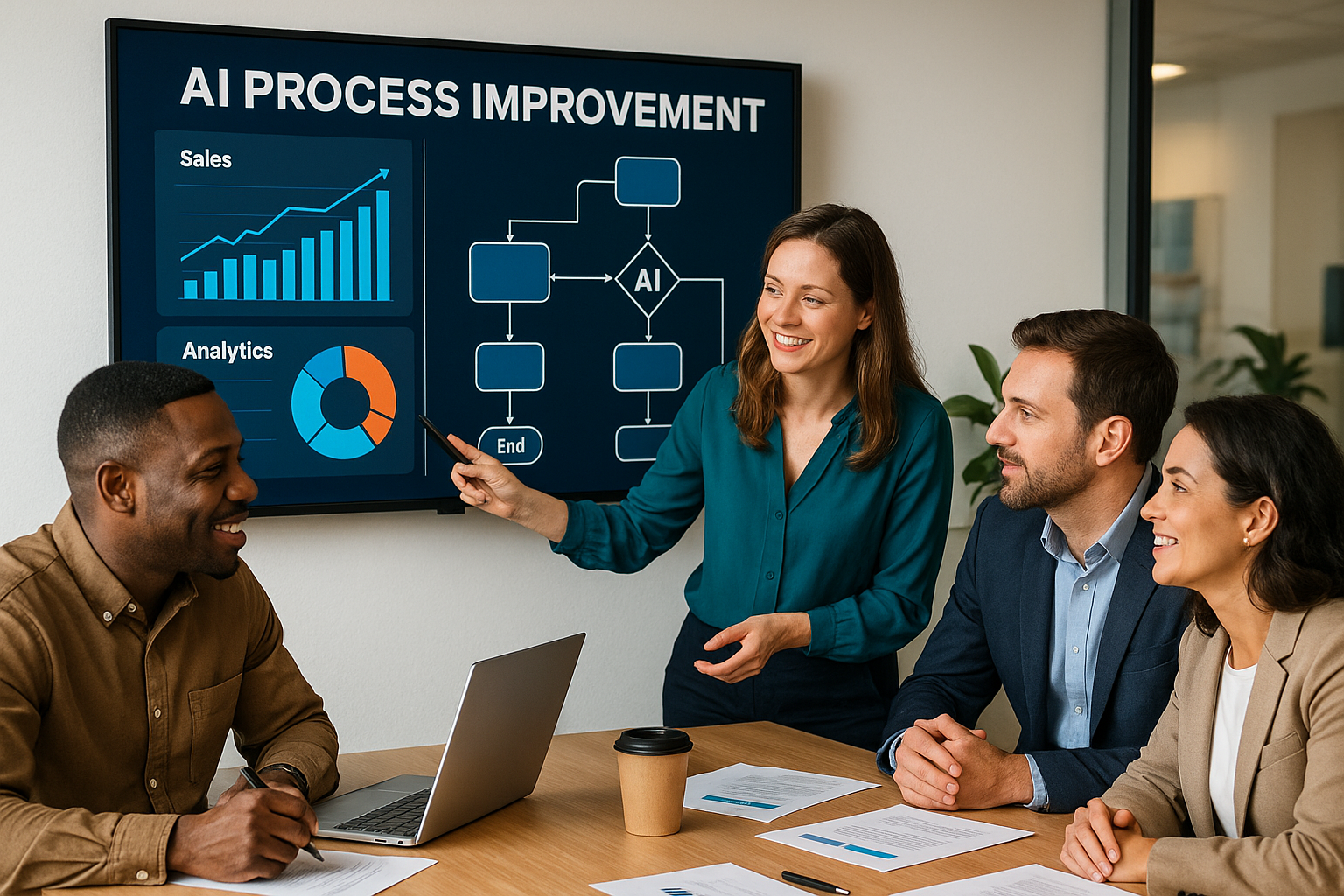
Introduction: Standing At The Edge Of A World Where No One Reads Code Anymore
There is a quiet moment many leaders recognize.
The dashboard is full of alerts, a new AI copilot just rolled out, another “productivity” tool is pending, and the inbox still explodes. Strategy decks lag behind what is already happening on the ground. It feels like running a marathon on a moving walkway that keeps speeding up.
Now add one more realization.
Very soon, most people in the organization may never see a line of code, yet code and AI will run almost everything that matters—hiring flows, pricing rules, learning journeys, even who gets promoted. That realization is both exciting and unsettling at the same time.
This is the future GitHub’s ex-CEO is betting on. AI systems will write, read, and interpret code so that humans live “above the glass,” working through natural language, visual builders, and smart assistants. In that world, AI process improvement does not just make things faster; it quietly rewires how work flows, how skills grow, and what leadership even means.
For HR, L&D, CIOs, and senior executives, this raises sharp emotions. There is fear of losing control and relevance, pressure to prove ROI on AI projects, and a deep sense of responsibility to protect people, values, and trust. Yet there is also a once-in-a-career opening to redesign work so humans spend more time on strategy, ethics, and relationships and less time wrestling with tools and manual steps.
This article walks through that shift. It explains what a “no code, all AI” future really means, how AI process improvement builds on Lean and Six Sigma, and which leadership skills matter more when AI runs the plumbing. Along the way, you will see how iAvva AI positions its AI Coach App as a human-centered layer that turns this vision into daily, measurable leadership habits—not another dashboard, but a growth companion that helps people stay human and effective in an AI-first operating model.
“AI will not replace leaders. But leaders who know how to work with AI will replace those who don’t.”
Key Takeaways
- The future where most humans no longer look at code is not science fiction; it is emerging through AI copilots, agents, and low-code tools that sit between people and the underlying software.
- AI process improvement goes beyond basic automation; it uses AI to observe how work happens, spot patterns, and keep optimizing workflows in real time across HR, operations, and customer-facing processes.
- Lean, Six Sigma, and classic continuous improvement still matter; AI accelerates their analysis, broadens their data sources, and sustains gains across hybrid and distributed teams.
- The biggest shift is human, not technical; leadership value moves toward strategy, ethics, creativity, empathy, and the ability to steer change in an AI-first environment.
- HR, L&D, CIOs, and executives need to redesign roles, skills, and development paths for a low-code/no-code world where AI sits in the middle of almost every process.
- iAvva AI’s AI Coach App turns this shift into daily leadership habits, connecting self-reflection and behavior change to clear business and process outcomes.
- You can start small by applying AI to one process, such as onboarding or performance reviews, and pairing it with focused leadership coaching to keep adoption and culture on track.
- Strong governance, transparency, and human-in-the-loop rules are essential whenever AI optimizes people-related processes like hiring, promotion, feedback, and learning.
What Does It Mean When Humans No Longer Look At Code?
GitHub’s ex-CEO paints a simple but radical picture. AI systems will increasingly generate, read, and debug code on their own. Copilots help developers today, but the arc points toward agents and pipelines that update and repair systems without humans opening source files. For most employees—and many leaders—the code layer will work like an electric grid: vital, but invisible.
This is already visible in low-code and no-code tools, drag-and-drop workflow builders, GitHub Copilot–style experiences, and auto-generated rules inside CRM, HRIS, and ERP systems. People describe the result in business terms: “The workflow changed,” “The routing improved,” or “The approval logic updated,” not “The code changed.” AI lives in the middle, translating intent (“route high-risk cases to senior reviewers”) into executable logic.
In that context, AI process improvement becomes the engine under the surface. Instead of human experts mapping workflows on whiteboards, AI watches real data, experiments with variations, and nudges work to move in smarter ways. Processes stop being static diagrams and start behaving like living systems that adjust whenever conditions shift—new volumes, new products, new regulations.
When AI takes over the “how”—the branching logic, the code, the optimization—human work moves up a layer. The tasks that remain on the human side are:
- Setting direction and constraints
- Defining what “good” means beyond simple efficiency
- Making tough trade-off calls where fairness, trust, and well-being matter as much as speed
That raises the key question for any senior leader in this future: if code and process logic hide behind an AI layer, what do the best leaders have to be excellent at? The rest of this article is a direct answer to that question.
From Lean & Six Sigma To AI Process Improvement
For many organizations, continuous improvement started with Lean, Six Sigma, or Kaizen. Teams identified waste, mapped processes, collected samples in spreadsheets, and ran projects to remove bottlenecks. This work delivered meaningful gains, but it was often periodic and heavy. Data snapshots aged quickly. Insights depended on whoever was in the workshop.
AI process improvement keeps the discipline but changes the speed and scope. In simple language, it means using AI to watch how work really flows, automate repeatable steps, predict where trouble will appear, and keep tuning workflows without waiting for a formal project. It shifts continuous improvement from a special event into a built-in function of the operating model.
Classic CI still shines at structure, governance, and frontline engagement. Frameworks like DMAIC and PDCA help teams define problems, test countermeasures, and standardize better ways of working. Leaders still need that shared language. What changes is the toolset around it:
- Instead of manual mapping, process mining reconstructs real flows from event logs.
- Instead of spreadsheet analysis, machine learning searches for hidden drivers in millions of records.
- Instead of annual audits, real-time monitoring spots when a process starts to drift.
For HR, L&D, CIOs, and executives, the mindset move is important. The language moves from “We are running an improvement project this quarter” to “Our system is always learning, and our job is to steer it.” Before going deeper into people and leadership, it helps to get a non-technical view of the main technologies that make this possible.
Core Technologies Behind AI Process Improvement
Under the hood, AI process improvement relies on a small set of building blocks that work together. You do not need to program them, but knowing what they do makes conversations with IT and vendors much easier.
Process Mining uses event logs from systems like HRIS, CRM, ATS, and ticketing tools to rebuild the actual path work takes. It shows which steps happen in which order, where work loops back, and where cases wait too long. It replaces “how we think the process runs” with “how it truly runs.”
Machine Learning And Predictive Analytics look at historical data and learn patterns. They can estimate which cases are likely to be late, which tickets will escalate, or which teams may face higher attrition. They do not see the future, but they provide probabilities and early warnings that help leaders act sooner.
Natural Language Processing (NLP) allows AI to make sense of written and spoken language. It can scan survey comments, exit interviews, chat transcripts, and policies, then group themes, detect sentiment, and flag recurring concerns. For HR and L&D, this opens up large volumes of feedback that used to sit unstructured and unread.
Robotic Process Automation (RPA) mimics simple digital actions such as clicking buttons, copying data, and updating fields across systems. When AI indicates that a certain update should happen, RPA can carry out the mechanical steps, freeing people from tedious multi-system work.
AI Agents And Copilots sit closer to the user. They live inside tools people already use—email, document editors, HR portals—and suggest next steps, draft messages, or walk employees through a complex task.
When you combine these pieces with integration and workflow platforms, you get end-to-end AI process improvement that can analyze, decide, and act across whole journeys while humans stay focused on higher-value thinking.
How AI Process Improvement Transforms Workflows, People, And Leadership
As these technologies mature, they stop being isolated experiments and start reshaping entire flows of work. Instead of just automating a task, AI begins to orchestrate full processes across HR, operations, finance, and customer experience. This shows up in faster onboarding, smoother performance cycles, quicker issue resolution, and more targeted learning.
In HR and L&D, AI process improvement redefines familiar processes:
- Onboarding shifts from a checklist to a monitored journey where AI watches which steps stall and nudges people or systems to move.
- Performance management moves from annual reviews to continuous sensing, with AI surfacing themes in feedback.
- Leadership development becomes a measurable, adaptive process where AI suggests content and assignments based on real behavior and outcomes.
For leaders, this is not just a tooling change. The daily job shifts. Instead of spending hours chasing status, moving data, and guessing what is wrong, leaders receive live insight streams: where work is stuck, where risk rises, where engagement slips. Their value comes from how they interpret those signals, how they talk about them with teams, and what experiments they are willing to run. The next sections break this down into three core capability areas.
Automation Of Routine Tasks And “Invisible Code”
One of the easiest places to see AI process improvement is simple task automation. Data entry, document classification, reminders, status updates—these are all activities AI handles well. Intelligent document tools read resumes, contracts, or forms and load key fields into the right systems. Bots send reminders for overdue tasks, update HR records after key events, or log learning completions without human clicks.
This kind of automation drives measurable gains. Studies across industries report double-digit productivity improvements when routine tasks move from people to intelligent automation. Error rates drop because there is less manual keying and retyping. Cycle times improve because work keeps moving even when someone is out or busy. For HR and people managers, this means less time wrestling with forms and more time in meaningful conversations.
Most of this runs on code that leaders never see. Workflows are built visually or even requested in natural language. Underneath, AI and automation platforms generate and maintain the code. That is the “no more code” vision in action. From the outside, leaders simply notice that admin is lighter and information is more up to date. The challenge is to use that freed time to double down on coaching, workforce planning, and strategic dialogue, not just fill the gap with more meetings.
Workflow Optimization And Real-Time Orchestration
Beyond single tasks, AI starts to reshape entire workflows. It can watch how long steps take, how many handoffs occur, and where rework shows up most often. With that view, AI can route work based on current load, skill match, risk, and predicted impact, rather than static rules.
In HR and people processes, this may look like:
- Dynamic approval paths for promotions, where lower-risk cases flow quickly and only unusual patterns pause for senior review
- Employee cases and training requests routed to the right team based on topic and urgency
- Shared service centers balancing caseloads so that no group burns out while another group waits for work
For employees, this makes the experience smoother: fewer mysterious delays, clearer ownership, and more predictable responses. For managers, the benefit is less time chasing status and more time using dashboards that show where their intervention will matter. But that only happens if leaders are willing to act on the signals—reassigning work, adjusting staffing, and removing blockers instead of treating dashboards as decoration.
Real-Time Analytics, Continuous Monitoring, And Predictive Insight
Traditional metrics often arrive too late. Engagement surveys run annually, training reports show up after programs end, and attrition numbers appear only when people have already left. AI process improvement changes timing by feeding live data into analytics and predictive models.
Imagine dashboards that show onboarding completion in real time, with early warnings when new hires in a specific region lag behind. Leadership development programs can be tracked not just on attendance, but on early behavior indicators and team outcomes. Burnout risk can be flagged using patterns in workload, schedule, and sentiment data, with strong privacy protections in place.
Predictive models add another layer. They can estimate where skills gaps will appear, which teams might face higher promotion or churn risks, and which learning paths are most likely to lift performance. For leaders, the key is how these predictions are used. If they become verdicts, trust erodes quickly. If they become conversation starters—signals that invite deeper discussion, care, and support—they can help managers act earlier while keeping human judgment and fairness at the center.
As W. Edwards Deming reminded leaders, “In God we trust; all others must bring data.” Modern leaders must add: and we must also bring judgment and ethics to that data.
The Human Shift: What Your Leaders Must Be Great At When AI Runs The Code
As AI runs more of the infrastructure and process layer, the value stack inside organizations rearranges itself. At the bottom sits the infrastructure layer: cloud platforms, data pipelines, AI models, and code. This layer becomes more automated over time. Above that sits the process layer, where workflows live, decisions get routed, and work is orchestrated. AI plays a large role here too.
The top is the human layer. That is where strategy, ethics, relationships, creativity, and change leadership live. In a world where AI can suggest a thousand micro-optimizations, the tough questions become “Which outcomes matter most?” and “What are we not willing to trade away for speed or cost savings?” Leaders who can answer those questions clearly, and then bring people along, will separate high-performing organizations from ones that simply chase the next tool.
This “AI-first leader” is not a programmer. Instead, this person is comfortable with data without being ruled by it, confident using tech while staying deeply human, and skilled at orchestrating human teams working side by side with AI agents and automated flows. The following capabilities stand out.
Strategic Thinking And Systems Perspective
When AI handles the tactics of optimization, human leaders must sharpen their sense of direction. They need to define clear outcomes for AI to pursue, and those outcomes must go beyond a narrow focus on cost. Quality, fairness, well-being, innovation, and long-term resilience belong in that mix.
This requires thinking in systems. An AI tweak that speeds up a promotion process might also introduce bias if it leans too heavily on past patterns. A change in scheduling that lifts productivity could raise burnout risk. Leaders need to see these connections and ask, “If I push this part of the system, what happens elsewhere?”
Lean and Six Sigma already teach this kind of end-to-end thinking. AI now provides richer data and simulation to explore the ripple effects, but humans still choose which trade-offs the organization can live with.
Ethical Judgment, Governance, And Trust
As more decisions flow through opaque models and invisible code, ethics and trust become core leadership work. In people processes, risks are real: biased recommendations, over-monitoring, or black-box scoring can harm careers and culture. Employees sense when systems act on them without clear logic, and that erodes engagement.
Senior HR, CIO, and business leaders carry specific responsibilities here. They must be open about where AI is used, what data it touches, and what guardrails exist. They need clear doctrines on where humans must always have the final say—such as promotions, terminations, pay decisions, or sensitive customer cases. Regular audits for bias and side effects should be part of standard governance, not an afterthought.
Ethical leadership is not optional. It shapes how willing people are to adopt new AI tools, share honest feedback, and stay with the organization through change. When employees see leaders ask hard questions about fairness and stand by agreed guardrails, trust deepens and adoption of AI process changes becomes far easier.
Emotional Intelligence, Coaching, And Change Leadership
When AI takes over more routine work, many employees go through a quiet identity shift. People worry about being replaced, losing status, or having skills that no longer matter. Working under constant monitoring or prediction can trigger anxiety, even if the intention is support rather than control.
Leaders with strong emotional intelligence make the difference here. They slow down to listen, ask how people feel about specific changes, and acknowledge fears without dismissing them. They explain how AI is meant to help teams focus on more meaningful work and show, with real examples, how roles are evolving rather than simply disappearing.
Neuroscience and positive psychology both highlight that people learn and adapt better when they feel safe, clear, and supported. Practices like short, regular check-ins, reflection, and small, consistent behavior shifts build that environment. This is where tools like the iAvva AI Coach App add value—by nudging leaders toward daily habits of reflection, communication, and courage that keep human connection strong while AI reshapes the work around them.
AI Process Improvement Across The Employee Lifecycle: Practical Use Cases
One of the most concrete ways to think about AI process improvement is to walk across the employee lifecycle. From first contact with a candidate to exit interviews and alumni networks, every step can be seen as a process with inputs, activities, and outcomes. AI can help on both the operational side and the human development side.
Attraction and hiring have plenty of repetitive work and high volumes, which makes them natural candidates for automation. Onboarding needs tight coordination across departments. Performance and engagement depend on frequent, high-quality conversations, which can be supported by data but cannot be replaced by it. Learning, leadership development, and internal mobility benefit from personalization and matching, which AI handles well when governed carefully.
For HR and L&D teams, the opportunity is to design each stage as a measurable, adjustable system where AI does the observing, nudging, and automating, while leaders and coaches do the meaning-making and relationship-building.
Hiring And Onboarding
In hiring, AI already screens and classifies resumes, parses applications, and helps with scheduling interviews. With strong bias controls, it can reduce time-to-hire and free recruiters for deeper candidate conversations. Chatbots can answer common questions about roles, benefits, and timelines at any hour, giving candidates a smoother experience without overloading HR teams.
Onboarding is rich ground for AI process improvement. AI can orchestrate workflows that span IT, facilities, managers, and L&D:
- Equipment orders and system access
- Policy acknowledgments and compliance modules
- Introductions, buddies, and early coaching touchpoints
It can watch where tasks stall—perhaps access to core tools is always delayed in one location—and highlight these issues to process owners. Metrics like time-to-productivity, early engagement scores, and first-90-day retention help leaders see whether onboarding is really working.
Leaders have a special role here. They humanize the process by welcoming people personally, explaining how AI tools fit into daily work, and setting expectations about how data and automation support, rather than replace, human judgment. That early clarity shapes how new hires feel about AI and about the organization as a whole.
Performance, Feedback, And Engagement
Performance management used to revolve around annual forms and rating meetings. With AI, feedback can become more continuous and better informed—if handled carefully. NLP tools can scan anonymized and aggregated notes, survey comments, and review narratives to spot themes: recurring roadblocks, signals of confusion, or signs of frustration.
AI can then offer prompts to managers. It might highlight that feedback around role clarity keeps appearing in one team, or that certain behaviors seem linked to the team’s best outcomes. Rather than pushing a score, the system surfaces patterns and questions leaders can explore in one-on-ones and team discussions.
This raises the bar for leadership behavior. Managers are expected to have more frequent, higher-quality conversations that move beyond ticking boxes. They need to use insights as starting points for shared problem-solving, not as tools of surveillance. When done well, employees feel heard and supported, and data turns from a threat into a shared resource for growth.
“Data can point you toward the problem, but only people can co-create the solution.”
Learning, Leadership Development, And Internal Mobility
In learning and development, AI’s strengths in personalization and pattern spotting align closely with organizational needs. Systems can recommend courses or micro-learning based on role, current skills, performance data, and expressed aspirations. Internal talent marketplaces can match people to stretch assignments, projects, or gigs that build needed skills while advancing careers.
This opens the door to thinking of leadership as a measurable process. Inputs include training, coaching sessions, and reflective practices. Outputs show up as team performance, engagement scores, adoption of AI tools, and contributions to process improvement work. Over time, organizations can see which combinations of learning experiences and coaching patterns tie most strongly to desired outcomes.
iAvva AI fits here as the human-centered layer that makes AI-personalized journeys stick. The AI Coach App invites leaders into short daily reflections that ground the flood of data in personal awareness and intentional behavior. It helps people connect their growth to concrete goals and OKRs, making the leadership side of AI process improvement just as trackable as the operational side.
Where iAvva AI Fits In: Human-Centered AI Process Improvement For Leaders
As AI starts to own more of the code and the continuous optimization of workflows, the real competitive edge shifts to how effectively an organization’s leaders think, decide, and lead people through change. Process mining, automation tools, and analytics are powerful, but by themselves they do not change how a manager runs a tough conversation or frames a new AI initiative with a worried team.
Many organizations discover this gap the hard way. They invest in high-end platforms, but adoption stalls because managers are unsure how to explain changes, afraid to rely on new data, or too busy to reflect on what needs to shift in their own behavior. In that sense, technical tools solve one half of the equation, while leadership habits remain largely untouched.
iAvva AI steps into that gap. The platform recognizes that AI process improvement is not just a technology strategy; it is a leadership and behavior strategy. While other tools monitor and improve process flows, iAvva focuses on the humans who guide those flows. It offers an AI-powered coaching experience that is designed for modern, multi-language, hybrid realities and connects personal growth directly to business metrics and OKRs.
IAvva AI Coach App As Your Always-On Leadership Copilot
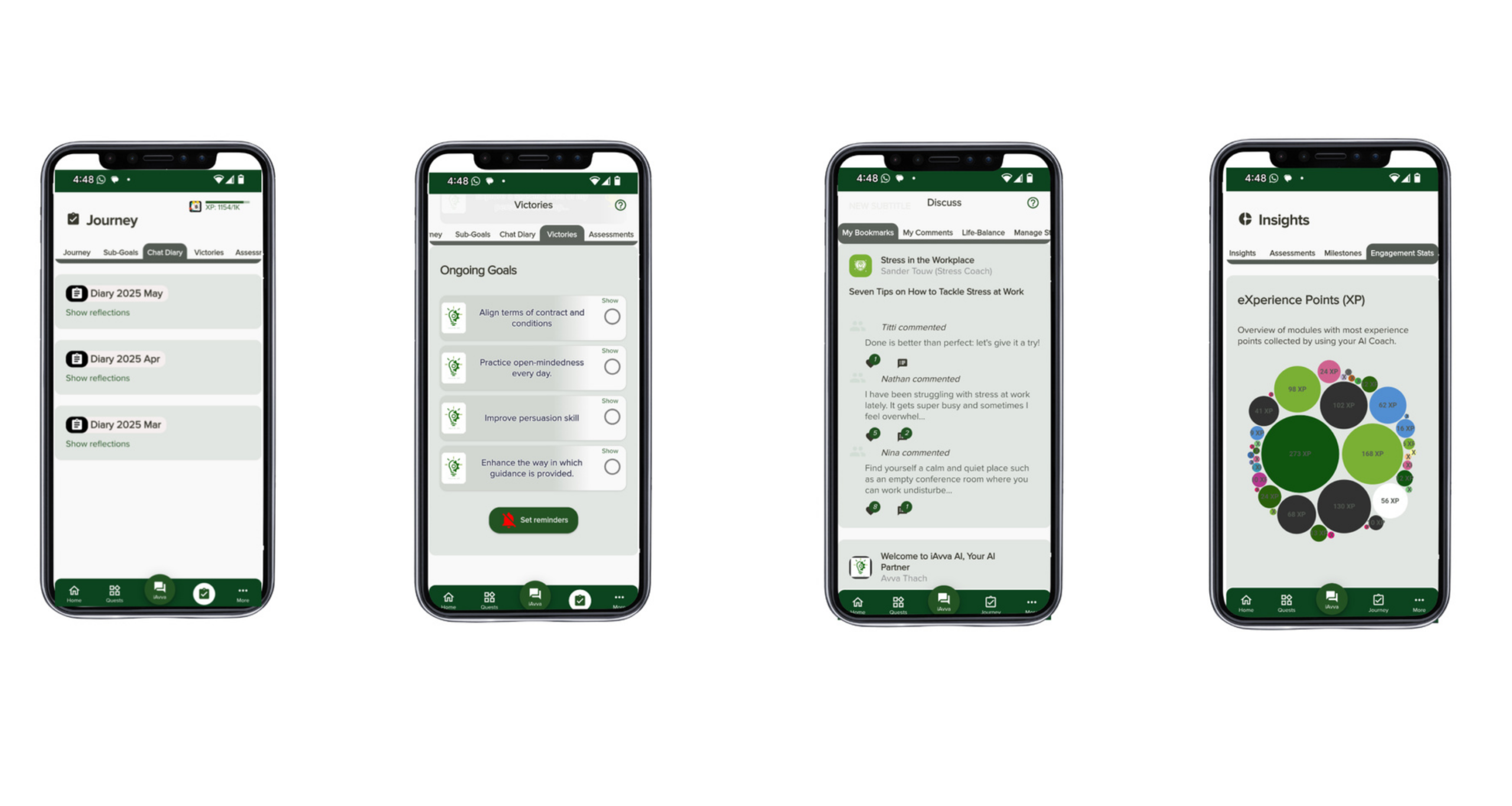
The iAvva AI Coach App is a five-minute, multilingual self-reflection companion available on web, iOS, and Android. It is built around principles from neuroscience, positive psychology, and ICF-aligned coaching, which means it nudges leaders to notice patterns, set intentions, and practice small, meaningful shifts every day rather than waiting for the next workshop.
This app does not replace human coaches. Instead, it functions as a steady ally between coaching sessions, leadership programs, and real-world challenges. Leaders can reflect in text or voice, choose languages that feel natural, and engage without needing long blocks of time. That makes it realistic for busy HR heads, CIOs, and managers responsible for AI initiatives.
In the context of AI process improvement, the iAvva AI Coach App acts as a bridge. While AI engines under the hood optimize workflows and predict issues, the coach app helps leaders optimize their own focus, communication, and decisions. This alignment keeps human capabilities growing at the same pace as the systems they oversee, rather than falling behind them.
Turning AI Process Improvement Into Daily Leadership Habits
Big AI programs often fail not because of the models, but because leaders’ day-to-day habits never change. iAvva AI addresses this by turning abstract ideas into simple daily questions that tie directly to AI process improvement work. A leader might reflect on:
- Moments when an AI insight challenged their assumptions
- How they talked about automation with their team
- Which process bottleneck they managed to remove that day
Over time, these reflections support habits of clarity, courage, and consistency. Clarity shows up in how leaders explain why a process is changing and what success looks like beyond just cost savings. Courage appears in decisions to pause or redesign an AI-enabled process when fairness or well-being concerns emerge. Consistency becomes visible when leaders keep engaging teams, asking for feedback, and following up on commitments.
These habits have practical effects. Adoption of AI tools improves because people trust the intent behind them. Psychological safety rises because employees see that questions and concerns are welcome. Problem-solving becomes more proactive, as leaders use AI signals as prompts for early action instead of waiting for crises. iAvva AI helps embed those patterns into the daily rhythm of leadership.
Strategic Alignment: From Personal Growth To Business OKRs
For CHROs, CIOs, and CFOs, development investments must connect to measurable outcomes. iAvva AI is designed with that expectation in mind. The platform maps personal development goals to organizational objectives and key results, so leaders see how their focus areas relate to process metrics, financial outcomes, and people measures.
Consider an objective such as “Reduce onboarding time-to-productivity by 30 percent.” Under that sit key results around process cycle time, new hire engagement, and early performance. With iAvva AI, leaders involved in onboarding can track reflections and habits tied to those results—frequency of meaningful one-on-ones, clarity of expectation-setting, responsiveness to early feedback. Over time, organizations can see how changes in leadership behavior correlate with movement in onboarding metrics.
HR and L&D teams gain access to real-time analytics dashboards that aggregate engagement with the app, dominant growth themes, and self-reported boosts in focus or productivity. Individual privacy stays protected, but the organization gains a powerful view of how leadership growth lines up with process performance, turning the human side of AI process improvement into something visible and manageable.
Inclusive, Secure, And Scalable For People-Centric Transformation
Any tool used for leadership reflection must respect differences and protect sensitive thoughts. iAvva AI is designed with neurodiversity-friendly features, such as both audio and text options, short daily interactions instead of long essays, and gentle nudges rather than pressure-heavy reminders. This allows more people—introverts, non-native speakers, leaders with busy or uneven schedules—to participate effectively.
Security and privacy are central. The platform follows GDPR-aligned practices and uses strong encryption, which is especially important when leaders are reflecting on live work challenges, people issues, and strategic concerns. At the same time, aggregated, anonymized analytics give HR and L&D teams enough insight to steer programs and understand patterns without breaching individual confidentiality.
Because the iAvva AI Coach App scales easily across levels, regions, and functions, it can become the human capability layer that rolls out alongside AI process improvement programs. When the organization upgrades its systems and workflows, it can upgrade leadership capacity at the same time, not years later.
Building An AI-Ready Culture: Governance, Skills, And Change Management
Technology, data, and models matter, but they do not decide how AI will shape an organization’s future. Culture, governance, and skills do. An AI-ready culture is not one that adopts every new tool. It is one that knows why it uses AI, where it draws red lines, and how it builds confidence and skills so people feel part of the change rather than targets of it.
HR, L&D, and IT leaders share responsibility for this environment. HR brings insight into people, values, and policies. L&D designs experiences that build literacy and judgment. CIOs manage data, platforms, and security. When they work as a coalition, AI process improvement becomes part of a broader people and technology strategy instead of a scattered set of pilots.
The work falls into three areas: data and governance, upskilling around AI literacy and judgment, and change management rooted in psychological safety.
Data, Governance, And Human-In-The-Loop Design
AI runs on data, and poor data leads to poor decisions. That means quality, integration, and access rights across HRIS, LMS, CRM, and ERP systems are not just IT concerns; they are leadership issues. Clear data ownership and standards help AI models learn from consistent, reliable sources instead of messy fragments.
Governance practices must spell out who owns each AI use case, how models are approved, and when they are reviewed. Processes should include documented escalation paths for unusual or risky cases and regular model performance checks that look at both accuracy and fairness. This turns AI from a black box into a managed component of the operating model.
Human-in-the-loop design is key. Some actions can safely run on auto-pilot, like updating a status field or sending a reminder. Others must always involve a person, particularly in hiring, promotion, pay changes, and sensitive customer or patient decisions. Writing these rules down and communicating them clearly reassures employees that AI supports, rather than silently replaces, human judgment in areas that touch their lives directly.
Upskilling Leaders For AI Literacy And Judgment
“AI literacy” for non-technical leaders does not mean learning to code. It means understanding, at a practical level, what AI can and cannot do, and how to work with it responsibly. Leaders should feel comfortable reading dashboards, asking why a model suggests a certain action, and explaining to employees how AI-informed decisions were made.
L&D teams can create blended programs that mix simple explanations of AI concepts with hands-on practice inside real tools. Case studies from the organization’s own processes—onboarding flows, service centers, training programs—make the learning feel grounded and relevant. Sessions on ethics and bias help leaders see not just the power, but the risks of misuse or over-reliance.
iAvva AI can reinforce this learning over time. Reflection prompts focused on AI literacy and ethical use help leaders process what they learned, notice where they feel unsure, and commit to clearer communication and better questions. That ongoing reinforcement turns one-time workshops into lasting improvements in judgment.
Change Management And Psychological Safety In An AI-First Organization
Every AI initiative is also a change initiative. Employees may fear job loss, feel watched, or worry that their work will be reduced to numbers. Ignoring these feelings slows adoption and can even push top talent toward more thoughtful employers.
Effective change management starts with honest communication about goals and guardrails. Leaders should explain why specific processes are being improved with AI, what benefits are expected, and how the organization will protect fairness and privacy. Co-designing new workflows with frontline staff—asking what slows them down and which steps feel pointless—helps people feel ownership instead of resistance.
Recognition matters too. Rewarding experimentation, learning, and honest feedback—not just quick results—signals that the organization values adaptation. Research in neuroscience shows that people handle uncertainty better when they feel safe, informed, and able to act. Psychological safety, clear messages, and room for input all accelerate healthy adoption of AI process improvement across the enterprise.
A Practical Roadmap: How You Can Start With AI Process Improvement Today
With so many tools and headlines, it is easy to feel stuck at the “where do we even begin?” stage. The most successful organizations follow a simple pattern: start small, learn fast, and scale with a clear structure. They pick targeted use cases, pair technology pilots with leadership development, and build a repeatable way to govern and grow.
HR, L&D, CIOs, and executives each have roles in this roadmap. HR identifies pain points in people processes. L&D designs leadership and skills programs around those changes. CIOs shape the tech and data foundation. Executives set priorities, sponsor pilots, and model behavior.
Step 1 – Discover And Prioritize High-Impact Use Cases
The first step is to choose where to apply AI process improvement. Good candidates share a few traits:
- They touch high volumes of work
- They cause noticeable pain for employees or customers
- They have clear metrics that matter to the business
- They have at least one strong senior sponsor
Common examples include the onboarding journey, where delays frustrate new hires and managers; the performance feedback process, which often feels heavy but underpowered; and leadership development workflows that lack clear connections to outcomes. Process mining and simple feedback analysis can help map the current state and reveal the biggest friction points.
Once a shortlist is in place, leaders can rank use cases by impact and feasibility. The aim is to pick something meaningful enough to matter, but contained enough to pilot without overwhelming the organization.
Step 2 – Pilot AI And Pair It With Leadership Development
With a use case selected, the next move is a controlled pilot. That could mean automating key steps in onboarding, using AI to route tasks more intelligently, or applying NLP to performance feedback and engagement comments. The design should include clear success measures such as cycle time, error rates, or satisfaction scores.
At the same time, the managers involved in that process should start a focused leadership development track using the iAvva AI Coach App. Their reflections can center on how they use new data, how they talk with teams about AI, and how they support employees through the shift. This pairing keeps the human and technical sides moving together.
During the pilot, organizations should track both process outcomes and human signals:
- Are cycle times and error rates improving?
- Are employees reporting more clarity or less frustration?
- Are leaders engaging with the coach app and adjusting their behaviors?
These insights guide adjustments and shape the case for wider rollout.
Step 3 – Scale, Govern, And Embed Continuous Improvement
If the pilot shows promise, scaling requires more than just copying the workflow to other teams. A cross-functional AI process improvement council with HR, L&D, IT, and operations can oversee expansion. This group sets standards for use-case selection, ethical review, and change support.
Playbooks help make scaling repeatable. They outline how to analyze a new process, how to engage employees in design, and how to connect leaders to iAvva AI as a standard support tool. They also embed measurement practices so that improvements in cycle time, quality, engagement, and retention are tracked and linked to leadership behaviors nurtured through the coach app.
Over time, AI process improvement becomes a normal part of how the organization runs, not a special initiative. Leaders get used to seeing AI-generated insights, reflecting on their own role, and adjusting in near real time. Culture shifts toward continuous learning, supported by technology and grounded in human values.
Conclusion
Picture that early feeling again: standing at the edge of a future where most people never read code, yet code and AI shape nearly every part of work. That future is arriving fast. AI systems write and tune the logic, while people interact at higher levels through natural language, dashboards, and assistants.
The central question is not whether AI will change work. It is what distinctly human work leaders will choose to own when AI runs more of the systems. This article has traced how AI process improvement extends Lean and Six Sigma, how it turns processes into living systems, and how it demands a new kind of leadership grounded in strategy, ethics, empathy, and change skills.
It has also shown that leadership development itself must become a measurable, AI-informed process. Leaders need support to think clearly about trade-offs, talk honestly about automation, and coach people into new roles. That is where iAvva AI comes in—bridging powerful AI systems and powerful human leaders with an AI Coach App that turns big shifts into small, daily actions.
If you are planning or already running AI initiatives—whether in onboarding, performance, service centers, or operations—the next logical step is to pair them with intentional leadership growth. Consider piloting iAvva AI alongside your next AI process improvement effort, perhaps with a key leadership cohort linked to a specific process. A short discovery conversation, a well-designed pilot, or integrating the iAvva AI Coach App into existing leadership programs can move your organization from watching the future to shaping it. In a world where humans no longer look at code, the leaders who invest in their own growth will define what that code is really for.
FAQs
Question: What Is AI Process Improvement, In Simple Terms?
AI process improvement is the use of AI to keep work getting better over time. AI watches how tasks and workflows actually happen, helps automate repetitive steps, and suggests smarter ways to route and organize work. It also spots patterns and predicts where problems may appear so that teams can act earlier. This approach is wider than basic automation, because it includes analytics, forecasting, and decision support, and it builds on, rather than replaces, traditional process excellence methods like Lean and Six Sigma.
Question: How Does The Idea That Humans Will Not Look At Code Affect HR And L&D?
If most employees interact with AI-powered tools instead of raw code, HR and L&D need to shift their development focus. Large-scale coding training becomes less important than building AI literacy, ethical judgment, and change leadership skills. People must understand how to work with AI systems, read insights, and question recommendations, not how to write the underlying code. This also means redesigning roles, competency models, and learning journeys so teams can thrive in an AI-first, low-code or no-code environment where human strengths center on strategy, relationships, and problem-solving.
Question: Can AI Process Improvement Be Used In Small And Mid-Sized Businesses, Or Is It Only For Large Enterprises?
AI process improvement is very accessible to small and mid-sized businesses because many HR, finance, and customer tools already have AI built in. SMBs can start with one or two important processes, such as invoicing, onboarding, or customer service, and use AI features to reduce delays and manual work. The key is to pick areas with clear measures and visible pain, involve employees in redesign, and support managers as they learn to work with new insights. In smaller organizations, leadership behavior and culture play an even bigger role in whether AI changes stick.
Question: Where Does iAvva AI Fit If We Already Have Process Mining Or Automation Tools?
Existing tools such as process mining platforms, RPA, and analytics focus on optimizing workflows and systems. iAvva AI focuses on optimizing leaders and their behaviors in that environment. It sits on top of your current tech stack as a human-centered layer, helping managers use insights well, communicate clearly about change, and build habits that support adoption and culture. By tying daily reflection and growth to OKRs and process metrics, iAvva AI helps you get more long-term value from the AI and automation investments you already made.
Related reading: See how human-in-the-loop AI improves trust and outcomes, why AI strategy at work matters, and how AI implementation turns ideas into results.












Leave a Reply