




Introduction: Why AI Fluency Becomes Non‑Negotiable By 2026
Picture opening your laptop in 2026. Every app quietly asks how it can help. Email drafts itself, meetings summarize while they happen, HR systems suggest talent moves before anyone asks, and leadership dashboards surface insights that once took weeks. In that world, AI fluency is no longer a nice extra. It is the difference between steering the ship and being dragged by the current.
When I talk about AI fluency, I do not mean knowing a few prompts or trying the latest chatbot on a slow Friday. Research such as (PDF) A Study on Artificial Intelligence Assisted Language Learning Tools demonstrates how AI-augmented skills are becoming measurable workplace competencies rather than optional experiments. I mean a practical ability to understand what AI can and cannot do, to work with it responsibly, and to weave it into real work. It sits between “I watched an AI webinar once” and “I build models for a living.” It is closer to how we treated digital literacy and data literacy a decade ago: a baseline skill leaders and teams must have to stay effective.
AI fluency is not about turning HR, L&D, or finance into data science teams. It is not coding, it is not a one‑time AI 101 session, and it is not collecting random “prompt hacks” in a slide deck no one opens. It is a structured capability that shows up in daily behavior: how leaders frame problems for AI, how teams check AI outputs, and how they protect people, data, and the business while moving faster.
By 2026, organizations that build AI fluency will see clear gains in speed, quality, and engagement. Their leaders will use copilots to think through strategy, coach their teams, and communicate with clarity. Their HR and L&D teams will design role‑based AI training and link it to real outcomes. Those that ignore AI fluency will face something harsher: stalled productivity, frustrated talent leaving for AI‑ready employers, and rising risk from shadow AI and unreviewed AI‑generated decisions.
This is exactly where iAvva AI comes in. The iAvva AI Coach App connects daily leadership habits with AI‑era skills. It turns vague “we should be more AI ready” goals into concrete reflections, micro‑behaviors, and analytics that tie growth to OKRs and business results.
In this article, I walk through what AI fluency really means, why 2026 is the tipping point, how the 4D framework makes AI collaboration practical, and how to turn all of this into a roadmap. Along the way, I show how tools like iAvva AI can make AI fluency and leadership growth a daily, trackable practice rather than another forgotten program.
“AI won’t replace managers, but managers who can’t work with AI will be replaced by those who can.”
Key Takeaways
- By 2026, AI fluency will sit beside digital literacy as a fundamental leadership and workforce skill. Without it, AI investments will stall and shadow AI will grow.
- AI fluency is a structured skillset that combines conceptual understanding, practical collaboration with AI (using the 4D framework), ethical judgment, and everyday productivity behaviors.
- The biggest risk is not AI itself, but untrained, ungoverned use—especially for hiring, performance, compensation, and customer‑facing work where errors and bias hit hardest.
- HR, L&D, IT, and senior leaders need to co‑design AI fluency programs that are continuous, inclusive, and measurable, rather than one‑off “AI awareness” sessions.
- Platforms like the iAvva AI Coach App make AI fluency and leadership habits daily, trackable, and scalable by turning five‑minute reflections into behavior change and business‑aligned analytics.
- In the rest of this article, I define AI fluency in plain language, explain why 2026 is an inflection point, and offer a practical roadmap with clear phases, metrics, and examples to build AI fluency across a global workforce.
What Is AI Fluency And Why It’s Different From “Knowing AI Tools”
When I talk with executives about AI fluency, I frame it in simple business terms. AI fluency is the ability of people across the organization to understand, evaluate, and collaborate with AI systems in ways that are effective, safe, and aligned with strategy. It is not a technical badge; it is a work habit. Someone who is AI‑fluent can look at a task, decide where AI fits, give it clear instructions, check the output with a critical eye, and log what was done for future learning and accountability.
AI fluency sits between basic awareness and deep technical expertise. On one side, there are people who know AI exists and may have tried a chatbot once. On the other side, there are engineers who design models and infrastructure. AI‑fluent leaders and teams live in the middle. They know enough about AI, data, and generative models to use them wisely, but they do not write code or tune neural networks. Their strength is knowing what to ask for, how to check it, and when human judgment needs to override the machine.
Several components make up real AI fluency:
- A conceptual layer: understanding what AI, machine learning, generative AI, and reasoning engines are at a high level.
- A practical layer: interaction skills captured in the 4D framework—Delegation, Description, Discernment, and Diligence.
- A judgment layer: the ability to see ethical, legal, and human impacts, especially in HR and leadership situations.
- A habit layer: using AI across the day, not just in one‑off “experiments,” and building routines around it.
AI fluency is very different from surface‑level activities many companies are doing now. It is not a single AI workshop given during an all‑hands week. It is not handing staff a “prompt cheat sheet” without also teaching them how to question outputs or protect data. It is not letting a few power users experiment in isolation while the rest of the organization watches from the sidelines. Those patterns keep AI as a side project instead of a core capability.
A more helpful way to think about AI fluency is to treat it like leadership training or Lean Six Sigma. Exploring the impact of artificial intelligence on English language teaching: A meta-analysis shows that systematic AI training produces measurable improvements in both performance and confidence across diverse learner populations. It can be taught with clear models, practiced in real work, measured through behaviors and outcomes, and improved with reflection and coaching. That is why tools like iAvva AI, which support mindsets and habits through daily prompts and analytics, fit so well alongside AI tool rollouts and policy work.
As Peter Drucker famously said, “What gets measured gets managed.” AI fluency has to move from slogans to observable behaviors that can be coached and tracked.
Why 2026 Is The Tipping Point For AI Fluency In Organizations
The reason 2026 matters is not a date in a slide deck; it is the point where several trends converge. The first is the technology curve. By 2026, copilots and reasoning engines will be native parts of Microsoft 365, Google Workspace, major HRIS platforms, learning systems, and CRMs. Instead of “going to an AI tool,” people will simply type into Outlook, Teams, or their HR platform and find AI already woven into every button and field. When AI becomes the default interface, AI fluency stops being a nice specialty and becomes a basic expectation.
Second, competitive dynamics will make gaps obvious. Companies that invest in AI tools and AI fluency will run projects faster, write better content, and make decisions with more context. Their people will use AI to summarize meetings, analyze customer feedback, and adapt communication for different groups. Their cost per unit of work will drop. Their time to insight will shrink. Competitors who only buy licenses without building AI fluency will see uneven use, disappointed sponsors, and boards asking hard questions about wasted spend.
The talent market adds another push. High‑performing professionals are already choosing employers that provide AI‑augmented environments and clear learning paths. By 2026, candidates will treat AI fluency support the way they currently treat flexible work or learning budgets. They will ask how your company is using AI, how you train managers and teams, and how you protect employees from unfair automated decisions. Employers that cannot answer these questions will watch their best people leave for organizations that can.
Regulation is also tightening. The EU AI Act, US guidance, and sector‑specific rules are moving from draft to enforcement. They pay special attention to AI use in hiring, performance management, compensation, credit, health, and safety. Boards and regulators will not accept “we did not know the AI did that” as a defense. Leaders will need AI fluency to understand where AI is in their processes, how it is reviewed, and how to prove that humans remain accountable.
Without an AI fluency strategy, internal risks grow fast:
- Shadow AI appears when teams use unapproved tools and paste sensitive data into consumer apps.
- Adoption becomes fragmented: some groups power ahead while others opt out, creating cultural divides between AI “haves” and “have‑nots.”
- Design teams may use AI to speed content, while HR hesitates; sales may sprint ahead while compliance panics after the first public mistake.
By 2026, this unevenness does not just feel messy—it shows up in the P&L, retention numbers, legal exposure, and brand trust.
In simple terms, 2024–2025 is the build window. These are the years to clean up data, set policies, choose platforms, and start AI fluency training. By 2026, the organizations that used this time well will operate with AI‑ready leaders and teams. Those that did not will be racing to catch up under much more pressure and scrutiny.
The Four Dimensions Of AI Fluency: A Practical 4D Framework
To move AI fluency from theory into practice, I find the 4D framework very helpful. It describes four dimensions of working with AI in daily work: Delegation, Description, Discernment, and Diligence. These are not abstract ideas; they show up in the way a manager writes a prompt, how a recruiter checks an AI‑generated shortlist, or how a CLO designs a program.
The strength of this model is that it gives HR, L&D, IT, and leaders a shared language. Instead of saying “people need better prompts,” we can say, “our Description skills are weak; we need templates and examples.” Instead of blaming tools when something goes wrong, we can ask, “where did Delegation, Discernment, or Diligence break down?” That clarity makes training, coaching, and policies much more concrete.
Delegation: Deciding What To Hand Over To AI
Delegation is about choosing which parts of a task AI should handle and which must remain in human hands. When I delegate well, I treat AI as a junior partner: I give it work that is safe to draft or analyze, and I keep judgment, context, and accountability with myself. When Delegation is poor, people either offload too much (letting AI decide sensitive issues) or too little (refusing help and wasting time).
For HR, L&D, and managers, good Delegation often means using AI for first drafts and analysis:
- An HR Director can ask AI to summarize engagement survey comments by theme, generate a first version of a job description, or outline a training program.
- A CLO can ask for draft case studies or regional adaptations of a course.
- A people manager can have AI turn raw notes into a structured development plan.
All of these are reversible and easy to review.
Some tasks should stay firmly with humans. Final promotion and termination decisions, complex employee relations cases, and sensitive messages such as layoff letters require human values, empathy, and legal review. AI can suggest structure or language, but leaders must stay responsible for the final call. The same goes for actions with heavy legal or safety impact; AI may help research options, but not make final decisions.
When Delegation is thoughtful, the productivity payoff is clear. Time to first draft shrinks, hours spent on formatting and basic analysis drop, and people can repurpose that time into coaching, problem‑solving, and stakeholder work. That is the heart of AI fluency: using AI to clear routine work so that humans focus on the parts of leadership that only humans can do.
Description: Communicating Clearly With AI (Prompting With Purpose)
Description is how I tell AI what I need. Many people treat prompting as guesswork or magic words. In practice, it is simply structured communication. When I share the right role, context, goal, constraints, input, and audience, AI has a much better chance of giving me a helpful answer. When I skip those pieces, the output feels vague or off‑target, and AI wrongly gets the blame.
Consider an HR Director designing an AI fluency curriculum. A clear Description could sound like this in a prompt:
“You are an L&D strategist helping me design a six‑month AI fluency program for HR, L&D, and IT leaders in a US‑based company with 1,500 employees. Our goal is to build practical skills around Delegation, Description, Discernment, and Diligence. Propose a phased curriculum with modules, sample exercises, and assessment ideas, in under 800 words.”
Here, the role, context, goal, and constraints are all clear.
A CLO creating a leadership microlearning series might say:
- “Act as a leadership coach. I need a 10‑part microlearning sequence for frontline managers on working with AI as a team member. Each part should take under 10 minutes and include a short concept, a reflection question, and a workplace exercise. Keep the language simple and suitable for an 8th‑grade reading level.”
An IT Manager writing AI guidelines might specify:
- “Draft an FAQ for employees explaining which AI tools are approved, how we classify data, and what they should never paste into an AI tool. Aim for one page, clear headings, and friendly tone.”
Description is not a one‑shot event. AI‑fluent teams use iterative prompting, which sits inside the Description–Discernment loop. I look at the first output, decide what is missing or off, update my Description, and ask again. Over time, teams can codify good Descriptions into internal templates and prompt libraries: reusable patterns that anyone can adapt. That is how Description moves from individual skill to organizational asset.
Discernment: Critically Evaluating AI Output
Discernment is the muscle that turns AI from a risky shortcut into a real collaborator. It is the habit of reading AI output with a skeptical but open mind. Instead of assuming “if the copilot wrote it, it must be right,” an AI‑fluent leader asks whether it is accurate, relevant, and aligned with policy and values. In effect, Discernment is quality control.
A simple mental checklist helps. I ask:
- Is this accurate and current, or could the model’s training data be out of date?
- Does this match our internal policies, local laws, and culture?
- Who could be hurt or disadvantaged if this output is wrong or biased?
- If I would not sign my name under this text, should it be sent or published at all?
There are practical techniques to support Discernment. I can cross‑check key claims against internal documents or trusted external sources. I can ask AI to explain its reasoning step by step, to list assumptions, or to present alternative viewpoints. I can even ask it to critique its own answer for risk, diversity, and inclusion issues. This helps expose hidden gaps or narrow perspectives that might not be obvious at first glance.
Discernment matters most where people are affected. Automated shortlist generation for hiring, AI‑drafted performance feedback, or AI‑suggested pay ranges can all cause harm if leaders accept them uncritically. AI‑fluent managers treat these outputs as drafts or hints, not as final decisions. They use Discernment to check fairness, adjust for context, and document why they accepted or rejected certain suggestions.
Diligence: Keeping AI Use Safe, Ethical, And Sustainable
Diligence is the long‑term habit of using AI responsibly. Where Discernment looks at a single answer, Diligence looks at patterns over time. It means following AI usage policies, sticking to approved tools, documenting AI’s role in important work, and speaking up when something seems wrong. It is the guardrail that keeps AI helpful rather than harmful.
In practice, Diligence starts with policy adherence:
- Use AI through the tools IT and security have approved, not random consumer apps.
- Follow data rules: avoid pasting personal, health, or financial information into general‑purpose models unless they are explicitly set up for that use.
- Remember that screenshots and exports can leak sensitive context just as easily as plain text.
- For high‑risk work, such as performance decisions or regulatory filings, make sure a human review step is built in.
Diligence also includes documentation and reporting. When AI contributes to a major policy, presentation, or people decision, I note that fact. This can be as simple as a comment or a short log. If AI produces biased, unsafe, or clearly inaccurate outputs, I do not just fix it quietly—I report it through agreed channels so patterns can be spotted and tools or policies adjusted.
This dimension becomes more important as new risks appear. Deepfakes, copyright questions in generated content, and misuse of personally identifiable information are no longer edge cases. Organizations need leaders and employees who see these risks, know how to respond, and stay up to date as laws and tools change. That is why Diligence belongs in leadership competency models and performance expectations, not just in a policy document.
Beyond Hype: What AI Fluency Actually Looks Like In Daily Work
To make AI fluency real, I like to walk through “day in the life” examples. One pattern I see in AI‑fluent organizations is that people do not just “check in with AI once a week.” Instead, they weave AI across the full cycle of work: ideation, analysis, drafting, review, and reflection. The difference in both speed and learning is substantial.
Take an HR Director. In an AI‑fluent day, they:
- Ask AI to summarize the last three years of engagement surveys, pull out top themes by location, and propose three focus areas.
- Request a draft communication plan and potential employee questions, then refine these with their own knowledge of culture and history.
- Before a policy rollout, use AI to simulate potential reactions from different employee personas, using those insights to adjust messaging and manager toolkits.
A CLO or L&D leader uses AI to design blended learning paths:
- Ask AI to outline a manager course on AI‑ready leadership, suggest case studies for different industries, and generate quiz questions.
- When rolling the program out globally, have AI propose localized examples and adjust language for different regions, which local partners then review.
For a C‑suite leader in an SMB, AI fluency appears in strategic work:
- Use a copilot to scan recent market reports, extract signals on customer behavior, and compare competitors’ moves.
- Before a board meeting, ask AI to stress‑test their plan from the view of a skeptical CFO or risk officer.
- When writing a message to employees, have AI produce versions for different audiences—frontline staff, managers, and external partners—and then adjust tone and emphasis.
An IT Manager practicing AI fluency may:
- Use AI to draft AI policy FAQs, explain the technical architecture of new tools in plain language, and summarize vendor proposals into comparable tables.
- Ask AI to outline a change management plan that HR and communications can refine.
- For complex projects, use AI to prototype documentation and run initial risk lists before final expert review.
People managers—often the forgotten middle—benefit greatly from AI‑fluent habits:
- Before feedback talks, they ask AI to help structure the conversation, turning scattered notes into clear examples and coaching questions.
- When sending a message to a struggling but valued employee, they use AI to suggest phrasing that is honest and supportive, then adapt it with their own voice.
- For development plans, they ask AI to propose stretch assignments and learning resources aligned with both company needs and employee goals.
Across these roles, AI fluency speeds up the “zero‑to‑first‑draft” step, deepens cross‑functional collaboration (through shared prompts and patterns), and raises the baseline quality of communication and learning content. The last step many teams miss is reflection: asking, “How did AI help here? Where did I over‑ or under‑rely on it? What would I change next time?”
This is where a tool like the iAvva AI Coach App adds real value, by turning those reflections into a daily habit supported by prompts and analytics.
Why AI Fluency Is Now A Core Leadership Competency
Leadership work is changing in quiet but profound ways. When anyone in the company can ask a copilot to summarize research, draft a plan, or analyze comments, leaders no longer stand out mainly for holding information. Their value shifts to how they combine human judgment, team input, and AI insights to make better decisions and build trust. That is why I now treat AI fluency as a core leadership competency, not a side interest.
AI‑fluent leaders develop new micro‑skills:
- They use AI to explore multiple perspectives before they commit to a path.
- Faced with a major decision, they might ask AI to outline the view of a risk officer, a front‑line employee, a union leader, and a skeptical customer.
- They use AI to stress‑test assumptions instead of only asking their closest advisors.
At the same time, they do not abdicate responsibility. They are clear that AI is a tool, not the decision‑maker.
These leaders also model ethical and transparent AI use. They explain when AI helped prepare a draft and when humans stepped in to review. They talk openly about hallucinations and bias, and they show how they apply Discernment and Diligence. When mistakes happen—and they will—they use them as learning moments: reviewing what went wrong in Delegation, Description, or Discernment instead of blaming a person or a tool alone.
Coaching employees on when and how to use AI becomes a regular leadership task. Instead of saying either “use AI for everything” or “do not use AI at all,” AI‑fluent leaders guide their teams. They help teammates spot safe starting points—idea generation, first drafts, document summaries—and high‑risk areas that need stronger review. They ask to see both prompts and outputs when reviewing work, so they can coach on the full Description–Discernment loop.
All of this needs to show up in leadership frameworks. Competencies such as “Leads confidently in an AI‑first environment” can be broken into behaviors:
- Regularly uses AI to explore options before big decisions.
- Transparently documents AI’s contribution.
- Supports team learning with AI.
- Applies the 4D framework in their own work.
This makes AI fluency visible in performance reviews and development plans.
Culturally, AI‑fluent leaders are key in lowering fear and resistance. They do not talk about AI as a threat to jobs; they talk about AI as help for tasks and a reason to invest in new skills. They support reskilling and advocate for AI for all, not for a small group. They work with HR, L&D, and IT to roll out tools and training in ways that feel fair and accessible. If leadership does not move first, AI fluency initiatives often stall or look inconsistent.
“The function of leadership is to produce more leaders, not more followers,” wrote Ralph Nader. In the AI era, that includes producing leaders who can think and act with AI, not just around it.
The Hidden Risks Of Lacking AI Fluency By 2026
When organizations delay AI fluency, the risks show up in many corners of the business. The first is strategic risk. Leaders who do not understand AI well tend to swing between two extremes: over‑investing in shiny tools without clear use cases, or under‑investing because they hope the trend will pass. Both paths are costly. In the first case, money goes into licenses, pilots, and vendors, but employees lack skills and governance to use them well. In the second, competitors quietly push ahead, and by the time leadership reacts, the gap is wide.
Operational risk grows next. Without shared fluency, AI usage is patchy and unpredictable:
- One recruiter may use AI heavily for candidate screening, another may ignore it, and a third may experiment privately with unapproved tools.
- Content quality fluctuates because some teams use copilots for drafts and checks, while others do not.
- Compliance teams struggle to track where AI is involved in decisions, and no one has a clear map.
People and culture risks are easy to overlook. When employees do not feel supported in learning AI, they often split into two camps. Some give up and wait for instructions, which slows transformation. Others try to self‑teach at night, bouncing between tutorials and tools, risking burnout and inconsistent practices. Without fair access to tools and training, there is a real sense of “AI insiders” and “everyone else,” which erodes trust. Shadow AI—where staff quietly paste sensitive information into public tools—becomes standard.
Reputational risk is also real. An AI‑generated marketing email with factual errors, a policy that misses local legal details, or a chatbot that gives biased answers can damage trust with customers and employees. In HR, an AI‑drafted performance review that uses clumsy or biased language can lead to grievances or worse. Without AI fluency, people may not even know an output is risky before it goes live.
Mini‑scenarios make these risks clearer:
- A regional HR leader asks a general chatbot to write a maternity leave policy, then posts it with minimal review. The policy looks polished but misses a state requirement, leading to a complaint.
- A hiring team uses AI to propose candidate shortlists. If no one checks the logic, it might favor certain schools or backgrounds, entrenching bias.
In both situations, the problem is not “AI is bad,” but “AI fluency and governance were missing.”
By 2026, as AI weaves deeper into systems and workflows, AI fluency becomes the main control layer between raw model power and responsible, high‑quality outcomes. Without it, the organization is effectively driving a faster car with weaker brakes and foggier windows. With it, leaders have gauges, guardrails, and a shared way to talk about what is safe, what is not, and how to improve.
How iAvva AI Helps Organizations Build AI Fluency And Leadership Readiness For 2026
To turn AI fluency from a slide into behavior, organizations need more than content. They need a way to weave reflection, practice, and measurement into daily work. This is where iAvva AI is designed to help. Instead of being just another learning portal, it acts as an AI‑era leadership companion that supports habits central to Delegation, Discernment, and Diligence—and connects them to business outcomes and OKRs.
IAvva AI Coach App: Always‑On Fluency And Leadership Companion
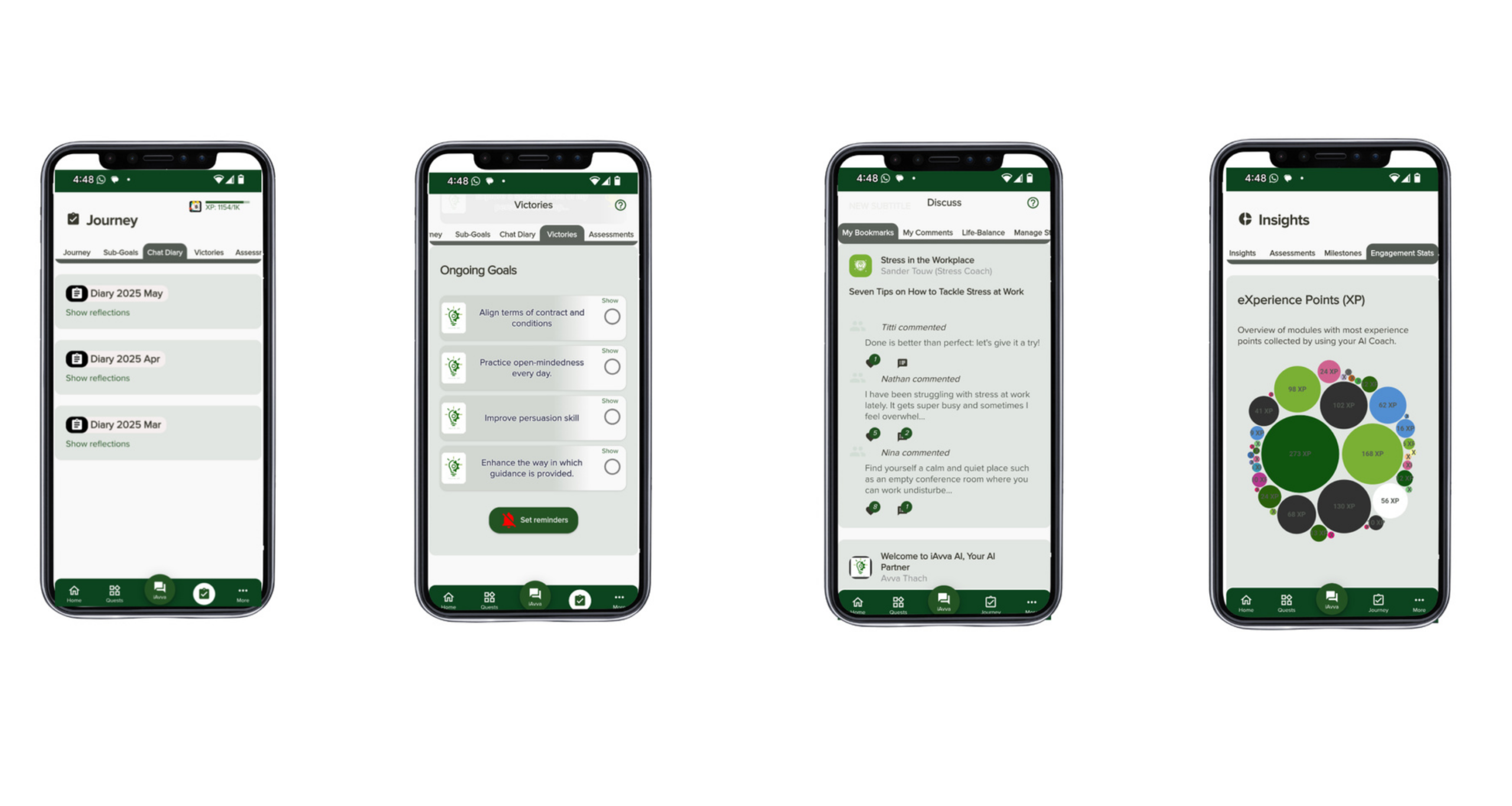
The iAvva AI Coach App is built as a five‑minute, multilingual self‑reflection experience that runs on Web, iOS, and Android. Each day, leaders and professionals receive short prompts rooted in neuroscience, positive psychology, and ICF coaching principles. The goal is not to flood them with theory, but to nudge small, repeatable actions and reflections that add up over time.
This design supports AI fluency in a subtle but powerful way. Many of the behaviors needed to use AI well—focus, self‑awareness, ethical reflection, and clear decision‑making—are the same behaviors good coaches work on with leaders. Through daily prompts, the app helps leaders notice when they used AI in their work, how they delegated tasks, whether they checked outputs carefully, and what they might do differently next time. This reflection reinforces the 4D framework without adding heavy training hours.
The app does not replace human coaching or existing leadership programs; it amplifies them. A leadership cohort can, for example, go through an AI fluency workshop and then use iAvva AI to keep that learning active across the following months. Instead of a one‑off spike of inspiration, you get steady, guided practice. Over time, that is what shifts culture: not a single event, but consistent, supported reflection on how leaders think and act.
Strategic Alignment: Linking AI Fluency To Business OKRs
One of the strongest aspects of iAvva AI is how it links individual leadership growth with organizational objectives. Inside the platform, leaders can connect their personal development goals to business OKRs, including AI transformation goals. This means AI fluency is not just a personal interest; it becomes part of how the organization tracks progress.
For example:
- An HR Director might set a personal goal around responsible AI use in recruiting and tie it to a company‑level objective of fair, data‑informed talent decisions. Their daily reflections might focus on how they delegate to AI in screening, how they check for bias, and how they communicate AI use to candidates.
- A CLO might align AI fluency training goals to outcomes such as faster time‑to‑productivity for new managers or a measured increase in AI‑assisted workflows across learning teams.
For executives, this alignment solves a common problem: leadership development often feels disconnected from strategy. With iAvva AI, growth in AI‑era behaviors—such as thoughtful Delegation and careful Discernment—can be tied directly to OKRs on productivity, quality, and risk reduction. Leaders are not just “getting better” in the abstract; they are supporting a clear AI strategy the board can see.
Inclusive, Secure, And Scalable AI Fluency At Global Scale
AI fluency must be accessible to everyone, not just to a few leaders at headquarters. iAvva AI is built with this in mind. It offers support in 19 languages and a neurodiversity‑friendly experience, with both audio and text options and an interface that works across devices. This allows people in different regions, roles, and learning preferences to engage in ways that fit them.
Security and privacy matter deeply when you coach leaders and ask them to reflect on decisions. The platform follows GDPR principles, uses encryption, and applies privacy‑by‑design practices that meet enterprise expectations. For IT and compliance teams, this reduces friction: they are not being asked to approve a consumer app, but a platform that treats data seriously.
Because of this inclusive and secure design, organizations can roll out AI‑era leadership development at scale. A global People Operations team can give managers in multiple countries the same core experience, adjusted for language and context, and know that data control and privacy are handled. That is a big step toward fair access to AI fluency and leadership support, instead of leaving some regions under‑served.
Measurement And Analytics: Making AI Fluency Visible And Actionable
Finally, iAvva AI brings one thing many leadership and AI fluency programs lack: clear analytics. The platform offers real‑time dashboards for HR, L&D, and People Ops teams, showing engagement, reflection patterns, and indicators of leadership growth. This moves AI‑era leadership from “we hope people are changing” to “we can see how habits are forming.”
Data from the app can highlight which teams are building strong AI‑collaboration habits, aligned with the 4D framework. For instance, reflection themes may show that a certain department is regularly thinking about Delegation and Discernment, while another rarely mentions AI in their work. That insight lets HR and L&D target extra support where it is most needed.
Metrics can include:
- Changes in self‑reported confidence using AI.
- Frequency of reflections about AI‑assisted decisions.
- Links between reflection habits and productivity gains measured elsewhere.
Over time, organizations can correlate leadership behavior signals from iAvva AI with business metrics such as project cycle times, error rates in AI‑augmented processes, or engagement survey results. That level of visibility helps leaders prove the value of AI fluency investments in board‑room terms.
Building An AI Fluency Roadmap For 2024–2026
Turning AI fluency into reality calls for a structured roadmap, not scattered experiments. I like to frame this as a four‑phase plan spanning 2024 to 2026. HR, L&D, IT, and senior leaders each have clear roles in every phase, and tools like iAvva AI support continuity between them.
Phase 1 (0–3 Months): Foundations, Policies, And Leadership Buy‑In
The first phase lays the ground. I start by mapping current AI use:
- Which tools are in play.
- Where shadow AI appears.
- What skills exist and where gaps are most visible.
This might involve short surveys, interviews, and a quick systems inventory. The aim is not a months‑long study, but a practical map that shows where to focus.
Next, I bring Legal, IT, HR, and DEI together to define or refine AI principles and usage policies. We agree on which AI tools are approved, what kinds of data can be used where, and where human review is mandatory. We capture simple, concrete “do and do not” examples rather than long theoretical texts. These principles become the backbone of Diligence.
In parallel, I schedule short, focused AI fluency briefings for the C‑suite and HR/L&D leaders. These sessions explain AI capabilities and limits, the 4D framework, and early case studies relevant to the business. The goal is that senior leaders understand enough to sponsor the work, not to turn them into experts. I then use this momentum to secure explicit sponsorship for a multi‑year AI fluency roadmap tied to clear business outcomes.
Phase 2 (3–9 Months): Role‑Based Enablement And Practical Skills
With foundations set, phase two shifts from awareness to hands‑on skills. I work with L&D to design role‑specific content: AI for HR, AI for L&D, AI for IT, AI for people managers, and so on. Each module focuses on the 4D framework, effective prompting, and real workflows. Sessions include practice with actual tools and actual documents, not toy examples.
At the same time, IT enables AI features in core tools such as Microsoft 365, HRIS copilots, and LMS assistants, in line with policy. We ensure identity and access controls match data rules. Employees learn not only what is possible, but also which tools to trust with which tasks.
Communities of practice and an “AI champion” network help sustain learning. Early adopters in each function share prompts, workflows, and stories of both success and failure. Platforms like iAvva AI come into play here as well, providing daily reflection prompts that reinforce the skills and mindsets from workshops and help leaders look at how they are using AI in day‑to‑day decisions.
Phase 3 (6–18 Months): Integrated Leadership Development And Culture Change
Phase three moves AI fluency into the core of leadership development and culture. I work with HR and business leaders to update leadership competency models so AI fluency and responsible AI collaboration appear clearly. Behavioral indicators might mention the 4D framework, transparent use of AI, and support for team learning.
Manager and leadership programs are then redesigned. New cohorts experience AI‑enabled simulations and case studies where AI is part of the scenario. Assignments require participants to use AI to draft, analyze, or plan, and then reflect on what happened across Delegation, Description, Discernment, and Diligence. This turns AI from theory into lived practice within leadership courses.
Tools like iAvva AI become daily companions in this phase. Leaders receive regular prompts that encourage them to reflect on recent AI‑assisted decisions, their emotional reactions to AI, and the ethical trade‑offs they see. Aggregated insights from these reflections help HR and L&D see where leaders feel confident and where they feel stuck, guiding updates to programs and communications.
Phase 4 (12+ Months): Continuous Improvement, Innovation, And ROI
In the final phase, AI fluency stops being a project and becomes part of “how we run the company.” I help leadership teams set up regular reviews of AI fluency metrics and business impact. These reviews look at productivity gains, quality improvements, risk incidents, and engagement signals. Where data is missing, we adjust measurement plans.
Curricula and policies evolve as tools and regulations change. New modules launch for emerging topics such as deepfake awareness, updated local regulation, or new platform features. Old content is refreshed rather than left to age. Innovation events—such as internal “AI days” or challenges where teams improve real workflows with AI—keep energy high while staying within guardrails.
Finally, once internal AI fluency is in good shape, organizations may extend it to partners, contractors, or even customers where relevant. At that point, AI fluency is not just an internal capability; it becomes part of the organization’s broader value network. Throughout, platforms like iAvva AI keep leadership habits, reflection, and measurement steady, so the human side of AI keeps up with the technical side.
Measuring AI Fluency And Proving Business Impact By 2026
Boards and C‑suite leaders will rightly ask, “How do we know AI fluency programs work?” To answer this, I look at AI fluency through four measurement lenses: knowledge, skills, behavior, and ethics/compliance. Each lens has its own metrics, and together they tell a story about both learning and impact.
- Knowledge is the easiest to assess. Short quizzes and scenario questions can test understanding of basic AI concepts, the 4D framework, data rules, and responsible use principles. This shows whether people grasp the language and ideas.
- Skills measurement goes further: it looks at how well people apply the 4D framework in practice. This can be done through simulations, graded prompts, or exercises where participants must design a safe AI‑assisted workflow for a given case.
- Behavioral measurement tracks how often and how deeply people use AI in real work. Tool analytics can show usage frequency, types of tasks, and diversity of use cases, as long as privacy is respected. For example, you might see that a sales team uses AI mainly for email drafting, while an HR team uses it for policy summaries and survey analysis. Over time, you want to see not just more use, but more varied and thoughtful use that aligns with policy.
- Ethics and compliance metrics look at adherence to AI policies and incident rates. You can track the number and severity of AI‑related issues: data leakage cases, biased outputs caught in review, or public content errors. You might also run periodic audits on high‑risk processes, such as hiring or performance reviews, to check how AI is involved and whether human review steps are in place and documented.
On the business side, I track productivity, quality, innovation, and talent:
- Productivity metrics include time saved on core activities—documentation, analysis, communication—and shorter project cycles.
- Quality metrics include manager ratings of AI‑supported outputs, error rates in AI‑augmented processes, and consistency of communication.
- Innovation can be measured by the number and effect of AI‑enabled initiatives or process improvements.
- Talent metrics include engagement survey items about AI readiness, perceived support for learning, and retention of key roles.
Strong measurement often starts with pilots. One group receives AI fluency training plus access to selected tools; a similar group does not. Over several months, you compare differences in time to complete key tasks, error rates, satisfaction, and engagement. This before‑and‑after, side‑by‑side view makes it easier to show ROI to a board.
Platforms like iAvva AI add a layer of behavioral insight that standard tools rarely capture. Reflection data can show how often leaders think about AI in their decisions, what dilemmas they face, and which parts of the 4D framework they find hardest. When those patterns are linked (in aggregate) to business data such as project outcomes or engagement scores, you get a richer picture of AI‑era leadership growth. Transparent communication with employees about what is measured and why is key here, so trust stays high.
“You can’t manage what you don’t measure,” as W. Edwards Deming emphasized. AI fluency deserves the same discipline you already apply to quality and safety.
Conclusion
AI fluency is no longer a side hobby for tech enthusiasts; by 2026, it is a foundational capability, especially for leaders. It shapes how strategy is made, how people decisions are taken, how risk is managed, and how everyday work gets done. In a world where copilots live inside every major tool, not understanding how to work with AI will feel as limiting as not knowing how to use email once did.
The reasons to act before 2026 are clear. AI features are becoming standard across productivity, HR, and learning systems. Competitors that combine tools with fluency will move faster and with more confidence. Talent will gravitate toward employers that support AI‑ready careers. Regulators are sharpening their focus on AI in hiring, performance, and customer treatment. Delay does not keep you safe; it simply leaves you less prepared.
The good news is that AI fluency is teachable and measurable. With the 4D framework, organizations can describe the behaviors they want, coach toward them, and measure progress. With a structured roadmap, they can move from policies and awareness to role‑based skills, leadership integration, and continuous improvement. The missing piece for many is a way to keep this alive in daily work, where real habits form.
That is where iAvva AI fits. For HR and CLOs, it offers a practical way to turn AI‑era leadership and AI fluency into a daily practice, tied to OKRs and business outcomes. For C‑suite leaders and IT, it provides a secure, inclusive, analytics‑driven platform that supports culture change, not just tool adoption. If building AI fluency and leadership readiness by 2026 is on your agenda, the next step is clear: align on your roadmap, define your metrics, and explore how iAvva AI can turn your plans into sustained behavior change across your organization.
FAQs
Question: Isn’t AI Fluency Just Another Buzzword For Digital Literacy?
AI fluency shares roots with digital literacy but goes further. Digital literacy focuses on using digital tools and basic systems. AI fluency adds new behaviors: deciding what to delegate to AI, describing tasks clearly, checking outputs critically, and staying diligent about data and ethics. It also responds to risks specific to AI, such as hallucinations and bias. Because of these distinct skills and impacts, AI fluency deserves its own programs, frameworks, and metrics, rather than being folded into generic digital training.
Question: How Technical Do Our Leaders And Employees Need To Be To Achieve AI Fluency?
Leaders and employees do not need to be coders or model builders to be AI‑fluent. They need a solid grasp of what AI can and cannot do, the basics of data quality, and an understanding that generative models can sound confident while being wrong. On top of that, they need practical interaction skills: using the 4D framework, crafting clear prompts, reviewing outputs, and following policies. Well‑designed AI fluency programs—and tools like iAvva AI—translate technical ideas into plain language and role‑relevant practice, so non‑technical staff can participate fully.
Question: What’s The Fastest Way To Start Building AI Fluency In Our Organization?
The fastest effective start combines three moves:
- Give the C‑suite and HR/L&D leaders short briefings that set shared language and urgency.
- Agree on simple, clear AI usage policies and choose an approved AI tool stack, so experimentation happens within safe boundaries.
- Launch pilot AI fluency programs for a few high‑impact teams, such as HR, L&D, or customer support, using their real workflows as practice grounds.
Layering in daily reflection and coaching through iAvva AI helps turn those early skills into habits rather than one‑time events.
Question: How Do We Prevent Misuse Of AI While Encouraging Experimentation?
The key is to pair freedom with guardrails:
- Start with clear acceptable‑use policies, a short list of approved tools, and straightforward rules about what data can never be shared with AI.
- Teach the 4D framework so people know how to delegate safely, describe tasks well, and check outputs.
- Build in review steps for high‑stakes uses and set up simple channels for reporting issues or near misses.
Analytics from enterprise AI tools and platforms like iAvva AI can help spot patterns of risky behavior, so you can respond with coaching and adjustments instead of blanket bans.
Question: How Can We Show ROI On AI Fluency Programs To Our Board Or C‑Suite?
To show ROI, combine hard and soft measures:
- Track time savings on critical activities, improvements in quality or error rates for AI‑supported work, and reductions in AI‑related incidents.
- Run pilots with clear before‑and‑after comparisons between teams that have AI fluency training and tools and those that do not.
- Add engagement and retention indicators, especially among key roles and high performers.
Beyond numbers, gather stories of faster decisions, better collaboration, and more thoughtful risk management. Platforms like iAvva AI strengthen the case by providing dashboards that connect leadership reflection habits and AI‑era behaviors to business outcomes, offering concrete evidence your board can understand.
Related reading: Pair this with our guide to LLM basics for business leaders, our perspective on the AI leadership mindset, and our service page on AI implementation.















Leave a Reply