


AI Process Improvement, AI In Renewable Energy, AI In Healthcare Process Engineering, AI Coaching, AI Training, AI Implementation, AI Strategy
Introduction
Almost nine out of ten companies already run some form of digital and AI transformation program. At the same time, more than two thirds of these efforts miss their targets, even when the AI implementation looks strong on paper. The gap is rarely about algorithms. It is about people, habits, and leadership. That is why 85 percent of organizations now say training and coaching are essential for successful AI Strategy and AI transformation.
You can buy the best tools and still see very little change in how work actually happens. Dashboards stay unused, AI insights never reach frontline teams, and employees quietly keep old processes alive. When that happens, the company does not just waste budget. It also loses time, talent, and market position while competitors move ahead. The missing link is a clear AI Strategy paired with Leadership Coaching that helps people at every level adjust how they think, decide, and act.
This guide walks through how to close that gap. You will see how AI corporate training and an AI coach app like iAvva AI connect technology with human behavior. You will get a step‑by‑step framework for AI implementation, ways to remove common blockers, and industry examples from healthcare, renewable energy, and process improvement. By the end, you will have a concrete view of how to build AI transformation that sticks and how iAvva AI supports you from first pilot to full rollout.
“Without data, you’re just another person with an opinion.”
— W. Edwards Deming
Key Takeaways
By reading this guide, you gain a clear picture of why AI implementation fails when it focuses only on tools and ignores people. You see how a strong AI Strategy, combined with continuous Leadership Coaching, shifts AI from a side project to a core business driver.
You also learn how AI coaching raises workforce productivity by roughly 22 percent, increases employee engagement by around 21 percent, and improves retention by about 15 percent. You understand how an AI coach app pairs daily micro‑coaching with bi‑weekly human sessions to act as a scalable Success Coach and Business Coach across your whole company.
You discover a practical framework for planning AI transformation, running pilots, and measuring ROI. And you see how iAvva AI uses Lean Six Sigma, OKR alignment, and enterprise analytics to connect AI corporate training with hard business outcomes within the first month.
1. The Strategic Imperative For AI Implementation Demands More Than Technology

True AI implementation goes far beyond installing a new platform or building a model. It means redesigning how decisions get made, how processes run, and how people grow. When AI Strategy focuses only on software, it treats AI as an IT project instead of a change in how the business operates day to day.
Research shows that about 70 percent of large digital and AI transformation efforts fall short. The main reasons include:
- Weak or vague strategy
- Cultural resistance
- Skill gaps and unclear roles
In other words, people and leadership are the real constraint, not the technology itself. That is why AI implementation must sit on three connected pillars at once:
- Clear AI Strategy
- Continuous training
- Ongoing coaching for leaders and teams
When you treat AI transformation as a business imperative, not just an IT upgrade, the picture changes. Early adopters that pair AI corporate training with Leadership Coaching report faster adoption, better use of insights, and stronger competitive advantage. Platforms like iAvva AI exist exactly for this reason. They combine AI coach app technology, human group coaching, and process improvement methods to help your organization move as one.
“Change before you have to.”
— Jack Welch
Understanding The AI Transformation Environment
Across industries, AI adoption keeps expanding. Manufacturing uses AI for predictive maintenance, banks use it for risk models, and healthcare organizations use it for diagnostic support and process engineering. Still, many companies run AI experiments in isolated pockets, without a clear line of sight to business value or people readiness.
Common patterns appear again and again:
- Individual teams build pilots that never scale
- Executive sponsors do not share a single AI Strategy
- HR and Learning teams scramble with last‑minute training
- Middle managers receive little support to explain changes
These issues show that AI transformation cannot follow the same playbook as earlier technology waves.
AI affects judgment, not just tools, so leadership has to carry a sharper role. Leaders need to set simple, concrete objectives, connect AI implementation to OKRs, and use Leadership Coaching to model curiosity and openness. When you treat AI like a long‑term capability instead of a one‑off project, your people can adjust in a more confident and structured way.
The Hidden Cost Of Failed AI Initiatives
Failed AI projects carry more than a line item on a budget report. They leave behind confusion and fatigue. When teams see one AI transformation after another stall out, they become less willing to engage with the next round of change. That resistance slows future programs, even when those programs are well designed.
There is also a clear financial cost. Companies spend significant amounts on licenses, consultants, and internal project time. When AI implementation does not connect to real process improvement or revenue, that investment turns into sunk cost. At the same time, competitors that get their AI Strategy right gain faster cycles, better customer insight, and stronger margins.
Under the surface, the causes are predictable:
- Leaders send mixed messages
- Processes stay messy and undocumented
- Employees never receive the AI corporate training they need
- Managers lack Coaching support to answer questions and fears
A structured AI coach app such as iAvva AI helps you address these root causes by building clarity, skills, and alignment day after day.
“Transformation is a process, not an event.”
— John P. Kotter
2. Building Your AI Strategy With A Framework For Success

An effective AI Strategy starts with business outcomes, not with tools. Before you pick an AI platform, you define what success looks like in terms of revenue, quality, speed, or risk. From there, you work backward into processes, data, and people.
A simple AI Strategy pyramid is helpful:
- Vision – why AI matters for your business
- Objectives – clear goals, often framed as OKRs
- Capabilities – data, skills, and tools you need
- Implementation – projects, pilots, and workflows
- Measurement – how you will track progress
When you build your AI implementation on this type of structure, you avoid random pilots that never scale. You also give HR and Learning teams a clear map for AI corporate training, Leadership Coaching, and Success Coach support. Everyone understands why an AI project exists and how their role connects to it.
iAvva AI uses this kind of framework in its own AI Strategy consulting. The platform connects personal growth plans to company OKRs and ties training content to specific business objectives. That makes it easier to show how AI transformation links to process improvement, not just to technology change.
Phase 1 – Vision And Objective Setting
In phase one, you create a straightforward AI vision statement. This is not a long slogan. It is a short description of how AI will help your company:
- Serve customers better
- Run smarter processes
- Open new offerings or services
You then connect that vision to concrete objectives, often framed as OKRs that both leaders and teams can understand.
You identify the first use cases that match that vision. Some will be quick wins, such as automating part of a report. Others will be larger, like redesigning a key workflow with AI support. For each, you decide what success means in numbers, such as shorter cycle time, fewer errors, or higher customer satisfaction.
Executive buy‑in comes from this clarity. When your leadership team sees a simple, quantified story that links AI implementation to strategy, they can back the effort with confidence. AI coaching helps here as well. Daily prompts from an AI coach app such as iAvva AI guide leaders to practice clear communication and consistent messaging about AI transformation.
Phase 2 – Capability Assessment And Gap Analysis
Next, you take an honest look at where you are now. This includes your technology stack, your data quality, your processes, and your people. Many organizations discover that their main blockers sit in process engineering and workforce skills, not in missing tools.
You review what skills your teams already have in areas like:
- Data literacy
- AI fundamentals
- Change leadership
- Critical thinking and ethics
You also surface process points that create delays or errors. Lean Six Sigma methods fit well here, since they help map process flow and spot waste before you apply AI.
You also measure cultural readiness. That means checking how your people feel about AI transformation, where fear shows up, and where curiosity is high. iAvva AI supports this step by offering self‑assessments and analytics around engagement and coaching themes. With that insight, you can build a realistic roadmap that connects AI Strategy with coaching and AI corporate training where it is needed most.
Phase 3 – Strategic Roadmap Development
Once you understand gaps and strengths, you create a phased roadmap. A typical rhythm moves from pilot, to scale, to ongoing refinement. In the pilot stage, you test AI implementation in a narrow but important process. You link it to specific objectives, and you wrap it with targeted training and Leadership Coaching.
As those pilots prove value, you scale them across units or regions. During scale‑up, you blend change communication, Success Coach support, and AI coach app prompts so that new behaviors spread faster. You also align this roadmap with other digital initiatives so teams experience one coherent plan instead of many disconnected ones.
Governance also matters. You define who owns AI Strategy decisions, how you handle ethics concerns, and how you adjust course when data shows a different need. Because iAvva AI tracks engagement, goal progress, and coaching themes, it gives you a steady feedback loop you can use to adjust this roadmap without guesswork.
3. Overcoming The Three Critical Barriers To AI Transformation

Even the best AI Strategy runs into obstacles. Across many organizations, the same three barriers keep showing up:
- Silos and cultural resistance
- Skill gaps combined with weak processes
- Lack of strategic clarity and leadership alignment
These blockers are people issues, not just technical ones. That means you cannot solve them only with more tools or new dashboards. You need a mix of AI corporate training, ongoing Leadership Coaching, and clear communication. An AI coach app like iAvva AI helps here by giving every employee a safe space to reflect, learn, and connect their own goals to the wider AI transformation.
When you address these barriers directly, AI implementation moves from something that people fear to something they can shape. That changes how your staff shows up in training, how leaders speak about AI, and how quickly new processes become normal.
Barrier 1 – Silos And Cultural Resistance
Silos form when teams focus only on their own targets without a shared view of the whole business. During AI implementation, this shows up as:
- Separate pilots that never talk to each other
- Mixed messages about priorities
- Hidden resistance from groups that feel left out
The psychology is simple—people protect what feels familiar and safe, which is why Overcoming AI resistance with change management strategies becomes critical for successful implementation.
To shift this, you need both structural and human moves:
- Form cross‑functional teams around AI projects
- Open clear communication channels on progress and risks
- Share simple stories about early wins and lessons
On the human side, you use Leadership Coaching so managers can address worries openly and model curiosity instead of fear.
AI coaching platforms like iAvva AI help break silos by syncing personal goals with shared OKRs. When an engineer sees their own growth plan directly linked to an AI process improvement objective, the AI transformation feels relevant. Daily prompts about collaboration, feedback, and shared success also nudge people toward a culture of openness.
Barrier 2 – Skill Gaps And Process Inefficiencies
Many companies underestimate the skill shift that AI demands. They assume a short course will prepare staff to work with new models or dashboards. In reality, AI requires new habits over time. People need:
- Data literacy
- Prompt design basics
- AI ethics awareness
- Stronger analytical and critical thinking
At the same time, if processes stay clumsy, AI just automates weak steps faster.
Traditional one‑off training cannot close this gap fast enough. Completion rates are low, and people forget most of what they hear without practice. AI corporate training tied to an AI coach app solves this by turning learning into short daily steps. iAvva AI, for example, uses five‑minute prompts and micro‑lessons rooted in neuroscience and Lean Six Sigma. That approach helps staff practice new skills inside their real workday.
Process engineering also matters. Before you plug in AI, you use Lean Six Sigma methods to clean up workflows. Then AI tools amplify a stronger base. When you pair this process work with Coaching support, teams understand why steps change and how their roles grow, not shrink. That reduces friction and lifts both quality and speed.
Barrier 3 – Lack Of Strategic Clarity And Leadership
When leaders send mixed messages about AI Strategy, everyone else feels confused. One day AI is the top priority, the next day it disappears from meetings. Teams then see AI implementation as a trend rather than a clear direction. This leads to scattered experiments that compete for resources and fade without impact.
Leadership Coaching addresses this on two levels:
- It helps executives sharpen their own view of AI transformation and connect it to simple business goals
- It guides them to communicate in consistent, plain language
Daily AI coaching prompts from iAvva AI help leaders practice clarity, courage, and consistency so they do not revert to vague speeches.
Clear accountability is the final step. You set milestones for AI projects, assign owners, and review progress against OKRs. The AI coach app reinforces this through personal goal tracking and reminders. When leaders and teams see the same goals in their coaching dashboard and in business reviews, AI transformation stops feeling like a side quest and becomes part of daily work.
4. AI Corporate Training That Builds Workforce Capability At Scale

Traditional corporate training often focuses on content delivery instead of behavior change. Employees attend a workshop or click through an online course, pass a quiz, and then go back to old habits. For AI implementation, that model fails badly. AI requires new ways of thinking, deciding, and working that must be practiced over time.
AI corporate training: Personalized learning approaches with an AI coach app flip this pattern by adapting to individual needs and work contexts. Instead of long, rare sessions, it uses short, frequent interactions that fit into daily work. iAvva AI leads with five‑minute coaching prompts, voice or text interaction, and customized micro‑lessons tied to real goals. Because these touchpoints happen often, they build lasting neural pathways rather than fading out.
The results show up in numbers. Organizations using AI coaching report around 60 percent weekly engagement with the platform, compared with 20 to 30 percent for many legacy learning systems. That engagement, combined with strong content and Coaching methods, drives the 22 percent productivity gains, 21 percent engagement lift, and 15 percent retention increase seen in many AI transformation programs.
Why Traditional Training Fails In The AI Era
Legacy learning platforms often act like digital filing cabinets. They hold videos, PDFs, and slide decks but do not support active practice. Employees log in only when forced, rush through a course, and then forget most of the material. There is little room for reflection or real‑time feedback.
For AI Strategy and AI implementation, this is a major problem. People need to:
- Apply AI concepts to their own tasks
- Test ideas in their daily work
- Adjust their behavior based on feedback
Classroom sessions or recorded webinars rarely follow up at the moment of need. They also treat every learner the same, even though roles, skill levels, and learning styles vary widely.
Another weakness is measurement. Many systems track only completion rates, not actual changes in behavior or performance. That makes it hard for HR, CLOs, or CIOs to show ROI. AI corporate training must go further. It has to connect learning to real work, adapt to the individual, and provide clear data on progress.
The AI Coaching Advantage With Personalized Learning At Scale
AI coaching platforms fix these gaps by personalizing the experience for each person. When you use an AI coach app like iAvva AI, the system learns your goals, preferences, and patterns over time. It then offers prompts, questions, and micro‑lessons that match your role and current focus. A frontline manager might receive coaching about feedback and delegation, while a data lead works on AI ethics and stakeholder communication.
Daily micro‑learning sessions keep the pace manageable. Five minutes of reflection feels possible even on a busy day. Over weeks, those short sessions form strong habits. Because iAvva AI offers both text and voice modes, people can choose how they interact. That supports neurodiversity and allows global teams in 19 languages to stay engaged.
Real‑time feedback loops add another layer of value. When an employee reflects on a tough conversation or a new AI tool, the AI coach responds with questions that sharpen insight and with targeted content. Role‑play simulations let staff rehearse sales calls, difficult feedback, or risk discussions in a safe setting. Neuroscience principles built into the design help turn insight into action by repeating small, successful steps.
Measuring Training ROI From Engagement To Business Impact
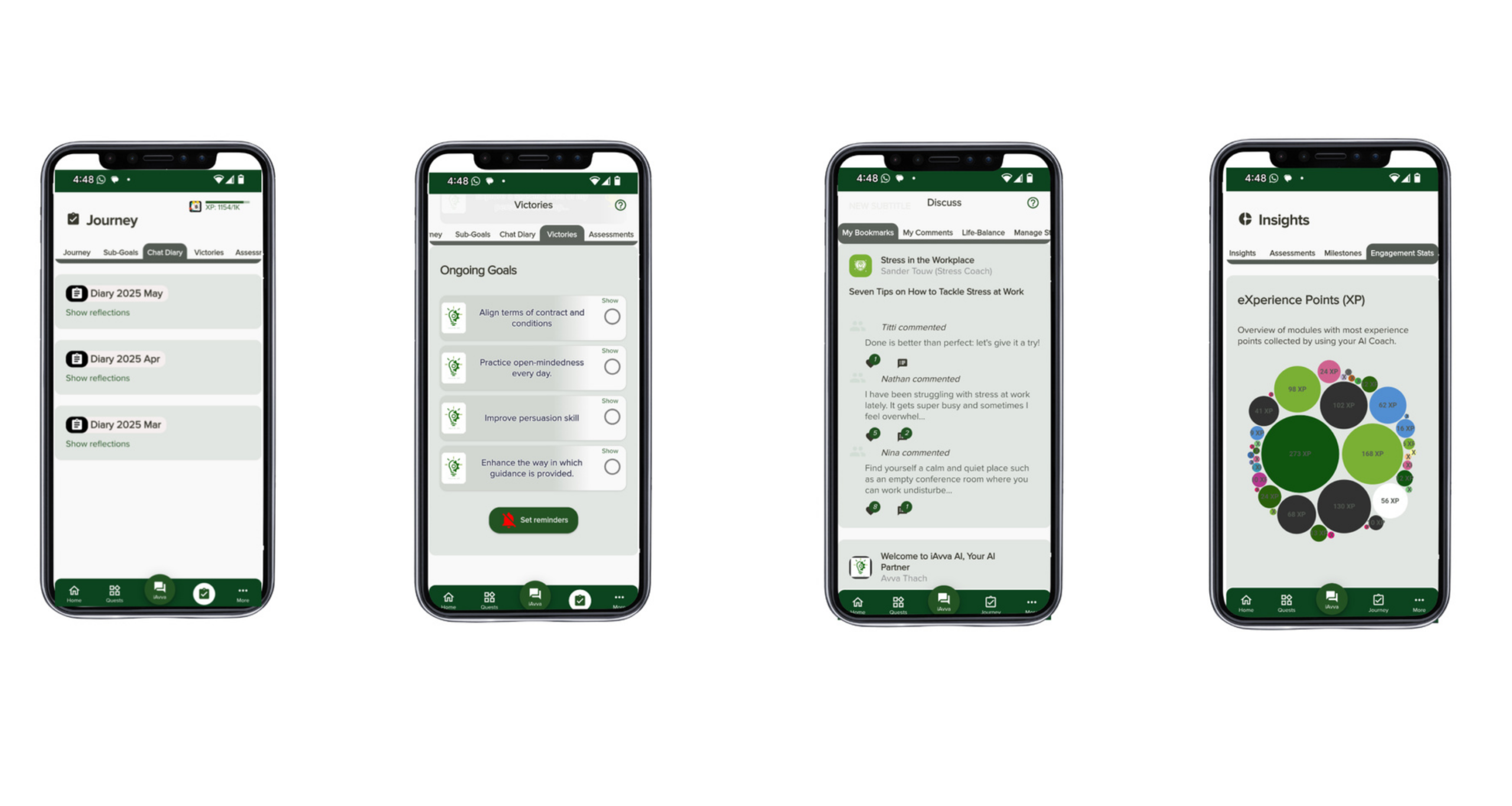
High engagement is the first signal that AI corporate training is working. When around 60 percent of your workforce uses an AI coach app weekly, you know the experience feels valuable, not forced. iAvva AI tracks usage, goal progress, and themes, giving HR and Learning leaders clear insight into how training lands across regions and roles.
Those engagement metrics then connect to business outcomes. You can see how improvements in coaching usage align with:
- Higher productivity
- Stronger engagement scores
- Better retention
Because iAvva AI aligns personal goals with business OKRs, it also shows how many goals move from planned to completed.
Analytics dashboards make it easier to report to CFOs and other executives. Instead of telling a story about course completions, you present data about behavior change and performance shifts. You can also compare the cost of AI coaching to the cost of traditional one‑on‑one coaching and show how a blended model stretches the impact of your Leadership Coaching budget.
5. Leadership Coaching In The Age Of AI For Change‑Ready Leaders

AI transformation changes what leaders need to do, not just what they need to know. They must guide teams through uncertainty, use data wisely without losing human judgment, and speak clearly about why AI matters. No single workshop can prepare them for that. They need ongoing Leadership Coaching supported by an AI coach app that helps them practice every day.
Research indicates that around 78 percent of leaders see higher transformation success when AI Strategy integrates with coaching. That makes sense. AI implementation reshapes decision rights, information flows, and team roles. Leaders must adjust how they set direction, give feedback, and manage risk. Coaching helps them spot blind spots and learn new behaviors quickly.
iAvva AI approaches leadership development with a blended model. The platform offers daily AI coaching plus bi‑weekly group sessions with human coaches. This mix makes Leadership Coaching accessible far beyond the C‑suite, while preserving the depth and accountability that human interaction brings.
The New Leadership Paradigm With Skills For AI Transformation
Leadership in the AI Era requires navigating and shaping organizational guidance with a wider skill set than before, as leaders must handle ambiguity without freezing and make data-backed decisions. Leaders must handle ambiguity without freezing, make decisions backed by data, and still listen to their teams’ lived experience. They guide people through change that touches both tasks and identity.
Key skills include:
- Adaptive leadership
- Psychological safety building
- Clear, honest communication
- Ethical decision‑making
Ethical thinking takes a larger role. Leaders have to consider fairness, privacy, and long‑term impact when they deploy AI. They also need a growth mindset, so they see their own skills as something they can keep building. AI coaching reinforces these habits through frequent practice, nudging leaders to pause, reflect, and choose better responses.
AI Coaching As A Leadership Development Accelerator
Traditional leadership programs can take years to shift behavior, especially when they rely on occasional workshops. AI coaching shortens this path by giving leaders a daily mirror. When a leader reflects on a tough decision with an AI coach app like iAvva AI, the system asks focused questions that bring patterns into view.
Solution‑focused coaching methods encourage leaders to move from problem stories to action steps. Instead of staying stuck on what went wrong, they identify what works and how to do more of it. Personalized development paths in iAvva AI align these insights with each leader’s specific growth goals, such as clearer delegation or stronger cross‑team communication.
Role‑play simulations add safe practice for high‑stakes situations. Leaders can rehearse layoffs, feedback talks, conflict resolution, or board presentations without risk. The AI coach offers gentle but specific feedback on their wording and emotional tone. Between human coaching sessions, the AI helps leaders stay on track, turning Leadership Coaching from a rare event into a daily practice.
The Blended Model With AI And Human Coaching For Maximum Impact
AI coaching does not replace human coaches; it amplifies what they do best. In the iAvva AI model, leaders interact with the AI coach app each day and join live group sessions every two weeks with certified coaches. The AI captures themes, tracks progress, and reinforces techniques. Human coaches bring deep empathy, nuanced judgment, and real‑time adaptation.
This mix creates a coaching environment where leaders learn, apply, and reflect in a steady rhythm. Peer groups build shared language and support. The AI keeps the momentum between sessions so insights do not fade. Over time, this blended approach leads to visible behavior changes, stronger confidence, and better outcomes for AI transformation projects.
For HR Directors and Chief Learning Officers, the benefit is scale with depth. You can extend Leadership Coaching beyond senior executives to middle managers and high‑potential talent, while still keeping a human element. That supports a wider leadership bench, which is vital when AI implementation touches many teams at once.
6. Implementing An AI Coach With A Step By Step Deployment Guide
Moving from interest in AI coaching to a live AI coach app in your organization does not need to be slow or risky. With a clear plan, you can go from idea to active use in a few weeks. The keys are thoughtful planning, smooth technical setup, and ongoing attention to engagement.
iAvva AI follows a three‑phase framework:
- Strategic planning and preparation
- Technical deployment and onboarding
- Driving engagement and continuous improvement
Across all phases, you align AI implementation with AI Strategy, HR processes, and learning goals.
Because iAvva AI supports white‑label options and digital twin models, you can also build a branded AI coach app that reflects your own leadership frameworks and culture. That means your AI corporate training and Leadership Coaching carry your voice from day one.
Phase 1 – Strategic Planning And Preparation
Before you configure any software, you clarify what success looks like. You define goals for your AI coach app program, such as:
- Leadership skill growth
- Support for AI transformation projects
- Improved engagement for a specific group
You also set simple success measures like weekly active usage, goal completion rates, and behavior changes.
Next, you decide who joins first. Many organizations start with leaders linked to key AI implementation projects or with high‑impact functions like IT, operations, or sales. You choose what level of customization you need, including branding, content libraries, and integration depth with HR or performance tools.
Executive sponsorship is vital. Senior leaders explain why AI coaching matters and how it supports your AI Strategy. You plan launch communication that speaks in simple, human terms instead of heavy jargon. You also set up support roles for HR and Learning teams so questions get answered quickly once the program goes live.
Phase 2 – Technical Deployment And Onboarding
In this phase, your IT and HR teams work with iAvva AI to connect systems and configure the platform. Secure Single Sign‑On keeps access simple and safe, while integration with HR or LMS tools allows automatic user provisioning and data flow. Branding elements such as your logo and colors help the AI coach app feel like a natural part of your environment.
You set up admin dashboards so HR Directors, CLOs, and People Operations leaders can view high‑level analytics. You also load or connect any custom content you want, such as leadership frameworks, process improvement guides, or AI Strategy documents. If you choose a digital twin, iAvva AI trains the AI model on your own methods and tone.
Onboarding content for users is short and practical. Simple videos or quick guides show how to start a session, how daily prompts work, and how privacy is protected. Because iAvva AI deployments often complete in two to four weeks, you can align go‑live with other key events like new strategy rollouts or major AI implementation phases.
Phase 3 – Driving Engagement And Continuous Improvement
After launch, the focus shifts to building steady habit use. Your internal communication team shares short stories of how the AI coach app helps managers and teams. Leaders model usage by talking about insights from their own sessions. You might run light contests or recognition programs to encourage early activity.
You also establish a rhythm for group coaching sessions where they are part of your package. For example, teams might join bi‑weekly Leadership Coaching circles led by human coaches, while the AI handles daily practice. Over time, this rhythm becomes part of how your company leads and learns.
Analytics from iAvva AI show which groups engage most, which topics surface, and where barriers appear. HR and Learning leaders use this data to adjust messaging, add relevant content, or provide extra support to certain segments. Feedback from users flows into product refinement so the AI coach app stays aligned with your culture and goals.
Measuring Success With Key Metrics And Analytics
To show value, you track a mix of usage and outcome metrics. For example:
- Weekly active users
- Session frequency
- Goal completion rates
- Skill progression scores
- Self‑reported behavior changes
At the organizational level, iAvva AI provides anonymized, aggregated analytics. You view patterns by function, level, or region without exposing individual conversations. You then connect these coaching metrics to business KPIs such as productivity, engagement scores, retention, and AI project milestones. This data makes it easier to brief executive stakeholders and refine both AI Strategy and AI corporate training plans.
7. The AI Coach App Revolution With Features That Drive Results
AI coaching apps form a new class of tools that sit between traditional learning platforms and one‑on‑one coaching. They combine conversational AI, structured Coaching methods, and analytics to create a personal Success Coach for every employee. Among these, iAvva AI stands out as a complete AI transformation partner.
The platform blends daily AI coaching with professional development courses, bi‑weekly group coaching, and enterprise analytics. It draws from neuroscience, International Coaching Federation (ICF) principles, and Lean Six Sigma. It also supports multimodal interaction across 19 languages, with neurodiversity‑friendly design.
Unlike general AI assistants, an AI coach app does not try to answer every question about the internet. Its job is to ask the right questions, guide reflection, and connect personal growth to business results. That is why iAvva AI focuses so strongly on OKR alignment, behavior change, and security.
Personalized Daily Coaching As The Foundation Of Growth
The heart of iAvva AI is a short daily interaction. In about five minutes, the AI coach leads you through reflection on your priorities, recent actions, and upcoming challenges. These questions follow a solution‑focused method. That means they point you toward desired outcomes and concrete steps instead of staying stuck on problems.
You can adjust the AI coach’s tone, voice, and style to fit your preference, making the experience feel more natural. Behind the scenes, neuroscience research informs the structure of prompts and repetitions. By revisiting key behaviors in small steps, the app helps form new neural pathways.
Instead of handing you advice, the AI coach asks powerful questions that spark your own insight. This builds self‑awareness and ownership. Because the space is private and non‑judgmental, you can explore mistakes and fears openly, which is vital during AI transformation.
Goal Setting And Performance Tracking
Inside the app, you set personal and professional goals. These might range from leading an AI implementation project more confidently to improving feedback skills or learning a new AI Strategy skill. The system then nudges you toward small actions that move those goals forward.
For organizations, iAvva AI links these personal aims to company OKRs. When an employee picks a goal like “cut report cycle time,” the app connects it to the wider process improvement objective. Habit tracking and timely reminders keep the focus fresh without feeling heavy.
Personal dashboards show your trend over time. You see how often you complete sessions, which themes you work on most, and how many goals you finish. This visual feedback keeps motivation up and allows you to adjust your focus as your role evolves.
Enterprise Grade Analytics And Security
For HR and L&D leaders, visibility and safety are both vital. iAvva AI provides dashboards that show usage trends, goal categories, and progress across departments, while still guarding individual privacy. Data is aggregated and anonymized, so no manager sees the details of a single person’s coaching sessions.
On the security side, the platform follows GDPR, ISO 27001, and SOC 2 Type 2 standards. All data stays encrypted in transit and at rest. Single Sign‑On and careful access controls support safe, simple logins. The business model centers on subscriptions, not data resale, so conversations are not mined for external use.
These safeguards matter especially when coaching supports AI transformation, where sensitive discussions about risk, job design, and leadership performance appear. Knowing that their privacy is protected helps employees fully engage with Leadership Coaching and AI corporate training through the app.
Advanced Features For Skill Mastery
Beyond daily reflection, iAvva AI offers features aimed at deeper skill practice. Role‑play simulations let users rehearse sales pitches, hard feedback sessions, interviews, or board updates. The AI coach responds in real time, helping users improve word choice and emotional tone.
A curated content library brings in articles, short videos, and learning “pills” matched to each person’s growth path. Self‑assessments and optional 360‑style feedback help users see blind spots and choose focus areas. Accessibility settings such as font changes and color adjustments support neurodiverse team members.
With 19 language options, global companies can roll out one AI corporate training platform across regions without losing local nuance. Integration with professional development courses turns iAvva AI into a central hub where employees can reflect, learn, and act in one place. That makes it a natural anchor for AI implementation and Leadership Coaching efforts.
8. Top AI Coach Apps And Platforms With An Objective Comparison
The AI coaching market is growing fast, with several platforms offering different mixes of AI, content, and human Coaching, including the 10 Best AI Coaching platforms for employee development that have emerged in recent years. Choosing the right AI coach app depends on your goals, size, and security needs. Some tools focus on executive Coaching with a strong human network. Others center on self‑service growth.
In this field, iAvva AI positions itself as a full AI transformation partner rather than a point tool. It connects AI implementation, AI Strategy support, Leadership Coaching, and AI corporate training into one experience. To make a clear choice, it helps to compare iAvva AI with other known names on key dimensions like engagement, analytics, multilingual support, and enterprise readiness.
iAvva AI Coach As The Complete AI Transformation Platform
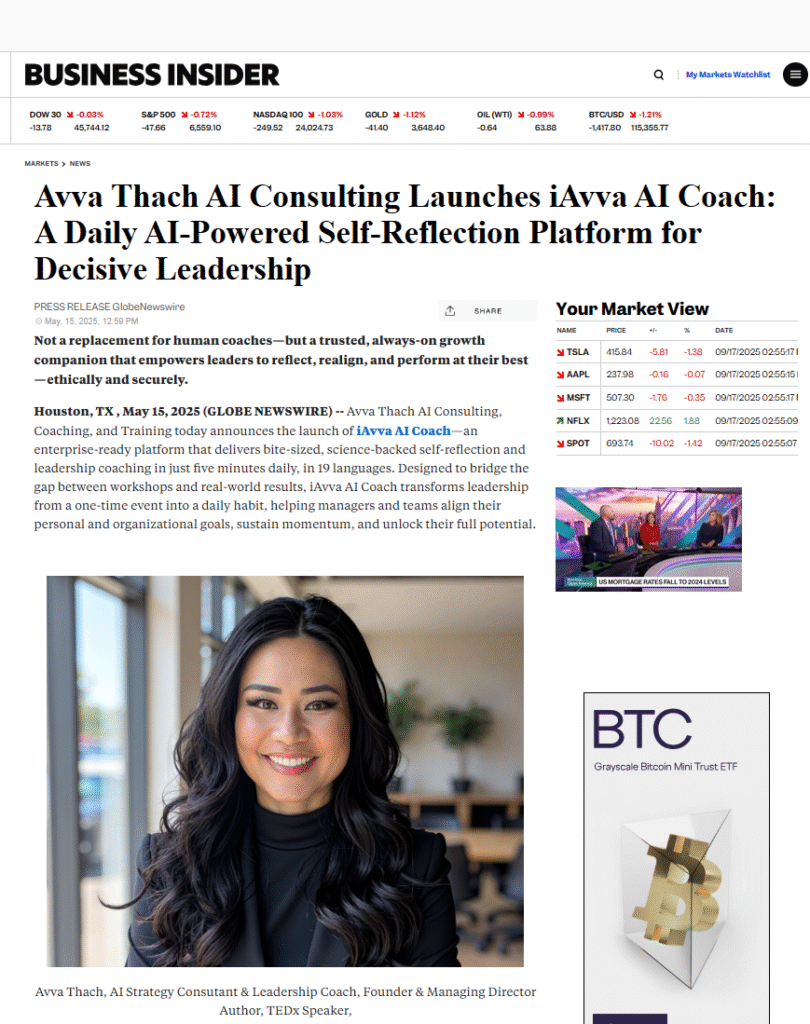
iAvva AI combines AI coaching technology, human group Coaching, and professional development courses into one integrated offering. Employees interact with the AI coach app daily through text or voice and join bi‑weekly group Coaching sessions led by certified coaches. This creates a steady rhythm of reflection, learning, and accountability.
Engagement is a strong point. Many clients see over 60 percent weekly active usage, which is two to three times higher than common LMS numbers. The platform draws on neuroscience, ICF Coaching standards, and Lean Six Sigma methods. It also links personal goals to company OKRs, so Leadership Coaching and AI corporate training tie directly to business results.
For larger clients, iAvva AI offers white‑label and digital twin options, allowing you to build a branded AI coach that reflects your own frameworks. Enterprise‑grade analytics display productivity, engagement, and retention shifts, often visible within the first month of use. With 19 language options, multimodal interaction, and strong security certifications, the platform fits organizations from 50 to 5000 employees that need measured AI transformation, not just content.
BetterUp
BetterUp is known for premium Coaching that focuses heavily on human one‑on‑one sessions. Its platform uses AI mostly for matching and tracking rather than for conversational Coaching. This makes it attractive for executive and high‑potential programs where deep human connection is the main goal.
Strengths include a large global coach network and a broad set of personal growth themes. However, because the model centers on live Coaching, scaling to every employee can become costly. Daily micro‑coaching through an AI coach app is less central than in iAvva AI, so mid‑level staff may receive fewer touchpoints.
While AI builds strong tools for custom AI coaching experiences, it places less emphasis on integrated human group Coaching and full enterprise analytics than iAvva AI. For SMBs organizations that need AI implementation support, Leadership Coaching, and AI corporate training in one connected system, iAvva AI offers a more complete package.
Sounding Board
Sounding Board focuses on leadership development with a platform that connects leaders to human coaches and tracks progress. Its strengths lie in structured Coaching programs and talent development for managers and senior leaders.
AI appears mainly in the background for logistics and measurement rather than as an AI coach app for daily interaction. That works well when the main aim is deep executive Coaching. For broader workforce engagement and micro‑coaching linked to AI transformation projects, iAvva AI provides a wider reach.
Torch
Torch offers Coaching, mentoring, and learning paths focused on leadership and culture. It supports both one‑on‑one and group formats and includes tools for feedback and assessments. The platform uses AI to support these processes but not as a front‑line conversational coach.
This approach suits organizations that want mentoring plus Coaching for select groups. Compared with iAvva AI, Torch puts less focus on a daily AI coach app experience, OKR alignment, or process improvement methods like Lean Six Sigma. For AI implementation that touches many roles, iAvva AI’s daily micro‑coaching and analytics can provide clearer line of sight to ROI.
When you compare across all dimensions, iAvva AI stands out by combining strong AI coach app features, human Coaching, analytics, OKR alignment, and flexible deployment models. That makes it a strong choice if your main aim is AI transformation supported by measurable Leadership Coaching and AI corporate training.
9. AI In Process Engineering And Industry Specific Applications
AI implementation matters most when it improves real processes in real industries. Healthcare, renewable energy, manufacturing, finance, and retail all gain from AI‑driven process improvement. Yet each sector has its own regulations, culture, and skills. That means your AI Strategy must consider both technology and people in context.
Process engineering sits at the center of this. When you map workflows, remove waste, and then apply AI to key steps, you can raise quality, lower cost, and support better decisions. Lean Six Sigma provides a strong base for this kind of work. AI then adds prediction, pattern recognition, and automation on top.
Across all these areas, AI corporate training and Coaching play a key role. Doctors, nurses, engineers, and branch managers all need to learn how to work with AI tools without losing their professional judgment. iAvva AI helps by offering targeted Coaching paths for leaders and staff in each sector.
AI In Healthcare Process Engineering
Healthcare offers powerful examples of AI‑driven process improvement. Hospitals use AI to predict patient admission volumes so they can staff wards and allocate beds more wisely. AI models can suggest better scheduling for operating rooms, cutting delays and reducing wait times.
Equipment teams use AI for predictive maintenance on scanners and vital machines, reducing downtime that can delay care. In clinical settings, AI assists with diagnostic support, image analysis, and risk scoring, although final decisions stay with licensed clinicians. Administrative processes such as billing, coding, and claims review also benefit from smart automation.
These gains come with a clear training need. Clinicians and administrators must understand how AI outputs work, where limits sit, and how to blend them with clinical judgment. AI corporate training and Leadership Coaching support this shift. With iAvva AI, hospital leaders can build change management skill, while front‑line staff use the AI coach app to process concerns, practice communication with patients about AI, and grow digital fluency.
AI In Renewable Energy Process Engineering
Renewable energy companies rely on complex assets and changing conditions. AI helps predict wind turbine failures before they occur, schedule maintenance, and reduce downtime. Solar farms use AI to forecast output based on weather, panel state, and grid demand, supporting more stable supply.
Grid operators use AI to balance load, integrate distributed energy resources, and avoid blackouts. On the materials side, AI speeds up the search for better solar cells, battery chemistries, and energy storage options. Process engineering teams rely on these models to run cleaner, more reliable operations.
However, many staff come from traditional energy backgrounds where AI tools were limited. They need new skills around data analysis, AI basics, and human‑AI collaboration. AI coaching helps leaders in these firms guide teams through change. With iAvva AI, they can offer an AI coach app that supports daily learning about AI Strategy, ethics, and communication, so workers move from fear of replacement to pride in new capabilities.
Cross Industry AI Process Improvement
Outside healthcare and energy, many industries see similar patterns:
- Manufacturers use AI for predictive maintenance, quality checking, and supply chain planning
- Banks use AI for fraud detection, credit scoring, and customer service
- Retailers use AI for inventory optimization, dynamic pricing, and personalized offers
The common thread is the blend of process engineering and human behavior. AI can point out patterns, but people still decide how to respond and which processes to redesign. Lean Six Sigma and AI together produce large gains when teams are ready to act on insights.
iAvva AI helps build that readiness. Its AI corporate training paths support cross‑functional teams in any industry. Leadership Coaching programs guide managers to use AI outputs wisely, while the AI coach app keeps individuals focused on practical goals linked to process improvement. That mix turns AI ideas into sustained operational gains.
10. Business Coaching For AI Transformation With The Success Coach Advantage
During AI transformation, executives often face a mix of pressure and uncertainty. They must make big bets on AI Strategy, reassure teams, and show near‑term wins while keeping long‑term goals in view. Business Coaching provides a place to think clearly, test ideas, and commit to action.
However, traditional Business Coach models reach only a small group of leaders. AI coaching spreads many of the same principles across the organization. When you pair an AI coach app with human coaches, every manager and many individual contributors can access a form of Success Coach support.
iAvva AI is built around this blend. It takes core Business Coaching methods such as the GROW model, emotional intelligence coaching, and goal setting, and weaves them into daily AI corporate training and Leadership Coaching flows. That way, AI implementation and business performance rise together.
“The most important thing in communication is hearing what isn’t said.”
— Peter Drucker
The Business Coach Role In Digital Transformation
A strong Business Coach helps leaders see their situation clearly, connect strategy to action, and stay resilient under stress. In AI transformation, those needs double. Leaders must decide where to invest, which AI use cases to pursue first, and how to structure teams. They also carry staff fears about job changes and skill shifts.
Studies show that organizations with a strong coaching culture often see higher profitability. That is because Coaching helps leaders align plans, communicate expectations, and handle conflicts early. In AI implementation, a Business Coach supports better prioritization and faster course corrections.
Yet human coaches alone cannot reach every person involved in AI projects. Middle managers and experts also need guidance. AI coaching extends principles of Business Coaching into their daily work through brief prompts and structured reflection. That allows your whole leadership chain to act with more clarity and courage.
AI Coaching As Your Scalable Success Coach
Classic Success Coach programs focus on high performers, but AI coaching can play this role for nearly everyone. An AI coach app like iAvva AI learns from each user’s goals and context, then offers targeted questions and content. It nudges them to turn strategic thinking into small steps they can take that day.
Because the platform uses solution‑focused methods, it keeps attention on next actions, not just on analysis. Daily reflection helps employees and managers build habits such as planning, reviewing outcomes, and adjusting. Over weeks, this turns into a more proactive culture where people take ownership of AI implementation tasks.
iAvva AI’s model goes further by adding bi‑weekly group Coaching with human coaches. This creates a rich Success Coach environment. The AI handles scale and daily practice. Human coaches bring deep listening and personal guidance. Together, they help teams handle AI transformation with more confidence and shared language.
Measuring Business Coaching ROI During AI Implementation
Measuring the value of Coaching can feel soft, but AI coaching platforms make it clearer. With iAvva AI, you can see how coaching activity aligns with key business outcomes during AI implementation. Organizations often notice faster adoption of AI tools, lower resistance scores, and more consistent progress on AI OKRs when Coaching is in place.
The earlier statistics apply here as well. With AI coaching active, workforce productivity often improves by around 22 percent, engagement scores by roughly 21 percent, and retention by about 15 percent. Leadership effectiveness ratings climb as leaders communicate AI Strategy more clearly and support their teams through change.
The analytics dashboards inside iAvva AI help you connect these gains to specific programs or groups. You can see how coaching support for a major AI project team impacts delivery time or quality. That allows you to refine Business Coach investments and make a strong case for continued funding.
11. Creating A Culture Of Continuous Learning With AI Coaching
Long‑term AI success depends on culture as much as on code. A company that learns fast, shares insight, and adapts its processes will gain much more from AI tools than one that treats AI as a one‑time purchase. This is where continuous learning moves from slogan to daily practice.
A learning culture values questions, feedback, and experimentation. It sees mistakes as data, not just as faults. AI transformation puts pressure on this culture because it introduces new tools, metrics, and ways of working. Without a strong learning habit, people fall back on old methods even after new systems go live.
AI coaching platforms like iAvva AI help build this culture from the inside out. By inviting employees into short, frequent reflection and goal tracking, the AI coach app makes learning personal. When done well, this ripples out into team norms and company habits.
The Learning Organization As Foundation For AI Success
Thinkers like Peter Senge describe learning organizations as places where people continually grow their capacity to create desired results. In an AI context, this means your teams are always gaining new skills, updating mental models, and improving processes. Static organizations, by contrast, struggle because AI tools and markets move faster than old routines.
A key element is growth mindset. Employees and leaders need to believe they can build new skills, even later in their careers. Psychological safety also plays a central role. When people feel safe raising concerns about AI models or process risks, you catch issues early and adjust.
A strong learning culture also helps attract and keep talent. People want to join places where they can grow, especially in AI Strategy and related fields. When AI corporate training and Coaching are woven into work, candidates notice. Over time, this gives your company an edge as AI implementation becomes a standard requirement.
AI Coaching As A Culture Change Agent
AI coaching turns the idea of learning culture into daily behavior. Each time an employee answers prompts in iAvva AI, they pause, reflect, and plan. These micro‑habits add up. Over months, staff become more used to checking in with themselves and adjusting instead of staying on autopilot.
Because iAvva AI is available to all levels, not just “high potentials,” growth becomes a shared experience. When most of your workforce uses the AI coach app weekly, a tipping point appears. People swap tips from their sessions, share small wins, and bring a common language about goals and OKRs into team talks.
Community features and group Coaching sessions deepen these effects. Employees see that everyone, including senior leaders, is learning. This normalizes feedback and reduces stigma around asking for help. As iAvva AI aligns personal goals with company objectives, it reinforces a sense of shared purpose and shared success.
Leadership’s Role In Cultural Transformation
Leaders set the tone for learning culture. If they pretend to know all the answers or hide their own challenges with AI tools, others will also stay silent. When leaders use an AI coach app and talk openly about their sessions, they signal that growth is normal at every level.
AI coaching supports leaders in this role by helping them practice vulnerability, clear communication, and follow‑through. Middle managers can receive targeted Coaching to act as culture carriers for their teams. They learn how to recognize effort, praise learning, and handle setbacks in AI projects without blame.
Through iAvva AI’s blended model, leaders gain both AI coaching and human Coaching support. This mix prepares them to model the kind of learning behavior that drives AI transformation forward. Over time, that example becomes more powerful than any slogan on a wall.
“People don’t resist change. They resist being changed.”
— Peter M. Senge
12. The Future Of Work With AI, Coaching, And Human Potential
Work is shifting toward tasks that require human judgment, creativity, and empathy, while AI handles more routine analysis and repetitive steps. In this setting, AI implementation is not just about efficiency. It is about freeing people to do more meaningful work and helping them build the skills to thrive in new roles.
AI Strategy must therefore include plans for human development, not just for model deployment. Continuous Coaching and AI corporate training give workers a path to stay relevant, even as job descriptions change. Rather than seeing AI as a threat, employees can see it as a partner when they feel supported.
iAvva AI positions itself as a long‑term partner in this future of work. Its AI coach app and Leadership Coaching programs help workers at all levels practice skills that remain valuable no matter how tools change.
The AI Augmented Workplace With Humans And Machines
In an AI‑augmented workplace, tools handle data crunching, pattern spotting, and predictable tasks. Humans focus on complex problems, customer relationships, innovation, and ethical judgment. New roles appear, such as AI trainers, AI ethicists, and human‑AI collaboration specialists.
Automation shifts time away from low‑value tasks. When done with care, this gives teams room to explore new ideas, test products, or improve services. The human edge stays in areas like empathy, creativity, and systems thinking. AI supports these areas by providing fast insight and removing busywork.
For this model to work, organizations must invest more, not less, in human development. Coaching helps workers learn how to work alongside AI, question outputs, and use judgment. AI implementation that ignores this human side risks shallow gains and deep mistrust.
Essential Skills For The AI Powered Future
Technical knowledge still matters, but its shelf life shortens. What matters even more is the ability to learn new tools quickly and to apply them wisely. Soft skills take center stage. For example:
- Emotional intelligence to handle reactions and support others
- Complex communication to explain AI outputs to different audiences
- Ethical reasoning to align AI use with values and norms
- Creative problem solving to apply AI in fresh, valuable ways
Digital literacy and AI fluency are also key. Workers must understand what AI can and cannot do, how to frame good prompts, and how to spot bias or error. iAvva AI builds these skills through daily reflection sessions, targeted micro‑lessons, and Coaching paths focused on adaptability and resilience. That steady practice makes lifelong learning feel normal rather than overwhelming.
Preparing Your Organization For Tomorrow Today
Waiting for disruption to hit before building these capabilities is risky. Companies that start now can shape roles, reskill willing staff, and design better AI Strategies. Early adopters of AI coaching and AI corporate training will have a workforce ready to respond to new opportunities and challenges.
Preparation includes:
- Building infrastructure for continuous development
- Mapping potential career paths into AI‑related work
- Embedding Coaching into performance and talent systems
- Building organizational agility so teams can shift between projects
iAvva AI offers a flexible platform for this preparation. As your AI implementation grows, the AI coach app and Coaching programs grow with you. New content, new skills, and new leadership challenges can be folded into daily sessions. That keeps your people and your AI Strategy aligned, even as the market changes.
Conclusion
AI implementation has moved from a nice extra to a central part of business strategy. Yet many AI transformation efforts still fall short because they treat AI as a technology add‑on rather than as a shift in how people think and work. The real wins come when you combine clear AI Strategy, process engineering, and continuous human development.
Throughout this guide, you saw how AI corporate training and Leadership Coaching act as the missing link in many AI programs. Daily support from an AI coach app, backed by human coaching and solid analytics, helps employees turn new tools into new habits. When this happens, organizations see measurable gains in productivity, engagement, and retention, often within the first month.
iAvva AI brings these elements together in one platform. It links personal goals with business OKRs, uses neuroscience and Lean Six Sigma for process improvement, and supports 19 languages for global teams. With over 60 percent weekly engagement and enterprise‑grade security, it offers a practical way to move from AI plans to AI results.
If you want AI transformation that lasts, the path is clear. Invest in your people as much as in your platforms. Give them a Success Coach that lives in their pocket and a Business Coach culture that reaches from the C‑suite to the front line. With iAvva AI, you can build that environment and guide your organization through AI change with confidence and clarity.
FAQs
What Is An AI Coach App In Simple Terms?
An AI coach app is a digital coach that talks with you through text or voice. It asks questions, helps you set goals, and keeps you on track with daily prompts. Unlike a chat bot that only gives answers, it focuses on Coaching you to think, act, and grow.
How Does iAvva AI Support AI Implementation?
iAvva AI connects AI Strategy with daily behavior. It offers AI corporate training, Leadership Coaching, and an AI coach app that links personal goals to business OKRs. This helps employees learn new skills and apply them directly to AI projects and process improvement work.
Will AI Coaching Replace Human Coaches?
No. AI coaching handles scale and daily practice, while human coaches bring deep empathy and complex insight. iAvva AI uses both. The AI coach app supports people every day, and bi‑weekly group Coaching sessions with human coaches provide accountability and richer discussion.
How Fast Can An Organization Roll Out iAvva AI?
Most organizations can launch iAvva AI in about two to four weeks. During that time, teams set goals, connect Single Sign‑On, brand the app, and plan communication. After launch, staff start using daily prompts and, where included, attending group Coaching sessions.
Is The Data In AI Coaching Sessions Private?
Yes. iAvva AI encrypts data and follows GDPR, ISO 27001, and SOC 2 Type 2 standards. Individual coaching conversations stay private. HR and leaders only see aggregated, anonymized analytics that show trends, not personal details.












Leave a Reply