

Introduction
“Success is the sum of small efforts, repeated day in and day out.” – Robert Collier
Leaders keep hearing that AI transformation will change everything, yet most results stay vague and scattered. Budgets grow, pilots appear in pockets, and pressure mounts while real impact on performance and people feels out of reach.
AI transformation means a strategic change in how a company creates value, makes decisions, and develops people with artificial intelligence at the core. In this guide I explain what AI transformation is, why it matters now, which AI capabilities leaders should focus on, and how to build a measurable, people centered approach. I also show how iAvva AI links AI strategy with daily leadership behavior through hybrid human plus AI coaching and services.
If you want a clear path from AI ambition to practical action in the next 90 days, this guide is for you.
Key Takeaways
- AI Transformation Is a Business Rewiring, Not a Tech Project that reshapes value creation, decision making, and daily work.
- Start With Economic Leverage Points and Clear Outcome Metrics so each AI step connects to revenue, cost, risk, and people results.
- Leadership, Culture, and Skills Decide Success Rates because technology without behavior change rarely moves the profit and loss line.
- Platforms, Data, and Governance Turn Experiments Into Enterprise Value by making AI safe, repeatable, and reusable across teams.
- iAvva AI as a Hybrid Human+AI Partner for Measurable Leadership Impact that links micro coaching, consulting, and analytics to business goals.
What Is AI Transformation And Why Does It Matter Now?
AI transformation is an organization wide shift that embeds AI into products, operations, and ways of working to create measurable value. It goes far beyond adding a chatbot or one clever pilot and instead rewires how leaders, teams, and data interact every day.
According to IDC, organizations plan to invest around 3.4 trillion dollars in digital and AI initiatives by 2026, and AI Investment Activity to surpass $650 billion in enterprise spending alone reflects how quickly these budgets are scaling. At the same time, analysis of The Seventy Percent: Why IT transformation has remained statistically difficult for twelve years confirms that roughly 56 to 70 percent of digital programs still miss expectations. That gap is where leadership, culture, and clear strategy matter most.
Defining AI Transformation In A Business And People Context
When I talk about AI transformation, I mean a deliberate, ongoing shift where AI supports nearly every part of the business and people system. Instead of isolated experiments, AI ties into product design, customer experience, operations, and how we recruit, develop, and support employees. The focus moves from isolated tools to a connected set of ways to think, decide, and learn.
A few key traits stand out:
- There is an AI first mindset that asks how work would look if data, prediction, and human judgment sat at the center from the start.
- Leaders choose a small set of high value business drivers rather than dozens of scattered pilots.
- Feedback loops stay active so models, processes, and skills keep improving instead of freezing once a system goes live.
Human judgment stays in the loop, especially in people decisions. For HR and Learning leaders, that means AI supports leadership assessment, personalized development paths, and talent decisions, while managers still own final calls. Research from McKinsey shows organizations that scale AI in this way can gain about 20 percent uplift in EBITDA, which only happens when people and technology move together.
Platforms such as iAvva AI reflect this mindset. Our AI Coach connects daily leadership choices to company OKRs, while human coaching and AI strategy services help executives rewire habits, not just deploy software.
Tip: Treat every AI project as a behavior change initiative with a technology component, not the other way around.
What Is At Stake For Leaders, HR, And IT In 2026 And Beyond?
The stakes around AI transformation keep rising for every leader I meet. IDC expects trillions of dollars in digital and AI spend, yet research on Digital Transformation Failure: 2026 highlights that most large scale efforts still fail to deliver clear gains. That combination of large budgets and high failure rates can put careers and company health at risk.
For HR Directors and Chief Learning Officers, the risk shows up as outdated leadership development that cannot keep pace with AI driven change. For C-suite leaders, the stakes include EBITDA growth, resilience in volatile markets, and reputation with boards and investors. For CIOs and IT Directors, pressure centers on secure platforms, data foundations, and faster delivery of AI enabled services.
Most of all, there is a risk of leadership obsolescence. Leaders who cannot speak the language of AI and data will struggle to steer product, people, and risk decisions. AI transformation is not only a technology shift; it is a leadership and workforce shift that HR, L&D, and IT must guide together.
Which AI Capabilities Should Leaders Actually Care About?
The AI capabilities that matter most for AI transformation are the ones that change how people decide, learn, and serve customers. Leaders do not need to master every technical detail, but they do need a clear picture of what each type of AI can do for their business and workforce.
I focus on a practical set of building blocks. These include natural language tools, vision systems, document digitization, connected devices, automation, expert decision support, generative and agentic AI, plus big data platforms. Used together, they create new ways to run operations, support employees, and guide leadership growth.
Core AI Technologies In Plain Language For Non-Technical Executives
To make smart choices, I like to group AI capabilities into a few clusters that executives can remember.
Language and conversation AI covers natural language processing, chatbots, and translation. These tools let employees ask questions in everyday language in Microsoft Teams or Slack and receive relevant answers drawn from systems such as Workday or Salesforce. They also help HR analyze survey comments and exit interviews for themes and mood.
Vision and document AI covers computer vision and optical character recognition. Computer vision watches video or images for safety issues on a factory floor, while intelligent document tools convert paper contracts, resumes, and manuals into searchable digital text. This data then feeds models in systems from ServiceNow or SAP to improve service and compliance.
Data, automation, and advanced AI covers connected sensors, workflow automation, expert systems, big data platforms, and generative plus agentic AI. Sensors in trucks or plants send continuous data into lakehouses on platforms such as Amazon Web Services or Google Cloud. Automation tools then route tasks, while expert and generative models suggest decisions, create content, or even run multi step processes under human oversight.
When leaders see AI in these clusters, they can better connect technology to real questions about customers, employees, and performance.
As Andrew Ng has said, “AI is the new electricity.” The point is not the buzzword itself, but where it quietly powers everyday work.
How These Capabilities Translate Into Leadership And Workforce Impact
These technical building blocks only matter when they change how people work and grow. That is where leadership, HR, and IT teams can work together.
AI enables scalable personalized learning and leadership support. A manager in Dallas and another in Mumbai can both receive tailored micro learning, reflection prompts, and scenario practice based on their goals and performance data. Tools like iAvva AI Coach, Coursera, or LinkedIn Learning help L&D move beyond one size fits all workshops.
AI improves employee experience and engagement. HR chatbots answer routine questions inside tools such as Microsoft Teams, while sentiment models monitor survey results to reveal burnout patterns. Leaders can respond faster, and People Operations teams can design better programs based on evidence instead of guesswork.
AI helps leaders take better decisions with less delay while people move toward higher value tasks. Decision support systems show leaders different workforce, customer, or supply chain scenarios, and automation lifts low level work out of manager calendars. As AI takes routine tasks, human roles focus more on empathy, problem framing, and creative thinking, which raises the bar for leadership skills and AI fluency.
How Do You Build An AI-First Strategy With Measurable Outcomes?
An AI first strategy treats AI as a core design ingredient for the business, not as a tool you sprinkle over existing processes. In AI transformation, that means leaders ask how AI, data, and people can work together to reshape products, operations, and talent programs from the ground up.
To turn that vision into results, we need clear links between AI efforts and economic outcomes, a priority that C-Suite Digital Transformation Statistics show is now the top concern for executives heading into 2026. According to McKinsey, organizations that treat AI as a value creation system, not just a technology budget, can see about three dollars of additional EBITDA for every dollar invested in AI. That only happens when use cases connect to specific financial, operational, and people metrics.
From Digitization To AI-First – Rethinking The Business And People System
Digitization focused on moving paper and manual steps into digital tools. AI first thinking asks a deeper question: If we built this company now with AI and data at the center, how would products, processes, and roles look from day one?
For HR and L&D leaders, that means reconsidering how we spot and grow leaders:
- Instead of annual talent reviews and static libraries, AI can infer skills from work history, project data in Jira or Asana, and feedback, then propose targeted development paths.
- Learning moves closer to daily work through prompts inside collaboration tools and systems of record.
- Development plans can adjust in real time as people take on new projects or responsibilities.
Decision forums shift as well. Executive meetings include AI generated scenario briefs alongside human insight, and teams use prediction models to shape bets on customers, supply, and talent. Our role as leaders becomes product owner of these AI infused systems, including those that support people. At iAvva AI we see this when leaders use the AI Coach as a daily practice that aligns personal focus with company OKRs, which turns AI first thinking into a lived habit.
Choosing High-Impact AI Use Cases And Defining Success Metrics
Not every idea deserves investment, and research on Most Large-Scale Tech Programs that fail offers a clear framework for how to prioritize use cases that have a genuine chance of success. I advise leaders to start with a small set of economic value drivers where AI can change outcomes in a visible way. Instead of chasing many pilots, focus on areas where a 20 or 30 percent improvement would matter for revenue, margin, or risk.
A simple way to think about it is to pair each function with one or two high value drivers and clear targets.
| Function | Example Value Driver And Target |
|---|---|
| Talent and HR | Reduce time to fill for priority roles by 30 percent and cut regretted attrition in key segments by 20 percent |
| Customer service | Increase first contact resolution by 15 percent while maintaining or improving CSAT or NPS |
| Sales | Improve conversion from marketing qualified lead to closed deal by 10 percent in one focus segment |
| Learning and leadership | Raise completion and on the job application rates for leadership programs by 25 percent |
From there, define specific metrics:
- Financial metrics: EBITDA, revenue per employee, cost to serve, gross margin.
- Operational metrics: cycle times, error rates, throughput, backlog levels.
- People metrics: engagement scores, internal mobility, leadership behavior ratings, retention in priority segments.
Ownership should sit with senior business leaders, supported by HR, L&D, and IT, so that AI projects stay linked to real business performance, not just model accuracy.
Recommendation: Pair each AI use case with one financial metric and one people metric. If you track everything, you learn nothing.
What Are The Stages Of AI Transformation And Where Are You Today?
AI transformation usually unfolds in stages, rather than one big leap. Each stage has its own questions, risks, and leadership tasks. Understanding where you sit on this path helps you choose the next right move instead of jumping ahead or standing still.
From my work with mid sized and enterprise clients, successful efforts follow a recognizable pattern. They begin with exploration and learning, move through assessment and prioritization, then build data foundations, models, and workflow integrations, before scaling into day to day operations across regions and business units.
The AI Transformation Path From Exploration To Enterprise Infusion
Although details differ by company, the pattern across industries from banking to energy stays surprisingly consistent.
Exploration and shared learning come first. Executives, HR, L&D, and IT host short sessions to build a common language around AI, often with examples from firms like Microsoft, Amazon, or Netflix. The aim is curiosity, not decisions.
Assessment of current data, systems, and talent follows. CIOs and data leaders map systems such as SAP, Oracle, and Workday, highlight quality gaps, and review cloud readiness. HR maps leadership, data literacy, and AI skills so people and tech progress together.
Objectives, use case portfolio, and roadmap take shape. Leaders agree on a few high value domains, select lighthouse projects, and set targets, such as a 20 percent reduction in underwriting time or a 25 percent drop in attrition for critical engineers. An AI Center of Excellence or small strategy cell often appears at this step.
Data foundations, model development, and integration into workflows come next. Teams clean and connect data flows from CRM, HRIS, and operations into a data lakehouse. Models are trained and tuned, then surfaced inside existing tools like Salesforce, ServiceNow, or LMS platforms so employees experience assistance where they already work.
Scaling and infusion into the enterprise finish the loop. Proven use cases roll out across countries and units, supported by shared platforms, standards, and change plans. Business models, roles, and leadership habits adjust as AI becomes part of normal work rather than a special project.
Throughout all stages, HR, L&D, and IT leaders play hands on roles in design, communication, training, and governance.
Self-Assessment – Identifying Your Current Stage And Gaps
A quick self check can reveal where you stand on this path and what to do next.
You are likely in:
Exploration when AI discussions feel mostly conceptual and scattered. There are few concrete use cases, no shared portfolio, and limited AI literacy across leadership. The next move is focused learning and a first list of high value opportunities.
Assessment and early design when you have mapped systems, data, and talent, and can name a short list of priority domains. Maybe a small AI team or steering group exists, but data quality, governance, and leadership skills still limit progress. The next move is to pick one or two lighthouse projects with clear metrics.
Build and scale mode when data pipelines, models, and AI features already run inside tools like CRM, HRIS, or ERP. You have some success stories but must step up governance, training, and platform reuse. Here, partners such as iAvva AI can help by linking leadership habits, AI strategy, and change coaching so progress does not stall at the pilot stage that Harvard Business Review warns about.
Self-reflection question: If you paused all AI projects for 90 days, which parts of the business would scream the loudest? Your answer reveals where AI is already woven into operations versus still in experimentation.
How Do Operating Models, Governance, And Trust Make AI Stick?
AI transformation only sticks when the structure of the organization, its governance, and its trust practices support long term use. Without clear roles, repeatable ways to build and run AI systems, and strong trust around data and fairness, even the best models will sit unused.
This is especially true for people and leadership use cases, where employees trust HR and IT to protect privacy and apply AI wisely. Structures such as AI Centers of Excellence, AI Operations teams, and strong data governance councils give leaders a way to coordinate many efforts without slowing them to a crawl.
AI Centers Of Excellence, Managed Services, And Human-Centered Design
An AI Center of Excellence (CoE) works as a cross functional hub that helps the rest of the business use AI safely and at scale. It:
- Manages the portfolio of AI use cases.
- Sets standards for data, security, and model quality.
- Supports teams with experts in data science, engineering, user experience, and change.
AI Operations functions keep an eye on models and automation in production. They monitor performance, drift, and incidents, and coordinate updates as business rules or regulations shift. For smaller firms or those with lean IT teams, AI managed service partners can run much of this engine, while internal leaders keep control of strategy and outcomes.
Human centered design is the glue. Co creating AI experiences with the managers, employees, and customers who will use them builds trust and usability. For leadership and HR tools, that means:
- Clear explanations of how recommendations arise.
- Easy ways to give feedback.
- Simple routes to override AI when needed.
At iAvva AI we follow these principles by designing the AI Coach and dashboards around daily leadership patterns that CLOs and HR leaders describe, not around model novelty alone.
“The technology you use impresses no one. The experience you create with it is everything.” – Sean Gerety
Data Governance, Security, And Responsible AI For People Data
Data governance and security give AI transformation its backbone. Without clear rules on who owns which data, who can access it, and how it can be used, risk and confusion grow. This is especially sensitive for people data in HR, talent, and leadership programs.
Strong practice starts with a data inventory across systems such as Workday, SuccessFactors, and learning platforms. Leaders then:
- Define standards for quality, timeliness, and lineage so models draw from reliable sources.
- Apply access controls and encryption in transit and at rest to protect sensitive details.
- Run audits to test for unauthorized use or drift in usage patterns.
Fairness and explainability matter just as much, as the 2026 Global AI in Financial Services Report from Cambridge Judge Business School shows that governance gaps around bias and transparency remain among the top risks organizations face when deploying AI in people-related decisions. Models that support hiring, promotion, or performance decisions should avoid signals that encode bias and should provide human reviewers with clear reasons behind suggestions.
A study from MIT Sloan Management Review found that only about 10 percent of organizations gain significant value from AI, often because trust and governance lag behind technology. iAvva AI addresses this by using GDPR compliant processes, end to end encryption, and transparent privacy policies so HR and L&D teams can adopt AI coaching and analytics with confidence.
Leadership, Talent, And Culture – The Human Core Of AI Transformation
AI transformation lives or dies in the hands of leaders and teams, not in data centers. The most advanced models cannot change results if leaders lack AI fluency, if teams cling to old habits, or if the culture punishes experimentation.
In my experience, successful organizations treat AI driven change as a people program supported by technology. They raise expectations for leadership skills, invest in data and AI literacy for everyone, and create a culture where learning, feedback, and adaptation become part of daily work.
What New Leadership Capabilities Are Required In An AI-First World?
Leaders in an AI first world need a different mix of skills than in past waves of technology, and Firm Data on AI from the Federal Reserve Bank of Atlanta — drawing on representative surveys across four countries — confirms that leadership capability gaps are among the most consistent barriers to AI value creation at the enterprise level.
Core capabilities include:
Data and AI literacy. Executives and managers do not need to code, but they must understand what models can and cannot do, how to read AI dashboards, and how to question outputs from tools like GitHub Copilot or internal chatbots.
Ethical judgment and courage. Leaders must weigh fairness, privacy, and long term impact when they apply AI to hiring, pricing, or customer service. Saying “no” to a tempting but risky use case is just as important as approving a promising one.
Curiosity and a test-and-learn mindset. Leaders need to try new patterns, admit when something does not work, and adjust without blame. Small experiments, fast feedback, and course correction beat big bets that no one wants to revisit.
Coaching and communication skills. Human roles shift toward sense making, alignment, and empathy as AI takes on more rote analysis. Leaders must help teams interpret AI output and decide what it means for action.
Structure matters too. Research summarized by McKinsey shows leading firms target more than 70 percent of tech and AI talent in house, with most of those people as hands on builders rather than coordinators. HR and CLOs have a key role in building these capabilities, weaving AI content into leadership programs, and treating AI skills as core, not optional.
How To Build A Culture Of Continuous Learning And AI-Enabled Upskilling
Skill half life keeps shrinking, which means occasional training days cannot keep your workforce ready for AI centric work — a finding reinforced by Connecting pre-existing digitalization and technology adoption speed with AI-driven business model transformation through employee competencies. I encourage clients to think of learning as a daily pattern rather than an event.
Some practical moves:
Use micro learning and reflection moments. Short prompts, quizzes, or scenarios inside tools like Microsoft Teams or the iAvva AI Coach help leaders apply ideas right after a meeting or decision. They support behavior change without long time blocks away from work.
Bring learning into the flow of work. Instead of separate portals, serve tips and learning suggestions inside CRM, HRIS, and project tools. For example, after a performance review draft in Workday, a manager could receive AI guidance on bias free language or stronger feedback.
Offer role specific upskilling for managers, HR, L&D, IT, and frontline staff. Managers need skills in human AI collaboration and change leadership, while IT teams need deeper knowledge of MLOps and security. HR and L&D teams need skills in AI powered analytics and content design.
Make inclusion and accessibility a design rule. Language support, audio options, and neurodiversity friendly interfaces give every leader a fair chance to grow. iAvva AI follows this by offering coaching prompts in 19 languages, with audio and text modes, which helps global and neurodiverse teams stay included in AI supported growth.
Tip: Track learning as behavior in the wild—for example, how often managers request feedback or run experiments—rather than only course completions.
How iAvva AI Turns AI Transformation Into Measurable Leadership Impact
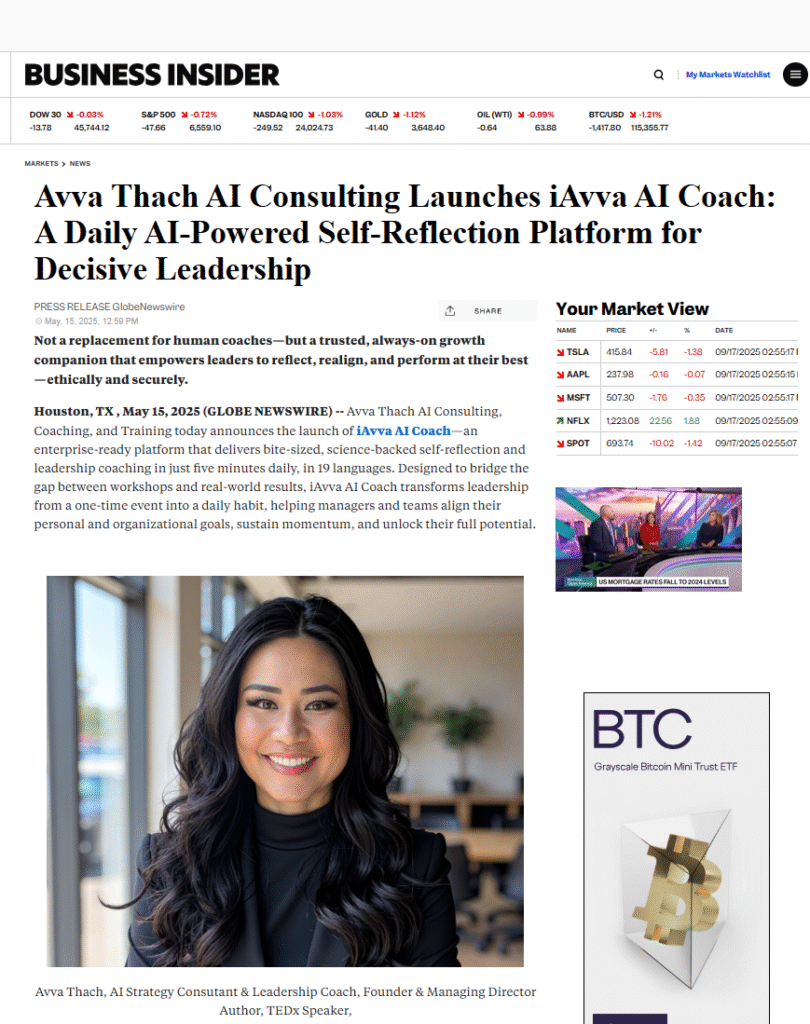
Many organizations have an AI strategy on paper yet still struggle to see changes in leadership behavior, culture, or business results. iAvva AI exists to close that gap between plans and daily actions. We combine an AI coaching platform, human coaching, AI strategy consulting, and training into one connected system.
Instead of treating leadership development, AI projects, and change management as separate efforts, we link them. This approach helps companies reduce the failure risk that Harvard Business Review highlights and convert AI transformation from a set of experiments into an engine for measurable behavior change and performance.
The iAvva AI System – Coach Platform, Human Coaching, Strategy, And Training
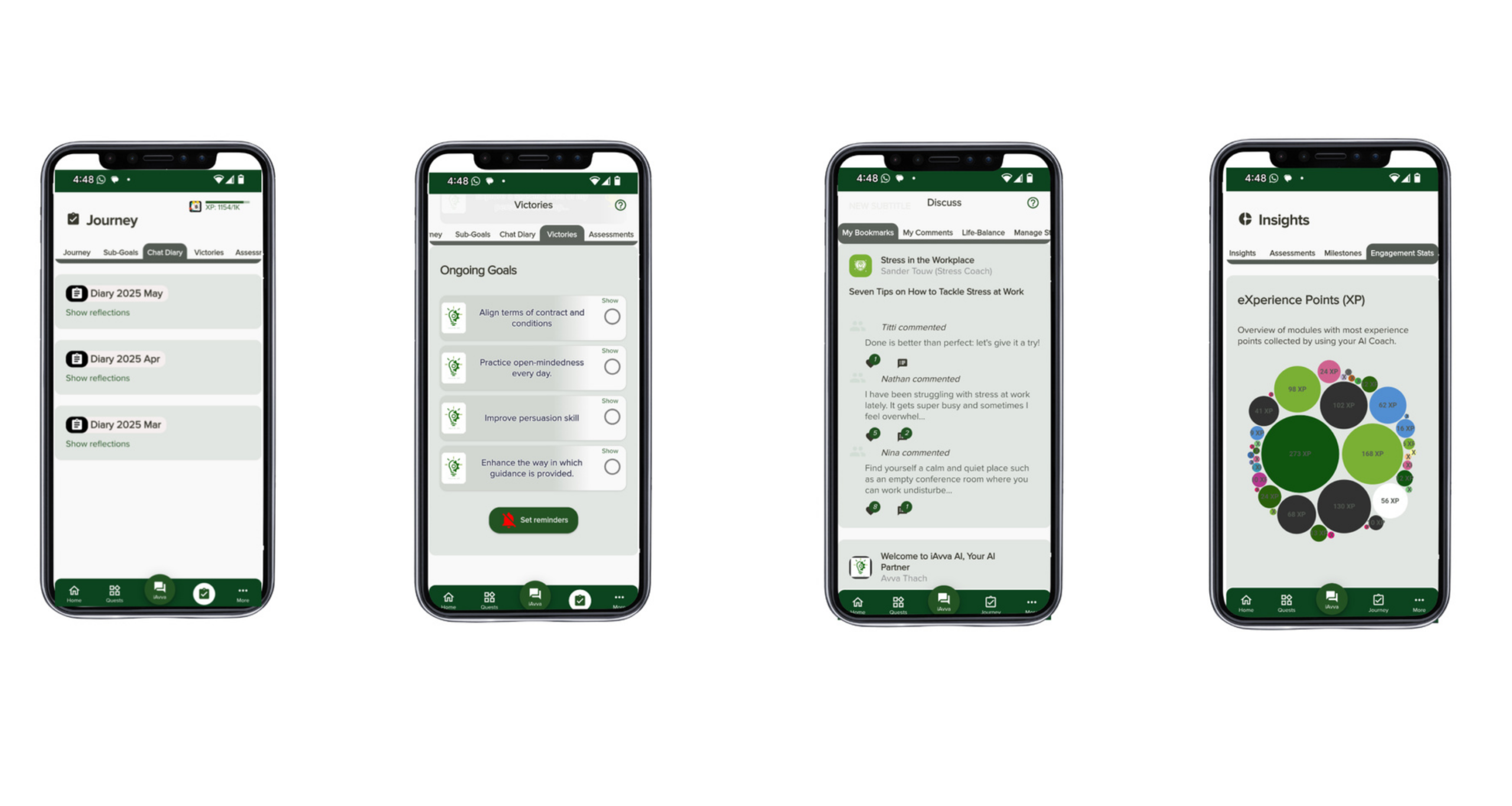
At the core sits the iAvva AI Coach, a five minute micro coaching app available on web, iOS, and Android in 19 languages. Leaders receive short, science backed prompts rooted in neuroscience, positive psychology, and ICF coaching principles. They choose Coach mode for deeper self reflection or Mentor mode for more directive guidance, which keeps the experience flexible and personal.
The platform connects personal goals directly to organizational OKRs. When a Vice President aligns a weekly focus prompt with a revenue or retention target, our analytics dashboards show HR and L&D how behavior patterns relate to those outcomes. Early adopters report gains in focus, self awareness, and productivity, which are foundations for AI ready leadership.
Around the app, we provide:
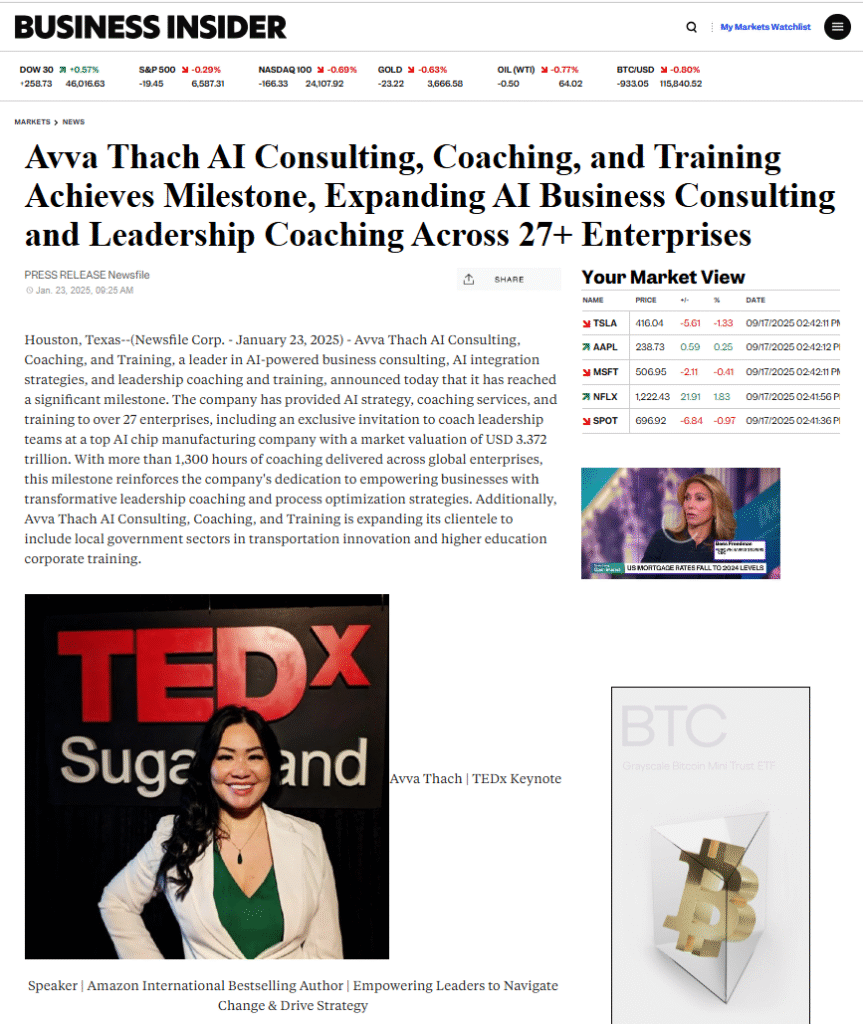
- Personalized human coaching for individuals and groups, with more than 1,400 hours delivered across 68 enterprises, including firms like PayPal and public sector bodies.
- AI strategy and automation consulting that bridges the business–IT gap, from readiness assessments through use case selection and roadmaps.
- An AI defined IT project management certification that helps IT and operations leaders guide AI programs with confidence, especially in distributed teams.
Why Our Hybrid Human+AI Model Increases Transformation Success
Digital and AI programs fail for human reasons more often than for technical ones, a pattern that the Citi Significantly Raises AI industry forecast acknowledges as enterprise deployment accelerates faster than organizations can adapt their leadership and culture. Leaders lack time for reflection, middle managers feel stuck between old and new ways of working, and IT and business teams struggle to speak the same language. Our hybrid model targets those root causes.
- Daily five minute micro coaching turns big change themes into small, repeatable actions. Leaders practice focus, self management, and clear decision making in the exact moments when AI projects need that steadiness.
- When those prompts tie to OKRs, leadership growth no longer sits apart from business performance; it feeds directly into it.
- Human coaches add depth where needed, working on resilience, emotional intelligence, and executive presence.
Our founder brings experience from a 22 billion dollar digital program at Accenture and work with senior leaders across sectors, which adds practical insight to every session. At the same time, our strategy and certification services help CIOs and project managers design AI programs with the governance, metrics, and cross functional teams that research from McKinsey and others link to success.
Because the iAvva AI Coach scales across languages and devices, you can support hundreds or thousands of leaders without losing personal relevance. That combination of reach, data, and human depth gives organizations a realistic way to raise leadership quality while they invest in AI platforms and data foundations.
How To Start Or Accelerate Your AI Transformation In The Next 90 Days
AI transformation can feel huge, yet meaningful progress often starts with a focused 90 day window. The goal is not to solve everything at once but to build shared understanding, pick a small set of high value bets, and launch one or two lighthouse efforts with clear metrics.
According to Harvard Business Review, a large share of digital programs falter because early steps lack clarity and ownership. A simple 30–60–90 day plan helps leaders, HR, L&D, and IT move together instead of in separate tracks.
A 30-60-90 Day Action Plan For Leaders, HR, L&D, And IT
First 30 days – Shared learning and honest assessment.
- Run short, focused sessions for executives, HR, L&D, and IT that cover AI basics, practical use cases, and examples from firms such as Microsoft, Google, or Netflix.
- In parallel, take a quick inventory of data sources, systems, security posture, and leadership skills related to AI.
Next 30 days – Choose and shape one or two lighthouse initiatives.
- Use your earlier analysis to shortlist three to five potential use cases linked to clear value drivers, such as call center deflection or leadership development at scale.
- Then select one or two to start, define success metrics, and agree on owners, timelines, and rough budgets.
Final 30 days – Launch pilots and learn fast.
- Integrate AI tools into existing systems where possible so adoption feels lighter, for example by adding an AI coach into your LMS or a customer support copilot into your CRM.
- Track early data, capture stories from users, and adjust your roadmap and change plans based on what you learn.
Tip: Treat each pilot as a learning engine. Ask every team to document three things to keep, three to change, three to stop after the first month.
Where iAvva AI Fits Into Your First 90 Days
iAvva AI can plug into several parts of this first 90 day window.
- Many clients choose to make the iAvva AI Coach their first lighthouse initiative for leadership and culture. They roll it out to a pilot group of managers, tie prompts to one or two key OKRs, and use our analytics to watch changes in focus, reflection rates, and behavior indicators.
- At the same time, our AI strategy and automation consulting teams help executives refine their use case portfolio and roadmap. We guide workshops that align C-suite, HR, L&D, and IT leaders around realistic priorities, platform choices, and governance.
- For IT and operations leaders, our AI defined IT project management certification gives teams methods and language for AI era projects.
By the end of 90 days, you can have an AI informed leadership cohort in motion, a shared AI roadmap, and one or two live pilots collecting data, with iAvva AI as a partner across each step.
Closing Thoughts On AI Transformation And Leadership
AI transformation is not a single project or software purchase. It is an ongoing rewiring of how your organization decides, learns, and creates value with AI and human talent working side by side. That rewiring touches strategy, operating models, data foundations, and, most importantly, leadership behaviors.
Measurable impact comes when AI efforts link to economic value drivers, sound data pipelines, and people metrics such as engagement, skill growth, and retention. Research from McKinsey shows meaningful lifts in EBITDA when companies connect these dots and treat AI as a full system change. At the same time, sources like IDC and Harvard Business Review remind us how easy it is to spend heavily on technology without changing results.
Our experience at iAvva AI is that success grows from daily habits. When leaders receive regular micro coaching, when HR and L&D design AI ready programs, and when IT builds secure, reusable platforms, AI transformation shifts from buzzword to muscle. The next 90 days offer a chance to set that muscle in motion.
Whether you lead HR, learning, IT, or a business unit, choose one concrete step from this guide. That might be a shared learning session, a first lighthouse initiative, or a pilot with the iAvva AI Coach. Small, steady actions now can shape how your organization competes and cares for its people in the AI era.
Frequently Asked Questions
How Is AI Transformation Different From Traditional Digital Transformation?
Question: How Is AI Transformation Different From Traditional Digital Transformation?
AI transformation focuses on prediction, language, perception, and generation, not just moving paper processes into software. It treats models as living assets that learn over time and affect roles, decisions, and culture. Traditional digital change often installs static systems, while AI led change reshapes decision rights, skills, and leadership behavior across the enterprise.
How Long Does It Usually Take To See Measurable Impact From AI Transformation?
Question: How Long Does It Usually Take To See Measurable Impact From AI Transformation?
Most organizations see early impact from focused AI use cases within three to six months and broader effects over 12 to 24 months. Quick wins come from targeted projects in customer support, operations, or leadership development. Larger value appears when data foundations, platforms, and leadership habits align around AI across multiple domains.
What Skills Should My Leadership Team Develop First To Lead AI Initiatives Effectively?
Question: What Skills Should My Leadership Team Develop First To Lead AI Initiatives Effectively?
Leaders should build AI and data literacy, so they can ask good questions and judge model outputs. They also need strategic framing skills, ethical judgment, and the ability to guide change across teams. Coaching skills help them orchestrate human AI collaboration. Platforms like iAvva AI Coach can reinforce these habits through daily micro practice.
Can Smaller Organizations And SMBs Realistically Afford AI Transformation?
Question: Can Smaller Organizations And SMBs Realistically Afford AI Transformation?
Yes, SMBs can focus on a few high impact use cases and lean on SaaS tools instead of building everything themselves. Cloud platforms, AI coaching apps, and managed services lower entry costs while providing enterprise grade capabilities. The key is a narrow, value based scope and smart partnerships with firms like iAvva AI, not massive internal teams.
How Do We Manage Employee Concerns About Job Loss And Surveillance With AI?
Question: How Do We Manage Employee Concerns About Job Loss And Surveillance With AI?
Start with honest, regular communication that frames AI as support for people, not secret monitoring. Involve employees in design and pilots so they can shape how AI changes their work. Publish clear policies on data use and privacy, and highlight positive uses such as learning support, coaching, and workload relief instead of hidden tracking.
How Do We Measure The Impact Of AI On Leadership And Culture, Not Just Financial Metrics?
Question: How Do We Measure The Impact Of AI On Leadership And Culture, Not Just Financial Metrics?
Track people focused indicators such as engagement scores, leadership behavior ratings, learning completion and application, internal mobility, and retention in key segments. Use analytics from leadership and coaching platforms like iAvva AI to connect these signals to business outcomes. Over time, patterns in these measures reveal how AI supported programs shape culture and performance together.












Leave a Reply