


Introduction
“Success is the sum of small efforts, repeated day in and day out.” – Robert Collier
Quality teams often feel stuck in firefighting mode, racing to fix issues after they hurt customers or audits. That is exactly where ai in quality management changes the story.
Instead of waiting for defects, AI helps a quality management system spot risks early, predict failures, and guide better decisions. In simple terms, AI in quality management means using machine learning, natural language tools, and smart analytics to keep processes stable, documentation accurate, and people focused on higher value work. In this article, we look at how this shift affects technology, leadership behavior, culture, and why platforms like iAvva AI matter for HR, L&D, IT, and executives.
We explore use cases across the quality lifecycle, measurable business impact, risks and governance, and a practical path to act with confidence. Along the way, we show how iAvva AI links AI strategy with daily leadership habits, so quality does not depend on heroics but on repeatable behavior.
Key Takeaways
Before we go deeper, it helps to see the main ideas you can take back to your organization. These points give a fast map of where ai in quality management delivers value and where leadership comes in.
The new role of AI in quality management turns QMS from a static set of procedures into a living, data driven system. Instead of sampling and guessing, AI pulls information from MES, ERP, HR, and customer channels to guide daily action. This gives leaders real time visibility so they can support teams instead of only reacting to surprises.
Leadership and culture decide whether an AI enabled QMS actually works or stalls in pilot mode. When leaders model curiosity about data, ask better questions, and follow through on actions, people start to trust the system. Without those behaviors, even the best AI tools feel like yet another system that adds work but not value.
High impact AI use cases already exist across design, supplier quality, production, training, complaints, and post‑market feedback. Examples include predictive maintenance, automated visual inspection, risk based training, and NLP based complaint analysis. Together, these cases cut defects, shorten cycle times, and support stronger compliance.
Governance and human in the loop safeguards keep AI safe, explainable, and acceptable to regulators. That means clear rules for where AI only suggests, where it can act on low risk steps, and where humans must decide. It also means strong data protection, model validation, and easy to read audit trails.
iAvva AI speeds up AI enabled QMS change by focusing on leadership behavior, not only software. Our AI coach platform, coaching services, and AI strategy work help HR, L&D, and IT teams tie quality metrics to daily leadership habits. That closes the gap between AI strategy decks and what people actually do in plants, offices, and remote teams.
What Is AI In Quality Management And Why Does It Matter Now?
AI in quality management means using artificial intelligence to monitor, control, and improve your quality management system in real time. This modern approach matters now because data volumes, regulations, and customer expectations have outgrown manual, reactive quality methods.
Organizations rely on integrated systems, sensors, and learning platforms that generate massive amounts of quality related data. Manual spreadsheets and infrequent audits miss patterns that machine learning models can see in minutes. At the same time, regulators such as the FDA and frameworks like ISO 9001 expect better traceability and faster responses across global operations.
According to Greenlight Guru, more than 70 percent of MedTech professionals see AI as useful for analyzing both market and internal business system data — a trend backed by broader AI in Healthcare: Statistics research showing accelerating adoption across regulated industries. For HR Directors, CLOs, CIOs, and the C‑suite, this turns ai in quality management from a niche technology decision into a board level topic. The question is no longer if AI will shape quality, but how leaders guide that change.
From Traditional QMS To AI-Enabled Quality Systems
Traditional QMS setups depend on people to collect data, complete forms, route documents, and prepare for audits. Information lives in silos, status reports arrive late, and corrective actions often start only after a customer complaint or inspection finding. This creates stress, finger pointing, and long cycles before the same issue appears again in a different plant or region.
AI enabled quality systems still follow your core QMS structure, but they add machine learning, natural language processing, and predictive analytics on top. These tools pull data from MES, ERP, LIMS, CRM, and HRIS systems, then watch for patterns such as small parameter shifts or repeat training gaps. Instead of static reports, leaders see live dashboards backed by models that flag risk before it reaches the customer.
In practice, this means moving from defect correction to defect prevention and prediction. For example:
- Sensor data linked to equipment history can signal that a filling line or CNC machine needs service before measurements drift.
- Complaint text combined with production data can indicate a design risk long before failure rates rise.
When ai in quality management runs in this way, quality shifts from back office function to shared decision support for operations, HR, and executives.
Why AI In Quality Management Is A Leadership And Workforce Issue
AI changes what quality professionals, supervisors, and executives do each day. Routine data entry, report building, and manual tracking shrink, while time spent on analysis, coaching, and cross functional problem solving grows. That shift requires skills in data literacy, AI interpretation, and change leadership far beyond the quality department.
HR Directors and CLOs play a central role here, because they shape learning programs and leadership models. If leaders do not know how to question AI outputs, interpret dashboards, or guide teams through new workflows, adoption falters. Analysis from Harvard Business Review shows that 56 to 70 percent of digital change programs miss their goals, mostly for people and culture reasons rather than pure technology issues — a pattern confirmed by Digital Transformation Failure: 2026 research tracking failure rates across industries.
Without investment in skills and behavior, ai in quality management becomes expensive shelfware. Training, coaching, and clear communication are needed so people see AI as a helpful colleague, not as a threat to jobs or professional pride.
How Does AI Improve Quality Management Across The Lifecycle?
AI improves quality management across the lifecycle by linking data and decisions from design through supplier quality, production, and post‑market feedback. Instead of treating each stage as separate, ai in quality management creates a connected chain where information flows both forward and backward.
- In design and development, AI uses historical defects, complaints, and test data to highlight risky design choices early.
- During supplier selection and monitoring, AI driven scoring helps teams focus on suppliers with higher defect or delay risk.
- In manufacturing and service, predictive maintenance and automated inspection keep processes stable and safe.
- After launch, NLP analysis of complaints and reviews feeds directly into CAPA and design improvements.
Survey data cited by Greenlight Guru reports that 76 percent of MedTech leaders see AI as useful for market data analysis, and 71 percent see value in analyzing internal business systems, consistent with 120+ AI In The MedTech industry statistics compiled for 2026. That same pattern now appears in pharma, automotive, aerospace, and public sector environments. When HR, L&D, IT, and quality leaders work together, AI can shrink firefighting and create more time for improvement work.
Core AI Use Cases In Quality And Compliance
Several core use cases show up in nearly every AI enabled QMS:
Automated data collection takes information from machines, sensors, MES, ERP, and HR or training systems without manual typing. This reduces human error and gives leaders near real time visibility into deviations, training status, and process drift.
Advanced analytics and anomaly detection spot patterns that people rarely notice on their own. Small but consistent changes in temperature, cycle time, or supplier performance can signal future defects. AI driven root cause support then connects events, process parameters, and human factors such as overtime or staffing levels to guide smarter CAPA choices.
Intelligent document control uses natural language processing to index and connect SOPs, work instructions, and policies. The system flags inconsistent wording, outdated references, or missing links between procedures and regulations. For global organizations, AI supported translation keeps documents aligned across languages while quality and regulatory teams retain final approval.
Together, these use cases make compliance management easier while lifting the ceiling on quality performance, as validated by AI for quality management: peer-reviewed research published in Springer Nature.
High-Value Application Areas For HR, L&D, And Operations
For HR, L&D, and operations leaders, some application areas matter especially strongly:
AI based training and competence management connects learning records, assessment scores, and on the job errors — an approach supported by Deep Learning-Enhanced Industrial Visual inspection research demonstrating how multi-agent AI collaboration improves manufacturing quality assurance. This helps teams focus training on the roles and sites with the highest risk, rather than pushing the same modules to everyone.
Supplier quality and external partner scoring use performance data, audit results, and external signals to highlight where extra oversight or support is needed.
Complaint and feedback analysis uses NLP on tickets, surveys, and reviews so voice of the customer guides both quality and leadership development content.
When these insights reach supervisors and executives, they can shift time away from constant escalation toward coaching, prioritization, and long term improvement.
Where Does Generative AI Fit In Quality, Regulatory, And Training Work?
Generative AI supports quality management by drafting, summarizing, and refining text, code, and even structured templates that quality teams use every day. Rather than replacing experts, it gives them solid first drafts and focused summaries so they can spend more time on judgment and less on blank pages. In this way, ai in quality management extends from analysis into content creation.
Generative models trained on your approved SOPs, templates, and prior submissions can prepare drafts for review. Quality and regulatory staff keep control, but they start from higher quality inputs and cut hours from routine tasks. For HR and L&D, this also means faster creation of training modules, quizzes, and coaching prompts linked to real QMS content.
According to IQVIA, there are more than 101,000 global regulations and reference documents, with over 8,000 new items each year. That pace makes manual tracking almost impossible, which is why generative AI combined with surveillance tools has become so attractive in quality and regulatory work.
Generative AI For QMS And Regulatory Documentation
Quality and regulatory documentation often carry heavy, repeatable structure. Generative AI supports this by drafting SOPs, work instructions, audit responses, CAPA narratives, and deviation reports based on existing patterns. Teams prompt the model with context, choose from suggested structures, and then refine content using their expertise and local knowledge.
In regulatory affairs, generative AI can prepare sections of submissions, labels, and regulator responses based on past approved files and current data. When regulations change, AI summarization highlights key differences and points quality leaders to the impacted procedures, risk documents, and training plans. Research from IQVIA shows that regulatory updates arrive roughly every 13 minutes somewhere in the world, which underlines why support of this kind matters.
Governance still matters strongly here. Organizations need human review, clear version control, and audit trails that show where AI produced text and where humans edited. With these controls in place, generative AI within ai in quality management becomes a safe accelerator instead of a risky shortcut.
Digital Assistants And “Quality Bots” For Frontline Support
Conversational quality assistants answer everyday questions from frontline workers, supervisors, and new hires. Instead of searching through long SOPs, an operator can ask the assistant how to clean a device, log a deviation, or prepare for an audit. The bot then returns the exact steps, drawn from approved documents, in a simple format.
Role based behavior means a line operator sees different detail from a plant manager, even when they ask similar questions. During audits or CAPA meetings, a leader can pull quick summaries and document links in seconds instead of digging through folders. For distributed teams, multilingual assistants help people in different regions follow the same intent of a procedure while respecting local language needs.
Now connect that to coaching. When a quality assistant pairs with leadership support from a platform like iAvva AI, leaders receive both just in time process guidance and micro reflections on how they communicate, decide, and follow through. This combination turns digital assistants into a daily support layer, not a replacement for human mentoring.
What Are The Measurable Benefits Of AI In Quality Management?
The benefits of ai in quality management reach far beyond IT dashboards. Organizations see faster cycle times, fewer defects, better audit outcomes, lower costs, and improved employee experience when AI is used well. Executives care because these gains appear directly in revenue, margin, and risk profiles.
Research from McKinsey estimates that generative AI could add up to 4.4 trillion dollars per year to the global economy, and 30+ AI In The medical industry statistics show how this value is already materializing in healthcare and life sciences quality functions. Field experiments by Harvard University, MIT, and Boston Consulting Group show productivity lifts of up to 60 percent on certain knowledge tasks when AI support is present. When those same principles apply to quality and regulatory work, the upside is clear.
At the same time, IDC projects that digital change spending will exceed 3.4 trillion dollars by 2026, as reported by IDC. Leaders want to see which parts of that spending actually reduce risk, speed up delivery, and improve customer trust. Ai in quality management gives some of the clearest lines from AI investment to measurable outcomes.
Productivity, Velocity, And Cost Impact
On the productivity side, AI reduces time spent on manual data gathering, basic reporting, and first draft writing. For example:
- Quality engineers who once spent hours compiling deviations and CAPA summaries can now review AI generated drafts in minutes.
- Regulatory staff can answer authority questions faster because relevant history and patterns appear in seconds, not days.
Faster documentation cycles shorten lead times for change control, product updates, and market entry. Instead of waiting for scattered inputs, teams pull from unified data sets where AI already checked for gaps and inconsistencies. This tighter loop cuts waiting time in workflows, which reflects directly in time to market and time to resolution metrics.
Cost impact appears through fewer defects, less rework, and lower unplanned downtime. Predictive maintenance models schedule service when assets actually need attention, rather than on fixed intervals or after a breakdown. Automated inspection reduces scrap, while better supplier insights prevent deliveries that would otherwise trigger line stops or recalls. Together, these shifts affect both operating expense and gross margin in a visible way.
Quality, Compliance, And Workforce Experience Outcomes
Quality outcomes improve because issues surface earlier and with more context. AI driven monitoring finds small signals in process, complaint, and training data that point to rising risk, a capability advanced by frameworks like EvoDeep-Quality: A Closed-Loop Hybrid integrating CNN-LSTM models for continuous quality feedback loops. Quality teams can then act before defects reach the field, reducing complaints and protecting brand trust with regulators such as the FDA and notified bodies under ISO 13485.
Compliance posture strengthens as documentation stays aligned with current regulations, and as training records map cleanly to procedures and roles. AI supported audit preparation gathers evidence and status views automatically, which reduces stress for teams and shortens preparation time. Employees experience less repetitive data handling and more space for meaningful work such as problem solving and coaching.
For HR and L&D leaders, this forms a base for a culture of continuous learning and quality ownership. People see that data does not just punish errors but also highlights improvement and good performance. When platforms like iAvva AI add daily micro coaching on top of these insights, quality and leadership growth reinforce each other.
What Risks, Challenges, And Governance Issues Come With AI In Quality?
AI in quality management brings new risks along with new capabilities. Data privacy, security, model bias, explainability, and resistance from staff are real concerns. For regulated industries, ai in quality management only works when governance is clear and regulators can see how decisions happen.
Quality, IT, HR, and legal teams need shared rules for data use, access, and retention. They also need standards for how AI models are selected, validated, updated, and retired over time. Without this shared frame, well meant pilots can create audit exposure or erode trust among employees and customers.
According to Harvard Business Review, most large change programs still miss their intended goals, often due to unclear ownership and weak communication — a challenge explored in depth by The Seventy Percent: Why IT transformation has remained statistically difficult for over a decade. AI enabled QMS projects face the same trap if leaders treat them as IT upgrades instead of cross functional changes that reshape work.
Data Privacy, Security, And Integration With Legacy Systems
Quality data often includes sensitive pieces about patients, customers, suppliers, and employees. Records may include health information, complaint details, pricing, or training performance. Regulations such as GDPR and HIPAA, along with local labor laws, set clear rules on how this data is handled and who may see it.
To keep AI safe in this space, organizations use:
- Encryption and secure storage
- Strong identity management and multi factor authentication
- Tight role based access and least privilege principles
IT leaders and CISOs design logging and alerting so any unusual data access stands out quickly. When AI models read or generate content, those actions need traceable records so auditors can review them later.
Integration with legacy systems brings another challenge. Many plants and offices still run paper forms, standalone databases, or older QMS tools. To connect ai in quality management correctly, teams often rely on APIs, data lakes, and phased digitization. Joint ownership between IT, quality, and HR helps clean data, retire redundant tools, and avoid hidden spreadsheets that bypass official systems.
Explainability, Trust, And Change Management
Black box AI does not fit well in safety or quality sensitive settings. Quality managers, regulators, and auditors need to see why a model suggested a certain risk level, root cause, or action. That is where explainable AI practices come in, with features that show drivers, confidence scores, and links back to source data.
Change management is equally important. People worry about job loss, loss of status, or loss of professional judgment when AI starts to appear in their tools. Honest communication about goals, limits, and safeguards helps, as does clear proof that final accountability stays with humans. Training on how to question AI output and when to escalate issues builds confidence.
As quality pioneer W. Edwards Deming noted:
“Without data, you are just another person with an opinion.” – W. Edwards Deming
When leaders pair that mindset with respect for people and their expertise, ai in quality management can support better decisions instead of replacing human judgment.
How To Implement AI In Quality Management With Confidence
Implementing ai in quality management with confidence means treating it as a staged program that blends technology, governance, and people development. Rather than chasing every new feature, leaders select focused use cases that match business goals and data readiness. They then build guardrails, measure impact, and scale what works.
For HR, L&D, and IT leaders, this approach reduces fear that AI projects will drain resources without results. It also provides a clear story to share with employees and regulators about why certain changes happen first and how success will be judged. When teams see progress, motivation grows for later stages.
Research from IDC shows that organizations will invest trillions in digital projects over the next few years. A clear path for AI in quality raises the odds that your share of that spending produces lasting benefits.
Assessing Readiness And Prioritizing AI Use Cases
A readiness check starts with mapping how quality work happens today. Teams identify where defects, delays, or audit findings cluster, and where manual steps slow things down. This map includes not only production and lab processes, but also training, supplier control, and complaint handling.
Next, leaders review data maturity. They look at:
- Which systems generate structured data
- Where files and emails still rule
- Where key information sits in the heads of a few experts
IT and quality staff rate each area on data quality, availability, and privacy risk. This honest view sets the stage for realistic AI plans.
From here, a small portfolio of starter use cases comes into view. Common picks include anomaly detection on process data, automated document indexing, and AI supported training gap analysis. HR and L&D often join early through pilots on risk based training for deviations and CAPA. Finance and site leaders join the review so every chosen case has clear value, feasibility, and regulatory acceptability.
Governance, Business Case, And Human-In-The-Loop Design
Governance for ai in quality management defines who approves models, who monitors performance, and who owns decisions when AI suggests an action. Clear rules describe:
- Which steps AI may automate
- Which steps need human review
- Which steps AI may never touch
These rules appear in quality manuals, IT policies, and training content so they stay visible.
A strong business case links AI work to defect reduction, downtime savings, audit preparation effort, and time to market, and teams can benchmark their approach against the Digital Transformation Failure Rate: analysis of why most projects fall short of their projected returns. Finance teams help quantify both hard savings and softer gains such as improved employee retention or faster onboarding. Success metrics then appear in dashboards so leaders can adjust course as they learn.
Human in the loop design keeps experts central through features like approval queues, simple feedback mechanisms, and override options. When staff can correct AI suggestions and see that the system learns over time, trust grows. Platforms like iAvva AI can support this phase by coaching leaders on decision habits, communication, and follow through so governance policies come to life in daily behavior.
How iAvva AI Accelerates AI-Enabled QMS Transformation
iAvva AI accelerates AI enabled QMS change by focusing on the human side that often limits success. Where many vendors focus on software features, we combine an AI coaching platform, live coaching, and AI strategy services to support leadership behavior and culture. In other words, we help ai in quality management actually stick.
Research cited by Harvard Business Review notes that most digital change programs fail to meet targets, even with large budgets. Our experience across 68 enterprises shows that QMS and AI projects falter when middle managers lack support, when IT and business teams talk past each other, and when leaders do not model new habits. iAvva AI exists to change that pattern.
With a five minute per day AI coach, real coaches, and consulting support, we provide a connected way for HR, L&D, IT, and executives to guide both systems and people. This mix suits SMBs and large enterprises that run distributed teams and regulated operations.
Bridging The Human And Leadership Gap In AI-Driven QMS
The root cause of many QMS and AI project problems is not the algorithm but the way people lead through change. Leaders may announce new tools but keep old behaviors, such as reacting only to crises or ignoring data that challenges past decisions. Employees then fall back to old habits, and AI features sit underused.
iAvva AI addresses this through daily micro coaching based on neuroscience and positive psychology. Our iAvva AI Coach platform, validated in the Techstars accelerator, prompts leaders to reflect on how they set expectations, follow through on CAPA actions, and respond to quality signals. Over time, these five minute actions build habits that support a reliable quality culture.
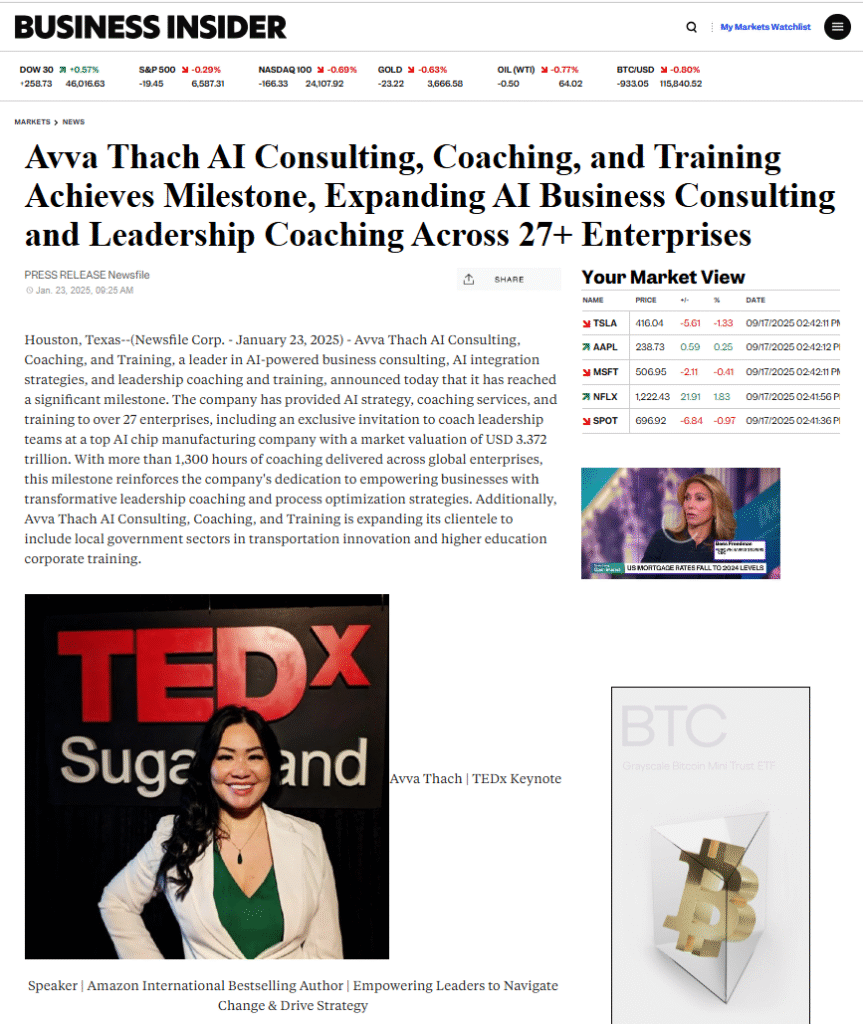
Our founder, Avva Thach, brings over 20 years of experience, including contribution to a 22 billion dollar digital program and more than 1,400 coaching hours with leaders at organizations such as PayPal and Canadian government bodies. That depth shapes how we support AI in quality settings, always linking tools back to behavior, accountability, and cross functional trust.
iAvva AI Offerings For Quality-Focused Leaders And Organizations
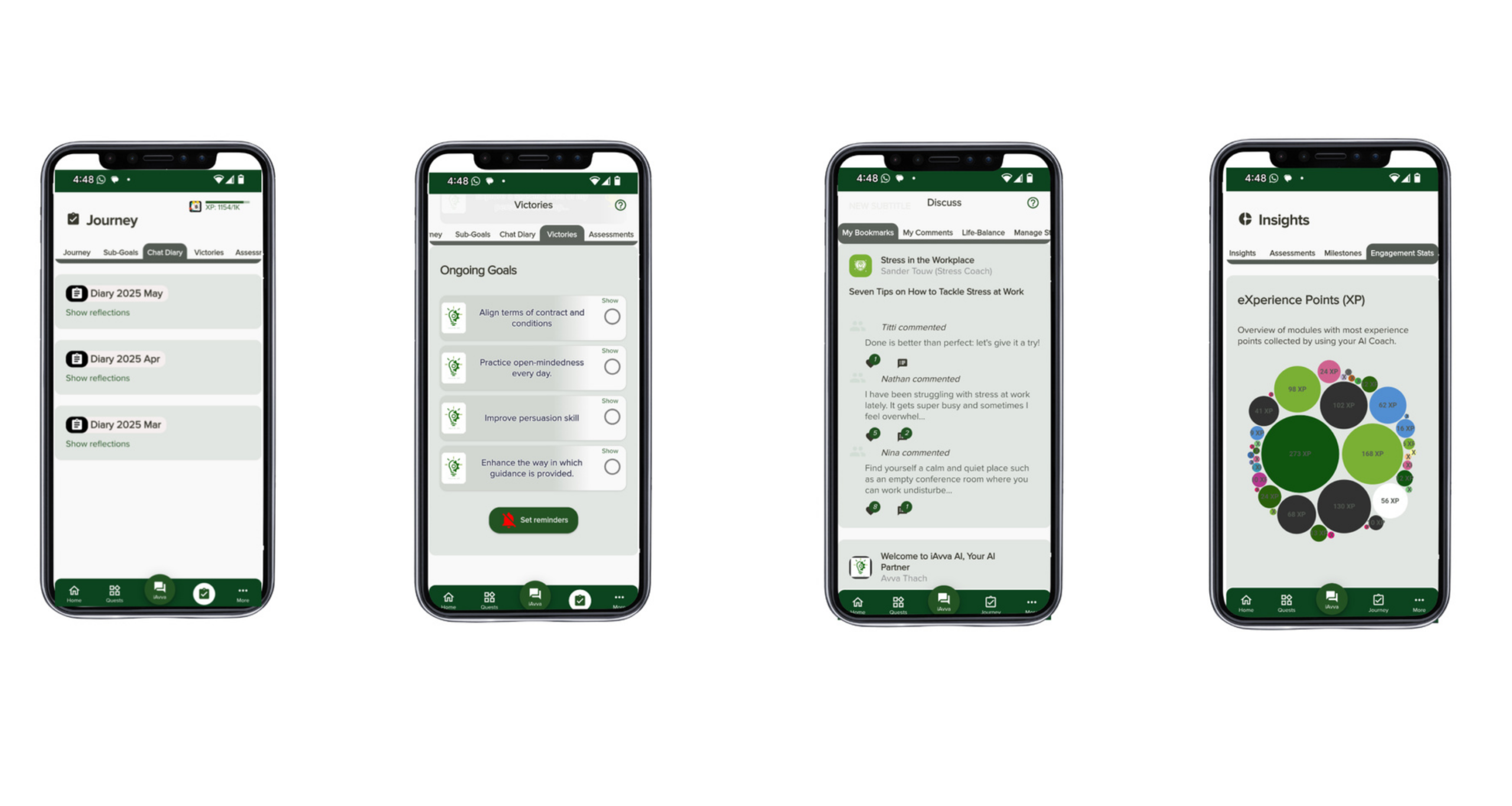
iAvva AI Coach is our enterprise grade micro coaching app for web, iOS, and Android in 19 languages. Leaders receive brief, science based prompts that tie personal goals to quality related OKRs and QMS priorities. Real time analytics help HR, L&D, and People Operations teams see engagement and growth patterns across locations, while keeping individual reflections private and encrypted.
Our 1 to 1 and group coaching services support executives, middle managers, and project teams during AI and QMS change. Coaches help leaders handle resistance, communicate clearly about AI, and connect daily routines to audit readiness and risk reduction. This support proves especially helpful for middle managers who carry pressure from both senior leadership and frontline teams.
AI strategy and automation consulting, along with our AI defined IT project management training, help IT and quality leaders design realistic roadmaps. We work with you to align AI projects with QMS goals, integration needs, and governance demands. Together, these services reduce the chance of stalled pilots and guide ai in quality management efforts toward concrete, measurable results.
Frequently Asked Questions
This section answers common questions we hear from HR, L&D, IT, and quality leaders as they explore ai in quality management. Each answer stands alone, so you can skim to the topics that match your current stage.
Question How Do I Get Started With AI In Quality Management If Our Data And Processes Are Still Manual?
You start by mapping key quality processes and where data currently sits, even if that means paper and spreadsheets. From there, pick one or two high risk, high value areas such as deviations, CAPA, or training records and digitize them first. Simple AI tools for anomaly detection or document indexing can then run as pilots. Building cross functional champions in quality, IT, and HR helps those pilots turn into real programs.
Question Can Small And Mid-Sized Businesses Benefit From AI In Quality Management, Or Is It Only For Large Enterprises?
Small and mid sized businesses can gain strong advantage from cloud based ai in quality management tools. Many modern platforms offer subscription models and configurations that fit smaller teams without heavy customization work. Practical starting points include supplier scoring, complaint analysis, and automated training reminders. Partners like iAvva AI bring both expertise and scalable coaching so SMBs get enterprise level practices at manageable cost.
Question What Skills Do Quality And Regulatory Teams Need To Work Effectively With AI?
Quality and regulatory teams need solid data literacy, critical thinking, and risk based decision skills to work well with AI. They must read dashboards, question patterns, and understand limits of models instead of accepting outputs blindly. Strong communication and collaboration with IT, HR, and operations also matter because AI touches many functions. Coaching and leadership development, supported by tools such as iAvva AI, help people grow these abilities over time.
Question How Do We Convince Our Teams That AI In Quality Management Will Not Replace Their Jobs?
You build trust by explaining that ai in quality management removes low value, repetitive work rather than core expertise. Show real examples where AI helped catch issues early, supported audits, or reduced paperwork without removing roles. Invite employees into design and testing phases so they shape how tools behave. Pair that with clear upskilling paths, coaching, and career conversations so people see future roles, not just threats.
Question What Should We Look For When Evaluating AI-Enabled QMS Or Quality Tools?
Look for tools built for regulated quality use cases rather than generic AI features. Ask vendors about explainability, validation support, and how they help with audits and regulator questions. Security and privacy features such as encryption, access control, and integration with ERP, MES, HRIS, and LMS systems also matter. Finally, check the user experience so non technical staff find the interface simple, with role based views that match their work.
Question How Can iAvva AI Work Alongside Our Existing QMS Or AI Tools?
iAvva AI acts as a leadership and culture layer on top of your current QMS and AI stack. We can use quality, training, and change data to shape coaching themes and OKRs inside the iAvva AI Coach platform. Middle managers and project leads receive micro coaching that keeps them aligned with QMS goals and AI policies. Our consulting and training offerings then help IT and business leaders connect AI projects to clear quality outcomes.
Putting It All Together
Putting ai in quality management into practice means aligning people, processes, data, and leadership habits around a shared goal of better quality. AI can read patterns, draft documents, and highlight risks, but humans still carry responsibility for choices, culture, and ethics. When those parts work together, QMS moves from firefighting tool to quiet, steady backbone for your organization.
Across this article, we saw how AI supports every stage of the quality lifecycle, from design through supplier oversight and post‑market feedback. We looked at measurable benefits in productivity, cost, and compliance alongside risks in privacy, explainability, and change resistance. The message is clear. AI for quality is no longer an experiment for a few pioneers; it has become a practical, high impact lever for SMBs and large enterprises alike.
“Quality is not an act, it is a habit.” – Aristotle
That quote sums up why leadership matters so much here. Tools can change fast, but habits change only through daily practice, reflection, and support. This is where iAvva AI stands beside your QMS and IT stack, helping leaders build the steady behaviors that high quality work demands.
By combining strong governance, human in the loop design, and leadership development, you can move from anxiety about AI to confident, staged action. When HR, L&D, IT, and quality leaders pull in the same direction, ai in quality management stops being a buzzword and starts becoming part of how your organization thinks, decides, and serves people every single day.













Leave a Reply