



AI Implementation And Organizational Change
Introduction
A few years ago, only experimental teams talked about artificial intelligence. Now reports show that more than half of companies use some form of AI, yet only a small fraction see meaningful impact from their AI implementation at scale. The gap between those two groups is not about algorithms. It is about clarity, culture, and leadership.
Many leaders feel that gap every day. On one side there is pressure from boards, investors, and employees to move fast on AI. On the other side sit very real worries about data security, talent shortages, legacy systems, and the fear that people will push back once the first AI project touches their work. It can feel as if AI implementation is a massive IT project that sits far away from human conversations, skills, and everyday habits.
We see it differently. Effective AI implementation is an organizational change that connects strategy, data, technology, and daily leadership behavior. It is not only about models and cloud platforms. It is about how teams make decisions, learn, and adapt. That is why this guide brings together hard science (neuroscience, behavioral research) and proven coaching methods with practical steps for executives, HR, L&D, IT, and business leaders.
By the end, there will be a clear, step‑by‑step roadmap that covers everything from defining business objectives and assessing readiness, through data and infrastructure, to culture, ethical frameworks, and continuous improvement. Along the way, we will show how platforms like iAvva AI help leaders build the daily habits needed to lead AI with confidence, not fear.
Key Takeaways
A clear AI implementation strategy that starts from business objectives and human outcomes instead of technology for its own sake. This keeps investments focused on measurable impact instead of scattered experiments that never reach production.
A practical method to cut implementation risk by a large margin through honest readiness assessments that cover data, infrastructure, skills, and culture. This helps leaders stage their roadmap in a way that fits current capacity while building toward higher maturity.
An understanding of how AI implementation can raise decision quality, productivity, and customer experience across HR, operations, sales, and service. Leaders will see where AI can support their own teams rather than replace them.
A people‑first approach that connects culture, change management, and leadership development to every technical decision. This reduces resistance, builds trust, and keeps ethics and inclusion at the center of AI programs.
A structured twelve‑step framework that shows how to move from first pilot to scaled AI implementation, with guidance on monitoring, model drift, and continuous improvement. This turns AI into a long‑term asset instead of a one‑off project.
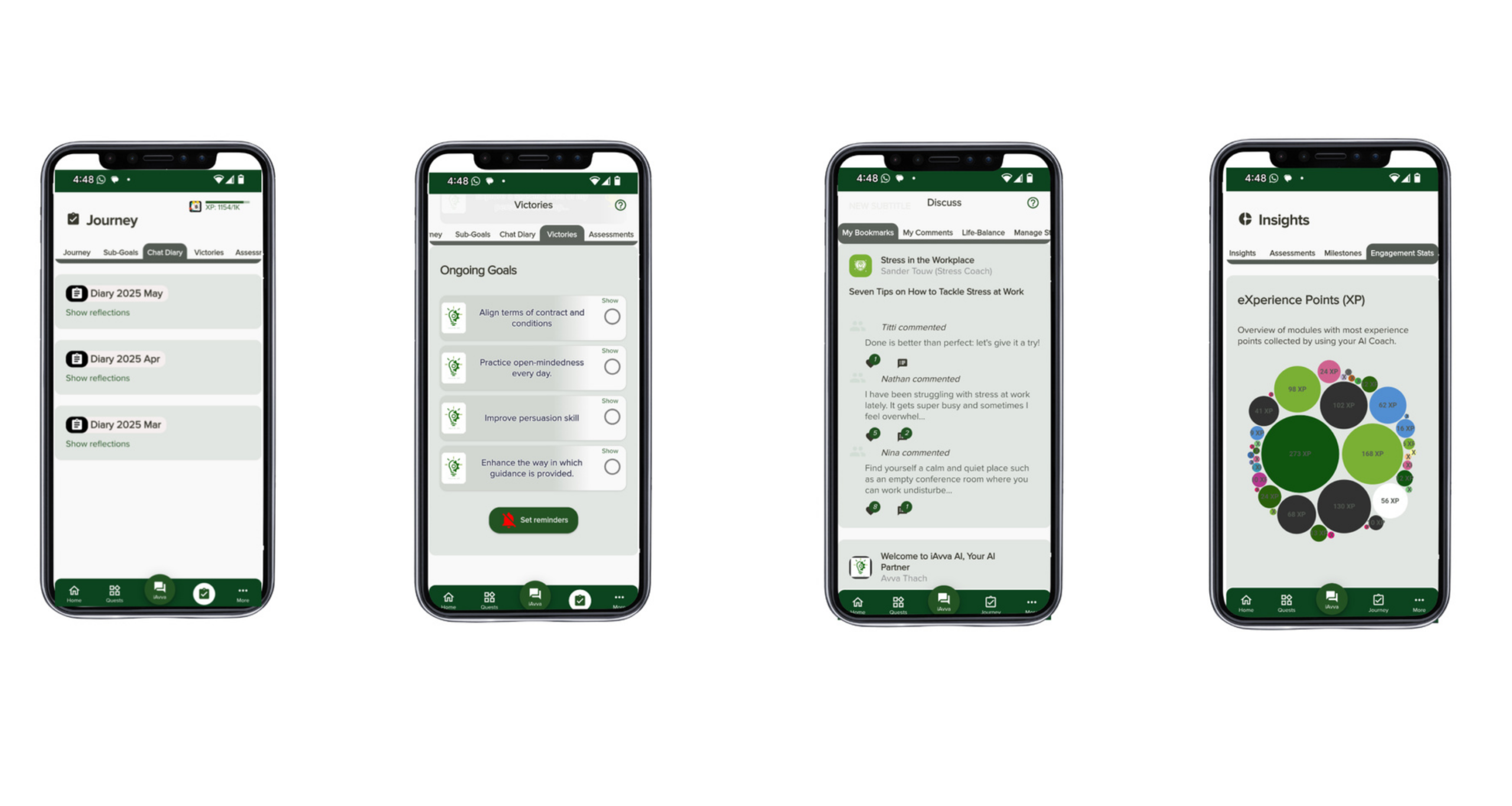
Insight into how iAvva AI’s coaching platform supports this work by building daily leadership habits, aligning personal goals with OKRs, and giving HR and L&D real‑time analytics that link growth to business results.
What Is AI Implementation And Why It Matters Now
When we talk about AI implementation, we mean much more than installing a chatbot or plugging an API into an existing app. At an executive level, AI implementation is the planned, repeatable process of using AI to change how the organization decides, operates, serves customers, and develops people. It spans strategy, data, technology, governance, and culture.
This matters now because AI is no longer a nice‑to‑have advantage. As competitors standardize on AI support for forecasting, personalization, and process automation, the baseline for performance rises. Companies that treat AI implementation as a central part of strategy build resilience. They can adjust faster to shocks, learn from data in real time, and test new business models at lower risk.
It is also important to distinguish AI implementation from simple automation or digitization. Automation replaces manual steps with scripts or rules. Digitization moves paper and offline tasks into software. AI implementation does both of those and then goes further by learning from data, improving over time, and supporting complex decisions that used to depend only on human judgment.
Effective AI implementation usually rests on five pillars:
- A clear strategy connected to business goals
- Data that is accurate, secure, and accessible
- Suitable technologies and platforms
- People with the right skills and mindsets
- A culture that supports experimentation, ethical thinking, and ongoing learning
The difference between superficial AI adoption and strategic AI implementation becomes clear when we look at how they behave.
| Dimension | Superficial AI Adoption | Strategic AI Implementation |
|---|---|---|
| Scope | One‑off pilots in single teams | Portfolio of use cases across functions |
| Ownership | Owned only by IT or data teams | Shared by business, HR, IT, and leadership |
| Data | Siloed, inconsistent, weak governance | Integrated, high‑quality, governed with clear policies |
| Culture | Suspicion, fear, low transparency | Open communication, learning mindset, ethical focus |
| Outcomes | Local efficiency gains, hard to measure | Clear impact on revenue, cost, risk, and people development |
AI implementation is not only for big tech firms. SMBs with 50‑5000 employees are often better positioned because they can move faster once they have clarity and a strong cross‑functional team. With thoughtful AI implementation, even a mid‑sized company can gain measurable uplifts in forecast accuracy, customer retention, and employee engagement.
“Artificial intelligence is the new electricity.” — Andrew Ng
Treating AI as core infrastructure rather than a side experiment is what separates lasting gains from one‑off pilots.
The Business Case For Strategic AI Implementation
Before asking people to back an AI implementation roadmap, leaders need a clear, numbers‑driven case. That case must connect directly to the metrics that matter to the board and to each function. When we do this well, AI stops sounding like a buzzword and starts looking like a practical lever for growth and risk reduction.
One of the strongest cases is decision quality. Modern AI can scan millions of records, pick up weak patterns, and surface insights in seconds. For example, AI‑driven forecasting helps revenue leaders see which deals are at risk and where to focus coaching. In operations, it helps planners predict demand spikes and adjust supply before issues hit customers. Research shows that AI implementation impact on workforce productivity depends heavily on proper AI training and organizational adaptation, enabling leadership teams to build decisions on that kind of intelligence and move faster with more confidence.
Productivity and efficiency gains are just as compelling. AI implementation shines when it takes repetitive work off people’s plates:
- HR teams can move from manual résumé screening to AI‑assisted shortlists.
- Customer service can route tickets based on intent, with virtual agents handling simple requests.
- Employees then use their time for high‑value work such as problem solving, relationship building, and coaching their teams.
Cost savings follow from these shifts. Predictive maintenance can cut unplanned downtime and repair costs. AI‑assisted scheduling can reduce overtime and contractor spend. In finance, anomaly detection can lower fraud and error losses. It is common to see double‑digit reductions in specific cost lines once AI implementation is tied to clear process changes.
Customer experience is another strong pillar. With AI, marketing and service teams can move from segment‑level messages to personalized interactions across channels. Recommender engines improve cross‑sell rates. Smart routing cuts wait times. Sentiment analysis shows which customer groups are at risk so teams can step in before churn rises. These improvements show up directly in loyalty metrics and lifetime value.
AI implementation also supports scale without linear headcount growth. When AI handles the repeatable parts of intake, triage, analysis, and reporting, companies can serve more customers, launch more products, or support more regions without a matching increase in full‑time staff. That is especially valuable for HR and L&D teams that must support growing global workforces.
Finally, there is the cultural and leadership effect. When people learn to ask better questions of data, use AI as a thinking partner, and see clear links between their goals and business outcomes, the whole organization becomes more data‑literate. Platforms like iAvva AI reinforce that shift by turning leadership development into a daily habit that feeds directly into OKRs and business KPIs.
Understanding The Critical Challenges In AI Implementation
If AI implementation were easy, every organization would already be reaping the rewards. The reality is that many AI projects stall or die after the first pilot. These challenges are not a sign that something is wrong with the company. They are normal obstacles that can be handled with clear planning.
Data quality and availability sit at the heart of most problems. When data is incomplete, inconsistent, or scattered across systems, AI models learn from a distorted picture. The familiar idea of “garbage in, garbage out” turns into wrong predictions, unfair decisions, and broken trust. Fixing this means investing time in data audits, integration, and ongoing quality checks.
Security and risk are another concern. AI systems often touch sensitive personal data, financial records, or confidential product plans. That larger attack surface worries boards and regulators. Organizations must treat AI as part of their overall security posture, not as a side project. That includes encryption, access controls, monitoring, and clear incident response plans.
Talent and skills shortages slow many AI implementation plans. Data scientists, machine learning engineers, and experienced product owners are in high demand. Factors influencing readiness for AI adoption, including leadership confidence and organizational culture, significantly impact implementation success, and business leaders and HR teams may not yet feel confident in AI topics. This combination can lead to misaligned expectations, unrealistic timelines, and friction between teams.
Integration with legacy systems is a frequent pain point. Many companies try to plug modern AI tools into old platforms that were never designed to share data or support real‑time connections. Custom integration work then becomes long, fragile, and expensive. Without a clear view of the current IT environment and a plan to modernize over time, AI projects can get stuck in technical glue.
Infrastructure limitations show up when models need more computing power or storage than current systems can offer. Training deep models or running real‑time recommendations calls for scalable cloud or high‑performance hardware. When these are missing, teams cut corners on model design or suffer slow performance that frustrates users.
Financial concerns also appear early. AI implementation demands spending on data, infrastructure, talent, and change management before the big wins arrive. If leaders cannot explain the link between use cases and ROI, skepticism grows. Projects then suffer from stop‑start funding and lose momentum.
Organizational resistance can be the hardest obstacle. Employees may fear job loss, feel judged by automated metrics, or simply prefer familiar workflows. Without thoughtful change management and open communication, even a well‑designed AI system will see low adoption.
Ethical questions add another layer. Bias in data, opaque models, and unclear accountability can lead to unfair or harmful outcomes. Regulators are paying close attention, and so are customers and employees. That means AI implementation must include governance, transparency, and human oversight from day one.
Various studies show that a large share of AI projects never move beyond pilot stages, often because these issues are treated as afterthoughts instead of design inputs.
The good news is that every challenge above has known mitigation patterns. The rest of this guide walks step by step through those patterns.
Step 1 Define Clear Business Objectives And Measurable Success Criteria
When AI implementation starts with “We should use AI somewhere,” trouble follows. Budgets get spent on cool experiments that never tie back to revenue, cost, risk, or people outcomes. The first step is to ground everything in sharp, business‑aligned objectives.
Vague goals such as “improve efficiency” or “use generative AI in HR” are not enough. Strategic objectives describe a specific problem, a target metric, and a time frame. They also state which group owns the outcome. That clarity guides technology choices, data needs, and change efforts.
We suggest starting by mapping key processes in each function. In HR, this might include hiring, onboarding, performance conversations, and leadership development. In operations, it may cover demand planning, maintenance, and logistics. For each process, leaders can ask a few core questions:
- Where do delays, errors, or bottlenecks show up again and again. These pain points often point to tasks that are rule based or data heavy, which are strong candidates for AI support.
- Which decisions rely mainly on instinct even though data exists somewhere in the company. These are opportunities where AI models can surface patterns that humans miss, while people still make the final call.
- Where do customers or employees report frustration or long wait times. These experiences often signal broken workflows that AI‑driven triage, routing, or personalization can improve.
From this discovery, teams can write concrete AI implementation objectives. For example, reduce time to first response in customer service by 40 percent within six months through AI‑assisted routing and virtual agents. Or improve forecast accuracy for monthly sales by 15 percent, so finance can plan cash and hiring with more confidence.
Different functions will generate different objectives. Marketing may focus on raising conversion rates with recommendation engines. Operations may target lower inventory carrying costs with demand forecasting. HR and L&D may aim to raise leadership program engagement using AI‑powered coaching platforms such as iAvva AI, linked directly to OKRs.
An “AI‑first scorecard” can then help prioritize. This is a simple tool that scores each potential use case on impact, feasibility, data readiness, and cultural acceptability. High‑score items move into near‑term plans, while lower‑score ideas shift into later phases.
Finally, teams need measurable success criteria. These include model metrics such as accuracy and recall, system metrics such as response time, and business metrics such as revenue, cost, satisfaction, or risk indicators. The guiding rule is clear and worth stating plainly in bold. Start with business problems, not technology choices. When that principle holds, AI implementation becomes far less risky and far more rewarding.
Step 2 Conduct A Comprehensive AI Readiness Assessment
Once objectives are clear, the next question is simple. Are we ready to deliver on them. A structured AI readiness assessment gives an honest answer. It stops over‑promising, highlights gaps, and informs a realistic roadmap.
This assessment looks at four main dimensions:
- Data
- Technical infrastructure
- Talent and skills
- Strategic and cultural readiness
Skipping any of these areas leads to surprise delays later.
Data Infrastructure Assessment
Data is the fuel for AI implementation, so we start here. The goal is to understand what data exists, how good it is, and how easy it is to access.
We review both structured data such as HR records, CRM entries, and ERP tables, and unstructured data such as emails, chat transcripts, documents, and support tickets. We look at how many copies exist, how often they update, and which systems “own” them. A key part of this review is spotting silos where departments store data separately in ways that block AI from seeing the full picture.
Quality is just as important as quantity. During the assessment, teams sample data sets to check for missing fields, inconsistent naming, duplicates, and stale values. They also check whether the data reflects the current business reality or an outdated version. This is where we begin to plan data cleaning and ongoing quality monitoring.
Technical Infrastructure Assessment
Next comes the question of whether the current environment can support AI workloads. That includes compute, storage, networks, and software platforms.
Teams look at whether they already use cloud platforms or still rely only on on‑premises servers. Cloud services can provide scalable compute for training and prediction without massive capital spend. Storage is another anchor. Data lakes and warehouses allow large volumes of data to be stored and queried in a way that AI models can use.
Integration capabilities matter too. Modern AI often depends on APIs and event streams. If current systems cannot expose or consume these, integration becomes slow and brittle. Security posture is also reviewed, including identity management, encryption, logging, and monitoring.
Talent And Skills Assessment
Even the best infrastructure cannot run itself. AI implementation needs people who understand data, models, and business context.
The assessment starts by listing existing roles: data analysts, BI developers, software engineers, HR and L&D specialists, and so on. We then look for AI‑related skills within these groups, such as basic machine learning knowledge, data engineering experience, or prior work with AI‑assisted tools.
Skills gaps are then mapped against the target roadmap. If the organization wants to build custom models, it may need more data scientists and machine learning engineers. If the focus is adopting AI‑ready platforms such as iAvva AI for leadership development, then the gaps may sit more in product ownership and change management. AI literacy among leaders is tested through simple questions and scenario discussions.
Strategic And Cultural Assessment
Finally, we examine how ready the organization is at a leadership and culture level. This is where an AI‑first scorecard is most valuable.
We ask whether senior leaders share a clear vision for AI, or if views differ widely. We look at how many departments already use data and analytics in daily decisions. We check for history of cross‑functional work, or whether silos dominate. Change readiness is explored through past transformation efforts and how they felt to employees.
To make these insights concrete, many organizations use a simple maturity model with levels from “ad‑hoc experiments” through to “AI integrated across the business.” Each dimension gets a score, which in turn guides which steps to take in the next twelve to eighteen months.
A readiness assessment may surface hard truths, but it saves time and money. It enables leaders to say, with evidence, where they can start AI implementation now and where they must first build foundations.
Step 3 Build A Strong Data Foundation And Governance Framework
There is a simple rule for AI implementation. Models are only as good as the data they learn from. A strong data foundation is therefore not a side project. It is the basis on which every AI‑driven decision will stand.
Many organizations already have databases and reporting tools, yet still struggle when they try to feed AI models. The reason is that AI needs data that is clean, well structured, and governed across its full life cycle. That includes how data enters systems, how it moves between them, how it is secured, and how long it stays.
Data Audit And Quality Management
The first move is a thorough data audit, which can be enhanced through AI documentation enhancement services that help organizations systematically catalog and improve their data infrastructure. This is a structured review of what data exists, where, and in what condition.
Teams list all key data sources across HR, finance, operations, sales, and customer service. For each, they check volume, format, update frequency, and ownership. They then sample records to look for missing values, incorrect entries, inconsistent coding, and obvious outliers. This is where hidden issues such as multiple employee IDs or mismatched dates come to light.
From here, a data cleaning plan forms. Cleaning may include removing duplicates, standardizing formats, filling in gaps where possible, and retiring data sets that are too flawed to rescue. The audit also looks at how representative the data is of the people and situations the AI will serve, to reduce the risk of bias.
Data Architecture And Accessibility
Once we know what data we have, we must decide how to store and feed it into AI models. This is the work of data architecture.
Many organizations move toward unified repositories such as data lakes or warehouses that combine structured and unstructured data, often using centralized knowledge base platforms to organize documentation and ensure team access. The goal is to offer a single, reliable place where AI models and analysts can access the information they need. Data pipelines then move data from source systems into these stores, applying cleaning and validation rules along the way.
Accessibility is balanced with control. Business teams need enough access to explore and build use cases. At the same time, sensitive data must not be exposed to people without a clear need. Role‑based access and clear data catalogs help here. Tracking data lineage, which is the path data takes from source through every transformation, gives traceability when questions or issues emerge.
Data Security And Privacy
AI implementation almost always touches person‑level data, whether it is employees, customers, or partners. That makes security and privacy central concerns.
Strong encryption for data at rest and in transit is standard practice. Access controls, multi‑factor authentication, and network security reduce the risk of unauthorized access. Regular security audits and penetration tests help uncover weaknesses before attackers do.
Privacy is more than a legal requirement. It is part of trust. Teams should apply privacy‑by‑design thinking, which means they ask from the start whether each data field is truly needed. Where possible, data is anonymized or pseudonymized. Logging and monitoring help detect unusual access patterns that might signal misuse.
Data Governance And Compliance
Data governance brings all of this together. It describes who is responsible for which data, how decisions are made about data, and how rules are enforced.
Clear policies define data ownership, acceptable use, retention periods, and sharing rules. A data governance council or similar group brings together representatives from IT, security, HR, legal, and key business functions. This group reviews new AI use cases to check alignment with regulations such as GDPR, CCPA, and sector‑specific rules.
A simple checklist is handy when building data governance for AI implementation:
- Define data owners and stewards for each major data domain. These people take responsibility for quality, access, and compliance in their area and act as points of contact for AI teams.
- Document where data comes from, how it is processed, and where it goes next. This record supports audits, debugging, and transparent communication with customers and employees.
- Set up routines for monitoring data quality and security over time. Reviews can be monthly or quarterly depending on risk, and should include metrics, incidents, and planned improvements.
With this foundation, AI models have a reliable, secure, and accountable base to learn from. In every project we see, strong data work pays for itself in better model performance and lower risk.
Step 4 Select The Right AI Technologies, Tools, And Platforms
Once goals and data foundations are clear, it is tempting to chase the newest AI tool on the market. That path often leads to flashy demos and little real impact. Technology choices should follow the problem, the context, and the level of readiness.
We start with a simple principle. Different AI methods fit different tasks. Matching the method to the need avoids over‑engineering and keeps systems easier to maintain.
Understanding AI Methodologies
Machine learning is the broad field most people think of when they hear AI. Within that field, several patterns are especially useful in business.
Supervised learning works when we have past examples with known outcomes. Churn prediction, credit risk scoring, and ticket classification fit this pattern. The model learns from labeled data and then predicts labels for new cases. Unsupervised learning helps when we want to find structure in data without labels, such as customer segments or unusual behavior in transactions.
Reinforcement learning is useful in settings with actions and feedback, such as dynamic pricing or recommendation engines that learn from click behavior over time. It learns by trying actions and seeing which ones lead to better long‑term rewards.
Natural language processing (NLP) focuses on human language. It powers chatbots, document summarization, sentiment analysis, and more. For HR and L&D, NLP can analyze open‑text feedback, help write job descriptions, or support coaching reflections. Computer vision, by contrast, works on images and video for tasks such as quality checks, ID verification, or monitoring physical spaces.
Deep learning uses multi‑layer neural networks to handle very complex patterns. It underpins many modern NLP and vision systems. Deep models can be very powerful, but they may be harder to explain and require more data and compute.
Infrastructure And Platform Decisions
The next set of choices concerns where these models run and which platforms support them. Many organizations now favor cloud platforms for AI implementation.
Cloud providers offer managed services for training, hosting, and monitoring models. That means teams can focus on data and use cases while the platform handles much of the heavy lifting. For companies with strict data residency or regulatory needs, hybrid approaches that mix on‑premises and cloud can work well.
Open‑source libraries such as TensorFlow, PyTorch, and Scikit‑Learn give teams a rich set of tools without high license costs. They also come with large communities, which makes hiring and support easier. On the other hand, AI‑ready enterprise platforms can speed up delivery when the use case matches what the platform offers.
For example, instead of building a custom coaching system from scratch, HR and L&D teams can adopt a platform like iAvva AI, which combines AI coaching, neuroscience‑based prompts, data dashboards, and multi‑language support. This shifts the work from building technology to designing programs and measuring impact.
Evaluation And Selection Criteria
To compare options, leaders can use a simple decision matrix. Each technology or platform is scored across several criteria:
- Technical fit – Can the tool handle the required data types, volumes, and response times.
- Compatibility – How well does it integrate with existing systems and standards.
- Scalability – Can it handle more users, regions, or use cases without major rework.
- Cost profile – Including development time, maintenance, training, and any extra infrastructure.
- Support and community – Vendor responsiveness and size of user community.
- Security and compliance features – Such as audit trails and certifications.
It is wise to test short‑listed tools through small pilot projects. A pilot reveals how hard integration really is, how users respond, and whether promised performance holds in the organization’s real data environment. These tests, combined with the decision matrix, help avoid both over‑buying and under‑investing.
Step 5 Assemble A High-Performing, Cross-Functional AI Team
AI implementation is a team sport. No single role can carry strategy, data, models, infrastructure, ethics, and change management at once. Successful organizations bring together people with different skills and viewpoints and give them shared goals.
The right mix depends on company size and ambition. A global enterprise may staff full centers of excellence, while an SMB may form a small core team supported by partners. In both cases, the core roles look similar.
Core Technical Roles
- Data scientists explore data, design features, select algorithms, and train models. They understand statistics and can interpret what models are saying. Their work turns raw data into patterns that align with business questions.
- Machine learning engineers take those models and turn them into production systems. They design training pipelines, set up model serving, and monitor performance in the real world.
- Data engineers build and maintain the data pipelines and storage layers that feed models.
- Software developers integrate AI functions into user‑facing applications. They design interfaces, APIs, and error handling so that business users experience AI as a helpful part of their daily tools, not as a separate lab project.
- IT and infrastructure specialists keep cloud resources, networks, and security controls running safely and reliably.
A short summary of how these roles work together can be helpful:
| Role | Primary Focus |
|---|---|
| Data Scientist | Model design and experimentation |
| ML Engineer | Model deployment and operations |
| Data Engineer | Data pipelines and storage |
| Software Developer | Application integration and user experience |
| IT / Infrastructure | Compute, storage, security, and reliability |
Business And Strategic Roles
Technology alone will not keep an AI implementation on track. Domain experts and business leaders define problems, validate requirements, and judge whether model outputs make sense in context. For example, a sales leader can quickly spot whether a lead‑scoring model fits how their team actually works.
Project managers coordinate all of this. They keep timelines realistic, budgets under control, and communication flowing. They track dependencies, risks, and decisions, and they help unblock issues before they grow.
Ethical AI or compliance specialists make sure privacy, fairness, and regulatory needs are baked into each project. They ask hard questions about data sources, model behavior, and auditability. Change management professionals focus on adoption. They design training, communications, and support for end users.
Building Vs Buying Talent
Leaders then face a choice: grow these skills inside, hire them from outside, or partner with firms that bring them as a service.
Upskilling existing employees is often a smart option, especially in data‑savvy teams such as analytics, BI, or engineering. These people already understand company processes and culture. Adding AI skills through training, mentoring, and practice projects can create loyal, long‑term capability. Platforms like iAvva AI can support this by giving managers and leaders daily coaching prompts related to AI leadership, ethics, and change.
Recruiting external experts makes sense when time is short or the required skills are rare. Senior AI leaders can help set standards, define architectures, and mentor internal teams. Junior hires add capacity for day‑to‑day model and data work. A mix of both gives stability.
Many organizations use a hybrid approach. They build a small internal core team that knows the business deeply, then partner with external specialists for spikes in demand or advanced use cases. Over time, knowledge is transferred inward.
Team Success Factors
Regardless of structure, certain patterns show up in effective AI teams:
- Roles and responsibilities are clear, with minimal overlap or gaps.
- Communication channels are well defined, including regular stand‑ups, design reviews, and steering meetings with executives.
- Team members share an understanding of the business objectives set in Step 1 and how success will be measured.
- People have space to learn and experiment and are not punished for early setbacks.
- Leadership sponsors shield the team from shifting priorities and provide visible backing.
Diversity in background, discipline, and thought leads to better models and fairer systems. People with different lived experiences are more likely to spot blind spots in data and design. AI implementation touches everyone in the organization, so it is vital that the team behind it reflects that range.
Step 6 Build An AI-Ready Organizational Culture And Innovation Mindset
“Culture eats strategy for breakfast.” — often attributed to Peter Drucker
Nowhere is that more clear than in AI implementation. Even the best technical plan will stall if the culture punishes questions, hides mistakes, or treats AI as something to fear.
An AI‑ready culture is not a “tech culture” in the narrow sense. It is a learning culture. People feel safe to experiment, ask for help, and admit when they do not understand something. Leaders model these behaviors and connect AI work to real human benefits, not only to efficiency.
Leadership’s Role In Cultural Change
Leaders at every level set the tone. They must explain, in simple language, why the organization is investing in AI and how it supports the mission. This story should include both business reasons and human reasons, such as reducing burnout, offering better service, or freeing time for meaningful work.
Commitment shows up in where leaders put their time and budget. When they attend AI steering meetings, use AI‑powered dashboards, and adjust their own routines, people notice. When they encourage questions and admit their own learning curve with AI, people relax and join in.
Leaders also have to address fears head on. That means talking openly about job redesign, reskilling, and the support available for people who want to grow. Empty reassurances do not work. Clear plans, fair processes, and honest dialogue do.
Building A Pro-Innovation Mindset
An innovation mindset means people are willing to try new things, learn from them, and try again. This does not require wild risk taking. It requires steady, supported experiments.
Organizations can encourage this by praising thoughtful tests, even when they do not “win.” Teams learn to frame experiments with a clear hypothesis and a way to measure results. They then share what they learned, so others do not repeat the same mistakes.
Data‑driven thinking supports this mindset. When employees at all levels can see and question data, they are more likely to suggest AI use cases and challenge weak assumptions. Over time, asking “What does the data say” or “How could an AI assistant help here” becomes normal.
Practical Strategies For Cultural Change
Cultural change can feel abstract, so practical moves help. Pilot projects are a good starting point. A small AI implementation in, say, one HR process shows what is possible without high risk. When employees see wait times fall or feedback improve, they start to trust the approach.
Cross‑functional initiatives also matter. When HR, IT, and a business unit work together on an AI use case, they learn each other’s language and constraints. This breaks down silos and builds shared ownership.
AI literacy programs for non‑technical staff are powerful. Short, simple sessions explain what AI can and cannot do, how bias appears, and how to work with AI tools safely. Platforms like iAvva AI contribute here by bringing AI into daily reflection. Leaders receive prompts about how they talk about AI with teams, how they handle uncertainty, and how they model ethical behavior.
Recognition systems can reinforce this culture. When leaders publicly thank teams that run thoughtful experiments, share lessons, or improve a process with AI, others follow their lead.
Fostering Continuous Learning
AI changes fast, so static training is not enough. Continuous learning must become a core value.
Organizations can support this by giving employees time for learning, not just expecting them to do it off the clock. Subscriptions to learning platforms, internal communities of practice, and informal sharing sessions all play a part. Mentoring relationships between AI champions and curious colleagues spread knowledge in a human way.
Attending conferences, meetups, or virtual events keeps the team aware of trends, but the most important learning often comes from within. Each AI implementation teaches something about the company’s processes, data, and people. Capturing and sharing those lessons turns experience into an asset.
iAvva AI is designed for this kind of continuous growth. With five‑minute daily reflections grounded in neuroscience and coaching science, leaders build habits of self‑awareness, curiosity, and ethical reasoning. These habits are exactly what an AI‑ready culture needs.
Step 7 Master Change Management And Secure Enterprise-Wide Buy-In
Many AI programs struggle not because the models are wrong, but because people never adopt them. That is why change management must sit at the center of AI implementation, not on the edges. HR, L&D, and business leaders all share responsibility for this work.
A strong change approach begins long before launch and continues well after. It treats employees as partners in designing the future, not as passive recipients of new tools.
Communication Strategy
Effective communication is clear, honest, and ongoing. Leaders should explain why AI implementation matters now, what problems it will tackle first, and how success will be measured. This message needs to be repeated through various channels such as town halls, emails, team meetings, and one‑to‑one conversations.
Transparency about impacts builds trust. If some roles will change, say so and explain how people will be supported. If some tasks will be automated, describe what new work people can move toward and what training will be offered. Hiding these points only fuels rumor and fear.
Two‑way dialogue is just as important. People need ways to ask questions, express concern, and offer ideas. Anonymous questions, Q&A sessions, and feedback forms all help. Stories from early adopters also work well, especially when they come from respected peers and show concrete benefits.
Stakeholder Engagement And Alignment
Different groups care about different things:
- Executives think about strategy and risk.
- Managers think about performance and team morale.
- Frontline employees think about workload and fairness.
- Customers think about service quality and privacy.
Mapping these stakeholders and their interests helps shape engagement. Executive sponsors should be visible and active, lending political weight. Department heads can join steering groups to keep priorities aligned. AI champions in each team can test tools early, answer questions locally, and share feedback with project teams.
Building cross‑functional coalitions multiplies influence. When HR, IT, and line leaders present a shared AI message, employees see that this is not a passing fad from one department.
Addressing Resistance And Fear
Resistance is normal. It often comes from reasonable worries about job security, competence, or loss of control. Treating resistance as something to crush only pushes it underground.
Instead, we listen carefully and respond with empathy. Acknowledge that change is hard. Share examples where AI has removed tedious work and created space for higher‑value tasks. Offer concrete paths for reskilling and upskilling rather than vague promises.
Psychological safety matters here. When employees see peers ask hard questions without punishment, they are more likely to speak up. Leaders trained with tools like iAvva AI learn how to hold these conversations with calm, clarity, and fairness.
Employee Involvement And Co-Creation
People support what they help create. Involving employees in AI design increases both quality and buy‑in.
End users can join design workshops to describe pain points and test early prototypes. Their feedback helps improve interface design, workflow integration, and even model behavior. They can also suggest new use cases based on their daily experience.
Feedback loops continue after launch. Simple channels for reporting issues, requesting improvements, or sharing stories allow AI systems to evolve in ways that serve people better. Recognizing employees who contribute ideas or improvements reinforces this behavior.
Training And Skill Development
Training is not a one‑time class. It is an ongoing program that adapts to different roles and levels.
Skill assessments help identify who needs what. Some employees need basic AI literacy, such as understanding recommendations or reading AI‑generated insights. Others need hands‑on training with specific tools. Leaders may need coaching on ethical decision making and data‑driven management.
Training should mix formats. E‑learning modules, live workshops, office hours, and peer mentoring all have roles to play. Sandbox environments where people can try AI tools with safe data build confidence before real use. iAvva AI supports this by prompting leaders to practice new behaviors daily, so training turns into habits.
Framing Change As Continuous Evolution
AI implementation is not a one‑off event that ends with a cutover date. It is an ongoing process of experimentation, scaling, and refinement. Leaders must set expectations that change will be continuous, not rare.
This mindset shift turns anxiety into readiness. Instead of waiting for “things to settle down,” people learn to expect steady updates. The organization as a whole becomes more agile. Change management thus becomes a core skill, not a temporary project.
A simple maturity model for change can help track progress, from awareness and interest through to adoption and internalization. Each new AI use case then builds on the skills and trust earned in the previous ones, creating a positive cycle.
Step 8 Implement Comprehensive Risk Management And Ethical AI Frameworks
As AI systems touch more decisions, the risks of getting things wrong grow larger. Legal penalties, public backlash, and loss of trust can all follow from careless or unethical AI use. Treating ethics and risk as afterthoughts is no longer an option.
Instead, ethical and risk frameworks should sit alongside business and technical requirements from the very start of AI implementation. That way, guardrails guide design rather than block it at the end.
Comprehensive Risk Assessment
A thorough risk assessment looks at several layers:
- Data privacy risks — when sensitive information could be exposed or misused.
- Security risks — when models or data paths could be attacked or manipulated.
- Model risks — wrong predictions, unstable behavior, or failure in rare but important cases.
- Operational risks — outages, poor integration, or unintended side effects that disrupt work.
- Compliance risks — violations of privacy, fairness, or transparency regulations.
- Reputational risks — when customers, employees, or the public see AI outcomes as unfair, invasive, or unsafe.
Risk assessments should cover the full life cycle of each AI system. That includes data collection, model design, testing, deployment, and monitoring. For each risk, teams estimate likelihood and impact, then design mitigation steps such as extra checks, human review, or limits on use.
Building An Ethical AI Framework
An ethical framework gives shared principles and practices for everyone working with AI. It usually includes fairness, transparency, accountability, and respect for autonomy.
Fairness means working to avoid and reduce bias. Bias can enter through historical data that reflects past discrimination, through feature choices that encode stereotypes, or through models that behave differently across groups. Teams can use representative training data, fairness‑aware algorithms, and regular audits of model behavior. They should also define fairness metrics and acceptable ranges.
Transparency and explainability matter especially in high‑stakes decisions, such as hiring, lending, or healthcare. Users and affected people should be able to understand why a decision was made. Explainable AI techniques, clear documentation, and simple language help here.
Accountability answers the question “Who is responsible when things go wrong.” Clear roles, escalation paths, and audit trails make it possible to trace decisions and learn from mistakes. Human oversight remains important. AI should support people, not replace accountability.
Privacy and user autonomy require clear consent, options to opt out where possible, and strong controls on data use. This is where regulations such as GDPR, CCPA, and new AI‑specific laws come into play.
Establishing AI Governance Structures
Governance structures turn principles into practice. Many organizations form an AI ethics committee or review board. This group includes people from legal, compliance, HR, IT, data science, and business units.
The committee reviews high‑risk use cases, sets standards for documentation, and tracks key metrics on model behavior. It also updates guidelines as regulations, technology, and social expectations change. For example, it may decide that some types of facial recognition or profiling are out of bounds, even if they are technically possible.
Governance processes also cover project approval, model sign‑off, and regular reviews of deployed systems. Clear documentation templates ensure that data sources, intended uses, limitations, and test results are recorded in a consistent way.
Practical Implementation Of Ethical Principles
Ethics must be woven into daily work, not left in policy documents. Teams can use simple checklists during design and review sessions. Questions might include whether the data represents all affected groups, what harm could come from wrong predictions, and how people can contest decisions.
Bias impact assessments can be run for sensitive use cases, similar to privacy impact assessments. External stakeholders, such as employee groups or customer panels, can be involved early to surface concerns.
Diverse teams play a key role here. People with different backgrounds are more likely to spot issues that others miss. Platforms like iAvva AI help leaders build ethical reflexes by prompting reflection on fairness, inclusion, and long‑term impact as part of their daily coaching practice.
Ethical AI is good business. It reduces legal and operational risk, protects brand value, and helps attract and retain talent who want to work in organizations that act responsibly.
Step 9 Optimize Infrastructure And Ensure Seamless System Integration
AI systems live inside a broader technical environment. If that environment is fragile or outdated, even the best model will stumble. That is why infrastructure and integration are core pillars of AI implementation.
Rather than bolting AI onto old systems, organizations should plan how compute, storage, networks, and applications work together to support AI at scale.
Building Reliable AI Infrastructure
Cloud platforms such as AWS, Azure, and Google Cloud give strong support for AI workloads. They allow teams to rent computing power and storage when needed instead of buying hardware in advance. This pay‑as‑you‑go model is especially attractive for SMBs that want to test and grow without heavy capital spend.
High‑performance compute, including GPUs and specialized AI chips, is often required for training deep models or handling large‑scale inference. Infrastructure teams must size and tune these resources carefully to balance performance and cost. Storage choices include data lakes for raw, varied data and warehouses for structured analytical data.
Network capacity and design also matter. Real‑time AI applications, such as chat assistants or fraud detection, need low latency and reliable bandwidth. Security controls at the network level, such as segmentation and monitoring, add another layer of protection.
Integration With Existing Systems
Integration is where theory meets the messy reality of existing IT environments. The first step is to catalog current systems, from core ERPs and CRMs to smaller departmental tools. For each, we review data formats, interfaces, and constraints.
API‑first thinking helps here. When systems expose stable, well‑documented APIs, AI services can connect more easily. Middleware platforms can bridge between modern services and older systems that lack native APIs. Microservices architectures also make it easier to add or change AI components without rewriting entire applications.
Choosing business tools that already support AI integration reduces effort. For example, using HR platforms with open APIs makes it easier to connect to AI‑driven coaching platforms like iAvva AI, which then syncs reflections and OKR progress in near real time.
Phased integration reduces risk. Teams start with limited user groups or non‑critical processes, watch performance, and then expand. They also design rollback plans in case anything goes wrong.
Infrastructure Scalability And Performance
As AI use grows, demands on infrastructure will change. Planning for this avoids late surprises.
Modular architectures allow teams to scale one part of the system without affecting others. For example, they can add more compute for training jobs without touching the storage layer. Load balancing helps spread traffic so that no single server becomes a bottleneck.
Performance monitoring tools track response times, error rates, and resource use. When these metrics drift beyond agreed thresholds, alerts prompt investigation. Techniques such as caching and model optimization can then improve speed without major redesign.
Cloud platforms support scalability with auto‑scaling features and managed AI services. These can add resources when demand spikes and reduce them when demand drops, keeping costs under control.
Security And Compliance At Infrastructure Level
Security must be built into infrastructure design, not added at the end. That includes encryption, identity and access management, logging, and security monitoring. Model endpoints should be protected just like any other critical service.
Compliance checks ensure that infrastructure meets relevant standards, whether general ones such as ISO certifications or sector‑specific rules. Regular security assessments and red‑team exercises help keep defenses strong.
Infrastructure that is stable, scalable, and secure becomes a silent partner in AI implementation. It lets teams focus on use cases and users rather than on firefighting outages and integration issues.
Step 10 Execute Rigorous Model Training, Testing, And Validation
The heart of AI implementation is the model development life cycle. Yet many non‑technical leaders see this as a black box. Making it more understandable helps align expectations and support.
Model development is an iterative process. It turns business questions and data into systems that make predictions or recommendations. Each step can be explained in simple terms.
The Model Training Process
Data collection and preparation happen first. Teams gather the data identified during the readiness and data foundation steps. They clean it by handling missing values, fixing errors, and removing duplicates. They also prepare it for modeling, for example by scaling numeric features or encoding categories. Thoughtful feature engineering creates new variables that express important patterns, such as time since last purchase or average handling time.
Algorithm selection comes next. Based on the problem, data scientists choose families of models such as decision trees, logistic regression, gradient boosting, or neural networks. Simpler models are often easier to explain, while more complex ones can capture richer patterns. Teams often try several options to find the right balance between accuracy, speed, and interpretability.
Data splitting strategy prevents over‑fitting. The full data set is divided into training, validation, and test sets. The model learns from the training set, is tuned on the validation set, and is finally evaluated on the test set, which the model has never seen. Splits are done carefully so that each set represents the full range of cases the model will handle in real life.
Model training and optimization is where the algorithm learns pattern weights. During training, the model adjusts its internal parameters to reduce errors on the training data. Validation results guide hyperparameter tuning, which adjusts settings such as depth of trees or learning rates. Techniques like cross‑validation give a more stable view of performance. Regularization methods help avoid models that memorize noise instead of learning real structure. Transfer learning, where a pre‑trained model is fine‑tuned on the company’s data, can reduce training time and data needs.
Throughout this process, data scientists work with domain experts to make sure inputs and outputs make sense. They check for “leaks,” where future information accidentally slips into training data, which would give overly optimistic results.
Rigorous Testing And Evaluation
Once a candidate model looks good in training, it must face tougher tests. These tests check both numeric performance and behavior across groups and scenarios.
Performance metrics depend on the problem. Accuracy measures the share of correct predictions, but it can be misleading when classes are imbalanced. Precision tells us, among all positive predictions, how many were correct. Recall tells us, among all actual positive cases, how many the model caught. The F1 score balances precision and recall. For ranking problems, the area under the ROC curve gives another view.
Bias and fairness testing checks model behavior for different demographic or business segments. Teams compare error rates and scores across groups. If a model performs much worse for one group than another, that may indicate bias. Fairness metrics such as demographic parity or equalized odds can guide adjustments.
Real‑world scenario testing goes beyond random samples. Teams design test sets with edge cases, unusual inputs, and time‑based splits. They may run A/B tests where the AI model competes against current rules or human decisions. Feedback from business users is collected to see whether outputs are understandable and useful.
Model validation ends with a structured review. Technical leads present performance, limitations, and monitoring plans. Business leaders confirm that the model meets the success criteria defined in Step 1 and fits risk appetite and ethical standards. Once approved, the model moves into deployment with a clear record of its behavior and guardrails.
Step 11 Deploy Strategically And Plan For Long-Term Scalability
Deployment is where AI implementation becomes visible to users. It is tempting to see it as a simple switch, but wise teams treat it as a careful rollout. Poor deployment can damage trust quickly, even when the model itself is strong.
At the same time, deployment plans must think beyond the first go‑live day. AI systems that cannot scale with the business will soon hold it back.
Strategic Deployment Approaches
A phased rollout strategy reduces risk. Instead of exposing the full organization to a new AI‑driven process at once, teams start with a limited group or region. They monitor performance, collect user feedback, and fix issues. As confidence grows, they expand to more users and scenarios.
Running AI systems in parallel with existing methods for a time can also help. For example, a new risk‑scoring model can operate alongside current manual reviews. Differences between them are analyzed to catch surprises and refine thresholds before removing the old method.
User support is central during rollout. Training, quick‑start guides, and help channels make it easier for people to adopt the new tools. Clear documentation, including examples of correct and incorrect use, prevents misuse.
Designing For Scalability
Scalability should shape deployment architecture from the start. Microservices and containerization make it easier to scale parts of the system independently. For instance, if prediction requests increase, teams can spin up more instances of the model service without touching other applications.
Data scalability is also important. As data volumes grow, pipelines and storage systems must keep up. Techniques such as data partitioning, indexing, and stream processing can support both batch and near real‑time AI needs. Designing data flows with scale in mind avoids later rewrites.
Performance scalability covers how the system behaves under load. Load testing simulates peak usage and helps uncover bottlenecks. Caching frequent results, optimizing model size, or moving from CPU to GPU inference are some ways to maintain speed.
Cloud platforms support scalability with auto‑scaling features and managed AI services. These can add resources when demand spikes and reduce them when demand drops, keeping costs under control.
Future-Proofing The AI System
Future‑proofing does not mean guessing every new technology trend. It means keeping systems flexible enough to adopt improvements without major disruption.
Modular designs, clear interfaces, and good documentation all help. When each component has well‑defined inputs and outputs, teams can swap models, upgrade libraries, or move to new platforms more easily. This is especially important as new AI techniques, regulations, or business needs appear.
Governance processes also support future‑proofing. Clear procedures for adding new use cases, updating models, and reviewing risks keep growth organized. Lessons from each deployment feed into the next.
Measuring Deployment Success
Deployment is only successful when it delivers on the business and human outcomes defined earlier. That means tracking adoption rates, user satisfaction, and key KPIs such as:
- Share of decisions supported by the model
- Time saved per transaction or case
- Changes in error rates or rework
- Shifts in revenue, cost, risk, or experience metrics linked to the use case
Qualitative feedback from users adds depth. Comparing these results with baseline measures from before AI implementation tells a clear story.
A simple deployment timeline, with checkpoints for technical readiness, training, soft launch, full launch, and post‑launch review, keeps everyone aligned. Over time, deployment becomes a repeatable pattern rather than a stressful one‑off event.
Step 12 Establish Continuous Monitoring, Maintenance, And Improvement Protocols
When an AI model goes into production, its story does not end. In many ways, it begins. Real‑world data shifts, business goals change, and users adapt their behavior. Without monitoring and care, model performance will decline.
Continuous monitoring and improvement are therefore essential parts of AI implementation. Treating models as living systems keeps them useful, safe, and aligned with the organization.
Continuous Performance Monitoring
Monitoring starts with clear metrics:
- Technical metrics – accuracy, precision, recall, and other measures chosen during validation.
- System metrics – response times, error rates, and resource usage.
- Business metrics – the KPIs the AI application is meant to influence, such as churn, cost per ticket, or time to fill a vacancy.
Dashboards bring these together for different audiences. Data and engineering teams need detailed views for debugging and tuning. Executives need higher‑level summaries that show impact and trends. Logging predictions and decisions, along with context, enables deeper analysis when issues arise.
Automated alerts should trigger when metrics cross agreed thresholds. For example, if accuracy falls below a certain level or response time rises above a limit, teams are notified. This reduces the chance that problems go unnoticed until users complain.
Detecting And Managing Model Drift
Model drift happens when the world changes but the model does not. Data drift occurs when input patterns shift, such as new customer types or products. Concept drift occurs when the relationship between inputs and outputs changes, such as a new regulation affecting customer behavior.
Drift detection methods compare current data distributions to those seen during training. Statistical tests and visualization tools can highlight changes. Monitoring performance separately for different time periods or segments also helps spot drift early.
Once drift is detected, teams decide what action to take. Sometimes adjusting thresholds or retraining with recent data is enough. In other cases, the underlying model may need redesign. Clear playbooks guide these decisions so that responses are timely and consistent.
Regular Model Retraining And Updates
Retraining schedules depend on use case volatility. Fraud detection models may need frequent updates because attackers adapt quickly. A model predicting long‑term equipment failure may change more slowly.
Organizations can set regular retraining cycles and also allow for event‑driven retraining when drift signals cross thresholds. Each retraining run should follow a scaled version of the original training and validation process, including fairness checks and documentation.
Model versioning is vital. Teams must know which version is running, when it was deployed, and what changed. This enables rollbacks when a new version performs worse than expected. It also supports audit requirements.
Continuous improvement extends beyond models. User feedback may suggest interface changes, new features, or better explanations. Business results may uncover new opportunities for AI support. Including AI performance reviews in regular business reviews ensures that learning from the field feeds back into design.
Studies on implementing AI models in clinical and business settings show that ethical monitoring is also ongoing, requiring continuous assessment of fairness, bias, and compliance across all deployed systems. Bias that was under control at launch can reappear as data and behavior shift. Regular fairness audits, privacy checks, and governance reviews keep AI aligned with organizational values and regulations.
By treating AI implementation as a living program rather than a one‑time delivery, organizations build systems that stay relevant and effective. Leaders who use tools like iAvva AI to reflect on their own decisions and behaviors are better prepared to guide this long‑term stewardship.
Conclusion
AI implementation is not a magic button, and it is not only a technical problem. It is a strategic, human, and ongoing effort that touches every part of the organization. When we look across the twelve steps in this guide, a pattern appears. The projects that work best are those where clear objectives, strong data, thoughtful technology choices, and people‑centered leadership all move together.
For HR directors, CLOs, CIOs, and business leaders, this means treating AI as part of core planning, not as an isolated experiment. It means investing in readiness assessments, data foundations, and ethical frameworks before rushing into large deployments. It also means preparing leaders and teams for new ways of working, with honest communication and real support for learning.
Tools and platforms then slot into this broader picture. Cloud services, open‑source libraries, and AI‑ready enterprise platforms provide the technical base. Coaching platforms such as iAvva AI tie the human side together by helping leaders build daily habits of reflection, focus, and ethical decision making, all aligned with OKRs and business outcomes.
If this guide does one thing, we hope it replaces vague slogans about AI with a concrete roadmap. With careful planning, cross‑functional teams, and a culture that values learning and ethics, AI implementation can raise performance and resilience in a measured, human‑centered way.
FAQs
What Is The First Practical Step To Start AI Implementation In An Organization
The first practical step is to define two or three sharp business objectives that AI should support. Leaders can then map the processes behind those objectives and check whether the right data, skills, and infrastructure exist. A short readiness assessment based on these priorities prevents teams from jumping straight into tool selection without a clear aim.How Long Does It Usually Take To See Value From AI Implementation
Timelines vary, but many organizations see early wins from focused pilots within three to six months. These quick wins often involve narrow use cases such as automated triage or simple forecasts. Larger gains from scaled AI, culture change, and leadership development take longer, often twelve to twenty‑four months. Consistent monitoring and iteration keep value growing over time.Do Small And Mid-Sized Businesses Really Need Their Own Data Science Teams
Not always. Some SMBs choose to build small internal teams and rely on partners for advanced tasks. Others focus on adopting AI‑ready platforms with strong analytics and coaching features, such as iAvva AI for leadership development, rather than building everything themselves. The key is to have enough internal understanding to set goals, judge vendors, and manage change, even if model building is partly outsourced.How Can Leaders Reduce Employee Fear That AI Will Replace Their Jobs
Leaders can reduce fear by speaking clearly about how roles will change and by backing those words with visible reskilling support. Sharing examples where AI removed tedious work and created space for higher‑value tasks helps people see benefits. Daily coaching, like the prompts in iAvva AI, can also help managers hold better conversations about change and growth with their teams.What Kind Of Metrics Should Executives Watch To Know Whether AI Implementation Is Working
Executives should track both technical and business metrics. On the technical side, accuracy, response time, and stability matter. On the business side, leaders should watch the KPIs tied to each use case, such as revenue lift, cost reduction, risk indicators, or employee engagement. Adoption measures, such as how often teams actually use AI features, are just as important, because unused models do not create value.
















Leave a Reply