

Introduction
“It always seems impossible until it is done.”
Nelson Mandela
AI transformation is the shift where we redesign how our organization works by using artificial intelligence in daily decisions, workflows, and leadership habits. It is not a new app or a single chatbot. It is a long-term, measurable change in how people, data, and technology move together.
The problem many of us face is simple. We pour money into new tools, yet behavior, culture, and performance stay mostly the same.
We wrote this guide to show how AI transformation really works and how leaders can measure impact at every step. We focus on people, leadership, and learning, not just models and platforms. Along the way we show how a hybrid human plus AI approach, like the one we use at iAvva AI, turns vision into visible behavior change.
If you want clear steps, real numbers, and practical moves for the next 90 days, keep reading. The path is hard, but it is very much possible.
Key Takeaways
Before we go deeper, here are the main ideas that shape this guide. These points act as a quick reference when you share the article with your leadership team.
AI Transformation Is a People Transformation
Every large AI effort changes jobs, skills, and power dynamics. If we ignore leadership, culture, and learning, the tech stalls. When we invest in people first, adoption goes up and resistance goes down. That is where lasting results come from.Focus On Economic Leverage Points, Not Random Pilots
Spreading effort across dozens of pilots rarely moves the P&L. Concentrating on one to three high-value domains creates visible wins. Those wins give us proof, confidence, and patterns we can reuse. AI transformation then grows from strength, not hope.Leadership Behaviors Must Change For AI To Deliver ROI
Leaders need new habits around data, experiments, and cross-functional work. Old command-and-control styles slow AI efforts. When leaders model curiosity and learning, teams lean in instead of pulling back. Coaching and feedback make this shift real.Build Platforms, Data, And Talent As Enduring Capabilities
Single tools fade, but shared data, secure platforms, and skilled people compound over years. Rewired companies treat tech and data as strategic assets. That mindset lets them respond faster and at lower cost. We can copy that pattern in our own context.Use Hybrid Human Plus AI Coaching To Make Change Measurable
AI can nudge daily habits while human coaches handle nuance and emotion. Together they tie leadership behavior to OKRs and business results. With iAvva AI we see this in micro-coaching, dashboards, and leadership programs that link growth to numbers. That combination turns soft skills into hard data.
What Is AI Transformation And Why Does It Matter Now?
AI transformation is a structured, enterprise-wide reset of how work, decisions, and growth happen with AI woven into every layer. It matters now because competitors that master this reset already pull ahead on profit, speed, and innovation.
According to McKinsey & Company, companies that pair advanced tech with operating model change often see around 20 percent gains in EBITDA. That kind of lift changes careers and companies.
“The most successful organizations treat AI as a management discipline, not just a technology choice.” – Adapted from McKinsey research on AI transformation
Defining AI Transformation In The Modern Enterprise
When we talk about AI transformation, we mean more than deploying tools. We mean integrating AI into products, services, workflows, and people systems so that the whole organization behaves in a smarter way. Decisions rely on data and models as much as on instinct. Work shifts from manual tasks to higher-level judgment.
Traditional digital transformation often digitized existing processes without questioning them. In AI transformation we redesign processes to be AI-native. That includes how we handle pricing, scheduling, customer care, and even leadership development. We also link data, security, and platforms into a shared fabric instead of a maze of point tools.
For HR, L&D, IT, and the C-suite, this reset covers six dimensions:
- Products and services gain intelligent features.
- Operations use automation and predictions.
- Decisions rely on analytics and AI assistants.
- Data and technology run on common platforms.
- Culture shifts so humans and AI support each other.
- Talent and learning adapt so skills keep pace.
We treat this as a multi-year path, not a set of disconnected experiments.
Why Leaders Cannot Treat AI As “Just Another IT Project”
AI transformation fails fast when we hand it to IT and walk away — as explored in depth by The Seventy Percent: Why IT transformation has remained statistically difficult for twelve years. Research in Harvard Business Review shows that between 56 and 70 percent of digital initiatives miss their goals, often because leadership and culture do not change. AI raises the stakes even more through its speed, reach, and regulatory exposure.
If we frame AI as an infrastructure upgrade, we underplay people impact. Roles change, power shifts toward data, and teams need new skills. HR Directors, CLOs, CIOs, and business unit heads all share responsibility here. They must agree on why we invest, which outcomes matter, and how they will support their people through the shifts.
For us at iAvva AI, this is the core insight. Every AI transformation is first a people and leadership transformation. Technology may start the conversation, but behavior change finishes it.
Which Technologies And Capabilities Power AI Transformation?
AI transformation rests on a family of technologies that work together to reshape work and learning. Leaders do not need to code, but they do need a clear mental map of what these tools can and cannot do.
When we understand these building blocks, we can make smarter bets, ask better questions, and plan the right skills and learning paths.
Core AI Building Blocks Leaders Must Understand
Several core capabilities appear again and again in AI programs:
Natural Language Processing (NLP)
NLP lets systems read and write human language. It powers chatbots, HR policy Q&A, leadership coaches, and multilingual support for global teams. Tools like Microsoft Copilot and many HR chatbots depend on NLP to summarize text, answer questions, and extract insights from documents.Computer Vision And OCR
Computer vision and optical character recognition turn images and scanned documents into structured data. They flag safety issues on factory floors, score presentation videos, and digitize paper records. For HR and L&D, this means old training binders and performance reviews can become searchable, analyzable data.IoT, Automation, And Decision Support
IoT sensors and automation bring real-time signals from devices into our systems. That supports predictive maintenance, logistics routing, or staffing based on live demand. Expert systems and decision support tools then use rules and models to suggest actions on top of that data. Leaders see recommendations about workforce planning, risk, and investment choices.Generative And Agentic AI
Generative AI creates text, images, and code from simple prompts, and recent Firm Data on AI from the Federal Reserve Bank of Atlanta shows rapid adoption of these tools across businesses of all sizes. It speeds up policy drafts, learning content, and software development. Newer agentic AI tools go further and complete sequences of tasks with guardrails, like drafting emails, updating records, and scheduling follow-ups.
All of this sits on big data and advanced analytics platforms that combine HRIS, LMS, CRM, and operational data at scale.
Tip: When evaluating AI vendors, ask them plainly, “Which underlying models and data sources do you use, and how often are they updated?” Clear answers are a good early signal of maturity.
What This Means For HR, L&D, And IT Leaders
These technologies do not live in a vacuum. They shape which roles we hire, which skills we teach, and which systems we modernize first.
When we choose tools that rely on solid skills data, for example, HR must clean and govern that data. When we deploy AI coaches, CLOs must align them with leadership models and learning goals. If we install AI assistants for managers, we must rethink performance reviews, feedback cycles, and learning pathways.
Data architecture and governance must include HR and L&D from the start. People data is sensitive and powerful. According to the World Economic Forum, 44 percent of workers’ core skills are expected to change within five years, so we cannot treat skills data as a side project. It is a main asset.
IT leaders play a key role in integrating people-facing tools such as iAvva AI into secure enterprise stacks. That means:
- Single sign-on and role-based access.
- Encryption and data residency choices.
- Clear separation of personal and organizational data.
- Monitoring, logging, and incident response.
When HR, L&D, and IT design together, AI-enabled experiences like personalized learning, AI coaching, and internal talent marketplaces feel safe and valuable for employees.
How Does An AI Transformation Path Unfold?
AI transformation usually follows a repeatable path from curiosity to full-scale adoption. The details differ, but the core stages and leadership moments stay surprisingly consistent.
By understanding these stages, we can locate where we stand today, predict the next hurdles, and time leadership and learning investments.
The 9 Key Phases Of AI Transformation
While every organization is different, most pass through nine broad phases:
Exploration
Leaders and teams read, attend demos, and test small pilots such as an HR chatbot or auto-generated learning content. This is where AI literacy sessions for the executive team help create a shared language. Curious early adopters inside the company play a big part here.Assessment
We look honestly at data quality, infrastructure, talent, culture, and change readiness. We see which systems talk to each other, where security gaps exist, and how employees feel about AI. This often reveals hidden costs and opportunities. It sets the stage for a realistic roadmap.Strategy And Leverage Point Selection
We define strategy and economic leverage points. We ask which one to three domains could see real gains from AI, such as supply chain reliability or leadership pipeline health. Based on those choices we build a roadmap, pick partners such as iAvva AI, Microsoft, or IBM, and decide what we will build in-house.Operating Model And Governance Design
We identify who owns AI strategy, which forums make decisions, and how we will manage risk. This includes responsible AI principles, data governance, and cross-functional squads for key initiatives.Data Foundation
The middle phases center on data. We collect, digitize, and clean data, then organize it as reusable products with clear owners. People data, learning data, and operational data gain shared standards, quality checks, and access rules.Model Development And Selection
We build or fine-tune AI models, including those that support HR and learning. Sometimes we adopt off-the-shelf models; other times we train custom ones. We validate these models for accuracy, bias, and security.Integration Into Workflows
After validation, we embed these models into workflows and systems like Workday, Salesforce, and our learning platforms. AI shows up in the tools people already use, not in isolated apps.Adoption, Change Management, And Upskilling
We invest in communication, training, AI literacy, and leadership coaching. Tools like iAvva AI Coach provide daily micro-coaching to help leaders turn new expectations into habits. Feedback loops refine both tech and behaviors.Scale, Optimization, And Continuous Learning
In the final phase, AI feels normal. It shapes daily work in HR, finance, customer service, operations, and leadership. People use AI support inside email, chat, and mobile tools. Governance, monitoring, and learning keep the system healthy so we stay ready for new AI waves such as agentic tools.
Where Leaders Typically Get Stuck And How To Avoid It
Many organizations stall in the pilot phase. They create many proofs of concept that never scale. Often the root cause is that they gamble on tools before they fix data, platforms, or leadership behaviors. Without clear leverage points and ownership, the effort spreads thin.
Common traps include:
- Pilot Sprawl – Dozens of small tests with no shared metrics.
- Tech-Only Ownership – AI sits inside IT without strong business sponsorship.
- Late Change Management – HR, L&D, and People Operations brought in just before rollout.
- Unclear Success Measures – Teams do not know what “good” looks like.
A better pattern is to set up simple guardrails at each phase:
- Use portfolio reviews to keep focus on key leverage points.
- Set success metrics early, combining business KPIs and behavior measures.
- Run learning loops with users after each release.
- Assign clear owners for adoption, not just for the technology.
According to IDC, global digital transformation spending is set to reach trillions of dollars, yet much of it underperforms for these reasons. Tight focus and shared accountability are not “nice to have”; they are survival skills.
What Distinguishes AI Transformation Leaders From The Rest?
Some organizations pull far ahead with AI while others tread water. The difference lies less in tools and more in how leaders think, organize, and build capabilities.
Research from McKinsey & Company highlights patterns that appear again and again in high performers. We can adapt these patterns inside our own context.
Twelve Strategic Themes Of High-Performing AI Organizations
AI leaders treat capabilities, not single use cases, as their edge. They tend to:
- Invest in shared platforms, quality data, and internal tech talent.
- Focus AI transformation on a few economic leverage points where impact on revenue, margin, or risk is large and clear.
- Aim for material outcomes such as double-digit EBITDA gains, major cycle-time cuts, and stronger customer loyalty.
- Put senior business leaders, not only CIOs, in charge of value targets.
- Raise the share of in-house tech talent and favor hands-on builders over layers of managers.
- Operate with cross-functional teams and reusable platforms instead of slow, one-off projects.
- Treat platforms and data as strategic assets that let them scale new ideas fast and safely.
- Design for adoption and scale from day one, not as an afterthought.
- Build trust through clear policies on data use and responsible AI.
- Prepare for agentic AI by growing skills in orchestration, monitoring, and guardrails.
- Link AI efforts to clear people metrics such as engagement, skills growth, and leadership behaviors.
- Treat learning as a constant practice rather than a one-time program.
“Culture eats strategy for breakfast, and AI is no exception.” – Often attributed to Peter Drucker, widely cited in transformation work
Implications For Leadership, Talent, And Culture
These themes reshape what we expect from leaders and HR.
Leaders now need:
- AI fluency – not coding, but an understanding of what AI can and cannot do.
- Systems thinking – seeing how data, processes, and people connect.
- Comfort with experimentation – running small tests, learning fast, and adjusting.
They must interpret model outputs, frame good questions, and decide when to override the algorithm. That is a shift from past models centered on static plans and top-down control.
Roles also need redesign so humans move toward higher-value work as AI automates routine tasks:
- Engineers spend more time on architecture and quality.
- HR partners focus more on workforce strategy and less on manual reports.
- L&D shifts from catalog management to outcome design and analytics.
- Frontline leaders coach teams through change, not just assign tasks.
Culture and performance systems must reward speed, learning, and collaboration across HR, IT, and business units. This is where tools like iAvva AI help. With daily micro-coaching tied to OKRs, we can embed new behaviors into the fabric of work. We move from one-off workshops to continuous, measurable growth.
How AI Transformation Changes Work Across Functions
AI transformation reshapes nearly every major function, from IT to HR to operations. The tools may differ, but a common pattern appears: routine work reduces and higher-order judgment grows.
Understanding a cross-functional view helps us avoid siloed efforts and plan skills and leadership support where it matters most.
AI Use Cases With Direct People And Leadership Impact
Across functions, common AI use cases include:
IT And Engineering
- Generative AI for code generation, testing, and documentation.
- AIOps tools that watch logs to predict incidents and suggest fixes before outages hit.
- Intelligent assistants that help prioritize backlogs and estimate effort.
This shifts developers toward design and oversight. It also changes how IT leaders measure productivity and quality across teams.
Customer Service And CX
- Virtual agents that handle simple questions day and night.
- AI that listens to calls, suggests next actions, and scores sentiment.
- Automatic summaries of interactions for CRM systems.
Human agents then handle complex, emotional issues. Leaders need to hire and train for empathy and problem solving, not only speed. AI can also provide real-time coaching hints during calls.
Supply Chain And Operations
- Demand forecasting using historical data, promotions, and external signals.
- Route optimization for logistics and field service.
- Predictive maintenance for machines and vehicles.
Planners move from manual spreadsheets to scenario analysis and exception handling. Training shifts toward data literacy and collaboration with AI tools.
HR, Talent, And People Operations
- AI-supported sourcing, screening, and interview scheduling.
- Personalized onboarding paths with tailored learning content.
- AI-generated summaries of performance data and feedback suggestions.
- Internal mobility recommendations based on skills and aspirations.
Sales And Marketing
- Lead scoring and next-best-action recommendations.
- Draft proposals, emails, and presentations generated from templates.
- Market and competitor analysis from large volumes of external data.
Innovation And R&D
- Simulation and modeling for product design.
- Pattern detection in research data.
- Support for hypothesis generation and experiment design.
In each area, leaders must set clear goals, align incentives, and update skills. Without that, even the best models sit idle.
What HR, CLOs, And IT Managers Must Do Differently
These use cases create clear responsibilities for HR, CLOs, and IT managers.
HR Directors and People Leaders should:
- Define AI-ready competencies and update leadership models.
- Align performance management with experimentation, learning, and collaboration with AI.
- Manage workforce planning and skills mapping as ongoing practices.
- Track equity and inclusion as AI tools roll out across locations.
Chief Learning Officers and L&D Teams need to:
- Shift from course catalogs to outcome-focused, AI-personalized learning ecosystems.
- Integrate AI tools into the flow of work rather than standalone portals.
- Use platforms like iAvva AI Coach to deliver personalized leadership development at scale.
- Tie learning analytics to performance metrics, not just completion rates.
IT Managers and Directors must:
- Deliver secure, scalable platforms that host AI services.
- Provide cloud or hybrid architectures, consistent APIs, and observability.
- Work with HR and L&D to connect tools like iAvva AI Coach into single sign-on, monitoring, and compliance frameworks.
- Collaborate on responsible AI policies and technical guardrails.
Cross-functional squads that bring HR, L&D, IT, and business owners together around each AI initiative keep all of this aligned and prevent isolated, low-impact projects.
Overcoming The Biggest Barriers To AI Transformation
Most AI programs do not fail because of models. They fail because of scope confusion, weak data foundations, trust issues, and human resistance. When we name these barriers early, we can design around them.
We see the same patterns in companies that call iAvva AI for help, from SMBs to large global firms.
Scope, Data, And Trust: The Structural Challenges
One core barrier is scattered scope. Organizations start many pilots without clear links to economic leverage points. That stretches teams and budgets thin. A better approach is to pick a small set of domains where AI can change key metrics such as margin, churn, or time-to-competency and focus there.
Data is another structural challenge. Many firms hold workforce, learning, and customer data in silos. Quality varies and access controls are inconsistent. Poor data leads to weak models and lower trust. Building a clear data governance framework with owners, quality standards, and security controls across HR, IT, and finance is now basic hygiene.
Trust in AI also matters deeply. Black-box models in hiring, promotion, or pricing will draw pushback and may violate laws. According to Harvard Business Review, regulators across regions now push for explainability and fairness. We need:
- Clear principles and policies.
- Model documentation and transparency.
- Monitoring for drift, bias, and misuse.
- Human oversight for high-stakes decisions.
Where AI touches people and customers, we should favor transparent logic and human review.
Change Management, Culture, And Upskilling: The Human Barriers
The human barriers often feel less technical but more stubborn.
Common concerns include:
- Employees worry that AI will take their jobs or watch them too closely.
- Middle managers fear loss of control or relevance.
- Many leaders do not yet feel confident reading model outputs or steering AI-enabled programs.
This is where communication and learning must be more than slogans. Organizations that succeed tend to:
- Share honest messages about which roles will change and what support employees will receive.
- Pair AI projects with real reskilling paths and internal mobility options.
- Involve employee representatives and ERGs in design and testing.
- Support managers with coaching and talking points for team discussions.
According to the World Economic Forum, six in ten workers need training by 2027, so delay only raises risk.
AI literacy programs for everyone, reskilling academies for targeted groups, and leadership development focused on AI are now standard moves. Platforms like iAvva AI help by providing daily micro-coaching, reflection prompts, and analytics at scale. That way we can support thousands of people with personalized nudges, while human coaches handle deeper work.
“The greatest danger in times of turbulence is not the turbulence; it is to act with yesterday’s logic.” – Peter Drucker
How iAvva AI Bridges Strategy And Measurable Leadership Behavior Change
Many organizations have a solid AI strategy on paper yet struggle to see behavior shift on the ground. iAvva AI exists to close that gap between PowerPoint and daily habits.
We combine an AI coaching platform with human coaching, AI strategy consulting, and training so that both the technical and human sides of AI transformation move in step.
The iAvva AI Coach And Ecosystem: What We Offer
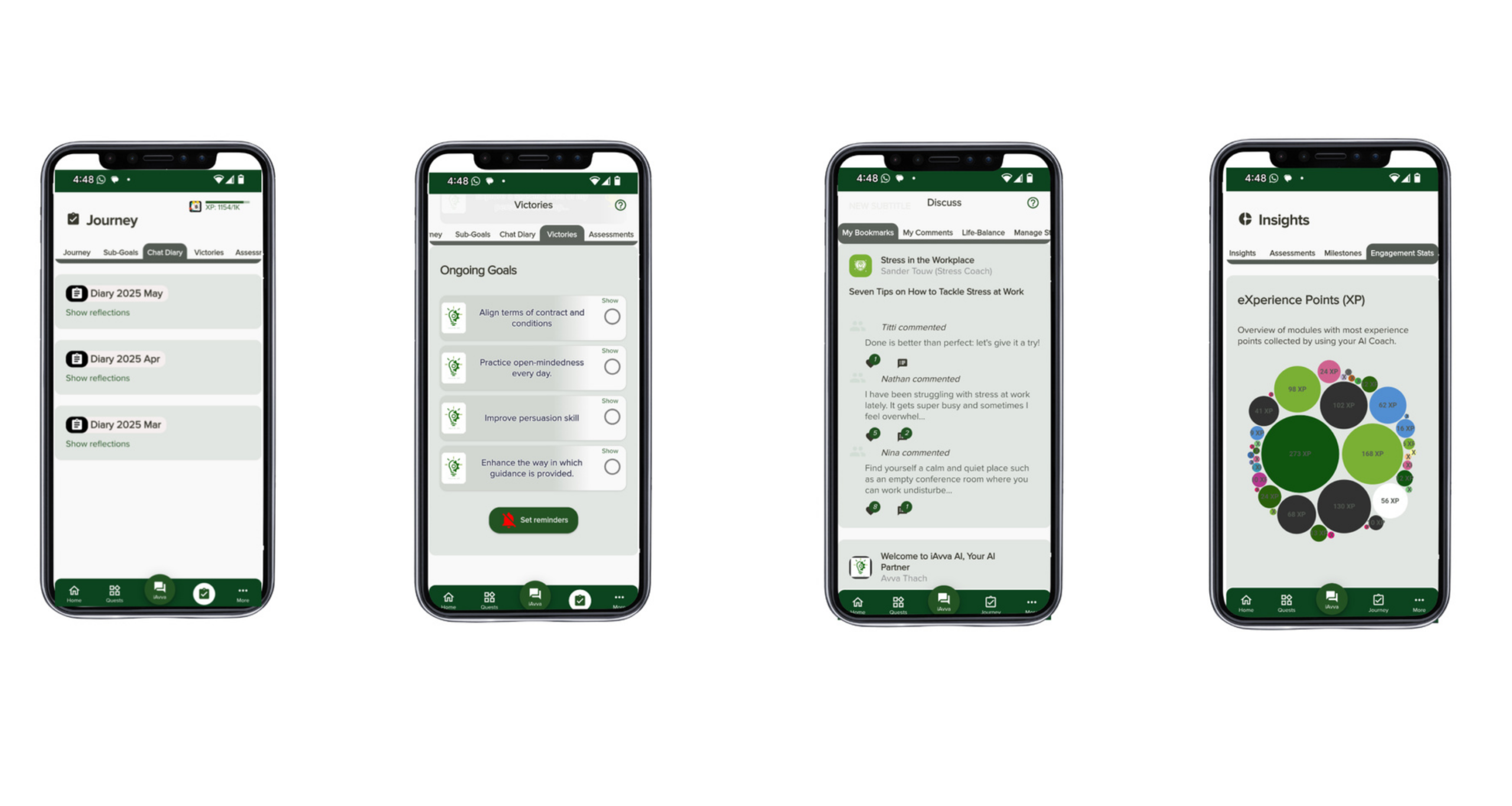
The iAvva AI Coach is our flagship platform. Leaders receive five-minute micro-coaching sessions each day on web, iOS, or Android in nineteen languages. Prompts draw on neuroscience, positive psychology, and ICF coaching principles. The questions focus on real choices leaders face as they guide AI projects, teams, and themselves.
Our Strategic Alignment Engine links personal goals with organizational OKRs. That means a manager’s daily reflection about leading an AI project connects directly to business targets such as cycle-time cuts or customer satisfaction. HR and L&D teams see progress through real-time dashboards, not only quarterly reports. The platform supports text and audio, with design that works well for neurodiverse users.
We combine this with 1:1 and group human coaching, with over 1,400 hours delivered so far. Senior coaches help executives, VPs, and managers process complex situations that AI alone should not handle.
Our AI strategy and automation consulting practice helps organizations design AI roadmaps and operating models that bridge business and IT. We also offer AI-defined IT project management certification and training so project leaders can run AI programs on time and focused on value.
Why Our Hybrid Human Plus AI Approach Delivers Measurable Impact
Our approach stands out because it treats behavior change as measurable, not mystical. The iAvva AI Coach and our human coaches both tie their work to OKRs. Leaders track habits like experiment frequency, feedback quality, and data-driven decisions. HR and L&D teams see patterns in dashboards and connect them to business outcomes.
Early users of the iAvva AI Coach report better focus, self-awareness, and productivity after consistent daily use. We aim for very high satisfaction scores and completion rates, and we track our own delivery reliability closely. This same discipline is what we encourage in client programs.
Scalability is built into our design:
- Multilingual support for global teams.
- Mobile access for frontline and remote workers.
- Inclusive interfaces for neurodiverse users.
- Configurable content aligned with client leadership models.
Organizations at any AI maturity level can start with literacy and basic habits, then grow into advanced leadership themes. Our founder’s experience leading billion-dollar programs at Accenture, and validation through the Techstars accelerator, gives leaders confidence that advice inside the platform reflects real-world practice, not theory.
How Different Leader Personas Can Drive AI Transformation (And Use AI Coaching)
Different leader roles hold different keys in AI transformation. HR, the C-suite, IT, L&D, and individual contributors all have specific levers to pull.
By naming these roles clearly, we can invite each group into the work with concrete actions rather than vague encouragement.
Role-By-Role: From HR Directors To Early Adopters
HR Directors and Chief Learning Officers shape the people system. They can:
- Update leadership competency models so AI fluency, experimentation, and collaboration sit beside ethics and empathy.
- Use platforms like iAvva AI Coach to deliver personalized leadership development far beyond the C-suite.
- Co-own people data governance and skills taxonomies.
- Design reskilling programs that match the new world of work.
C-Suite Executives and SMB Leaders decide where AI transformation hits the P&L. They:
- Choose economic leverage points and set value targets.
- Clear roadblocks between business and IT.
- Sponsor responsible AI and data governance.
- Use AI-powered coaching themselves to model continuous learning.
L&D Professionals guide how the organization learns. They:
- Move from static course catalogs to outcome-focused learning paths.
- Integrate micro-coaching and nudges into the flow of work using iAvva AI Coach.
- Use analytics to link learning to performance, retention, and internal mobility.
- Enable managers to coach teams through AI-related change.
IT Managers and Directors own the platforms and security. They:
- Build and maintain AI-ready data architectures and integration layers.
- Connect tools like iAvva AI to single sign-on, monitoring, and compliance frameworks.
- Partner with HR and L&D on privacy, consent, and access rules.
- Support experimentation while keeping guardrails in place.
Individual Professionals and Early Adopters turn theory into daily practice. They:
- Experiment with AI tools to improve their own work, from drafting documents to analyzing data.
- Share what works (and what does not) with colleagues.
- Use iAvva AI Coach to build leadership habits even before they hold formal titles.
- Become internal champions who model healthy human plus AI collaboration.
Tip: Identify ten to twenty early adopters across functions and invite them into a structured AI “champion” group with coaching support. Their stories will often shift culture faster than any memo.
Designing Your Next 90 Days Of AI-Ready Leadership
Ninety days is enough time to set a different course. Here is a simple plan we can follow or adapt.
Days 1–30: Understand And Align
- Assess current AI maturity, leadership readiness, and culture around learning and risk.
- Map current AI pilots and tools; identify overlaps and gaps.
- Form a small cross-functional group from HR, IT, and key business units.
- Agree on shared language around AI and start basic literacy sessions for senior leaders.
- Select a cohort of leaders to pilot iAvva AI Coach and gather baseline data on habits.
Days 31–60: Focus And Pilot
- Choose one to three economic leverage points and related people leverage points. Examples:
- Leadership pipeline strength.
- Time-to-competency for new managers.
- Frontline productivity or customer satisfaction.
- Design a small set of AI use cases tied directly to these leverage points.
- Launch limited pilots that combine AI tools with leadership development, such as:
- Project teams using AI assistants for analysis and documentation.
- Targeted groups using iAvva AI Coach with prompts aligned to the pilot goals.
- Start tracking both business metrics and behavior indicators (e.g., experiment frequency, feedback quality).
Days 61–90: Learn, Decide, And Scale The Right Things
- Review pilot data with the cross-functional group.
- Refine the AI roadmap and operating model based on early insights.
- Confirm who owns AI strategy, which platforms you will rely on, and how cross-functional teams will work.
- Expand micro-coaching cohorts aligned to core AI initiatives and OKRs.
- Set up dashboards that track:
- Business KPIs (EBITDA impact, productivity, customer metrics).
- People metrics (engagement, skills growth, leadership behaviors).
By day 90, AI is no longer just a slide in the strategy deck. It is a visible part of how leaders show up, decide, and develop their teams.
Summary Of Measurable AI Transformation
AI transformation reshapes how our organization works, decides, and learns. It is not a tools project. It is a people-centered reinvention that links technology, operating model, leadership, and culture into one effort. When we treat it that way, AI becomes a source of durable advantage rather than a short-lived trend.
For leaders, the message is clear:
- Focus on a small set of economic leverage points.
- Build shared platforms and data foundations.
- Grow internal talent and AI fluency.
- Tie AI investments to numbers such as EBITDA, productivity, and time-to-competency.
Hybrid human plus AI leadership coaching, like the approach we use at iAvva AI, turns these ideas into daily practice. Micro-coaching, analytics, and human support make new behaviors visible and measurable across thousands of people.
If we define our leverage points, upskill our leaders, and align AI efforts with clear outcomes, we can turn AI transformation from a buzzword into real, measurable impact.
Frequently Asked Questions
Question: What Is The Difference Between AI Transformation And Digital Transformation?
AI transformation redesigns work, decisions, and value creation with AI at the core. Digital transformation often digitizes existing processes without changing them deeply. AI transformation also reshapes culture, leadership, data, and operating models so humans and AI can work together. It is wider and more people-focused than a tech upgrade.
Question: How Can I Measure The Impact Of AI Transformation On My Organization?
We measure AI transformation through business and people metrics.
- Business indicators include EBITDA uplift — compare your results against EBITDA Multiples by Industry: benchmarks to gauge real performance — as well as productivity, error rates, time-to-market, and customer satisfaction.
- People metrics include leadership behavior change, engagement, internal mobility, and time-to-competency.
Platforms like iAvva AI link daily leadership habits to OKRs so you can see how behavior shifts connect to results.
Question: Where Should We Start Our AI Transformation If We Have Limited Resources?
Start by picking one to three high-impact areas with clear P&L or strategic value. Then:
- Build basic AI literacy for the leadership team.
- Choose a few feasible use cases in those areas.
- Partner with focused platforms and advisors, such as iAvva AI for leadership and learning, so you do not need to build everything from scratch.
Question: How Do We Address Employee Concerns About AI Replacing Jobs?
Address concerns with honest communication and action:
- Explain where AI will automate tasks and where new roles will grow.
- Share examples of tasks that will be augmented rather than removed.
- Pair AI projects with real reskilling programs and internal mobility options.
- Equip managers through leadership coaching so they can listen, answer questions, and guide people toward higher-value work instead of fear.
Question: What Governance Do We Need To Use AI Responsibly In HR And Learning?
You need clear rules on:
- Data privacy, consent, and retention.
- Bias monitoring and explainability.
- Role-based access for sensitive people data.
- Human review for high-stakes decisions such as hiring and promotion.
HR, legal, IT, and any AI Center of Excellence should share ownership of these guardrails. Choosing platforms like iAvva AI that follow GDPR, use encryption, and design for ethical use lowers risk and builds employee trust.
Question: How Quickly Can We Expect To See Results From AI Transformation?
You can see early wins within a few months when you focus on clear use cases. Larger financial impact, such as EBITDA and major productivity gains, often appears within one to two years for well-run programs.
Behavior-focused tools such as iAvva AI Coach can improve focus and productivity within weeks, which builds momentum for longer-term change and makes progress visible to both leaders and teams.












Leave a Reply