




Introduction
“Success is the sum of small efforts, repeated day in and day out.”
Robert Collier
Employee satisfaction sits at the center of those small efforts. In simple terms, employee satisfaction describes how content people feel with their job, pay, manager, workload, tools, and growth. When we measure and improve employee satisfaction in a deliberate way, we see real changes in performance and retention, not just nicer survey scores.
The challenge is clear. Many US workers feel stressed, overloaded, or stuck, even while companies pour money into perks and new software. Research from Gallup shows only about one third of employees feel engaged, while a sizable group feels actively disengaged.
In this guide, we break down what employee satisfaction really means, how it differs from engagement, how to measure it, and how to improve it in a measurable way. We also show how AI-powered leadership development platforms like iAvva AI help leaders turn data and insight into daily behavior change.
Now, let us walk through the pieces that make satisfaction a real business metric, not a side project.
Key Takeaways
For busy executives and HR leaders, here is the short version before we go deeper.
Definition vs. Impact
Employee satisfaction means how content people feel with their job and employer. The impact shows up in output, quality, and customer outcomes. When we track the impact, satisfaction shifts from a soft topic into a hard business measure.Satisfaction vs. Engagement
Satisfaction asks whether people like their job. Engagement asks whether they feel energized and committed to company goals. Strong organizations aim for both, so people want to stay and also choose to give extra effort when it matters.Measure, Do Not Guess
Guessing morale from hallway chats often hides brewing problems. Regular surveys, pulse checks, eNPS, and qualitative data give a clear picture. When we connect these numbers to turnover and performance metrics, we see where to act first.Fix the System, Not Just the Symptoms
Pizza parties do little if pay, workload, or tools feel unfair. High employee satisfaction comes from structural changes in pay, workload, flexibility, and internal support, paired with better leadership habits every day.Hybrid Human Plus AI for Scale
Human coaches change lives, but they do not scale on their own. AI platforms like iAvva AI add daily micro-coaching and analytics, so thousands of leaders can build better habits at once, in many languages, with clear links to satisfaction data.
What Is Employee Satisfaction And How Does It Differ From Engagement?
Employee satisfaction describes how content employees feel with their job, while employee engagement describes their emotional commitment and energy for the work. When we separate these ideas, we can design clearer strategies and avoid wasting budget on the wrong fixes.
Defining Employee Satisfaction In The Modern Workforce
Employee satisfaction is the degree of contentment people feel with their job, employer, and day-to-day environment. It covers:
- pay and benefits
- workload
- manager behavior
- relationships with colleagues
- work–life balance
- tools and systems
- future prospects
In plain language, it answers the question: “Do I like working here most days?”
Data from Gallup shows that only about 29 to 33 percent of US workers feel engaged, while around 16 to 19 percent feel actively disengaged. That pattern points to a large middle group whose satisfaction is fragile and can tilt in either direction. Across generations, dissatisfaction often comes from the same pain points: pay fairness, heavy workload, weak leadership, and poor tools.
We need satisfaction at a basic level so people stay, contribute, and do not become toxic voices in the culture. Common myths get in the way:
Myth 1: Satisfaction means free snacks and perks.
In reality, people mainly want fairness, respect, and meaningful work.Myth 2: If they are not complaining, they are satisfied.
Silence often hides fear, cynicism, or the belief that nothing will change.
How Employee Satisfaction And Employee Engagement Interact
Employee engagement goes beyond satisfaction. Engagement reflects emotional commitment and willingness to go above minimum expectations for the sake of the team and the company. It answers the question: “How much energy, creativity, and care do I bring to this work?”
You can picture a satisfied but disengaged employee who likes the pay and schedule yet does only the bare minimum. They are polite, but they do not push for better processes or support change. On the other side, an engaged but strained employee might care deeply about the mission, yet feel exhausted and underpaid, which puts their long-term satisfaction and health at risk.
If we chase satisfaction alone, we risk building a comfortable but complacent workforce. If we only push for engagement without fixing basic pain points, we create burnout and cynicism. The smart path is to build a stable base of employee satisfaction first, then add engagement drivers like:
- purpose and meaning
- autonomy in how work gets done
- chances to influence decisions
- recognition and growth
This balance matters even more during AI-driven change, when workloads and roles can shift quickly.
Why Employee Satisfaction Is A Strategic Business Metric (Not A “Nice To Have”)
Employee satisfaction matters because it links directly to productivity, quality, retention, and customer results. When we treat it as a measurable business metric, it becomes easier to win executive support and budget.
Impact On Productivity, Quality, And Customer Experience
Research from the University of Warwick found that happy employees are about 12 percent more productive, while unhappy employees are about 10 percent less productive. For a mid-sized company, that difference can equal millions of dollars in output every year. Satisfied employees show more focus, need less supervision, and recover faster from setbacks.
Quality follows the same pattern. Teams with higher employee satisfaction tend to:
- produce fewer defects
- record fewer safety incidents
- generate fewer customer escalations
In service environments, staff who feel respected take more care with details and are more patient under pressure. In healthcare and IT operations, studies cited by Harvard Business Review tie engagement and satisfaction to fewer serious incidents and smoother day-to-day operations.
Customer experience often mirrors inner morale. Satisfied employees deliver warmer interactions, faster responses, and more thoughtful problem solving. They are more likely to own the customer issue instead of passing it along. For tech-heavy companies, where customer journeys rely on both software and people, this link between employee satisfaction and customer loyalty becomes especially strong.
“Clients do not come first. Employees come first. If you take care of your employees, they will take care of the clients.”
— Richard Branson
Retention, Risk, And The Cost Of Dissatisfaction
Low employee satisfaction drives both visible turnover and hidden “quiet quitting.” According to analyses summarized by Gallup, disengagement costs US businesses hundreds of billions of dollars per year in lost productivity and churn. The direct cost of replacing one employee often ranges from 30 percent up to several times their annual salary, depending on role and scarcity of skills.
Dissatisfied employees are also more willing to listen when recruiters call. Studies cited by Pew Research Center show that limited advancement and unfair pay rank among the top reasons people quit, even when they once liked the job. Among those who stay, low satisfaction shows up as absenteeism, presenteeism, and resistance to change.
For organizations in the middle of AI or cloud programs, this risk is acute. Losing key engineers, product leaders, or middle managers can stall change timelines and inflate project costs. Higher satisfaction and strong engagement reduce the odds that a modest pay increase at a competitor can pull away these critical people.
What Actually Drives Employee Satisfaction Today?
Employee satisfaction does not come from one silver bullet perk. It comes from a mix of structural and human factors that add up over daily experience. When we know the main drivers, we can focus on the changes that matter most.
Core Drivers: Pay, Workload, Growth, Culture, And Tools
Several drivers consistently show up in research and in our work with clients at iAvva AI.
Pay And Benefits Fairness
People do not need to be paid the very highest salaries to feel satisfied, but they do need to feel their pay matches their skills and contribution. When they see new hires or peers with similar roles earning more, trust erodes. A clear compensation philosophy and periodic market checks help people believe the system treats them fairly.Workload And Burnout Risk
A large portion of US workers report burnout symptoms in surveys, often tied to constant pressure and long hours — a trend reinforced by behavioral data showing most American workers are checked out, with managers often the last to know. When employees feel there is never enough time, they become more error prone and less patient with colleagues and customers. Sustainable workloads, realistic deadlines, and support for rest are central parts of employee satisfaction.Career Development And Growth
Limited advancement and weak development options were leading reasons people left their jobs during the Great Resignation, according to Pew Research Center. Employees want a sense of progress, whether through promotions, lateral moves, or new skills. When they feel stuck, satisfaction drops even if other conditions look fine.Culture, Respect, And Inclusion
Day-to-day treatment shapes how people feel at work. Respectful behavior across all levels, psychological safety, and inclusion across gender, race, and location matter as much as pay bands. Toxic managers or cliques can quickly undo the best diversity and equity policies on paper.Tools, Systems, And Working Conditions
Outdated or clumsy systems drain energy and satisfaction. Zendesk found that more than half of employees see their internal software as hard to use or outdated. For IT and HR leaders, fixing internal experience tools is a direct lever for productivity and morale, not a cosmetic upgrade.
Emerging Expectations: Flexibility, Purpose, And Well-Being
New expectations are reshaping what employee satisfaction means, especially for Millennial and Gen Z talent.
Work–life balance has climbed toward the top of priority lists. An IBM study reported that 51 percent of employees see balance between work and personal life as the leading driver of engagement and satisfaction (IBM). People want enough time and flexibility to care for health, family, and community without fear of punishment.
Flexibility in where and when people work now feels standard for many roles. A survey from McKinsey found that 87 percent of workers with the option chose some form of flexible arrangement. Fair hybrid policies, clear norms for meetings across time zones, and equal opportunities for remote and in-office staff all support higher employee satisfaction.
Purpose and social impact also matter more. Many employees look for alignment between their values and their employer’s stand on ethics, climate, and social impact. They want to see that leadership lives the stated values in how it treats customers, communities, and its own people, especially when new AI systems change how work happens.
Well-being programs play a role here too. Access to mental health resources, realistic expectations around availability, and leaders who model healthy habits send a strong signal that people matter as much as quarterly numbers.
How Do We Measure Employee Satisfaction Reliably?
We cannot manage employee satisfaction well if we only rely on gut feeling. Reliable measurement uses a mix of surveys, quick pulse checks, and behavioral data, all handled in a thoughtful way.
Surveys, Pulse Checks, And eNPS
Standard employee satisfaction surveys give a broad view of how people feel across pay, workload, relationships, and growth. They usually combine rating-scale questions with a few open comments. To get accurate data:
- keep questions clear and neutral
- avoid leading language
- guarantee anonymity and communicate that clearly
- share high-level findings and actions afterward
Pulse surveys add speed. Short, targeted check-ins once a month or once a quarter let HR and leaders spot trends by team or topic. For example, an IT unit rolling out a new platform can send a quick three-question pulse to see how satisfaction with tools changes over time. Many organizations now use employee experience platforms that support these quick cycles.
Employee Net Promoter Score (eNPS) adds a simple loyalty metric. The core question asks how likely someone is to recommend the company as a place to work. We classify high scores as promoters, low scores as detractors, then subtract detractors from promoters to get a score between -100 and +100. Many tech firms aim for the +30 to +40 range, but trend and internal gaps matter more than a single number.
Tip: Pair eNPS with at least one “why” question so you know what is driving promoter and detractor scores.
Qualitative Signals: Interviews, 1:1s, Turnover, And Attendance
Numbers never tell the whole story. Exit interviews reveal why people actually leave, beyond what they mark on a form. Stay interviews with current staff shine light on what keeps them here and what might push them away. When we look across these conversations, we start to see patterns in:
- pay and benefits
- workload and staffing
- leadership behavior
- team dynamics
- tools and processes
Regular one-to-one meetings between managers and team members act as early warning sensors. A skilled manager notices when someone who used to contribute ideas grows quiet, or when a strong performer starts to miss small details. Those shifts often signal slipping satisfaction long before a resignation.
Behavioral data adds more clues. Watch for:
- spikes in absenteeism
- early turnover within the first year
- clusters of resignations under a single leader
- sharp drops in internal mobility
These are strong signs something is wrong. At iAvva AI, we encourage clients to combine survey data, interview themes, and behavioral trends, then use AI-based sentiment analysis to scan comments at scale for common concerns while still protecting individual privacy.
How Can Leaders Measurably Improve Employee Satisfaction?
Once we understand what drives employee satisfaction and how to measure it, the next step is action. Leaders improve satisfaction by changing both systems and daily behavior, then tracking the results over time.
System-Level Levers: Pay, Workload, Flexibility, And Internal Services
System-level levers set the floor for employee satisfaction.
Compensation And Benefits Clarity
Publish a clear compensation philosophy that explains how pay ranges relate to the market and performance. Run periodic pay equity checks and address unexplained gaps. When people see a fair process, even if pay is not the very highest, satisfaction rises.Workload And Burnout Prevention
Use basic analytics to watch workload metrics such as tickets per agent, projects per engineer, or hours of client calls. When data shows chronic overload, reduce low-value work, rebalance staff, or adjust service level agreements. Encouraging real vacations, not just accrued time on paper, also protects long-term satisfaction.Flexibility And Hybrid Work Design
Define which roles can be remote, hybrid, or on-site and why, then apply those rules consistently. Set shared norms for meetings, focus time, and response windows, so flexible work does not turn into always-online work. Fair access to growth and visibility across all modes is key.Internal Enablement And Support Services
Modern internal portals for HR and IT, clear help channels, and a usable knowledge base all reduce daily friction. Research from Zendesk shows that difficult or outdated experience software hurts both morale and productivity. Well designed internal services send a quiet signal that leadership respects employees’ time.
“Every employee is a customer of your internal systems. Treat those systems with the same care you give your external products.”
— Adapted from common IT service management principles
Human Levers: Leadership Behavior, Recognition, Growth, And Voice
Human levers shape how the system feels on the ground.
Leadership Behavior And Trust
Managers who listen, keep their word, and explain decisions clearly build trust even during tough periods — a connection validated by research on relationships between leader behaviors, employee well-being, and business outcomes. They set clear expectations, offer guidance, and model healthy boundaries. When we work with leaders through iAvva AI, we focus strongly on these behaviors because they have a direct line to employee satisfaction.Recognition And Appreciation
People want their efforts to be seen. Specific, timely recognition in one-to-one meetings, team calls, or internal channels goes a long way. Peer-to-peer recognition platforms, small spot rewards, and simple thank-you notes help build a climate where good work feels noticed across locations.Career Development And Upskilling
Clear role paths, mentoring, and access to learning content make employees feel invested in. AI-supported learning platforms can recommend courses and experiences based on current skills and goals. When people see a way to grow without leaving, their satisfaction with the organization rises, even during heavy change.Employee Voice And Participation
Two-way communication channels such as town halls, Q&A sessions, anonymous feedback tools, and working groups give employees a real say. The key step is to close the loop by sharing what leadership heard and what will change. When people see their input reflected in policy, their sense of ownership and satisfaction grows.
The Role Of AI And Data In Scaling Employee Satisfaction Initiatives
AI and analytics turn employee satisfaction from a static snapshot into an ongoing, data-rich discipline. When we combine human judgment with AI insight, we can spot risks earlier and scale support across large, distributed workforces.
From Annual Surveys To Continuous, AI-Powered Listening
Traditional annual surveys offer a backward-looking view, and recent research on The Well-Being Paradox shows that employees can feel calmer while engagement simultaneously collapses — a nuance that only continuous listening can detect. By the time results reach leaders, many employees have already made plans to leave. Continuous listening uses frequent pulse checks, open feedback channels, and AI-based sentiment analysis to keep a living picture of morale.
Natural language processing can scan thousands of survey comments, chat messages, or help desk tickets for patterns in sentiment. For example, AI can flag that teams in one location mention “burnout” and “deadlines” far more often than others. That insight guides HR and line leaders toward specific groups for deeper conversations and targeted support.
Key elements of an effective continuous listening program include:
- clear communication about what is being monitored
- strict rules on privacy and data access
- opt-in where appropriate
- a focus on themes and patterns, not individual surveillance
Governance matters as much as technology. Clear messages about what data is collected, how it is used, and what is off limits protect trust. Harvard Business Review has highlighted how misused people analytics can damage morale, even when leaders intend to help. We always advise clients to involve legal, HR, and employee representatives when shaping AI-based listening programs.
AI-Powered Leadership And Skills Development
AI also supports the learning and behavior-change side of employee satisfaction, and emerging research on whether employees would rather work with ChatGPT or a human coworker highlights important boundaries for where AI assistance helps versus hinders job satisfaction. Instead of one-size-fits-all workshops, AI systems can recommend targeted development paths based on role, skill gaps, and career goals. Microlearning fits into the workday, with short lessons and practice prompts rather than long seminars that people soon forget.
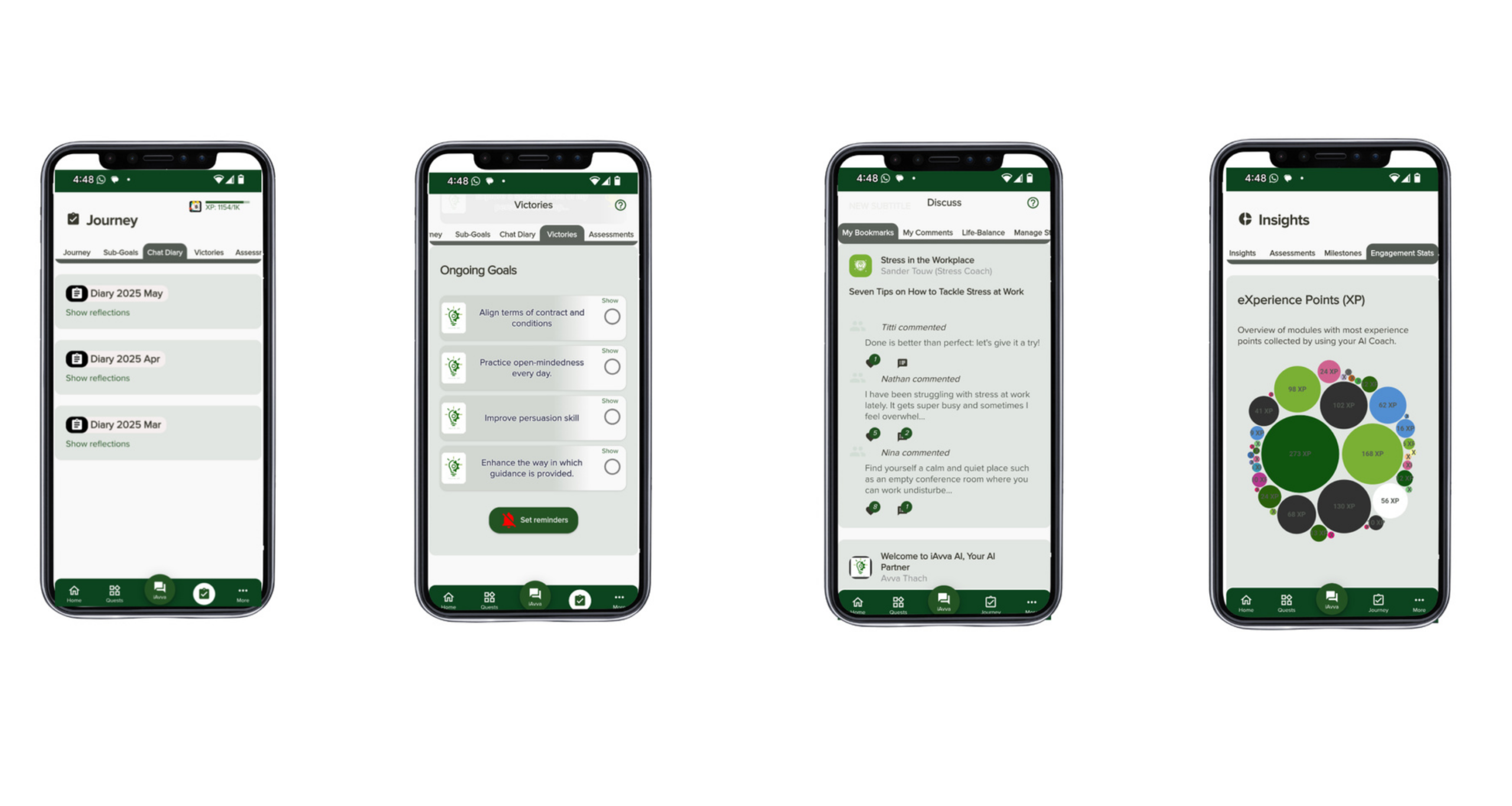
The iAvva AI Coach App is a clear example. Leaders spend about five minutes a day on guided self reflection, grounded in neuroscience, positive psychology, and ICF coaching principles. Frequent, small prompts help leaders adjust how they:
- give feedback
- recognize effort
- set expectations
- handle conflict
- support well-being
All of these behaviors strongly influence employee satisfaction.
AI-driven coaching does not replace human mentors or coaches. It makes development more continuous, consistent, and accessible. Human experts still play a vital role for complex, emotional, or high-stakes issues, and for group sessions that build shared understanding and trust.
How iAvva AI Helps Leaders Measurably Improve Employee Satisfaction
At iAvva AI, we built our platform around a simple belief: satisfied employees begin with self-aware, skilled leaders who practice better habits every day. Our hybrid human plus AI model links leadership growth directly to employee satisfaction and business outcomes.
iAvva AI Coach App And Hybrid Human+AI Coaching
The iAvva AI Coach App is a five-minute, multilingual self reflection platform created for busy leaders. Each day, the app offers a short micro-coaching prompt that helps leaders pause, reflect, and choose a better action around topics like trust, clarity, recognition, and fairness. These prompts draw on neuroscience, positive psychology, and ICF-aligned coaching methods.
Key features include:
- Daily Micro Coaching: Five minutes a day of focused reflection and planning.
- Goal Alignment: Leaders can connect their personal development focus with organizational OKRs, so each small habit shift links to tangible goals.
- Analytics For HR And L&D: Real-time dashboards show engagement with the app and aggregate growth themes, without exposing private reflections. This gives a new layer of data to guide employee satisfaction strategies.
- Global Reach: The app runs in 19 languages across Web, iOS, and Android, with neurodiversity-friendly design and strong privacy controls.
That makes it suitable for distributed, multilingual organizations that need a consistent development experience. Early users report greater focus, self-awareness, and productivity, which often appear as leading indicators of rising team satisfaction and engagement.
Consulting, Certification, And Real-World Transformation Support
Beyond the app, iAvva AI provides human coaching and consulting that address deeper sources of dissatisfaction. Our coaches have delivered more than 1,400 hours of one-to-one and group coaching to leaders across 68 enterprises. Clients include:
- executives at PayPal
- senior Canadian government officials
- leaders at a national energy corporation
We also offer an AI-defined IT Project Management certification and training track. This program helps bridge the long-standing gap between business and IT in change programs. When project leaders share a common language and realistic methods, frustration drops and employees feel more confident that change efforts will succeed.
Our AI strategy and automation consulting services help organizations design digital programs that account for human impact from day one. We look at workload, capability gaps, and change fatigue alongside technical architecture. Techstars accelerator backing and experience across more than 22 billion dollars in transformation portfolios show that this approach works at scale, not only in theory.
How To Launch A Measurable Employee Satisfaction Initiative In Your Organization
Turning ideas into a concrete employee satisfaction initiative can feel like a big lift. A clear, staged roadmap makes it manageable and easier to sponsor at the executive level.
Step-By-Step Roadmap For HR And C‑Suite
Start with a simple but structured plan.
Clarify Outcomes And Metrics
Agree on what success looks like in both human and business terms. For example, target improvements in satisfaction scores, voluntary turnover, customer NPS, or project delivery times. Pick a small set of core metrics to track on the executive dashboard.Baseline The Current State
Run a focused satisfaction survey and eNPS, then pull related data on turnover, absenteeism, and customer results. Use recent numbers, not old reports, so leaders see the current picture. According to Gallup, making this link visible helps keep attention on engagement and satisfaction over time.Identify Hotspots And Bright Spots
Segment results by team, role, location, and tenure where sample sizes allow. Look for pockets with low satisfaction and high turnover, as well as groups that perform well despite challenges. Both types hold clues about systems and leadership behaviors.Co-Design Targeted Actions With Employees
Involve employees in shaping changes for pay transparency, workload, flexibility, tools, or internal services. Short design workshops or focus groups often reveal practical ideas leaders might miss. When people help shape the changes, adoption and satisfaction rise.Launch Focused Leadership Development
Give managers concrete support to build skills in communication, feedback, recognition, and coaching. Here, tools like the iAvva AI Coach App help leaders turn training into daily habits without heavy scheduling. Pay special attention to the middle management layer, which often carries both top-down pressure and front-line emotion.Establish Continuous Listening And Review Loops
Add quarterly pulse checks and scheduled reviews of both human and business metrics. When numbers move, dig into why, and adjust or expand initiatives. Share wins and lessons with employees so they see the connection between input, action, and outcomes.
Tip: Start small, learn fast, and share stories of local success. Storytelling often shifts mindsets faster than dashboards alone.
Embedding AI-Enabled Leadership Development With iAvva AI
Once the roadmap is clear, AI-enabled leadership development can fit in without disrupting existing programs.
Start With A Pilot
Choose a meaningful but manageable group, such as middle managers, transformation leaders, or IT and operations managers. Introduce the iAvva AI Coach App as a five-minute daily habit that supports both personal growth and team satisfaction.Integrate With Current HR And L&D Offerings
Use the app as a reflection layer between live workshops, performance cycles, or town halls. Leaders can use prompts to practice concepts like psychological safety, feedback quality, and recognition right after they learn them.Use Analytics To Link Coaching And Outcomes
Over time, compare satisfaction scores, turnover, and performance metrics between pilot groups and control groups. Look for correlations between leaders’ use of the app and improvements in their teams. Share those results with executives to build the case for wider rollout.Scale With Clear Sponsorship
When you scale, keep change management simple and personal. Secure visible executive sponsorship, explain clearly why the program matters, and connect participation to OKRs and leadership expectations. With this approach, iAvva AI becomes part of how the organization grows leaders and, in turn, raises employee satisfaction in a measurable way.
In Summary
Employee satisfaction is not a side topic for HR; it is a lever for performance, retention, and success in change programs. When we define it clearly, measure it well, and act on the drivers that matter most, we create healthier, more resilient organizations.
Conclusion
We saw that employee satisfaction answers “Do I like working here?” while employee engagement answers “How much energy do I bring to this work?” Both matter for productivity, quality, and customer loyalty, especially as organizations adopt AI and new technologies. The biggest levers include fair pay, sustainable workload, growth paths, inclusive culture, and usable tools, all brought to life through everyday leadership behavior.
Measurement works best when it blends surveys, pulse checks, interviews, and behavior data, supported by AI-based sentiment analysis. AI platforms such as iAvva AI then help leaders turn insight into daily micro actions that build trust, recognition, and clarity at scale. The next practical step is simple: baseline your current state, choose one or two high-impact levers, and consider piloting iAvva AI with a core group of leaders to support real, measurable gains in employee satisfaction.
Frequently Asked Questions
Question: How Often Should We Measure Employee Satisfaction To Get Meaningful Insights?
Organizations should run a broad employee satisfaction survey at least once a year, then add shorter pulse surveys quarterly or even monthly. Always-on channels such as anonymous feedback forms or hotlines help catch emerging issues between surveys. AI-based sentiment analysis can scan open comments for trends. The key is to keep timing consistent and share what changed based on the data.
Question: What Is A Good Employee Satisfaction Or eNPS Score For A US-Based Organization?
A “good” eNPS score usually means above zero, since that reflects more promoters than detractors. Many strong organizations, especially in tech, aim for scores around +30 to +40. Benchmarks vary by industry, talent market, and company stage. Trend over time and differences between teams often matter more than chasing one perfect number, so always pair eNPS with satisfaction and performance metrics.
Question: How Can Small And Mid-Sized Businesses Improve Employee Satisfaction Without A Large HR Team?
Smaller organizations can focus on the basics: fair pay, reasonable workload, flexible schedules, and respectful treatment. Regular one-to-ones, clear communication from founders, and simple recognition rituals build trust without big budgets. AI-powered platforms like iAvva AI provide scalable leadership coaching and analytics without needing a full internal L&D department. Start with a small pilot, learn what works, then expand from early wins.
Question: How Do We Know If Low Employee Satisfaction Is Caused By Managers Or By Company-Wide Issues?
Segment survey results by team, manager, and location to spot patterns. If low employee satisfaction clusters under certain managers, leadership skills are likely part of the issue. If scores are weak across functions, company-wide factors such as pay policies, workload, or tools may be the main drivers. Combine data with stay and exit interviews plus HR business partner insight, then shape both structural changes and manager development.
Question: Can AI Tools Like iAvva AI Replace Human Coaches And HR Partners In Improving Satisfaction?
AI tools do not replace human coaches or HR partners; they extend their reach. AI offers scale, consistency, daily micro coaching, and rich analytics for employee satisfaction. Human experts bring empathy, context, and judgment for sensitive cases, conflict, and deep career questions. The iAvva AI model blends both: daily AI-supported reflection with optional one-to-one or group coaching and consulting to create the strongest impact.













Leave a Reply