





Introduction
“Success is not final, failure is not fatal. It is the courage to continue that counts.”
Winston Churchill
AI for workflow automation is that kind of courage in action. Instead of one more shiny tool, it reshapes how work, decisions, and learning move across a company. When we use AI for workflow automation well, every signal in our systems can trigger timely, human-centered action for leaders and teams.
The pressure is real. According to Harvard Business Review, between 56% and 70% of digital transformation efforts fail — a pattern explored in depth through Digital Transformation Failure: 2026 research statistics — even as IDC projects organizations will spend about 3.4 trillion dollars on transformation by 2026. HR, L&D, and IT leaders now face constant demands to show clear impact, not just busy dashboards.
In this guide, we explore AI for workflow automation as a leadership choice, not just a technical upgrade. We clarify what it is, where people-focused workflows benefit first, how to govern it safely, and how iAvva AI links automation to measurable leadership and culture change.
If you want AI that actually changes behavior, not only slide decks, keep reading and connect each section to your own organization.
Key Takeaways
Key ideas from this guide give a quick view for any busy leader. Each point highlights both the opportunity and the guardrails we use in our client work at iAvva AI.
Why AI Workflow Automation Is a Leadership Advantage
This approach turns scattered data and manual follow ups into guided, timely actions for managers and teams. Leaders can focus more on judgment and coaching, while AI handles repetitive preparation and coordination. That shift in time and attention becomes a real performance advantage.The Difference Between “Bots” and Strategic AI Workflows
Chatbots or one-off automations answer single questions in a narrow channel. Strategic workflows connect triggers, AI decisions, human review, and system updates across HRIS, LMS, and tools like Slack or Microsoft Teams. The second path is where lasting value and reliable measurement appear.Where HR and L&D Win First With AI Automation
People leaders see fast progress in onboarding paths, performance review support, survey summarization, and leadership nudges tied to calendars. These flows touch many employees, carry contained risk, and show time savings within weeks. They also produce cleaner data for future decisions.How To Build Governance, Not Just Experiments
Sustainable programs run on monitored, documented workflows, not copy and paste prompts in private chats. That means clear owners, test sets, audit logs, and human-in-the-loop checkpoints where decisions affect careers or pay. We treat these elements as standard parts of design, not later add ons.Why Hybrid Human + AI Is a Sustainable Path
AI can summarize, recommend, and remind, yet it cannot hold empathy, context, or accountability. Human coaches, HR partners, and line leaders provide those pieces. iAvva AI combines an enterprise coaching app with human facilitation and consulting so automation supports people instead of replacing them.
What Is AI For Workflow Automation (And Why Does It Matter For Leaders)?
AI for workflow automation means we use AI models, triggers, and business rules to move information and actions across systems with context. Instead of only routing data by fixed fields, the AI reads language, interprets meaning, and helps decide what should happen next. For leaders, this directly affects speed, quality, and fairness in people decisions.
At a leadership level, AI for workflow automation turns messy inputs such as emails, survey comments, and performance notes into structured signals. Those signals then drive nudges, alerts, and tasks in tools that managers already use. The result is less swivel chair work and more time for real conversations.
Traditional Automation Vs. AI For Workflow Automation
Traditional workflow automation tools follow fixed rules on structured data. They listen for a simple event, check a field, then apply an if X then Y rule. In HR, that might mean every ticket with type “benefits” goes to one queue, or every “new hire” entry in Workday creates standard tasks.
AI for workflow automation adds understanding and generation to that picture. It reads full emails, transcripts, or survey responses, then classifies, summarizes, and drafts responses in real time. In people workflows, this matters because tone, nuance, and context carry as much weight as a single field value.
Here is a simple comparison that leaders often find helpful:
| Aspect | Traditional Automation | AI Workflow Automation |
|---|---|---|
| Inputs | Structured fields only | Structured data plus text, audio, and documents |
| Logic | Fixed rules, hard to change | AI models with prompts plus rules |
| HR Example | Route ticket by topic field | Read message, detect sentiment, draft reply, route with priority |
| Flexibility | Breaks when data changes | Adapts to new language patterns with retraining and prompt updates |
For HR and L&D, that flexibility means AI can spot early signs of burnout in comments, or suggest focused coaching prompts for a manager, instead of pushing everyone through the same rigid path.
Why AI Workflow Automation Has Become A Strategic Capability
AI workflow automation has become a strategic capability because it touches how every knowledge worker spends time. Research from MIT Sloan Management Review reports that only a small share of AI pilots reach production, often because they never connect cleanly to real systems and daily work — a challenge further examined in The Seventy Percent: Why IT transformation has remained statistically difficult for over a decade. When workflows change, those pilots finally matter.
Three shifts stand out for leaders:
Rising expectations on transformation
Investment keeps climbing while failure rates stay high, with research on the Digital Transformation Failure Rate showing most projects still fall short of their promises, so boards now ask how HR and L&D will prove value, not only run programs.Coordination overload for leaders
Leaders drown in coordination work, status updates, and reporting instead of focused decision making.More digital conversations and data
Remote and hybrid work push more conversations into tools like Zoom, Teams, Slack, and email, which creates huge volumes of text and recordings.
AI for workflow automation turns that digital exhaust into insight and timely action. It gives leaders near real time views of engagement, risk, and capacity, then links those views to specific coaching or learning steps. Leaders who see it only as a time saver miss its role in culture, fairness, and long term competitiveness.
How Does AI Workflow Automation Transform HR, L&D, And Leadership?
AI workflow automation improves HR, L&D, and leadership by weaving intelligence into everyday processes instead of adding one more portal. When we connect HRIS, LMS, collaboration tools, and AI models, people-focused workflows become quicker, more consistent, and easier to measure. That is where AI for workflow automation stops feeling like theory and starts changing behavior.
For HR Directors and CLOs, this means routine tasks like onboarding emails, survey summaries, or learning reminders no longer require manual effort. For IT and business leaders, it means fewer tickets, clearer ownership, and better data on how people practices affect results.
Core People-Centric Use Cases For AI Workflow Automation
The clearest use cases sit where text, judgment, and repeatable steps already exist. These patterns appear across Workday, SAP SuccessFactors, Cornerstone, Microsoft Teams, Zoom, and many other tools your teams use daily.
Talent Acquisition And Onboarding
AI can parse resumes, label candidates by fit, and create short profiles for hiring managers. Calendars in Outlook or Google Calendar can sync with interview scheduling flows that respect time zones and preferences. After hire, new employees receive personalized onboarding paths and early leadership content based on role and region.Performance Management And Leadership Development
Large language models can condense a year of feedback, 1:1 notes, and project updates into a draft review for managers to edit. Engagement and pulse survey comments feed into models that flag early leadership risks or hot spots. When someone steps into a new role, workflows can launch role specific leadership paths automatically.Learning Operations And Content Workflows
Recorded webinars in Zoom or Webex become micro lessons, quizzes, and job aids with AI summarization steps, a process supported by research into NLP System for Automation of document workflows showing measurable gains in processing efficiency within knowledge-intensive organizations. Long leadership manuals convert into short, role focused playbooks without rewriting from scratch. Analytics flows pull from your LMS, HRIS, and perhaps Salesforce to build dashboards for CLOs.Employee Support And Knowledge Management
An intelligent HR helpdesk can sort tickets by topic, urgency, and sensitivity instead of only reading a subject line. Routine questions get answered from accurate, version controlled policy documents inside a retrieval system. Sensitive topics go to HR business partners with clear summaries and suggested next steps.Cross Functional Digital Transformation Workflows
Workflows can tie together BambooHR, Workday, your LMS, and survey tools such as Qualtrics. For example, when a team’s engagement drops and performance slips, a workflow can start a manager support path, alert HR, and schedule a check in, all while capturing data for later review.
“Automation applied to an efficient operation will magnify the efficiency… Automation applied to an inefficient operation will magnify the inefficiency.”
Bill GatesAI workflow automation works best when it refines already sound HR and leadership processes, not when it masks broken ones.
Measurable Benefits From Time Saved To Culture Shift
These use cases bring both hard and soft gains. On the operational side, organizations often see large cuts in cycle times for processes such as onboarding, ticket handling, or survey review. A study from McKinsey found that AI automation can reduce time spent on certain tasks by up to 60 percent, especially in information heavy roles, and IDC: Artificial Intelligence Will contribute $19.9 trillion to the global economy through 2030, underscoring the scale of value at stake.
People outcomes also move. According to Gallup, highly engaged teams show higher productivity and better retention. When AI supported workflows give managers timely nudges and clearer feedback, those engagement drivers become easier to practice. Leaders are less likely to cancel 1:1s or skip recognition when prompts arrive right before key moments.
Consider a simple before and after:
- Before: HR sends an email campaign about a new leadership model, then hopes managers read it and apply it.
- After: With AI embedded, performance data and survey comments trigger bite sized prompts in Slack linked to that model. Managers get context, examples, and reflection questions just when they need them.
Over time, that difference shapes culture, not just meeting notes — and with IDC Predicts $500 bn in AI-driven commerce shifts as agentic AI reshapes revenue growth, organizations that embed these workflows now will hold a structural advantage.
Where Can Leaders Start With AI For Workflow Automation?
Leaders can start with AI for workflow automation by choosing a small group of high value, lower risk workflows and proving clear outcomes. Instead of trying to automate everything at once, focus on repeatable processes where AI assists judgment but does not own final decisions. That keeps risk contained and shows value fast.
At iAvva AI, we often start with internal content summarization, onboarding support, and learning nudges. These flows touch many people, reduce manual effort, and build confidence in both HR and IT teams.
Identifying High-Impact, Low-Risk Workflows
The best starter workflows already feel repetitive and slightly painful. People copy text between tools, paste prompts into ChatGPT, or wait days for someone to read long comments. Research from MIT shows only a small share of AI pilots reach full production, often because they begin in fuzzy problem areas instead of clear tasks — an insight consistent with findings on C-Suite Digital Transformation Statistics that reveal how executive-level clarity on scope directly predicts program success.
Look for patterns such as:
Repetitive Judgment Work
When teams keep reading similar survey comments, support tickets, or manager notes, AI can help summarize, group, and label that content. Humans still decide what to do, yet the time spent to reach insight drops. This keeps risk lower while saving many hours.Multi-System Handoffs And Delays
Any process that moves from HRIS to email to spreadsheets to Slack is a candidate. If people update three tools after every change, workflows can tie those tools together with AI steps for text and decisions. That shrinks handoff time and reduces dropped balls.Employee Lifecycle Hot Spots
Walk through hire, develop, move, and exit across systems such as Workday, your LMS, and ServiceNow. Mark where leaders complain about slow feedback, missing context, or unclear ownership. Those points often match the best early automation targets.
Designing “Lighthouse” Pilots That Prove Value Fast
Once you know candidate workflows, pick a few lighthouse pilots that others can see and understand. These pilots should connect to goals leaders already care about, not side projects. That helps executive sponsors back the next waves.
Select Visible But Moderate Risk Workflows
Examples include AI drafted 360 feedback summaries with HR review, or onboarding paths that send managers prompts before key check ins. These flows touch many employees, yet final actions still sit with humans. Metrics such as time saved per review or new hire satisfaction show value in simple numbers.Define Success And Communicate Early Wins
Before building, agree on what good looks like, such as hours saved, error reduction, or higher survey scores. During the pilot, gather both data and quotes from managers and employees.“Start small, prove value, then scale with confidence.”
iAvva AI client guidance on AI pilotsShare these results widely so teams see AI automation as practical help, not a vague future plan.
What Makes AI Workflow Automation “Enterprise-Ready” For People Leaders?
AI workflow automation becomes enterprise ready when it is safe, observable, and usable for non technical teams. For HR, L&D, and C-suite leaders, the question is not only “Can this tool connect to Workday or SuccessFactors?” but “Can we trust and adapt these workflows at scale?” That is where careful evaluation matters.
Enterprise readiness involves visual builders for HR users, deep options for IT, and clear governance to prevent shadow AI. Without these pieces, even clever flows remain fragile pilots.
Evaluation Criteria For Choosing AI Workflow Platforms
When we help clients choose an automation backbone, we look at people focused criteria, not only technical specs. Several themes repeat across tools such as Zapier, Make, Workato, Microsoft Power Automate, n8n, and others, with iAvva AI providing the leadership and learning intelligence on top.
Key criteria include:
Ease Of Use For HR And L&D Teams
The workflow builder should let a People leader design or adjust a simple flow in under an hour. Templates for common HR and learning cases help even more. An AI copilot inside the tool can turn plain language into draft flows that builders then refine.AI-Specific Building Blocks
Strong platforms include native steps for summarization, classification, sentiment analysis, and retrieval over your own documents. They also support human-in-the-loop approvals and clear routing by intent, not only field values. That is vital for sensitive HR and leadership use cases.Testing, Evaluation, And Version Control
Before changing prompts or models, teams should run a standard set of test cases such as tricky feedback situations. Tools that support side by side comparisons and staged environments reduce risk. This capability matters when workflows touch promotions, pay, or complaints.Observability And Cost Clarity
Leaders need insight into how many runs occur, where failures happen, and what each part costs. Node level logs and dashboards make this visible. According to Atlassian, many teams list poor integration and visibility as key barriers to AI adoption — and research into A²Flow: Automating Agentic Workflow generation via self-adaptive abstraction operators points toward how next-generation platforms are addressing exactly these observability gaps — so this feature is more than a nice extra.Governance, Security, And Compliance
Enterprise tools must support fine grained role based access, secret storage, and detailed audit logs. Certifications such as SOC 2 and GDPR readiness help legal and security teams sleep at night. For global organizations, options for regional data residency also matter.
Matching Tools To Your Organization’s Maturity And Risk Profile
Not every organization needs the same automation stack. Smaller firms or early stage teams often find no code tools like Zapier or Make enough for first HR and learning flows. These tools move quickly, cost less to start, and let HR or L&D experiment without heavy IT tickets.
Larger or regulated companies often standardize on enterprise platforms such as Workato, Microsoft Power Automate, UiPath, or self hosted n8n. These handle complex, cross system workflows with strong controls. Managed services such as Wrk may fit when internal capacity is thin but workflows are dense and document heavy.
The best choice comes from partnership. HR, L&D, and IT sit together to agree on which tools are allowed, where data may travel, and who can build what. iAvva AI then plugs into that chosen backbone as the leadership and learning intelligence layer so you can align automation with culture and performance goals.
How Do We Govern AI Workflow Automation Responsibly In People Decisions?
Governing AI for workflow automation in people decisions means treating ethics, bias, and transparency as design inputs, not late checks. HR and legal teams already handle sensitive topics such as investigations, promotions, and layoffs. AI must support that care, never short cut it.
Done well, governance builds trust with employees while still unlocking speed and insight. Done poorly, it creates fear about monitoring or unfair treatment and can even raise legal risk.
Human-In-The-Loop By Design (Not As An Afterthought)
Human-in-the-loop design keeps people in charge where stakes are high. AI gives drafts and recommendations, yet humans approve, edit, or reject them. That balance respects both expertise and accountability.
Define Clear Checkpoints In Each Workflow
For performance feedback, AI may draft messages and suggest talking points. Managers then adjust tone and content before sending. For promotion cases, AI can organize evidence but final decisions stay with committees or senior leaders.Separate Suggestions From Actions In Tooling
Good workflows show what the AI proposed and what the human chose to do. Systems such as Workday, ServiceNow, or custom portals can display this side by side. That record becomes useful for learning and audit reviews later.Log And Review Outcomes Regularly
Over time, teams can compare AI suggestions with human choices and business results. That helps refine prompts, rules, and guidance. It also gives HR, IT, and legal clear material for periodic risk reviews.
Bias, Fairness, And Transparency With Employees
Bias is a real risk when AI touches hiring, performance, or promotion stories. Models often reflect patterns in historical data, which may include unfair practices. According to research highlighted by Deloitte, many leaders now rank AI ethics among their top concerns.
To reduce harm, you can:
- Remove protected attributes from inputs where possible and focus prompts on behavior, not identity.
- Build test sets that reflect different genders, regions, and backgrounds, then check outputs for tone and recommendation gaps.
- Adjust design when issues appear and keep humans firmly in control.
Transparency matters as much as technical controls. Employees deserve to know where AI helps summarize surveys, draft messages, or suggest learning content. Clear communication about what is and is not tracked, and who can see what, protects psychological safety. Legal, DEI, HR, and IT should all help set and review these guidelines.
“Trust is built when information is shared, not hidden.”
Common principle in change management and HR communications
How iAvva AI Turns Workflow Automation Into Measurable Leadership Impact
iAvva AI turns workflow automation into measurable leadership impact by pairing an AI coaching platform with human coaching and consulting. Instead of treating AI as a side project, we align it with clear OKRs, human habits, and governance. That way, automation shows up in daily behavior, not just architecture diagrams.
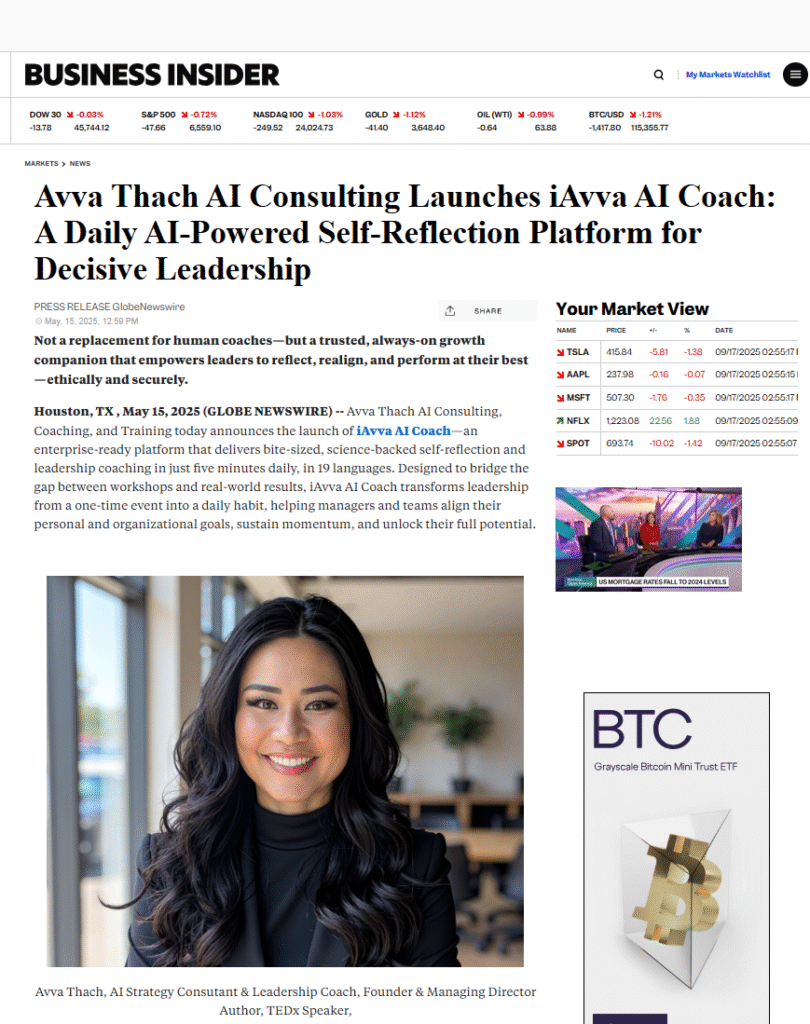
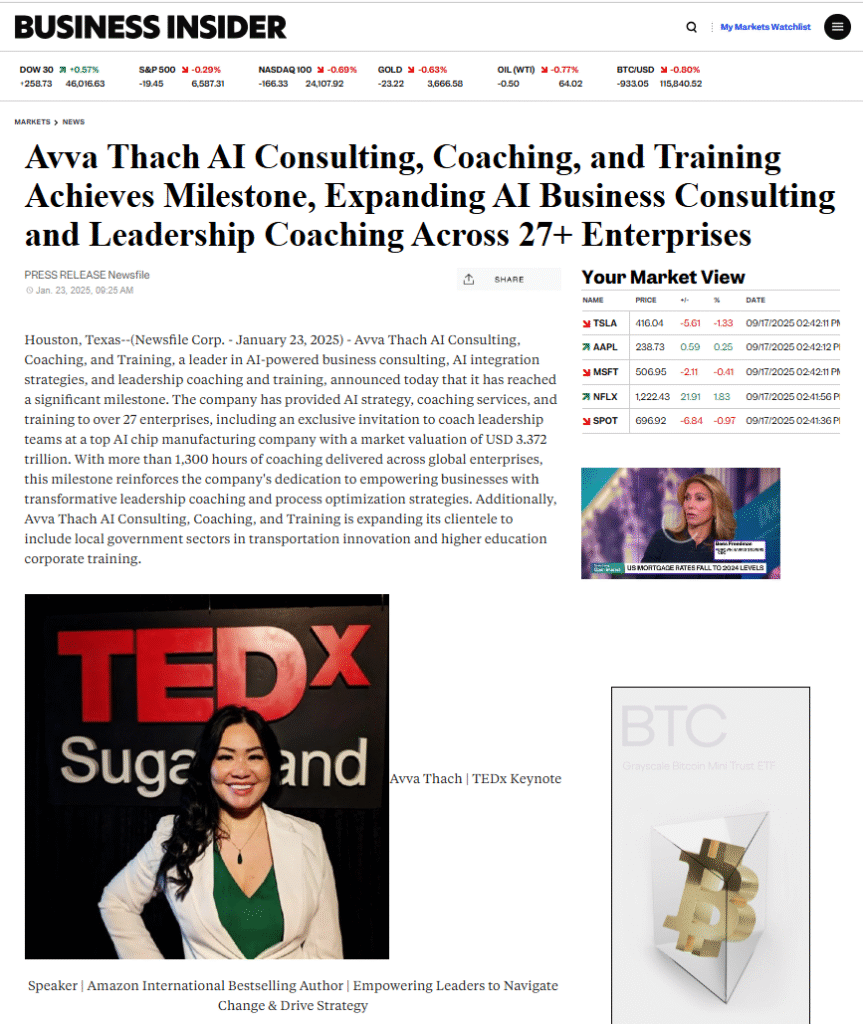
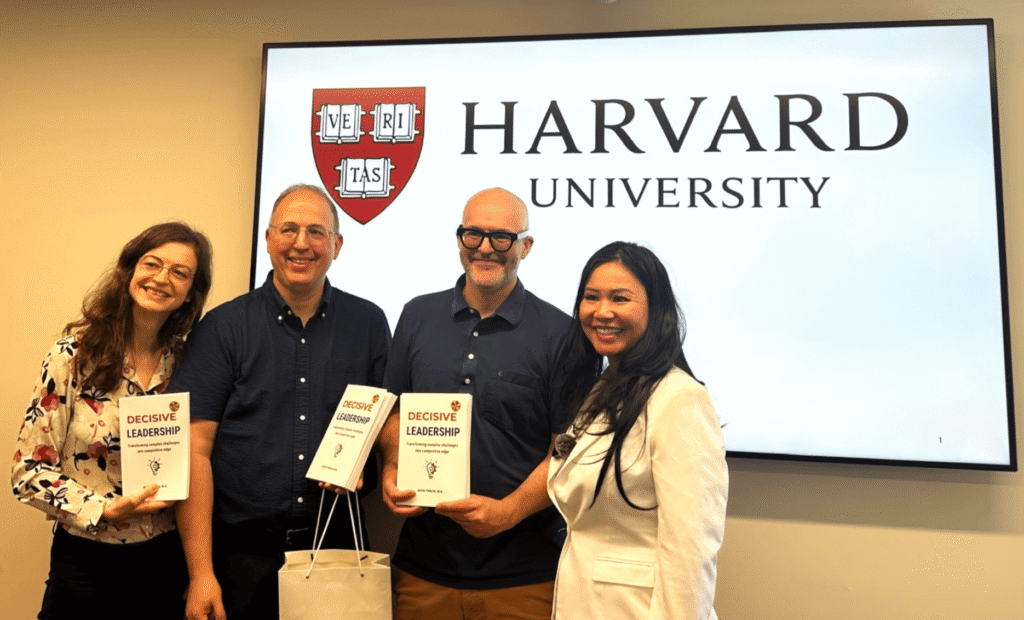
Our approach rests on both strong technology and lived experience. Founder Avva Thach spent years at Accenture working on large transformation programs and has coached leaders across 68 enterprises, which shapes every part of our design.
The Hybrid Human + AI Model: Coaching, Automation, And Strategy
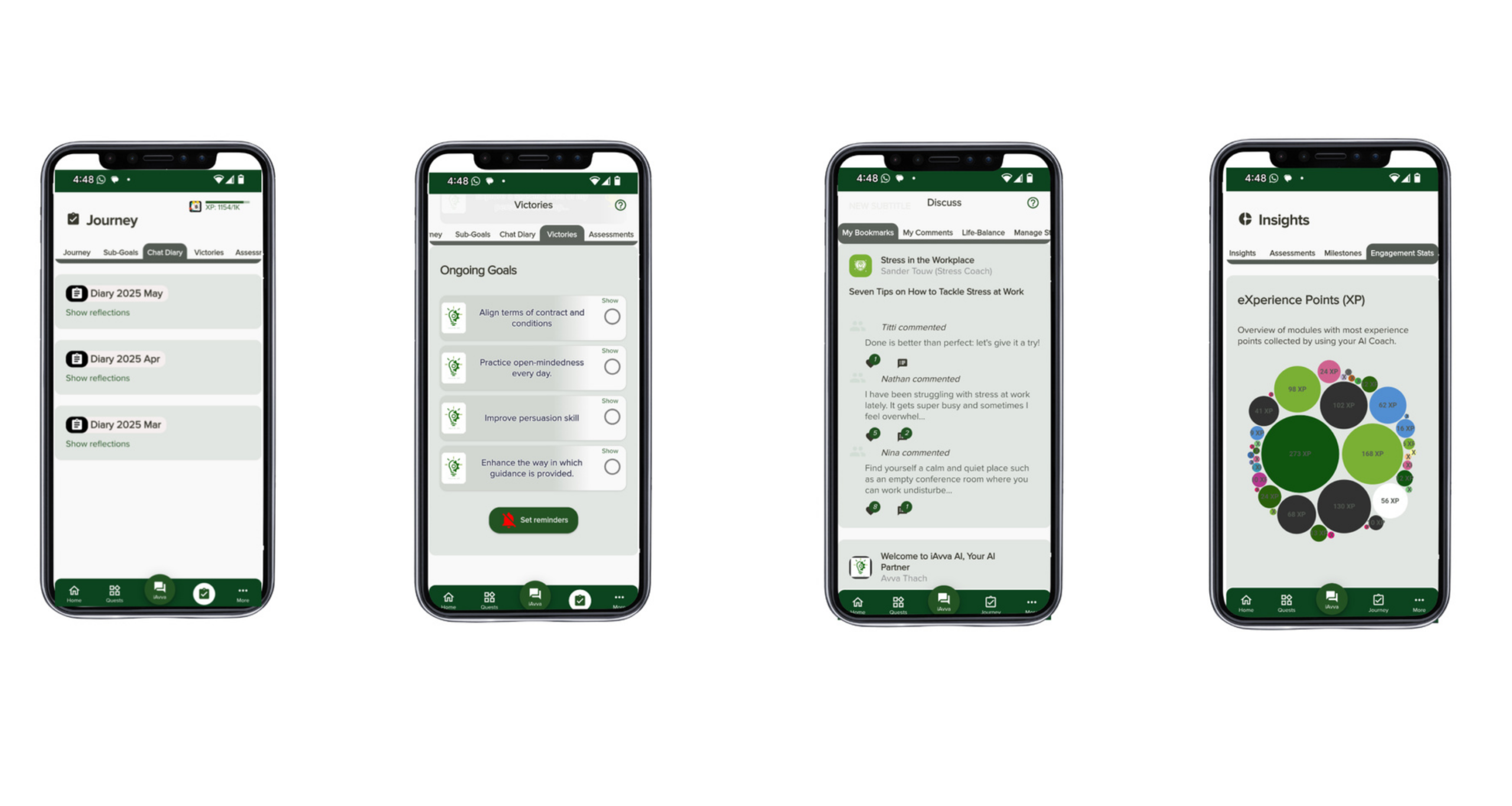
The hybrid Human + AI model at iAvva AI starts with the iAvva AI Coach platform. This five minute micro coaching app guides leaders through daily reflections that fit into packed calendars. It runs on Web, iOS, and Android in 19 languages with both audio and text, which supports global and neurodiverse teams.
Prompts build on neuroscience, positive psychology, and ICF aligned coaching principles. That means leaders build focus, self awareness, and better decision habits over time, not only during workshops. Internal user feedback shows many report clearer priorities and calmer responses in challenging situations, which directly supports workflow quality.
Human expertise then adds depth. Our team provides:
- 1:1 and group coaching,
- AI strategy support, and
- AI defined IT project management training.
This combination helps close the classic gap between business vision and IT execution that Harvard Business Review notes as a common reason for transformation failure.
Automating Leadership Workflows With Measurable, OKR-Aligned Outcomes
iAvva AI Coach does more than send prompts. It links personal goals with organizational OKRs so reflections point back to business outcomes. Real time analytics dashboards show HR and CLO teams engagement levels, growth patterns, and which prompts or themes relate to positive shifts.
In practice, iAvva AI connects with your chosen automation backbone, such as Workato, n8n, or Power Automate. For example:
- When engagement scores dip for a manager’s team, a workflow can trigger a focused leadership path inside iAvva AI Coach, notify HR, and schedule check ins.
- When someone moves into a new role, a path for that context can start the same day, coordinated across HRIS, calendar, and communication tools.
Security and inclusion sit at the center. The platform uses encryption and GDPR aligned practices, which matters for any enterprise handling sensitive data. Audio and text options, plus language coverage, help more leaders participate and benefit from AI assisted workflows, not just those in headquarters.
“What gets measured gets managed.”
Peter DruckerBy tying coaching and leadership prompts to OKRs and analytics, iAvva AI makes leadership behavior visible and manageable at scale.
A Step-By-Step Blueprint To Adopt AI Workflow Automation With iAvva AI
A clear blueprint helps leaders move from ideas to working AI for workflow automation programs. At iAvva AI, we guide organizations through an eight step path that blends process work, platform choices, and culture shifts. Each step keeps both people and systems in view.
This blueprint works with different starting points. Whether you are an HR Director, CLO, CIO, or CEO, you can adapt the steps to your scale and sector.
From Inventory To Integration: 4 Initial Steps
The first four steps focus on understanding your current work and wiring AI into it thoughtfully. They set the stage for later governance and scaling.
Inventory Key Processes Across The Employee Lifecycle
Map how hire, develop, move, and exit look today in tools such as Workday, Greenhouse, your LMS, and ServiceNow. Highlight where people copy text between tools, wait on slow approvals, or feel unclear about ownership. These painful moments often hide strong automation candidates.Segment Processes By Impact And Risk
Group workflows into low, medium, and high risk buckets. Low risk examples include survey summarization or learning reminders. Higher risk flows touch promotions or sensitive employee relations. As MIT Sloan Management Review notes, pilots succeed more often when they focus on clear, lower risk tasks first — a pattern corroborated by work on DRFLOW: A Deep research benchmark for personalized workflow prediction, which demonstrates how well-scoped AI workflows outperform generalized automation attempts.Choose An Automation Backbone With IT Partnership
Work with IT to decide whether a no code SaaS tool, enterprise iPaaS, or self hosted engine fits your needs. Check for role based access, logging, and integration with your HRIS, LMS, and collaboration tools. This shared choice reduces later conflicts about security and ownership.Integrate iAvva AI As The Leadership And Learning Intelligence Layer
Define simple input and output contracts between your backbone and iAvva AI Coach. For example, a workflow might send role, region, and engagement signals in, then receive recommended leadership paths or nudges. Privacy controls and clear data scopes keep trust high.
Scaling Responsibly: Governance, Skills, And Continuous Improvement
Once first workflows function well, the next four steps focus on making AI automation a steady capability instead of a one time effort. This is where governance and skills become daily habits.
Design Human-In-The-Loop Guardrails For Sensitive Workflows
Decide which steps always need HR or manager review, such as performance narratives or promotion dossiers. Build review steps into tools like Workday, ServiceNow, or custom portals. This pattern keeps AI in a support role for high impact decisions.Establish Evaluation And Monitoring Routines
Create test sets with anonymized but realistic HR and leadership scenarios. Run these whenever you change prompts, models, or workflow logic. Monitor business metrics such as:- time to productivity for new leaders,
- engagement shifts,
- error rates in HR processes, and
- completion of leadership development milestones,
not only technical uptime.
Build A Cross Functional Automation Guild And Train “Citizen Automators”
Gather people from HR, L&D, IT, and data teams to share patterns and review backlogs. Train selected HR and L&D staff to design and manage flows using no code tools. iAvva AI’s training and AI defined IT project management programs help leaders speak both business and technical language.Iterate Based On Outcomes Instead Of Hype
Regularly review which workflows still serve current goals and which need refresh or retirement. Focus on outcomes such as higher coaching coverage, reduced burnout signals, better internal mobility, and clearer succession pipelines. This habit keeps AI automation tied to strategy, not trends.
Tip: Schedule a quarterly AI workflow review with HR, L&D, IT, and one business sponsor. Treat it like a product review, not just an IT status update.
The Takeaway
AI for workflow automation has moved from experiment to core leadership lever. When we use it well, signals from HRIS, LMS, surveys, and collaboration tools no longer sit in silos. They trigger timely, guided actions that help managers coach better, employees grow faster, and organizations respond more calmly to change.
The key is not more bots. The key is governed workflows with human-in-the-loop design, clear ownership, and strong ethics. According to Harvard Business Review, misalignment between technology and people practices explains many failed transformation efforts. AI does not fix that on its own. Leadership attention and honest conversation do.
iAvva AI exists to support that work. Our hybrid Human + AI model links daily micro coaching, analytics, and automation so leadership development ties directly to OKRs and culture. If your organization is ready to move beyond AI slides and pilots, this is a strong moment to map your workflows and identify where guidance, not just speed, can help.
The next practical step is simple:
- Gather HR, L&D, IT, and one or two business leaders.
- Review your current people workflows.
- Explore where iAvva AI and an automation backbone can create your first or next wave of measurable, people centered AI workflows.
Frequently Asked Questions
This section addresses common questions we hear from HR leaders, CLOs, CIOs, and executives as they consider AI for workflow automation. Each answer stands on its own so you can skim what matters most.
Question How Is AI For Workflow Automation Different From Just Using ChatGPT Or A Generic AI Assistant?
Question: How Is AI For Workflow Automation Different From Just Using ChatGPT Or A Generic AI Assistant?
AI for workflow automation connects triggers, AI steps, human review, and system actions into repeatable flows. ChatGPT alone handles single prompts and manual copy and paste work. Integrated workflows link tools such as Workday, Slack, and your LMS, record logs, support approvals, and align with governance. That structure is what enterprises need.
Question What Types Of HR And Leadership Processes Should Never Be Fully Automated With AI?
Question: What Types Of HR And Leadership Processes Should Never Be Fully Automated With AI?
Final calls on hiring, firing, promotion, compensation, and sensitive employee relations cases should always stay with humans. AI can summarize evidence, suggest language, or flag risks, yet people hold accountability. This matches guidance from groups such as SHRM and regulators that expect human oversight in high impact people decisions.
Question How Can Small And Mid-Sized Businesses Start With AI Workflow Automation On Limited Budgets?
Question: How Can Small And Mid-Sized Businesses Start With AI Workflow Automation On Limited Budgets?
Smaller organizations can begin with low cost tools they already own and narrow use cases such as onboarding prompts or survey summaries. Focus on two or three workflows where time savings and clarity show quickly. Partnering with iAvva AI lets you add leadership focused workflows and coaching without replacing your whole tech stack.
Question How Do We Measure ROI On AI-Powered Leadership And Learning Workflows?
Question: How Do We Measure ROI On AI-Powered Leadership And Learning Workflows?
Start with baselines for time spent, error rates, and experience scores before automation. Then track changes in manager effectiveness ratings, new leader ramp time, engagement, and retention. iAvva AI Coach adds dashboards that link daily participation and goal progress with OKRs, which makes it easier to present clear numbers to executives.
Question What Skills Do HR And L&D Teams Need To Effectively Use AI For Workflow Automation?
Question: What Skills Do HR And L&D Teams Need To Effectively Use AI For Workflow Automation?
Teams benefit from process thinking, basic data awareness, prompt literacy, and comfort working with IT partners. They do not need to be full developers, yet they should design flows, test AI outputs, and read metrics. iAvva AI’s training and AI defined IT project management programs help build those skills across HR, L&D, and business leaders.
Question How Does AI Workflow Automation Affect Employee Trust And Psychological Safety?
Question: How Does AI Workflow Automation Affect Employee Trust And Psychological Safety?
AI automation can help or harm trust, depending on design and communication. When leaders explain what data is used, where AI helps, and what stays in human hands, employees feel more secure. Using AI mainly for coaching prompts, workload relief, and better support, rather than silent monitoring, protects psychological safety.
Question Can AI Workflow Automation Work Across Global, Multilingual, And Neurodiverse Teams?
Question: Can AI Workflow Automation Work Across Global, Multilingual, And Neurodiverse Teams?
Yes, when designed with language, access, and inclusion in mind. Workflows should support multiple languages, audio and text options, and flexible channels such as email, mobile apps, and chat. iAvva AI Coach supports 19 languages and neurodiversity-friendly features, which makes AI supported leadership development more accessible for global, distributed workforces.













Leave a Reply