



Introduction: When The Ground Shifts Under Your Content Strategy
There is a moment that feels the same in almost every organization.
You open your analytics dashboard, expecting a small win, and instead you see a flat line. Content performance is stuck. Engagement on learning portals stalls. Leaders skim, click away, and nothing really changes in the way people work. Yet the messages from the C‑suite are crystal clear: do more, faster, with fewer people, and do not put the company at risk.
At the same time, AI-generated content is showing up everywhere. Tools promise instant courses, auto-written leadership advice, and personalized learning paths at the click of a button. HR, L&D, CIOs, and executives feel a quiet anxiety building. Policies lag behind what employees already do with AI. Legal and compliance teams are nervous about IP and bias. And people on the ground feel bombarded by content that rarely turns into meaningful behavior change.
Into this tension comes a fresh signal. Reports say Amazon is talking with publishers about an AI content marketplace. On the surface, this sounds like a media story. Underneath, it points to the next phase of how content, data, and AI will be traded, licensed, and fed into the tools your workforce uses every day. Even if you never sign a contract with Amazon, your people will work inside an environment shaped by these kinds of deals.
The real issue is not just AI content. It is how ai operation works behind the scenes—how AI is governed, measured, and embedded into daily workflows. Without disciplined AI operations, an AI content marketplace is just more noise, risk, and confusion. With the right operations, it can be a powerful engine for learning, leadership growth, and meaningful change.
iAvva AI sits in a different corner of this story. It is not a marketplace, but it runs a continuous AI content engine for leadership development—daily prompts, reflections, analytics—in 19 languages, grounded in neuroscience and ICF principles. By the end of this article, you will see how Amazon’s move changes the environment around you, what strong AI operations look like, and how you can build a responsible, high-impact AI content environment inside your organization using models like iAvva AI.
“The ground is shifting under content strategies not because of one vendor, but because AI now participates in how every sentence is created, delivered, and acted upon.” – Adapted from conversations with senior HR leaders
Key Takeaways
- Amazon’s reported AI content marketplace talks signal a new era where AI-generated and AI-enriched content becomes standard across tools your workforce already uses.
- The strategic battleground is not who has the biggest content catalog, but who runs the most mature and ethical ai operation across IT, HR, learning, and leadership.
- Without governance, AI content brings serious risk for HR, L&D, CIOs, and executives, including bias, IP leakage, employee mistrust, and endless “content noise” without behavior change.
- Effective AI operations rest on solid data strategy, clear governance, thoughtful automation, strong observability, and human-in-the-loop decision-making.
- iAvva AI shows a higher standard for AI content in leadership: principle-based prompts, measurable outcomes, multilingual access, and strict privacy and security.
- A practical playbook can help define outcomes, audit tools and data, design human-centered pilots, and build KPIs that connect AI content to real business results.
- You can use the ideas here to evaluate any AI content vendor, shape internal policies, and position iAvva AI as a core part of a safe, high-impact leadership and learning system.
What Amazon’s AI Content Marketplace Signals For Your Organization
Reports about Amazon exploring an AI content marketplace with publishers point to a simple idea with big consequences. Publishers would license archives, data, and current content so AI models can learn from them and generate new outputs. Those outputs could then appear across Amazon products and partner tools, from reading apps and assistants to enterprise services. The content involved could range from news and reference guides to niche professional material and educational resources.
Even if your organization never buys content directly from Amazon, the tools your employees use are very likely to tap into these kinds of marketplaces. Productivity apps, knowledge bases, AI copilots, and training platforms can all rely on marketplace-fed models to generate articles, summaries, quizzes, or coaching snippets on the fly. That means your leaders and employees may already be consuming marketplace-powered AI content inside systems you consider internal.
For HR and L&D, this changes how you think about content strategy. Instead of only managing static courses or PDFs, you now have a moving stream of AI-generated explanations, recommendations, and scenarios that may or may not match your culture, policies, and leadership standards. CIOs and IT directors must think about where these models run, what data they see, and how they interact with your own content and infrastructure.
These shifts raise hard questions:
- Who owns the AI-generated content that your employees co-create with marketplace-driven tools?
- If a model learns from your internal playbooks or leadership materials, how is your IP protected?
- How do you prevent your people from acting on content that is inaccurate, biased, or misaligned with your ethics and diversity commitments?
- How do you even see what is happening, when content is generated on demand inside opaque black boxes?
The contrast below shows how the environment is changing.
| Dimension | Traditional Content Supply Chain | AI Content Marketplace Era |
|---|---|---|
| Ownership | Clear publisher or internal creator | Blurred among creators, platforms, and AI vendors |
| Distribution | Human-curated, scheduled channels | Algorithmically generated, personalized streams |
| Quality Control | Editorial standards and review | Model training choices, prompts, and governance |
| HR/L&D Impact | Static courses, PDFs, workshops | Dynamic, AI-generated learning and coaching experiences |
In this new context, AI content itself is not the main advantage. The advantage comes from ai operation—how you design, govern, monitor, and refine the AI that produces and delivers content. Without strong operations, an AI content marketplace just amplifies confusion. With the right operating model, it becomes raw material for precise, personalized, and ethical learning at scale.
Understanding AI Operations: From AIOps To AI-Powered People Systems
AI operations is a simple phrase for a big idea. It means the systematic way you design, run, govern, and improve AI-driven workflows across your organization. That includes IT operations, content generation, learning programs, leadership development, and everyday decision support.
There are two layers to think about:
- The first is traditional AIOps, where AI helps IT teams keep systems healthy. It ingests logs and metrics, spots anomalies, predicts incidents, and triggers automated fixes.
- The second is people-centered AI operations, where AI supports leadership growth, coaching, workforce planning, and content delivery. Here, AI nudges behaviors, recommends learning, and surfaces insights about skills, risk, and culture.
In a world shaped by AI content marketplaces, both layers matter. Technical AIOps keeps marketplace-fed tools stable, secure, and performant. People-centric ai operation makes sure the content those tools deliver is relevant, ethical, and aligned with your goals. Without the first, systems fail when usage spikes. Without the second, AI content drifts away from the outcomes you care about.
Several characteristics show up again and again in mature AI operations:
- Data aggregation at scale pulls together IT telemetry, HR data, learning records, and content usage into one view.
- Noise reduction helps you separate meaningful signals from the background chatter of clicks, alerts, and comments.
- Root cause analysis lets you see why a problem appears, instead of reacting only to surface symptoms.
- Automation and orchestration turn insights into actions: scaling servers, enrolling people into programs, sending targeted nudges, or adjusting learning paths.
- Continuous learning means your models get better as more data flows in, adapting to new behaviors, tools, and roles.
- End-to-end observability gives you a view across silos so you can see not just what AI is doing, but how it changes outcomes for people and the business.
“Without AI operations, an AI content marketplace is just another firehose. With it, you get a curated, measurable, and ethical learning system.” – Internal AI governance lead, global enterprise
When you view Amazon’s move through this lens, the question shifts. It is less about whether you should buy from a particular marketplace, and more about how ready your ai operation is to manage any AI content safely and productively.
The Risks And Opportunities Of AI Content Marketplaces For HR, L&D, And CIOs
AI content marketplaces bring real upside if you manage them well. They can give your organization on-demand access to substantial libraries of expert material that AI can reshape into micro-learnings, case studies, or practice scenarios. Instead of building every asset from scratch, your teams can combine marketplace content with your context-specific knowledge to support many roles and levels.
Another upside lies in reach and personalization. With the right prompts and models, content can be localized across languages and adapted for different job families, from frontline supervisors to senior executives. AI can generate variations that match different learning styles and time windows, from two-minute quick reads to deeper reflection exercises. For budget-conscious HR and L&D leaders, this can look like a faster path to scaling content without matching growth in headcount.
The risks sit in the background, and they are serious:
- Quality drift is a constant threat. Models can hallucinate details, flatten nuance, or simplify complex topics in ways that are at odds with your values or your legal obligations.
- IP exposure is another worry. If your employees feed internal materials into marketplace-powered tools, your proprietary content may influence models you do not control.
- Bias and fairness issues can creep in without clear guardrails. Marketplace models trained mainly on public content can reflect societal biases in areas like gender, race, or geography.
- Employee trust is also at stake. If AI-driven content feels generic, preachy, or misaligned with the lived experience of your teams, people may tune out or resist.
The implications differ across roles:
- For HR and CHROs, the big concern is ungoverned AI creeping into talent decisions, internal messaging, and culture narratives.
- For L&D leaders, the danger is drowning people in content that looks impressive on paper but fails to shift real behavior or skills.
- CIOs and IT directors face security, compliance, and stability risks if AI tools spread without proper AIOps discipline.
- SMB owners and executives must guard against buying attractive tools that do not fit strategy, scale, or ethics.
A useful mental contrast is “AI content without operations” versus “AI content with disciplined operations.” In the first case, you get fragmented tools, inconsistent quality, and hard-to-measure impact. In the second, your ai operation ties content to clear outcomes, tracks performance, and applies guardrails so AI supports your people rather than confusing them.
Core Components Of Effective AI Operations In An AI Content World
Data Strategy, Ingestion, And Integration
Effective ai operation starts with data, not with clever prompts. On the technical side, you need IT data such as logs, performance metrics, and usage statistics for the AI tools your people rely on. On the people side, you need learning records from LMS or LXP platforms, HRIS data about roles and movements, engagement and feedback scores, and performance outcomes.
Content usage data forms a third pillar. You need to know which AI-generated assets employees actually see, click, and apply, and where they drop off. This includes interactions in coaching apps, AI assistants, and marketplace-powered tools. When these streams live in separate silos, you cannot tell whether AI content is helping or just adding noise.
Core practices here include:
- Building connectors, APIs, and streaming pipelines to unite these sources.
- Maintaining shared taxonomies of skills, behaviors, and roles so AI can match the right content to real needs.
- Embedding privacy rules such as GDPR and CCPA into architecture from the start, with clear decisions about what data is collected, how long it is kept, and how it is anonymized or aggregated.
iAvva AI, for example, keeps personal reflections separate from aggregated analytics, and this kind of separation should be standard whenever content touches sensitive topics such as leadership struggles or wellbeing.
Algorithms, Models, And Natural Language Processing
Behind every smooth AI experience sits a stack of algorithms and models. Think of algorithms as codified expertise. In IT operations, they decide which alerts matter most and how to route incidents. In people and learning contexts, algorithms help you decide which skills to focus on first, which behaviors predict success, and which employees might benefit most from certain content.
Machine learning adds adaptability:
- Supervised learning uses labeled data to predict outcomes such as attrition risk, manager effectiveness, or program success.
- Unsupervised learning finds clusters and unusual patterns, which can reveal emerging skills or warning signs before they become crises.
- Reinforcement learning allows AI to experiment with different sequences of content or coaching prompts and learn what works best over time.
Natural language processing (NLP) is especially relevant in an AI content marketplace era. NLP powers summarization, translation, and personalization of text. It allows systems to digest large volumes of content, extract themes, and rephrase them for different audiences. NLP also reads sentiment and intent in feedback, reflections, and surveys, so your ai operation can spot themes like frustration, confusion, or motivation.
In sensitive areas—leadership feedback, promotion criteria, or performance conversations—explainability becomes important. Leaders need to understand, at least at a basic level, why a model suggests a certain focus area or risk score. Without that, trust in AI collapses, and people either ignore the tools or over-rely on them without understanding limits.
Automation, Workflows, And Orchestration
Insights are only half of AI operations. The real power shows up when you connect insights to action through well-designed workflows. In IT, this looks like auto-remediation scripts, autoscaling of infrastructure, or automatic ticket routing. These actions follow clear rules and are tested against reliability goals.
In people and learning operations, similar ideas apply. Automation can:
- Enroll employees into programs based on role, skill gaps, or strategic priorities.
- Trigger micro-coaching nudges or short learning pieces sourced from marketplace content when a manager steps into a new role or faces a known challenge.
- Generate recap emails and reflection questions tied to specific projects so learning stays close to real work.
Human-in-the-loop patterns are key. Your ai operation should define where automation can act on its own, and where humans must approve or override. For example, recommending a short course or an iAvva AI reflection series can be fully automated, while any AI suggestion that touches pay, promotion, or corrective action should remain under clear human control. This blend keeps operations efficient without handing over moral or legal responsibility to software.
Observability, Analytics, And Dashboards
To steer AI, you need to see what it is doing. Observability is the practice of turning data from systems and interactions into a clear picture of behavior. In IT, this covers service level objectives, incident counts, response times, and error rates. In people and learning, it extends to engagement with programs, self-reported behavior change, and shifts in performance or wellbeing markers.
Role-based dashboards help different leaders see the parts that matter to them:
- HR and CHROs might look at leadership capability trends, internal mobility, and risk segments where engagement or pipeline health is weakening.
- L&D leaders may watch program impact, content effectiveness, and skills heatmaps by region or function.
- CIOs and IT directors watch AI tool performance, security indicators, and adoption versus incident rates.
- C‑suite executives want to see readiness for strategy, culture indicators, and how AI-supported learning feeds into productivity, customer satisfaction, or change milestones.
| Role | Key Metrics For AI Content Impact |
|---|---|
| L&D | Completion, application, behavior change, time-to-competence |
| HR | Engagement, retention, promotion equity, leadership pipeline |
| CIO/IT | Uptime, latency, AI adoption vs incidents, license utilization |
| C‑suite | Revenue, NPS, change milestones, productivity |
When you wrap this kind of analytics around AI content from marketplaces and from tools like iAvva AI, your ai operation becomes a closed loop. You can see what works, retire what does not, and keep tuning both technology and programs over time.
iAvva AI: A Model For Responsible AI Content Operations Beyond Marketplaces
How iAvva AI’s AI Coach Operates As An Always-On Content Engine
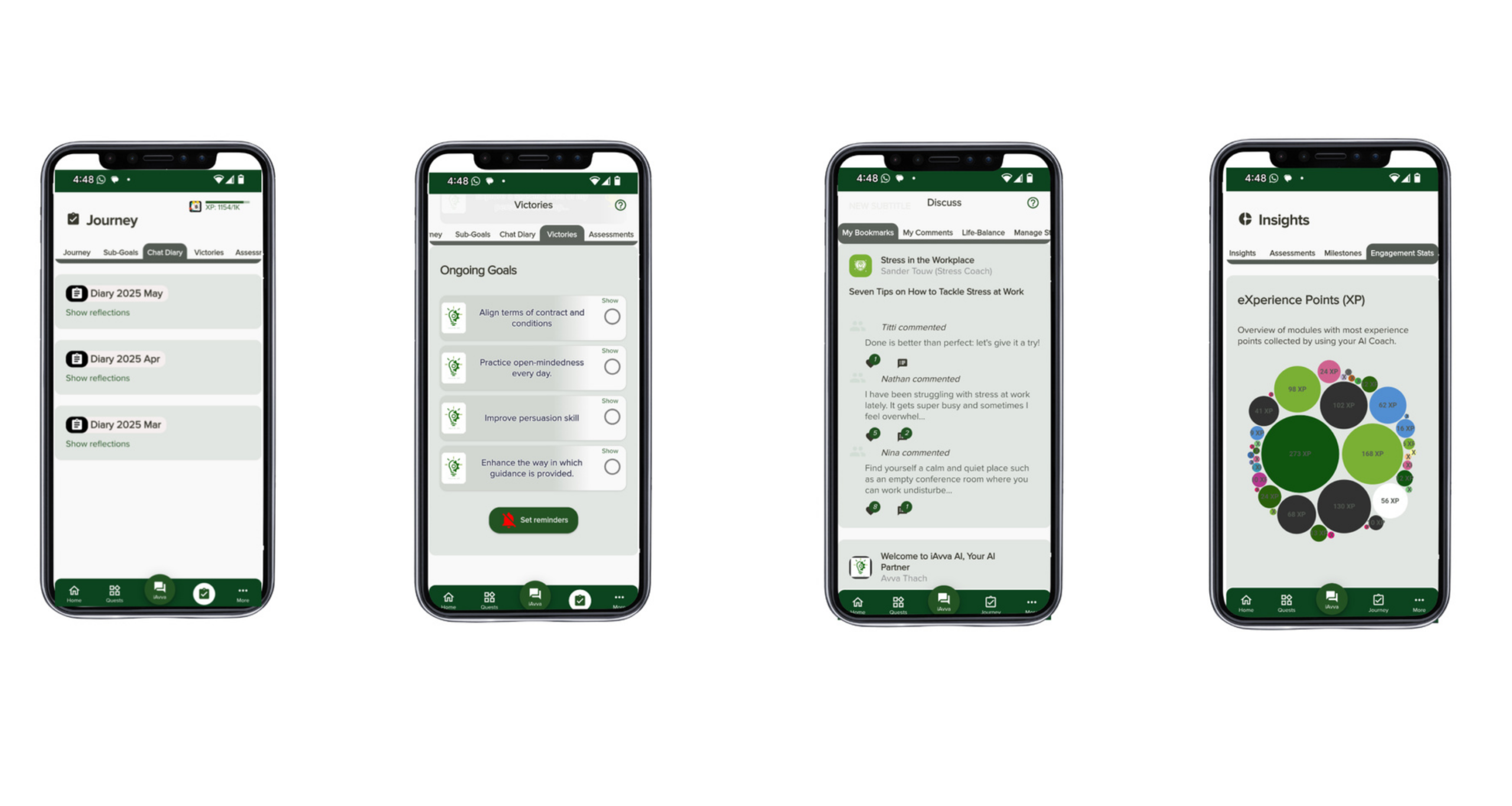
iAvva AI is not a marketplace, yet it runs a sophisticated AI content engine every day inside organizations. The core experience is simple for end users: a five-minute interaction with an AI coach that offers reflection prompts crafted for decisive, ethical leadership. Under the surface, those prompts draw on neuroscience, positive psychology, and ICF coaching methods.
The coach works in 19 languages and offers both text and audio, which matters for global teams and for employees who process information differently. Someone in a warehouse in Texas and a manager in Berlin can both receive content that feels natural and easy to consume. That same flexibility also supports people with different attention patterns or reading comfort levels.
Personalization sits at the heart of the system. The AI adapts prompts based on a person’s role, context, and past behavior. A first-time manager might see questions about delegation, feedback, and psychological safety, while a senior executive might face prompts about strategic tradeoffs, culture modeling, or AI ethics. Over time, the content sequence adjusts as the system sees what each person engages with and how their responses change.
In many ways, iAvva AI tackles the same problem that an AI content marketplace tries to solve: scalable, high-quality AI content for many people. The difference is that iAvva AI’s ai operation stays inside a focused domain—leadership and behavior—under tight governance. That focus allows deeper quality, better measurement, and a clear link between content and outcomes.
Principle-Driven Content: Quality, Ethics, And Scientific Foundations
The quality of AI content depends on the principles used to design it. iAvva AI grounds its prompts in established science. Neuroscience research guides how habits form and how short, frequent practice beats rare, long sessions. Positive psychology influences themes around strengths, resilience, and meaning, so leaders do not only react to problems but also build on what works.
ICF coaching principles shape the tone of the questions. Instead of giving canned advice, the AI coach asks open, reflective questions that invite the leader to think, notice patterns, and take ownership. This non-directive stance respects adult learners and avoids the trap of AI appearing as a know‑it‑all authority. Ideas from continuous improvement help structure small experiments and action steps after each reflection.
Ethics are built into the design. Reflection data is treated as sensitive and personal. iAvva AI does not use it for punitive assessment or hidden scoring. Instead, the platform focuses on growth and psychological safety, using encryption and GDPR-aligned practices to keep data secure. Aggregated patterns surface to HR and L&D only at group levels where individual voices cannot be identified.
“Good coaching, human or AI-supported, is less about giving answers and more about asking the questions that shift how people see their work.” – Paraphrasing common ICF coaching guidance
The contrast with generic AI advice is sharp. Random AI content may sound inspiring for a moment, but it rarely fits your leadership framework, values, or risk profile. iAvva AI shows how a principle-anchored ai operation can generate content that is both humane and aligned with the standards your organization cares about.
Measurable Impact: Analytics For HR, L&D, And Executives
One of the strongest aspects of iAvva AI is how it connects AI content to outcomes. The platform includes dashboards for HR, L&D, and executives that show engagement with prompts, completion patterns, and growth trajectories over time. These views never expose individual reflections; they aggregate data into safe groups to protect privacy.
Leaders can see, for example, that a cohort of new managers steadily increases self-reported clarity and focus over several weeks of using the coach. They can track how often people act on their reflections by setting small commitments or sharing insights with their teams. Organizations also report improvements in perceived productivity, better preparation for tough conversations, or smoother onboarding for new leaders.
These metrics feed directly back into the ai operation. When certain prompt types correlate with stronger outcomes, the models give them more weight. When some sequences show low impact for certain personas, designers adjust the content library or the conditions that trigger those prompts. This closed loop lets HR and L&D teams treat AI content as a living system, not a one‑time launch.
Marketplaces like the one Amazon is exploring can learn from this model. It is not enough to flood users with AI-generated content. You need a way to observe, measure, and refine based on how that content shapes real human behavior and business results.
Translating AIOps Concepts Directly Into People And Learning Operations
Observe: Building “People And Content Observability”
In classic AIOps, the first step is observing systems through logs, metrics, and traces. In people and learning operations, the same pattern applies. You start by wiring in data from LMS or LXP platforms, HRIS systems, collaboration tools, performance platforms, and AI coaching tools such as iAvva AI.
This gives you visibility into signals like declining completion of critical compliance training, or a slowdown in adoption of new AI-enabled tools. From reflection data (when aggregated and anonymized), you might see recurring themes around stress, role conflict, or confusion about strategy. Collaboration data, such as meeting load or after-hours messaging, can hint at burnout risk before it appears in attrition statistics.
Privacy-preserving strategies are central to this work. Your ai operation should apply aggregation thresholds so no report ever represents a single person. You can anonymize text data into themes rather than exact quotes and gain opt-in for sensitive analytics that look at communication patterns. This careful design lets you build observability without creating a sense of surveillance.
Engage: Putting Humans Where They Add The Most Value
Once you can see patterns, the next step is human engagement. AI can flag that a certain team shows low engagement with learning and high stress signals, but humans must decide what that means in context. HR may recognize that the team recently went through a reorg. L&D may know that the training content is outdated. Leaders in the business may see that workload or staffing is misaligned.
Different roles need different kinds of insight:
- HR may look for populations that need targeted enablement or policy tweaks.
- L&D may identify specific modules that are underperforming and need redesign or a better communication campaign.
- Line leaders can benefit from AI-generated conversation starters that help them discuss engagement or workload in a safe, constructive way.
Cross-functional rituals help keep this process grounded. Some organizations set up monthly reviews where HR, L&D, CIO, and business leaders look at AI-derived insights together. They discuss what might be driving trends and choose response experiments. Case studies from iAvva AI reflections, anonymized and de-identified, can also feed leadership forums as real, relatable stories rather than abstract metrics only.
Act: Automated And Semi-Automated Interventions
The final step in this lifecycle is action. Automation handles small, timely moves that do not require deep judgment. For example:
- When someone accepts a new leadership role, your ai operation can automatically assign a short onboarding path and activate a focused iAvva AI reflection series about first‑90‑day priorities.
- When signals show change fatigue, the system can send micro-learnings on resilience and prioritization to that group.
- When new tools roll out, AI can time bite-sized content just before people need to use specific features.
Semi-automated workflows sit between AI and human decision. Succession planning tools may suggest potential successors based on experience and learning data, but human leaders review and adjust before anything is final. When analytics show a team heading into risk, HR and L&D might launch a manager enablement campaign, with AI helping to schedule, remind, and gather feedback.
Feedback loops close the circle. As these interventions run, outcome data flows back into your models. If a certain sequence of prompts consistently reduces early attrition for new managers, you can expand it. If an automation campaign shows little impact, you can refine or retire it. This is what mature ai operation looks like: a living system that observes, engages, acts, and learns.
Governance, Risk, And Ethics: What Leaders Must Demand From AI Content Marketplaces
Governance Principles For AI Content Operations
For AI content to help rather than harm, governance cannot be an afterthought. Transparency is the first pillar. Vendors should be able to explain in plain language how their models are trained, what types of data they use, and how content is sourced and labeled. Internally, you should make it clear to employees where AI is involved and what it does with their interactions.
Fairness and bias mitigation follow close behind. Responsible ai operation includes regular audits that check for different impacts across demographic groups, locations, or job levels. This is especially important when AI-generated content touches leadership, performance, or DEI topics. Corrective steps might include adjusting training data, changing prompts, or adding human review in high-risk flows.
Accountability means that someone in your organization owns the outcomes of AI-assisted decisions. That owner sets policies on where AI can suggest, where it can automate, and where it must defer entirely to human judgment. Reliability rounds out the core. Before you roll out AI tools widely, you should test for hallucinations, content drift, and misalignment with your policies, and you should keep monitoring those risks over time.
These principles are not abstract. They should appear in procurement checklists, implementation plans, and leadership reviews. When you see how iAvva AI handles privacy, content quality, and analytics, you get a practical example of governance embedded into a product, not bolted on at the end.
Privacy, IP, And Data Rights In An AI Content Marketplace Era
AI content marketplaces raise new questions about who owns what. When your employees interact with AI tools, does that data train the model for other customers? Can you opt out of that use? Where is the content stored, and who has access to it? These are not small details; they shape your legal exposure and your ability to protect confidential methods or strategies.
When you speak with vendors, be ready with pointed questions:
- Do our people’s prompts and documents feed back into global models?
- Can we keep our fine-tuning isolated from other clients?
- Where are content and logs hosted, and how long are they retained?
- What controls exist for deleting data and proving that deletion?
For organizations that invest heavily in internal training, leadership curricula, and playbooks, it is vital to know how those assets are shielded from misuse.
Internal policies must keep pace. You may need clear rules for how employees use generative AI for internal materials, including what types of documents may never be pasted into external tools. Contracts with marketplace providers and AI platforms should include IP clauses that reflect your risk appetite and compliance requirements.
iAvva AI offers a helpful benchmark here. Its design keeps personal reflections encrypted and separate from aggregated analytics. The platform aligns with GDPR expectations and treats leadership reflections as sensitive content by default. When you see a vendor taking similar care, you can feel more confident that its ai operation respects both privacy and IP rights.
Building Employee Trust In AI-Driven Content And Coaching
No matter how strong your technology, AI content will not succeed without trust. Employees need to know what AI is doing with their data and what it is not doing. Clear, straightforward communication goes a long way. When you introduce an AI-based coach or learning assistant, explain how it works, what benefits people can expect, and which boundaries protect them.
Participation models matter as well. For some use cases, such as leadership reflection or coaching, voluntary participation makes more sense than strict mandates. This gives people space to try the tool, see value, and opt in more deeply over time. You can also provide easy ways to flag content that feels off, biased, or misaligned, and show that feedback leads to changes.
Cultural signals must match the message. If your organization talks about growth mindset, inclusion, and respect, but uses AI tools to monitor people in secret or judge them based on opaque scores, trust will erode. Tools like iAvva AI support a different story, where AI helps individuals grow, gives them control over their own development, and invites them into a shared ai operation that treats them as partners, not data points.
“Trust is the currency of any new technology. Without it, even the most advanced systems will sit unused.” – Common saying among digital change leaders
A Practical Playbook: Preparing Your Organization For AI Content Marketplaces And AI Operations
Step 1: Define Outcomes And Guardrails
The first move is not picking tools; it is deciding what you want AI content to achieve and where you will draw the line. Clarify which business and people outcomes matter most. For example:
- Faster upskilling for frontline managers
- More consistent leadership behaviors across regions
- Better support for employees learning to work with AI
- Stronger internal mobility and succession strength
Write these aims down and rank them.
Next, decide what decisions AI will never automate. For example, you might choose that promotions and terminations always require human deliberation, even if AI provides insight. You can think of this as setting “incidents” and “SLAs” for people operations. Leadership pipeline health, time to ramp for new managers, and minimum engagement scores are all candidates for such metrics.
iAvva AI offers a concrete example here. Its daily prompts are aligned to specific leadership competencies and change goals, not random topics. Your ai operation can follow a similar pattern by mapping each AI initiative to the competencies, values, and outcomes that your leadership framework already defines.
Step 2: Audit Your Current Content, Tools, And Data
Before you add an AI marketplace or another platform, take stock of what you already have. Start with an inventory of:
- Internal content libraries and course catalogs
- Vendor-provided courses and academies
- Informal assets such as slide decks, playbooks, and recorded sessions
- Existing AI tools, including “shadow” tools employees have adopted on their own
Map out your data sources and gaps. Which systems hold learning records, performance data, engagement scores, or collaboration metrics? Where are there duplicates, stale content, or assets that nobody touches anymore? This audit often reveals that a significant portion of your learning content is outdated or underused, even before AI enters the picture.
Once you see the full picture, you can decide where an AI content marketplace might add breadth, and where a focused domain tool like iAvva AI can deepen impact. The same review helps you design data pipelines and observability for your ai operation, instead of bolting them on later.
Step 3: Design Pilot Use Cases With Human-In-The-Loop
With outcomes and inventory in hand, you can design small, focused pilots instead of sweeping rollouts. Strong candidates include:
- First-line manager enablement: blending iAvva AI for daily reflection with curated AI-generated content on feedback, delegation, and change communication.
- Onboarding for leaders: pairing marketplace content on general leadership topics with your own case studies and iAvva AI prompts tied to real projects.
- Change programs: using AI content to explain new tools or processes, while iAvva AI supports leaders in modeling behaviors that reduce resistance.
In each pilot, define clear human roles. HR or L&D can review AI-generated content bundles before they reach employees, checking for alignment and quality. Managers can use AI prompts as starting points for real conversations in 1:1s or team meetings, rather than letting the AI speak in their place. This keeps human relationships at the center while your ai operation handles scale and timing.
Step 4: Implement Observability, KPIs, And Continuous Improvement
As pilots run, observability turns activity into learning. Define layered KPIs that track operations, people outcomes, and business markers:
- Operational metrics: uptime, latency, usage, support tickets for AI tools.
- People metrics: engagement with content, self-reported behavior change, time for employees to reach competence in new roles.
- Business metrics: revenue per head, customer satisfaction, internal mobility, or other outcomes connected to your AI-supported initiatives.
Create simple dashboards and rhythms for review. Monthly or quarterly sessions can examine which AI content is driving use and impact, and which needs refinement or retirement. This is how iAvva AI handles its own prompt libraries and journeys, using analytics to guide updates to content and sequences.
Over time, these practices will turn your ai operation from a loose collection of tools into a disciplined system that learns from its own data and gets better with every cycle.
Conclusion
Amazon’s talks with publishers about an AI content marketplace are more than a media industry headline. They are a signal that AI-generated and AI-enriched content is becoming the default layer behind many tools your workforce already touches. That reality can feel unsettling when your current content strategy is already under pressure and policies are struggling to keep up.
The advantage will not flow to organizations that simply plug into the largest marketplace. It will go to those that build thoughtful, ethical, data-driven ai operation across IT, HR, L&D, and leadership. These organizations will know what outcomes they are aiming for, how AI tools support those aims, and what guardrails keep people safe and respected along the way.
In this article, you explored what AI operations means in practical terms, how AI content marketplaces create both risk and possibility, and how iAvva AI offers a working model of principle-based AI content for leadership growth. You also saw a concrete playbook for defining outcomes, auditing tools and data, running human-centered pilots, and building observability and KPIs into your approach.
The next step is action. Begin with an internal assessment of your AI content and operations readiness. Bring HR, L&D, CIO, and business leaders into one conversation to define guardrails and choose a focused pilot. And consider iAvva AI as a partner that already operationalizes AI content in a measurable, privacy-conscious way for leadership and workforce development.
Leaders who treat AI content as an operational discipline—not a passing trend—will shape organizations that are both more resilient and more human-centered. With the right ai operation in place, AI marketplaces, coaching tools, and learning platforms become part of a coherent system that helps people grow while the business moves forward with confidence.
FAQs
What Does Amazon’s AI Content Marketplace Mean For My HR And L&D Strategy?
Even if you never buy content directly from Amazon, many of the tools your people use may be powered by marketplace-fed AI models. This means more AI-generated learning materials, summaries, and coaching-style content can enter your environment through productivity apps, knowledge bases, or training platforms.
For HR and L&D, this raises the bar on governance and alignment. You need standards for AI content quality, bias checks, and cultural fit, as well as a review process for sensitive topics. In many cases, it will make sense to use marketplace content for broad knowledge while relying on focused platforms like iAvva AI for leadership behavior change that reflects your specific values and context.
How Is “AI Operations” Different From Just Buying An AI Tool Or Marketplace Subscription?
Buying a tool or a subscription gives you a single capability in isolation. AI operations describe the whole system around it—data flows, governance rules, automation patterns, observability, and human roles. Without this system, AI tools remain fragmented and hard to measure, and they can introduce hidden risk.
With a mature ai operation, each tool fits into a clear architecture and outcome map. iAvva AI is designed to fit that kind of framework, providing governed, measurable AI-generated leadership content rather than just “more content” with no link to behavior or business results.
How Can I Ensure AI-Generated Content Is Accurate, Unbiased, And Aligned With Our Culture?
Start with vendor due diligence. Ask for details about training data sources, bias testing, and human oversight in content design. For critical areas such as leadership, DEI, and performance, set up internal review panels that sample AI-generated outputs before large-scale use. You can also draw firm red lines by stating where generative AI is not allowed, such as certain legal notices or final performance ratings.
Look for partners whose design reflects strong principles, like iAvva AI’s grounding in neuroscience, coaching ethics, and privacy protections, and use those standards to guide your expectations for other vendors.
Where Should I Start If Our Organization Has Almost No AI Operations In Place?
Begin small and intentional:
- Define a few clear outcomes and guardrails for where AI can and cannot be used.
- Choose a low-risk, high-learning pilot, such as leadership micro-coaching using iAvva AI with a single cohort, rather than trying to change the whole organization at once.
- Set up simple dashboards and feedback loops so you can see what is happening and hear from participants.
- Form a cross-functional group with HR, L&D, CIO, and legal to watch over the pilot.
You do not need full maturity on day one; what you need is a clear path, shared rules, and a way to learn as you go.
How Does iAvva AI Fit Alongside An AI Content Marketplace Or Other AI Learning Tools?
Think of iAvva AI as a domain-centric ai operation platform for leadership and behavioral change. Marketplaces and broad AI learning tools can give your workforce wide access to general knowledge and technical topics. iAvva AI complements them by providing daily, personalized reflection and practice tied directly to your leadership goals and business outcomes.
In a well-designed architecture, marketplace content offers breadth, while iAvva AI delivers depth and measurable impact. Used together within a governed AI operations framework, they can create a learning environment that is both expansive and sharply focused on the behaviors that matter most.














Leave a Reply