





Best Leadership Coaching Courses for L&D Teams: Curriculum, Outcomes, and Selection Tips
Choosing the right leadership coaching courses that drive measurable behavior change and scale across business units is harder than vendor brochures make it sound. Below we compare leading programs with clear curriculum breakdowns, expected outcomes, delivery formats, time-to-impact, and price bands. You will find a short selection checklist and practical guidance on when to invest in an internal AI-integrated coaching curriculum versus an external certification program.
1. Center for Creative Leadership Executive Coaching Program
Direct assessment: The Center for Creative Leadership (CCL) is a strong choice when you need an evidence-based, scalable coaching curriculum that ties leadership behavior to observable diagnostics rather than warm words. CCL’s strength is repeatable tools and facilitation frameworks that L&D teams can deploy across cohorts with predictable fidelity.
Program snapshot and participants
Who it fits: Mid-to-senior leaders and internal coach enablement tracks. CCL works best where organizations want third-party diagnostic rigor plus a train-the-facilitator path to scale coaching into talent programs. Not ideal if you need a cheap, rapid one-off coaching burst for front-line supervisors.
Curriculum highlights
- 360-style diagnostics and validated assessments: Structured baseline data that anchors coaching goals.
- Coaching conversation frameworks and behavioral observation labs: Practice with feedback rather than lecture.
- Action planning with measurable behavior targets: Clear commitments and follow-up mechanisms.
- Stakeholder engagement and calibration sessions: Connects coaching to talent reviews and succession conversations.
Expected outcomes and measurement: Expect improved leader self-awareness, clearer development plans, and higher consistency in coaching behaviors. Trackable metrics include 360 deltas, frequency of targeted coaching conversations, and improvement in team-level execution metrics tied to leader goals. CCL designs programs so L&D can export the same diagnostics to talent systems for longitudinal tracking.
Practical tradeoff: You pay for rigor. CCL programs are pricier and require internal facilitation bandwidth to get full ROI. If L&D skips the facilitator certification and only runs the workshops, you lose much of the fidelity that produces measurable behavior change.
Concrete example: An enterprise technology firm used CCL to upskill 40 product leaders over six months. They combined CCL assessments with monthly coaching labs and tied leader goals to product delivery metrics; within a single cycle the company reduced cross-team escalation by improving decision handoffs, and HR could show improved leader alignment in the talent review process.
Integration note: CCL’s diagnostics are suitable for augmentation with AI-driven analytics, but the vendor approach expects human facilitation. If your roadmap emphasizes AI automation of diagnostics and personalized micro-practice, plan for additional integration work or select a partner with built-in AI tooling.
CCL is a systems play – it earns ROI when L&D commits to certification and measurement, not when it is treated as an occasional offsite.
2. Marshall Goldsmith Stakeholder Centered Coaching Certification
Direct point: Marshall Goldsmith Stakeholder Centered Coaching is built around one practical premise – make coaching measurable by using the people who work with the leader as the primary validators of change. This program is not a generalist coaching skills course; it is a behavior-change methodology with a rigid feedback loop.
Curriculum snapshot
Core modules include: structured stakeholder feedback design, tight goal framing, implementation plans with short cycles, and accountability mechanisms that keep the leader publicly committed. The certification also covers coach role boundaries and methods to keep coaching focused on specific, observable behaviors rather than vague development themes.
Delivery and measurement: The program pairs short instructor-led modules with longitudinal stakeholder assessments over months. Expect repeated stakeholder rating cycles and documented behavior commitments that feed into measurable before/after comparisons you can put in a talent review or HR dashboard. See the program overview at Marshall Goldsmith Stakeholder-Centered Coaching.
What works in practice and where it fails
Practical insight: The method forces clarity. When leaders must commit publicly to specific actions and their stakeholders score progress, you get faster, visible movement on a narrow set of behaviors. That makes it excellent for leadership transitions, remediation, or when a few high-impact behaviors block a strategic initiative.
Key limitation: It is narrow by design. If your goal is to develop broad coaching capability across many managers or to build reflective leadership practice, this program can feel prescriptive. Also, stakeholder feedback cycles require stakeholder calibration and HR support; without that operational backbone the measurements are noisy and lose credibility.
- Trade-off: Faster, validated behavior change for targeted issues – at the cost of breadth in coach skill development.
- Operational requirement: HR or L&D must manage stakeholder selection, cadence, and data consolidation to make results defensible.
- Integration note: Works well as a bolt-on when you need coaching tied directly to business outcomes; combine with broader coach training if you also want scale.
Concrete example: A global manufacturing firm used Stakeholder Centered Coaching for ten newly promoted plant directors whose cross-functional alignment problems were delaying launches. Each director committed to two observable behaviors, stakeholders rated progress quarterly, and leadership used the ratings in succession discussions. The firm replaced anecdote-driven performance conversations with stakeholder-validated evidence, which shortened remediation cycles and clarified promotion decisions.
Judgment: Choose this certification when your priority is demonstrable, stakeholder-validated shifts on a few high-leverage behaviors and you have the infrastructure to manage repeat feedback cycles. If your L&D objective is broad manager capability or rapid scaling of coach skills, pair this with a scalable coach training pathway or consider an alternative that emphasizes practice labs and peer coaching.
3. Co-Active Training Institute Co-Active Coach Training Program
Direct assessment: Co-Active excels when your L&D objective is to turn managers into reliably generative conversational coaches rather than to produce narrow, stakeholder-validated behavior shifts. Its core value is building relational skill and presence across many leaders, which scales soft-skill practice more reliably than lecture-based approaches.
Curriculum-to-outcome snapshot
| Curriculum focus | What L&D gains | How to measure impact |
|---|---|---|
| Presence and listening skills | Improved coaching presence across manager population | Behavioral observation rubrics and participant self-efficacy surveys |
| Evoking insight and powerful questions | Faster reflective conversations that surface root causes | Recorded coaching pulls with calibrated ratings for depth of insight |
| Designing actions and accountability | Higher quality development commitments and follow-up | Action-plan closure rates and documented repeat commitments |
| Ethics and boundaries | Clearer coach-manager role definitions for internal programs | Policy adherence and escalation logs |
Practical tradeoff: The program is highly experiential, which means outcomes are driven by practice volume and facilitator skill. If you run Co-Active as a few instructor-led sessions without structured peer-practice, the promised gains in conversational fluency do not materialize. Also, the approach does not bake in strong business-metric linkage; you will need to add KPIs and data collection if measuring impact against transformation goals.
Concrete example: A regional bank trained 60 front-line managers with the Co-Active pathway over nine months. Managers reported clearer coaching routines and HR logged a 35 percent increase in documented development conversations. The bank still layered in quarterly business KPIs and a short stakeholder pulse to connect the softer coaching gains to reductions in service incidents.
Selection signals: Choose Co-Active when you want widespread coaching capability and are prepared to run structured practice cohorts with peer coaching and facilitator calibration. Avoid it if you need immediate, measurable improvements tied to a specific operational KPI or if you lack capacity to run repeated practice cycles. For organizations that need both relational skill and business alignment, pair Co-Active with a stakeholder-feedback mechanism or AI-enabled diagnostics such as those available from iAvva AI Consulting. See program details at Co-Active Training Institute.
If your priority is relational range and conversational skill at scale, Co-Active is a strong fit; if you prioritize immediate KPI lift, plan to augment it with outcome-focused measurement or a behavior-targeted method.
4. Korn Ferry Coach Certification and Practitioner Programs
Practical point: Korn Ferry is not a generic coach training vendor — its coach certification and practitioner streams are built to be an extension of an enterprise talent architecture, not a standalone skills course. If your talent process already uses Korn Ferry leadership profiles or competency maps, their programs convert coaching into a mechanics-level intervention you can measure and calibrate against succession and performance systems.
Program snapshot and curriculum alignment
Korn Ferry blends competency mapping, validated assessments, and coaching practice. Core curriculum elements include mapping coaching goals to competency frameworks, assessment interpretation workshops, coaching-for-performance methods, and facilitator calibration sessions that align coach ratings to talent-review criteria. See program details at Korn Ferry.
What L&D can expect: outcomes and how to measure them
Expected outcomes: clearer linkage between coaching activity and talent metrics, tighter succession pipelines, and more defensible promotion decisions. Measurement tends to favor talent-review KPIs: delta in competency ratings, movement in bench strength categories, calibrated promotion readiness, and reduction in high-risk talent gaps.
- Delivery formats: enterprise-custom cohorts, blended virtual instructor-led sessions, and embedded coach-of-record practicum.
- Typical timeline: programs commonly run between 3 and 9 months when embedded into talent cycles.
- Cost bracket: enterprise pricing is variable; expect mid-to-high market rates because the offering usually includes customization and integration with assessment tools.
Practical tradeoff: Korn Ferry gives you consistency and integration at scale, but that comes with two consequences. First, heavy customization and alignment work are required to avoid a checkbox implementation where coaching becomes paperwork. Second, you risk vendor lock-in to a specific competency lexicon unless you preserve translation layers between Korn Ferry outputs and your internal HRIS or AI tooling.
Concrete example: A multinational insurer rolled out Korn Ferry practitioner training to 120 mid-level leaders over eight months. L&D embedded the coach calibration sessions into quarterly talent reviews; within two cycles the talent team could point to a 1-step improvement in promotion-readiness bands for critical roles and fewer ad-hoc exceptions in succession decisions. The program required two internal HR leads to manage assessment logistics and vendor customization.
Integration consideration: Korn Ferry has robust assessment assets but limited out-of-the-box AI tooling for automated diagnostics and micro-practice. If your road map requires AI-driven dashboards, practice nudges, or automated progress signals, plan on integration work or partner with a firm that bridges methodology and tooling such as iAvva AI Consulting.
Judgment: Use Korn Ferry when you need coaching that is tightly coupled to succession, competency models, and enterprise assessment processes. Do not pick it if your immediate goal is rapid, low-cost upskilling of many front-line managers or if you want a vendor that ships ready-made AI practice tooling without additional integration.
Korn Ferry is a systems play: it delivers measurable lift when L&D treats coaching as an operational component of talent management, not as an isolated learning event.
5. NeuroLeadership Institute Brain-Based Coaching Certificate
Core claim: NeuroLeadership Institute (NLI) sells coaching grounded in neuroscience to increase learning transfer and sustain behavior change — and that claim is defensible, with conditions. Their curriculum translates cognitive principles into concrete coaching moves: reducing cognitive load during practice, leveraging habit windows, and structuring feedback to align with memory consolidation. For L&D teams focused on measurable persistence of new leadership behaviors, this is a different prioritization than programs that primarily teach conversational technique or stakeholder feedback rituals.
Curriculum and what it actually changes
What the course covers: NLI blends short science primers with applied labs. Expect modules on attention and habit formation, emotion and decision architecture, designing micro-practices for skill consolidation, and transfer strategies that use context cues and spaced repetition. The emphasis is on creating coach-led interventions that reduce friction for leaders to practice new habits between sessions.
- Concrete techniques: micro-practice design, cue-trigger mapping, debrief scripts that reinforce memory traces
- Measurement focus: practice adherence, behavioral persistence after 6 months, and targeted team outcomes rather than broad self-report
- Delivery model: blended cohorts with short workshops, coach labs, and workplace practice assignments
Practical limitation: The neuroscience label helps sell the approach but does not replace instructional rigor. You still need disciplined rehearsal logistics, manager accountability, and measurement systems. If L&D skips the practice architecture or treats neuroscience content as a sales pitch, the lift in long-term behavior retention will be negligible compared with more practice-heavy programs.
Integration note: NLI outputs are straightforward to augment with AI tooling for reminders, practice nudges, and progress dashboards, but NLI does not ship an enterprise AI layer. If you want automated practice nudges or integration into LMS and people analytics, budget for custom work or pair NLI content with an AI partner such as iAvva AI Consulting.
Concrete example: A healthcare system used NLI modules to reduce decision paralysis in department heads during a protocol rollout. Coaches rebuilt leader rituals into 5-minute micro-practices tied to shift handoffs; after four months adherence tracked via brief digital prompts, teams reported fewer protocol deviations and leadership cited clearer, faster decisions in daily huddles.
Judgment: Choose this certificate when your problem is low transfer and fading behavior after training — not when your immediate need is to certify large numbers of managers quickly. Neuro-informed content increases the probability that practice sticks, but only if L&D owns the operational mechanics that enforce repetition and measure persistence.
If your goal is sustained behavior change across a critical transformation (change management, resilience, or decision-making speed), brain-based coaching materially improves the odds — provided you pair it with operational practice systems and measurement.
6. Association for Talent Development Certificate in Coaching
Straight to the point: the Association for Talent Development Certificate in Coaching is a practical, low-friction pathway for L&D teams that need to make managers into competent on-the-job coaches quickly and affordably.
What the curriculum delivers
Curriculum focus: concise modules that teach structured coaching conversations, real-time feedback frameworks, goal-focused development planning, and short measurement techniques you can apply without heavy assessment infrastructure. The content is practitioner-oriented rather than academic — expect scripts, role-plays, and templates you can reissue across cohorts.
Delivery and logistics: the certificate typically runs as a cohort over 8 to 12 weeks with virtual and in-person options. Pricing is accessible for enterprise L&D budgets — think low four-figure per participant or lower with cohort discounts — and ATD offers straightforward licensing for repeat runs.
Expected outcomes and measurement ideas: managers should increase the frequency and quality of development conversations, produce clearer short-term development commitments with direct reports, and create more defensible talent decisions at the front line. Trackable indicators are coaching conversation frequency logged in HRIS or LMS, action-plan closure rates, and short stakeholder pulse checks tied to specific behaviors.
Practical trade-off: ATD is optimized for scale and speed, not for deep executive coaching or neuroscience-based transfer techniques. If you deploy it as a one-off workshop without follow-through mechanisms, gains will be superficial. Expect to add a practice architecture — microlearning, peer coaching cohorts, and a simple rubric — to convert training into sustained behavior change.
Concrete example: A regional retail chain ran the ATD certificate for 180 store managers across four cohorts in ten weeks. L&D paired the certificate with weekly 20-minute peer practice huddles and a short digital prompt system; within the next quarter HR logged a meaningful uptick in documented coaching conversations and clearer promotion evidence for hourly supervisors. The change was operational, not heroic — repeated practice plus supervisor accountability produced the outcome.
How to get the most from it: treat the certificate as the front end of a scalable coaching system. Use a train-the-trainer rhythm, embed micro-practices into workflows, and connect simple metrics to talent reviews. If you want automated nudges, progress dashboards, or to align coaching to transformation KPIs, pair the certificate with an AI or integration partner such as iAvva AI Consulting.
- Best fit: organizations that need to upskill many people managers rapidly and cost-effectively
- Not ideal when: you require high-stakes executive coaching, deep assessment rigor, or neuroscience-driven transfer without extra reinforcement
- Operational requirement: L&D must own reinforcement and measurement to avoid a short-lived training spike
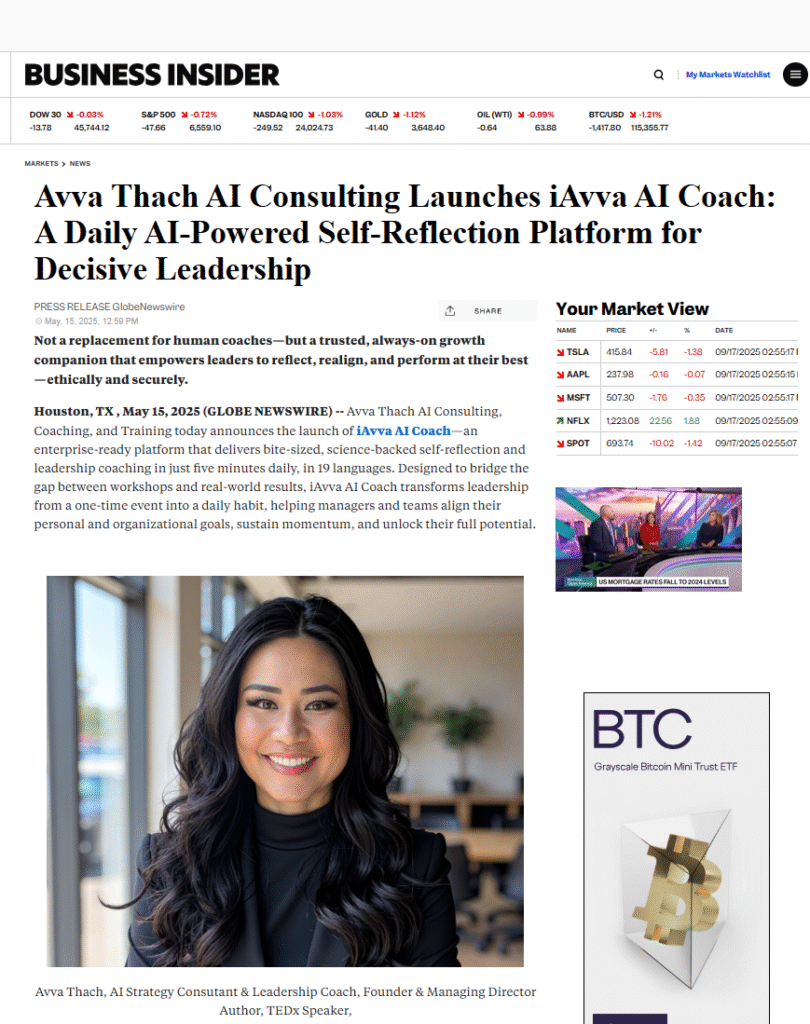
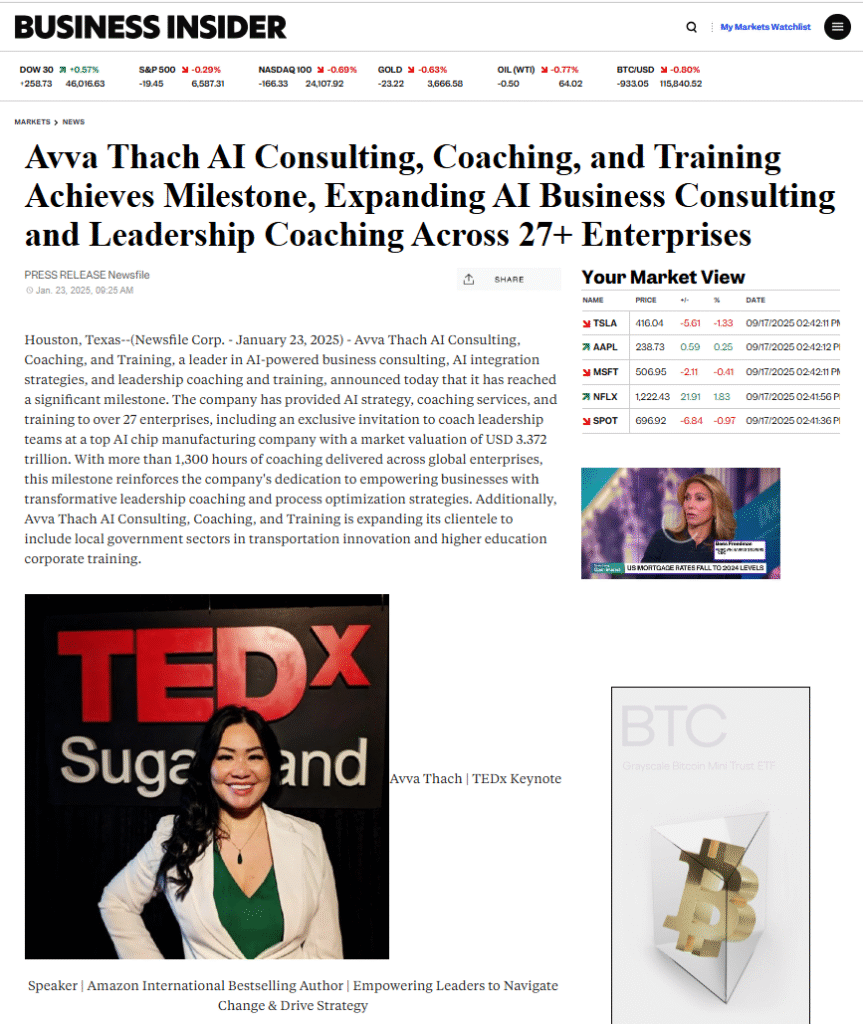
7. iAvva AI Consulting Leadership Coaching Program for L&D Teams
Direct point: iAvva combines executive coaching methods with AI-enabled diagnostics to make coaching directly measurable against transformation metrics rather than abstract leadership traits.
Curriculum and delivery
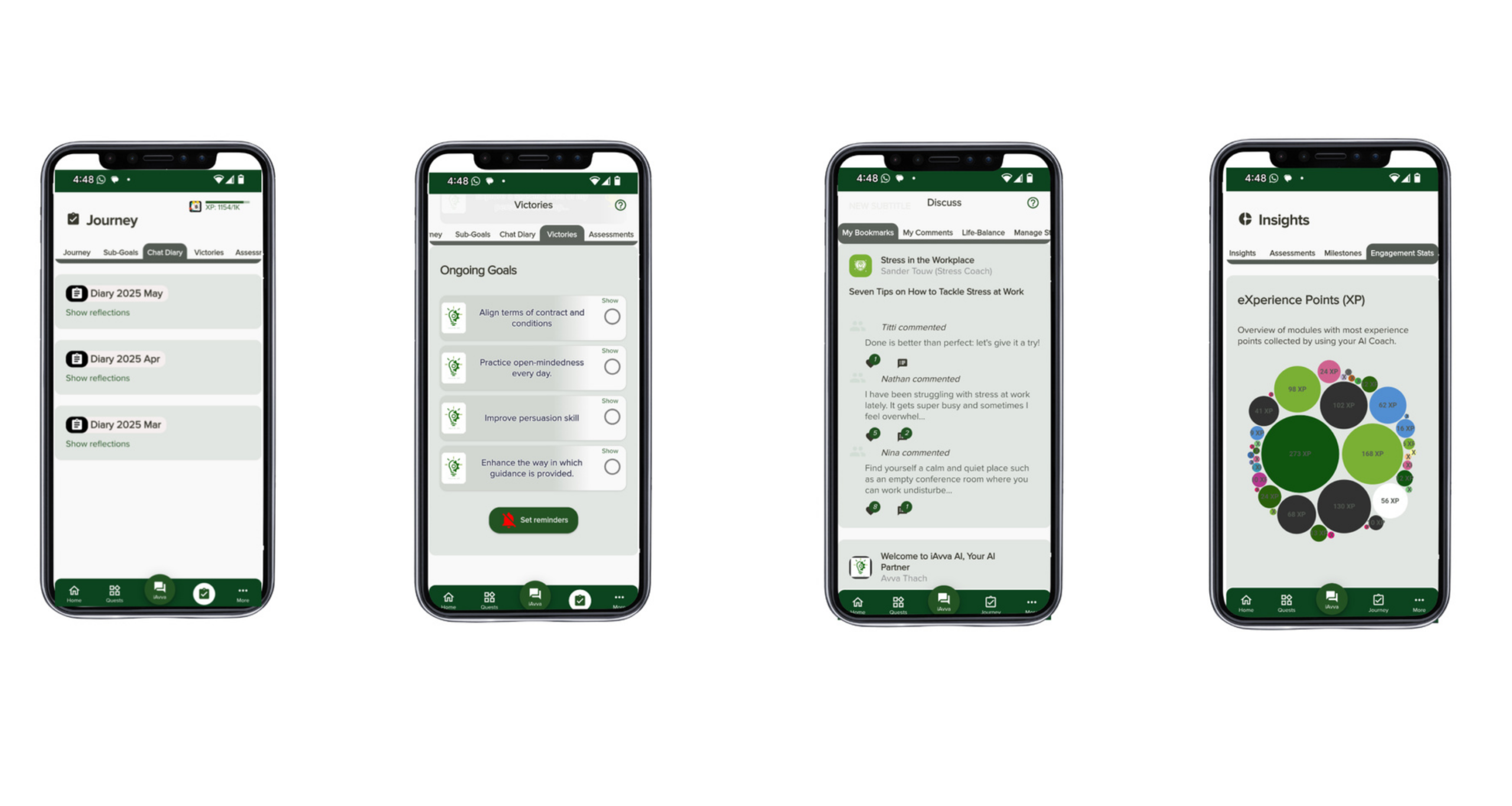
Core modules: AI-informed leadership diagnostics, target-setting aligned to transformation KPIs, structured coaching labs, stakeholder feedback integration, coach enablement (train-the-coach), and playbooks for scaling coaching into process improvement initiatives such as Lean or Agile. Delivery mixes cohort workshops, virtual practice sessions, and embedded diagnostic dashboards that connect to your LMS and people analytics.
- Delivery formats: blended cohorts with optional embedded coaching-as-a-service and AI tooling integration
- Typical duration: modular 3 to 6 months with optional ongoing measurement and practice nudges
- Investment posture: mid-market to enterprise pricing that includes integration support; expect additional budget for data and tooling connections
Expected outcomes: Faster alignment between leader behaviors and AI transformation goals, measurable improvement in decision velocity and cross-functional coordination, and clearer ROI signals tied to operational metrics like time-to-decision and reduction in process defects.
Key tradeoff and limitation: The program delivers best results only when underlying data and integration are solid. If HR systems, LMS, and operational telemetry are fragmented, the AI diagnostics will produce noisy signals and coaches will waste time on poor-quality insights. There is also a governance cost – data privacy, model explainability, and vendor integration work are practical obstacles that require cross-functional sponsorship.
Concrete example: A midmarket manufacturing client used iAvva to align 25 transformation leaders during an AI-enabled operations rollout. iAvva ran diagnostics on decision handoffs, trained internal coaches to interpret dashboard signals, and instituted weekly coaching labs focused on two measurable behaviors per leader. Within one quarter the organization observed faster interdepartmental approvals and fewer rework incidents tied to those leaders, and HR began using the same diagnostic outputs in talent calibration.
Practical judgment: Choose iAvva when your priority is coaching that is instrumented and tied to measurable process outcomes during an AI or digital transformation. If the immediate need is to certify a large population of front-line managers cheaply and quickly, a certification-first route is likely more cost effective. iAvva is not a plug-and-play substitution for basic coach skill building; it expects L&D to run deliberate practice loops and own data integration.
Next consideration: run a short pilot that pairs two coaches, a small leader cohort, and a scoped data feed. That pilot will expose integration frictions and prove whether the AI signals are operationally useful before full rollout.
Best Leadership Coaching Courses for L&D Teams: Curriculum, Outcomes, and Selection Tips
Choosing the right leadership coaching courses that drive measurable behavior change and scale across business units is harder than vendor brochures make it sound. Below we compare leading programs with clear curriculum breakdowns, expected outcomes, delivery formats, time-to-impact, and price bands. You will find a short selection checklist and practical guidance on when to invest in an internal AI-integrated coaching curriculum versus an external certification program.
…”, “inLanguage”: “en” }, { “@type”: “FAQPage”, “mainEntity”: [ { “@type”: “Question”, “name”: “What are the best leadership coaching courses for L&D teams?”, “acceptedAnswer”: { “@type”: “Answer”, “text”: “
The best leadership coaching courses for L&D teams include those that offer clear curriculum insights, measurable learning outcomes, and expert selection tips. It is important to choose programs that align with your specific organizational needs.
” } }, { “@type”: “Question”, “name”: “How do I choose the right leadership coaching course?”, “acceptedAnswer”: { “@type”: “Answer”, “text”: “
To choose the right leadership coaching course, consider the program’s ability to drive measurable behavior change and its scalability across business units. Evaluate curriculum breakdowns, expected outcomes, delivery formats, time-to-impact, and price bands.
” } } ] }, { “@type”: [“Speakable”], “@id”:”#speakableId1″, “_speakableSpecification”:{ “@type”:”SpeakableSpecification”, “_cssSelector”:[“h1″,”p.introduction”] } } ] }













Leave a Reply