



Introduction
“Success is not final, failure is not fatal. It is the courage to continue that counts.” — Winston Churchill, Former Prime Minister of the United Kingdom
Many companies invest heavily in perks and technology yet still struggle with low employee satisfaction and rising turnover. The frustration grows when surveys show problems, but nothing seems to change.
Employee satisfaction describes how content people feel with their jobs, leaders, tools, and growth path, and it is measurable and improvable. In this article, we explore what employee satisfaction really means, how it differs from engagement, how to measure it with real data, and which levers move it in a reliable way. We also show how iAvva AI blends human coaching with AI to turn leadership habits into higher satisfaction scores.
If you want teams who stay, perform, and support digital change, keep reading and use these ideas as your playbook.
Key Takeaways
Clear Definition Of Employee Satisfaction
Employee satisfaction reflects how content people feel about their work, manager, rewards, tools, and growth. It combines both rational factors, such as pay and workload, and emotional factors, such as respect and trust. When we treat it as a core business metric, we can track it, discuss it in reviews, and link it to decisions with the same seriousness as revenue.Why Satisfaction And Engagement Are Not The Same
Satisfaction answers the question whether people feel okay and fairly treated in their jobs. Engagement answers how much they care about results and how much extra effort they offer. We can have satisfied people who coast or highly engaged people who burn out and leave. Strong strategies build a solid base of satisfaction first, then aim for deeper engagement.How To Measure Satisfaction Reliably
Reliable measurement uses several methods, not one survey once a year. That includes baselines, pulse checks, eNPS, exit and stay interviews, and behavioral data such as absenteeism and turnover. When we combine numbers with comments and segment by team or manager, patterns become very clear and actionable.Evidence Based Levers To Improve Satisfaction
The biggest drivers are fair pay, realistic workload, usable tools, good managers, recognition, clear growth, and sense of purpose. Targeted programs that address those drivers, run as experiments and tracked over time, lift satisfaction and reduce unwanted attrition. Leadership development and better internal communication often create the fastest wins.Using iAvva AI To Scale Leadership Behaviors That Drive Satisfaction
iAvva AI uses a five minute daily coaching app plus human coaching and analytics to shift manager habits that employees feel every day. Micro prompts nudge leaders to recognize contributions, balance workload, and communicate with clarity. HR and L&D teams can then see which groups improve and connect leadership growth directly to satisfaction and performance metrics.
What Is Employee Satisfaction (And How Is It Different From Engagement)?
Employee satisfaction describes how content employees feel with their job, workplace, and employer across many aspects of experience. It differs from employee engagement, which focuses on emotional commitment and extra effort, and both need separate attention in strategy.
When we separate these ideas, we design better programs, choose better tools, and pick metrics that actually explain performance instead of hiding problems inside one vague “people score.”
Defining Employee Satisfaction In Strategic Terms
Employee satisfaction is the degree of contentment and positive feeling people have toward their role, environment, and organization. It reflects whether their expectations about work match reality across several areas that matter day to day. For leaders, it answers questions such as whether people would stay if recruiters call or whether they would recommend the company to a friend.
Key domains sit under that simple idea:
- Compensation And Benefits – Feeling underpaid or uncertain about pay quickly erodes trust. Clear structures and communication matter as much as the numbers.
- Respect And Recognition – How managers speak to people, give credit, and treat different roles shapes dignity and pride.
- Working Conditions And Tools – Physical space and digital tools both matter, so slow systems or clumsy workflows quietly drag down satisfaction.
Growth, autonomy, and a sense of meaning also play a strong role. Employees feel more satisfied when they:
- See a real path forward.
- Have some control over how they do their work.
- Understand why their tasks matter.
Job security and confidence in leadership add another layer, especially during change. When people believe leaders are honest and competent, they feel safer and more hopeful.
From a measurement view, satisfaction acts as both a lagging indicator of past choices and a leading indicator of future risk. Research from Gallup shows only about a third of US employees feel truly engaged, with a large middle group “just doing the job.” That middle group often reflects moderate satisfaction, which can slide either toward high performance or toward quiet quitting depending on leadership moves.
How Employee Satisfaction Differs From Employee Engagement
Employee satisfaction and employee engagement are related ideas but not the same thing. Satisfaction answers whether someone feels okay, fairly treated, and supported in their job. Engagement answers how much energy, focus, and emotional commitment they bring to the mission of the company.
Consider a satisfied but disengaged employee:
- Likes the pay, schedule, and colleagues.
- Rarely complains.
- Does the minimum, avoids new projects, and feels little connection to strategy.
- Leaves if a similar job with slightly better pay appears.
Now consider an engaged but dissatisfied employee:
- Loves the mission and cares deeply about customers.
- Faces heavy workload, clumsy tools, or pay that has not kept up with responsibility.
- Feels a mix of passion and strain that can lead to burnout and early exits.
According to Harvard Business Review, burnout strongly predicts turnover and health issues.
For HR and L&D, this split shapes investment:
- Step one: Build a stable base of satisfaction with fair pay, clear workload, modern tools, and baseline respect.
- Step two: Design engagement builders such as meaningful goals, autonomy, mastery, and strong team culture.
iAvva AI supports this by giving different micro prompts for different gaps, for example one set focused on recognition and fairness, and another focused on purpose and growth.
Why Employee Satisfaction Matters For Business Outcomes
Employee satisfaction matters because it links directly to productivity, retention, customer experience, and the success of digital initiatives. When satisfaction is low, even advanced tools and bold strategies struggle to gain traction.
When satisfaction is high, people bring more energy, stay longer, and support change, which gives leaders real financial and strategic advantages.
Business And Financial Impact Of Low Vs High Satisfaction
Research on happiness and productivity synthesizing multiple findings found that happy employees are about 12 percent more productive, while unhappy ones are about 10 percent less productive. That swing can decide whether a business hits targets without extra hiring. It also compounds across teams, projects, and years.
Low satisfaction raises costs in many ways:
- Replacement costs for an employee can range from roughly 30 percent of salary for junior roles up to several times salary for senior or niche roles, as highlighted by the Society for Human Resource Management.
- Quiet quitting spreads, with people doing only what contracts require, which lowers discretionary effort and increases absenteeism.
- Burnout increases errors, safety incidents, and health claims.
High satisfaction flips that picture:
- Satisfied employees tend to stay longer and speak well of the company, which boosts referrals and lowers hiring costs.
- Employee Net Promoter Score, or eNPS, tracks how likely people are to recommend their workplace, and strong scores link with better retention and stronger employer brands — a connection supported by research into employee happiness and productivity from Erasmus University Rotterdam.
- Teams with higher satisfaction also show more collaboration and innovation, since people feel safer raising ideas and concerns.
Customer outcomes follow similar patterns. The service-profit chain, described in research from Harvard Business School, shows that employee attitudes influence service quality, which then influences customer loyalty and profits. When employees feel valued and supported, they treat customers better and recover faster from problems, which lifts both satisfaction and revenue.
Employee Satisfaction As A Prerequisite For Digital Transformation
Employee satisfaction also shapes whether digital and AI programs succeed. Analysts at IDC estimate that organizations will spend trillions of dollars on digital transformation projects over a few years. At the same time, Harvard Business Review reports that more than half of such efforts fail to meet goals, often due to culture and people issues, not technology gaps.
When satisfaction is low, any new platform or workflow feels like yet another burden. Employees already feel overworked or unheard, so they:
- Resist new tools.
- Skip training.
- Build workarounds.
- Doubt leadership messages about benefits.
Change fatigue grows, and leaders misread this as “lack of skills” instead of a satisfaction problem.
Higher satisfaction reverses that dynamic. People with solid baseline trust and fair conditions are more willing to learn, test new systems, and give honest feedback. Managers with good coaching skills help their teams manage uncertainty and frame tools as support instead of threat.
iAvva AI was built for this reality, using human coaches plus AI prompts to support leaders through constant change, so that they protect satisfaction while asking teams to work in new ways.
What Drives (And Damages) Employee Satisfaction?
Employee satisfaction arises from a mix of pay, workload, recognition, leadership, tools, growth, and purpose. Each factor may seem simple on its own, yet together they shape whether people feel that work is fair, sustainable, and meaningful.
When one or two of these areas weaken badly enough, they can drag overall satisfaction down even if the rest looks good on paper.
Core Drivers Of Employee Satisfaction In US Organizations
Several drivers appear again and again in US research:
Competitive, Fair Compensation – Especially when combined with clear communication about how pay decisions work. According to research on salary expectations across hundreds of thousands of job postings and professionals, gaps between worker pay expectations and wages offered remain a leading driver of job dissatisfaction and turnover. People do not always need top dollar, but they want fairness and honesty.
Recognition And Respect – Employees want their work to be seen, not just in annual reviews but in weekly moments. That includes specific praise, public thanks where appropriate, and respectful treatment at every level. When people feel like second class citizens due to role, location, or background, their satisfaction drops quickly.
Workload And Burnout – Up to 40 percent of American workers report job burnout, according to Mayo Clinic, much of it tied to high workloads and tight time pressure. In practice, this means realistic goals, enough staffing, and norms that discourage constant after hours work. Work life balance and flexibility are part of this picture, as many employees now rank flexible schedules and remote options among their top needs.
Career Development And Advancement – Studies summarized by LinkedIn Learning show that lack of development is a common reason people leave. Employees feel more satisfied when they see clear career paths, have access to learning, and experience real internal mobility.
Leadership Quality, Communication, Inclusion, And Tools – Managers, policies, and systems determine whether the experience feels fair and workable. Inclusive practices and usable tools tie these drivers together and make them real day to day.
Common Satisfaction Detractors And Warning Signs
Just as positive drivers support satisfaction, common detractors erode it:
- Opaque Pay Decisions – When people suspect wide differences for similar roles or see promotions based on politics instead of clear criteria, trust falls away.
- Stalled Careers – Employees who feel stuck without clear next steps often disengage and start looking elsewhere.
- Damaging Manager Behavior – Micromanagement, unclear expectations, inconsistent feedback, or absence during important moments all send signals that people do not matter.
- Broken Promises – Changes around remote options, role scope, or development programs land especially hard, because they combine disappointment with lost trust.
- Tool Sprawl And Friction – Slow systems, too many platforms, and confusing processes add daily frustration that employees experience as disrespect for their time.
Warning signs appear before people resign, such as:
- Rising absenteeism or more sick days in certain teams.
- Internal complaints or HR and IT tickets with repeated themes about workload or tools.
- Pulse surveys showing declining scores tied to specific managers or systems.
- “Shadow attrition,” where top performers stop volunteering ideas, disengage from optional meetings, or show little interest in growth conversations.
Ignoring these early signals raises both human and financial risk. By contrast, continuous listening through surveys, focus groups, help desk data, and platforms like iAvva AI helps leaders spot trouble early. When we respond with visible actions, even small ones, we often restore trust before problems harden into resignations.
How Do You Measure Employee Satisfaction Reliably?
Reliable measurement of employee satisfaction uses several methods that work together. Surveys, interviews, and behavior data each show part of the story, and together they give leaders a clear picture of what is working and what is not.
When we measure well and respond openly, employees also feel heard, which by itself can lift satisfaction.
Core Methods And Metrics For Measuring Satisfaction
Employee satisfaction surveys are the starting point for many organizations. These surveys usually ask people to rate how satisfied they feel with different aspects of work, such as:
- Pay and benefits.
- Workload and work life balance.
- Tools and processes.
- Leadership and communication.
- Growth, inclusion, and recognition.
A simple scale, for example from one to five, makes it easy to track trends over time. Open text questions invite people to share what they like most and what they would change.
Pulse surveys add faster, lighter checks between big surveys. These might include three to ten questions focused on one theme, such as a new tool rollout or a reorganization. According to Qualtrics, organizations that use frequent pulses detect issues earlier and adjust faster than those that rely only on annual surveys. Shorter surveys also tend to have higher response rates, which improves data quality.
Employee Net Promoter Score (eNPS) offers a simple loyalty signal. The core question asks how likely someone is to recommend the company as a place to work. Scores at the top of the scale count as promoters, lows as detractors, and the difference between those groups gives the eNPS value. Research shared by Retently shows that a positive score above zero is a good baseline and many tech and knowledge firms aim for the mid thirties or higher.
Exit and stay interviews deepen the picture:
- Exit interviews help you understand why people chose to leave and whether there were moments when you could have changed that path.
- Stay interviews focus on current employees you want to keep and ask what keeps them and what might cause them to leave.
Behavioral indicators add another layer, including absenteeism patterns, performance swings, and voluntary turnover rates by team or manager. A simple dashboard that mixes these signals, something iAvva AI dashboards can support, gives executives a clear view of satisfaction health.
Avoiding Measurement Pitfalls And Biases
Measurement brings its own risks, and leaders need to handle them with care.
Common pitfalls include:
Low Participation – People who feel strongly positive or negative may respond more often than those in the middle, which can skew results. To improve participation, keep surveys short, explain how feedback is used, and share visible actions after each cycle so people see that their voice matters.
Timing Effects – Running a survey right after layoffs, bonus payouts, or major announcements can distort scores. To reduce this, many companies keep a stable survey rhythm and then interpret results in light of recent events.
Response Bias And Fear – Some employees may fear backlash for honest answers. According to research discussed by MIT Sloan Management Review, clear privacy messages and use of third party tools can increase candor.
Confirmation Bias In Interpretation – It is easy to look for data that confirms existing beliefs while ignoring hard messages. Cross functional review groups that include HR, IT, operations, and business leaders help reduce that bias.
AI based text analytics can also help by grouping open comments into themes such as manager behavior, workload, or tools without manual filtering. iAvva AI style dashboards can highlight hot spots so leaders act on facts, not just anecdotes.
Evidence Based Strategies To Improve Employee Satisfaction
Improving employee satisfaction works best when leaders focus on a small set of strong levers, test changes, and watch the data. Strong foundations in pay, workload, and tools come first, followed by leadership, recognition, growth, and purpose.
When we connect each effort to survey items, eNPS, and retention metrics, we can see what works and build on it.
Strengthening Foundations Pay Workload And Tools
Foundational conditions shape how every other initiative feels. If pay seems unfair, workload feels impossible, or tools constantly block progress, even the best leadership program will struggle. So we start here.
Key practices include:
Pay And Transparency
- Regular market benchmarking, informed by data on startup salaries and equity and their impact on retention, can help organizations set competitive pay structures.
- Clear pay bands by role.
- Open explanations of how pay decisions work.
- Training managers to have honest pay conversations to reduce confusion and rumor.
Workload And Work Life Balance
- Review data on overtime, after hours email volume, and project load by team.
- Where chronic overload appears, reorder priorities, add staff, or reduce low value tasks.
- Set clear norms around response times, such as no expectation of replies at night or on weekends except in true emergencies.
- Support time off and recovery so people feel their health matters.
Tools And Digital Workplace
- Many employees report frustration with outdated or clumsy internal systems, as shown in research by Nielsen Norman Group.
- IT and HR teams can run regular audits of major tools, ask simple satisfaction questions in surveys, and prioritize fixes for high friction areas.
- Faster login, simpler workflows, single sign on, and strong help desk support all reduce daily stress.
At iAvva AI, we often see satisfaction rise when digital friction drops, even before other programs begin. A few targeted process improvements can change how every day feels.
Elevating Experience Leadership Recognition Growth And Purpose
Once foundations are more stable, we can focus on the human experience that people feel in every interaction. Manager and leadership capability sits at the center.
Great managers:
- Set clear expectations.
- Hold regular one to ones.
- Give frequent feedback.
- Remove barriers for their teams.
Leadership programs that practice these skills with role plays, micro learning, and coaching have strong impact on satisfaction, a pattern supported by research on relationships between leader behaviors and employee well-being published in Scientific Reports. iAvva AI micro coaching prompts help managers apply these skills in real moments, not just workshops.
Recognition and appreciation are powerful and often underused levers:
- People want to know what they did well, not only what needs improvement.
- Formal programs that include peer to peer praise, small rewards, and values based awards all help, as long as they feel fair and inclusive.
- Informal habits matter too, such as starting meetings by acknowledging recent wins or sending short notes that highlight specific actions and their impact.
Career development and learning keep satisfaction high over longer periods:
- Clear role levels, competency frameworks, and internal job boards help people see realistic next steps.
- Learning journeys that blend technical, digital, and leadership topics support that growth.
- Research exploring whether employees would rather work with AI or human coworkers finds that job satisfaction is strongly tied to growth opportunities and the quality of workplace relationships, underscoring why learning investment matters for retention.
- When leaders connect daily tasks to mission and share stories about customer value, they add a sense of purpose that deepens both satisfaction and engagement.
“Culture eats strategy for breakfast.” — Peter Drucker, Management Consultant and Author
This quote reminds us that behavior and daily experience carry more weight than any slide deck. By linking each strategy to specific survey questions and eNPS items, then watching for shifts over six to twelve months, we can see which changes truly strengthen that culture.
How iAvva AI Helps You Measurably Improve Employee Satisfaction
iAvva AI exists to help organizations turn good intentions about employee satisfaction into measurable behavior change. We combine an AI powered coaching app, human coaching, and analytics so leaders can build habits that employees actually feel.
This approach supports HR, L&D, and C suite teams that need scale, consistency, and proof of impact across global and hybrid workforces.
Daily Micro Coaching That Shifts Manager Behavior
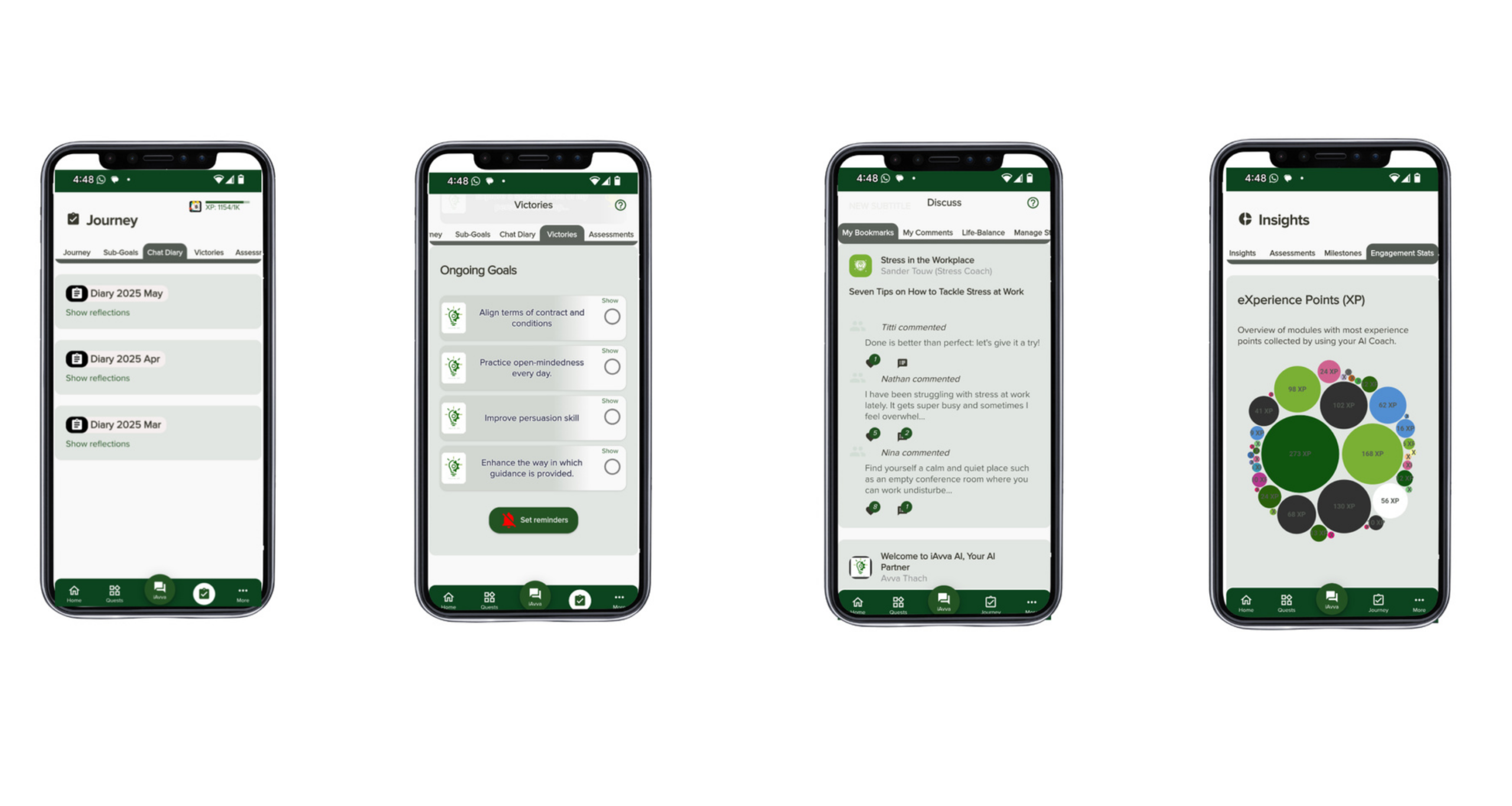
The iAvva AI Coach App is a five minute self reflection and coaching platform available on web, iOS, and Android in nineteen languages. Leaders use it daily or several times a week, which fits into busy schedules more easily than long workshops. Each short session invites them to reflect on recent interactions, decisions, and challenges through targeted questions.
Prompts draw from neuroscience, positive psychology, and International Coaching Federation standards. For example:
- Some nudges focus on recognition, such as asking who on the team contributed this week and how the leader will thank them.
- Others focus on workload and boundaries, asking where tasks can be delegated or which meetings do not need to happen.
- Still others help leaders link team work to mission, so employees see the meaning behind daily tasks.
The app offers Coach and Mentor styles so users can choose more structured guidance or more open exploration. With audio and text options, it supports different learning preferences and neurodiverse users.
Over time, this always on companion helps managers form habits that raise satisfaction, such as:
- Regular praise and acknowledgment.
- Thoughtful one to ones.
- Clearer communication.
- Fairer workload discussions.
Because sessions are short, leaders keep using the app instead of dropping off after initial motivation fades.
Analytics OKR Alignment And Hybrid Human AI Support
Behind the scenes, iAvva AI provides real time dashboards for HR, L&D, and People Operations teams. These dashboards show aggregate patterns such as usage, goal themes, and self reported growth areas, while respecting individual privacy. Leaders can:
- Compare groups and identify high performing teams.
- Track progress on coaching topics tied to satisfaction drivers.
- Spot teams that might need extra support.
OKR alignment is another key feature. Employees and managers can link personal growth goals with business objectives, which increases both clarity and perceived fairness. When people see how their development connects to company aims, they feel more valued and more motivated. Research on founder compensation insights and early-stage organizations similarly shows that aligning individual goals with company objectives strengthens both performance and retention.
The human side of iAvva AI includes personalized one to one and group coaching, with more than 1,400 hours of coaching delivered across dozens of enterprises. These sessions focus on skills that influence satisfaction directly, such as:
- Resilience and stress management.
- Emotional intelligence.
- Delegation and priority setting.
- Executive presence in middle management.
Our platform is GDPR compliant and encrypted, which supports trust, especially in large or regulated organizations. Many clients use iAvva AI analytics alongside their own surveys and HR data to form a richer picture of satisfaction trends.
How To Build A Satisfaction Focused Leadership And Learning Strategy
To raise employee satisfaction in a sustainable way, leadership and learning strategies need to treat it as a central design target. That means using satisfaction data to choose priorities and giving employees tools to shape their own experience.
When HR, L&D, IT, and business leaders work together on this, the organization gains both happier teams and stronger performance.
Turning Satisfaction Data Into Leadership Priorities
Satisfaction data only matters when it leads to clear action. The first step is to group survey questions and comments by driver, such as:
- Feedback and recognition.
- Workload and burnout.
- Tools and processes.
- Trust in leadership.
- Inclusion and belonging.
If scores around feedback and recognition are low, leadership programs should focus heavily on:
- Coaching skills.
- Specific praise.
- Regular one to ones.
If burnout and workload concerns dominate, training should center on:
- Priority setting.
- Delegation.
- Boundary setting and saying no.
Low trust in senior leadership points to different needs, such as:
- Communication training for executives.
- More transparent town halls.
- Clearer framing of tough decisions.
By aligning leadership journeys directly with top gaps, we avoid generic programs that feel disconnected from real pain points. Platforms like iAvva AI can customize micro coaching themes so managers work on exactly the skills their teams need most.
Before and after comparisons amplify learning:
- HR and L&D teams can look at team level satisfaction, eNPS, and retention data three to six months before a program and again after.
- When the numbers move in the right direction, leaders gain evidence that behaviors are improving life for employees.
- When they do not move, we adjust content, coaching, or support conditions until we see progress.
Over time, this cycle turns satisfaction work into a continuous improvement system.
Empowering Employees To Co Own Their Satisfaction
Organizations shape many conditions, but employees also play a part in their own satisfaction. When we frame satisfaction as co created, we invite people to build habits that support their energy, growth, and relationships.
Helpful skills include:
- Boundary setting, time management, and stress management to protect well being.
- Career navigation and self advocacy to seek assignments and paths that fit their strengths.
- Emotional intelligence and collaboration skills to improve team climate.
When people listen well, manage conflict, and give peers constructive feedback, team environments improve. Daily reflection with tools like the iAvva AI Coach App helps employees notice patterns in their mood, triggers, and wins. They arrive at one to ones with clearer requests and ideas about what would make work better.
IT and L&D functions support this by giving employees:
- Friendly tools and platforms.
- Clear learning paths.
- Easy access to coaching or mentoring.
According to The Well-Being Paradox research from Happily, organizations that invest in both systems and individual capability see measurable gains in resilience and satisfaction, even as broader engagement challenges persist. When people feel both supported and responsible, satisfaction becomes more stable, even during change.
Moving Forward
Employee satisfaction is not a soft side topic. It is a measurable, designable part of business performance that influences productivity, retention, culture, and the success of digital and AI projects. When we treat it with the same rigor as financial metrics, we gain clearer choices and stronger results.
The path forward starts with:
- Honest measurement and open communication about what we hear.
- Stronger foundations around pay, workload, and tools.
- Leadership capability in feedback, recognition, and inclusion.
- Continuous listening and shared ownership of growth and well being.
iAvva AI was created to make this practical at scale, through daily micro coaching, analytics, and human support that turn leadership theory into visible habit change. A simple next step is to select one business unit or transformation program and run a satisfaction focused leadership pilot, with clear baselines and targets. When you see the impact on both people and numbers, you can expand with confidence across the organization.
Frequently Asked Questions
Question: How Often Should We Measure Employee Satisfaction?
The best rhythm uses both annual baselines and regular pulse checks. Many organizations run a full survey once a year and then short pulses each quarter on key topics. Faster cycles make it easier to see whether actions work and to adjust. Whatever cadence you choose, always share what you heard and what you plan to change so employees keep trusting the process.
Question: What Is A Good Employee Satisfaction Score Or eNPS Benchmark?
A “good” score depends on industry, region, and starting point. For eNPS, any score above zero means you have more promoters than detractors, which is a solid base. Many tech and knowledge firms view scores around plus thirty to forty as strong. More important than one target number is steady improvement over time and healthier scores in teams that have received focused support.
Question: How Can Small And Mid Sized Businesses Improve Satisfaction Without Big Budgets?
Smaller companies can move satisfaction with thoughtful, low cost actions. For example:
- Regular one to ones.
- Clear communication during change.
- Frequent specific recognition.
- Flexible schedules where possible.
Honest career conversations matter even when promotion slots are limited. Lightweight AI powered tools such as the iAvva AI Coach App give managers and employees structured development without heavy infrastructure or long workshops.
Question: How Do We Get Managers To Take Employee Satisfaction Seriously?
Managers pay attention when satisfaction ties to their goals and support. Connect satisfaction and eNPS scores to performance expectations, promotions, and bonuses so the message is clear. Give managers simple data on their teams along with concrete tools, such as micro learning, coaching, and templates for conversations. Focus on support and skill building rather than blame so they feel safe facing hard feedback.
Question: Can AI Tools Really Improve Employee Satisfaction Or Do They Just Add More Tech?
AI can help or harm, depending on design and use. When AI reduces friction, supports learning, and personalizes coaching, it can lift satisfaction by making work feel smoother and growth feel more accessible. Examples include micro coaching apps like the iAvva AI Coach App and AI agents that answer HR or IT questions quickly. It is important to offer clear guardrails, easy human escalation, and honest communication about data use.
Question: How Long Does It Take To See Measurable Improvements In Employee Satisfaction?
You can often see early shifts in specific items, such as communication or recognition scores, within three to six months. Bigger moves in culture, leadership trust, and overall satisfaction usually take twelve to twenty four months. Set realistic expectations with your executive team, measure at regular intervals, and run targeted pilots before broad rollouts. Tools like iAvva AI help compress timelines by turning learning into daily practice.















Leave a Reply