


Introduction: The Uneasy Feeling That You’re Already Behind In AI
There is a particular silence that falls in a leadership meeting when someone says, “Have you seen OpenAI’s latest model?”
Slides keep moving. Heads nod. Yet inside, the thought hits hard that decisions about AI are racing ahead faster than your organization can adapt.
That quiet tension grows when someone mentions a competitor that just used AI implementation to cut cycle time, redesign a function, or launch a pilot on leadership coaching. You start to wonder how much productivity, innovation, and talent growth you are already leaving on the table. It can feel like there is a new rulebook for work and leadership, and you only have the table of contents.
On the news, Microsoft, Amazon, Google, and others are pouring billions into OpenAI and comparable labs. This is not a passing fad. They are locking in cloud and compute capacity, model access, and distribution so they own the rails of the next era of work. This race is not only about one company called OpenAI. It is about a new operating system for business that will sit inside every productivity suite, HR platform, and learning tool.
Here is the tension. You are accountable for people, culture, ethics, and performance, yet the AI conversation is dominated by GPUs, models, and architecture diagrams. Deep down, the real question is more human. How do you translate this Big Tech race into practical, ethical AI implementation that actually makes managers better, teams healthier, and results stronger?
That is where iAvva AI comes in. iAvva AI is an AI-powered leadership and self-reflection coach that uses advanced models behind the scenes, but focuses on one simple thing on the surface: daily, five-minute habits that make leaders better and connect directly to your business goals. In this article, you will see why Big Tech is racing to fund OpenAI, what that means for your own AI implementation choices, and how to turn all that investment into a direct advantage for your leaders, HR strategy, and workforce development.
“The real competitive advantage of artificial intelligence will belong to leaders who know how to apply it to people, not just processes.” – Adapted from common views in HR and leadership research
Key Takeaways
- Big Tech is investing in OpenAI to secure AI infrastructure, compute, and talent so they control the rails of future work, learning, and collaboration. This race is not about hype; it is about long-term power over platforms and distribution.
- For your organization, this means AI implementation is now a baseline expectation, not a side project. The biggest upside sits in people-intensive areas such as leadership development, coaching, upskilling, and smarter decision-making.
- You do not need to build your own OpenAI. You need to use trusted platforms that already integrate frontier models into the tools your workforce uses, while you focus on outcomes, governance, and culture.
- Leadership capability, broad AI literacy, and thoughtful ethics will define who gains from this shift. Organizations that delay risk both talent loss and slower performance.
- iAvva AI turns the OpenAI era into a daily leadership advantage by offering an AI coach that runs in five-minute sessions, aligns with OKRs, works in 19 languages, and gives HR and L&D real-time, privacy-safe analytics.
- By following a clear framework—outcome-first goals, readiness checks, the right partners, focused pilots, and ongoing governance—you can move from anxiety about AI to confident, measurable progress.
What’s Really Driving Big Tech’s Race To Fund OpenAI
When headlines say that a Big Tech company has committed billions to OpenAI or another frontier lab, it can sound distant from your people agenda. Underneath those headlines, however, sit forces that will shape the tools your workforce uses every day.
At the center is infrastructure. Training and running large models needs huge amounts of cloud compute and specialized chips. By backing OpenAI, cloud vendors secure demand for their platforms and make sure that the world’s most advanced models run on their stack. It is similar to owning the railroads when factories relied on trains; control the rails and you influence everything that moves on them.
Next comes model access and differentiation. As models improve, a small performance edge can mean faster coding, smarter assistants, or better predictions. Big Tech wants either exclusive or favored access to frontier versions, so they can bake those capabilities into products such as office suites, CRM tools, or HR platforms. That turns a research lab’s output into a competitive moat that others find hard to match.
There is also a clear platform play. When developers build apps and plugins on top of a given AI system, they deepen dependence on that stack. The more companies anchor their AI implementation on those rails, the harder it becomes to switch. This is why you see waves of integrations, app stores, and partner programs tied to these model providers.
Behind all of this is a race for scarce talent and intellectual property. Advanced AI researchers, safety experts, and data scientists are few compared with demand. Strategic funding deals give Big Tech closer ties to these teams and their methods. They also secure rights to use, adapt, or extend the outputs in their own products.
For you, the important point is this. Your organization will not train foundational models from scratch. You will consume AI through these systems—inside email, collaboration tools, HR platforms, and services such as iAvva AI. The upside is that frontier capabilities become cheaper and more available. The trade-off is that the menu of options grows crowded and complex, and you need a clear strategy to decide where to plug in, how to manage risk, and which partners help your people actually improve performance.
What Big Tech’s OpenAI Bets Mean For Your AI Implementation Strategy
The size of Big Tech’s bets on OpenAI signals one thing very clearly. AI will be woven into the default tools of work—not just special pilots or isolated bots. That shifts AI implementation from a side experiment into an assumption baked into daily workflows.
You are already seeing this in productivity suites that add AI co-pilots for mail, documents, presentations, and meetings. HR systems are adding AI-driven recommendations for candidates and internal moves. Learning platforms are starting to include automatic course summaries, AI tutors, and adaptive learning paths. Whether you plan for it or not, AI features will continue to arrive with every upgrade and license renewal.
People-intensive functions sit at the center of this wave:
- HR and people analytics can use AI to surface patterns in attrition, skills, and engagement before issues escalate.
- Recruiting and operations can automate scheduling, policy FAQs, or draft communications.
- Leadership development and coaching can shift from rare, high-cost workshops to continuous, AI-supported practice for managers at every level.
The risk comes if you stay passive. If you do not set an AI implementation agenda, AI still enters your organization through vendor updates and tools your employees adopt on their own. That leads to:
- Pockets of shadow AI
- Inconsistent employee experiences
- Data and compliance risk
- Missed chances to align usage with your strategy
In that scenario, you absorb the risk and cost with little coordinated gain.
The opportunity is to flip this. With the right plan, you can use OpenAI-level models, through trusted partners, to free managers from administrative drag, create daily leadership touchpoints, and personalize development for each role and context. That requires treating AI implementation in people functions as a discipline. It is not just buying a chatbot. It is:
- Designing end-to-end experiences
- Setting clear outcomes and KPIs
- Picking platforms such as iAvva AI that align with your culture
- Putting ethics and measurement at the center from day one
From Models To Management: How OpenAI-Level Capabilities Transform Leadership Development
Most coverage of frontier models focuses on coding, content creation, or search. Yet some of the strongest effects show up in leadership development, where small shifts in behavior compound across teams and years.
Generative AI opens the door to tailored coaching prompts, reflection questions, and feedback summaries that adjust in real time. Instead of static worksheets, a manager can receive context-aware prompts that reflect their role, current goals, and recent challenges. Natural language processing can scan written feedback, survey comments, or performance notes to surface themes without subjecting people to more forms.
Predictive analytics adds a further layer. By connecting data from engagement, performance, and workload, AI can highlight patterns that suggest burnout risk, team friction, or hidden high-potential talent. Used carefully, this helps HR and L&D direct support where it matters rather than rely only on noise or gut feel.
All this makes it possible to move from program-based development to always-on leadership growth. Traditional models depend on workshops and offsites a few times a year, followed by a slow fade back to old habits. In a world shaped by fast AI, that tempo is no longer enough. Leaders need short, regular moments of practice, reflection, and planning that fit inside busy schedules and reinforce new behaviors.
Personalization at scale is where AI shines. Micro-coaching can adjust to each leader’s preferred mode—text, voice, language, timing, and topic. Neuroscience shows that frequent, small nudges drive more lasting change than single, intense events. That is the pattern platforms like iAvva AI follow, with five-minute, daily reflections that link back to real work and team situations.
For HR and L&D, this shift means rethinking who gets coaching and when:
- Coaching is no longer reserved only for executives.
- First-line managers, project leads, and mid-level leaders can access meaningful support.
- HR gains aggregate insight into where leaders are struggling or thriving, without breaching confidentiality.
That is how advanced models turn into better management, not just better demos.
“Leadership is not a one-off event; it is a daily practice. AI lets us support that practice at a scale that was never economically feasible before.” – Common perspective among leadership coaches
Why You Shouldn’t Try To Build Your Own OpenAI (And What To Do Instead)
Seeing Big Tech build research labs and massive models can tempt some organizations to dream about their own AI stack. For people functions, this is almost always the wrong move. The economics and skills needed for foundational research simply do not match the value you gain.
Training large models takes billions in compute, huge specialized teams, and access to vast data. Even many tech companies choose to partner rather than build from scratch at that layer. By contrast, applied AI implementation in HR, L&D, and leadership focuses on closer-to-the-ground tasks:
- Connecting AI to your systems and workflows
- Shaping user experiences and change programs
- Embedding coaching in development tracks
- Measuring effect on engagement, performance, and retention
As a leader in HR, L&D, IT, or the business, your focus should sit with outcomes, culture, and governance. You do not need to create the rocket; you need to choose where it should go and how safely it flies. In practice, that means renting frontier capabilities from cloud and AI providers, then designing your own applications and change programs on top.
Think of it as “rent the rocket, own the mission.” You adopt platforms that already integrate OpenAI-level capabilities, such as iAvva AI for leadership coaching, and combine them with your values, OKRs, and internal programs. You decide which problems to address—new manager ramp-up, mid-level leadership support, AI literacy—and how to integrate AI into those flows.
There are choices about building, buying, or partnering:
- Build when you have a very narrow, proprietary use case and strong in-house tech skills.
- Buy or partner when the use case—leadership coaching, learning personalization, HR analytics—is common across many organizations and already well served by specialist vendors.
iAvva AI fits this second category, giving you a ready-made coaching engine tied to modern neuroscience and ICF principles, without years of internal development.
Getting this decision wrong can be costly. Attempts to roll your own AI platform often stall under security concerns, low adoption, hidden costs, and the sense that AI is a side experiment rather than a real lever on leadership and performance. By wiring in proven platforms and keeping your energy on design, ethics, and measurement, you move faster, with less risk, and with more direct effect on your people.
iAvva AI: Turning The OpenAI Race Into A Leadership Advantage For Your Organization
If manager quality drives engagement, performance, and retention—and research keeps showing that it does—then leadership is the highest-leverage place for AI implementation. When leaders set clear goals, hold effective one-on-ones, and handle change well, teams perform better. When they do not, even the best tech stack struggles.
For years, the main path to stronger leadership was costly coaching and long programs that could reach only a small part of the organization. AI changes the math by making high-quality coaching behaviors available in a lighter, always-on form. That is exactly the space where iAvva AI operates.
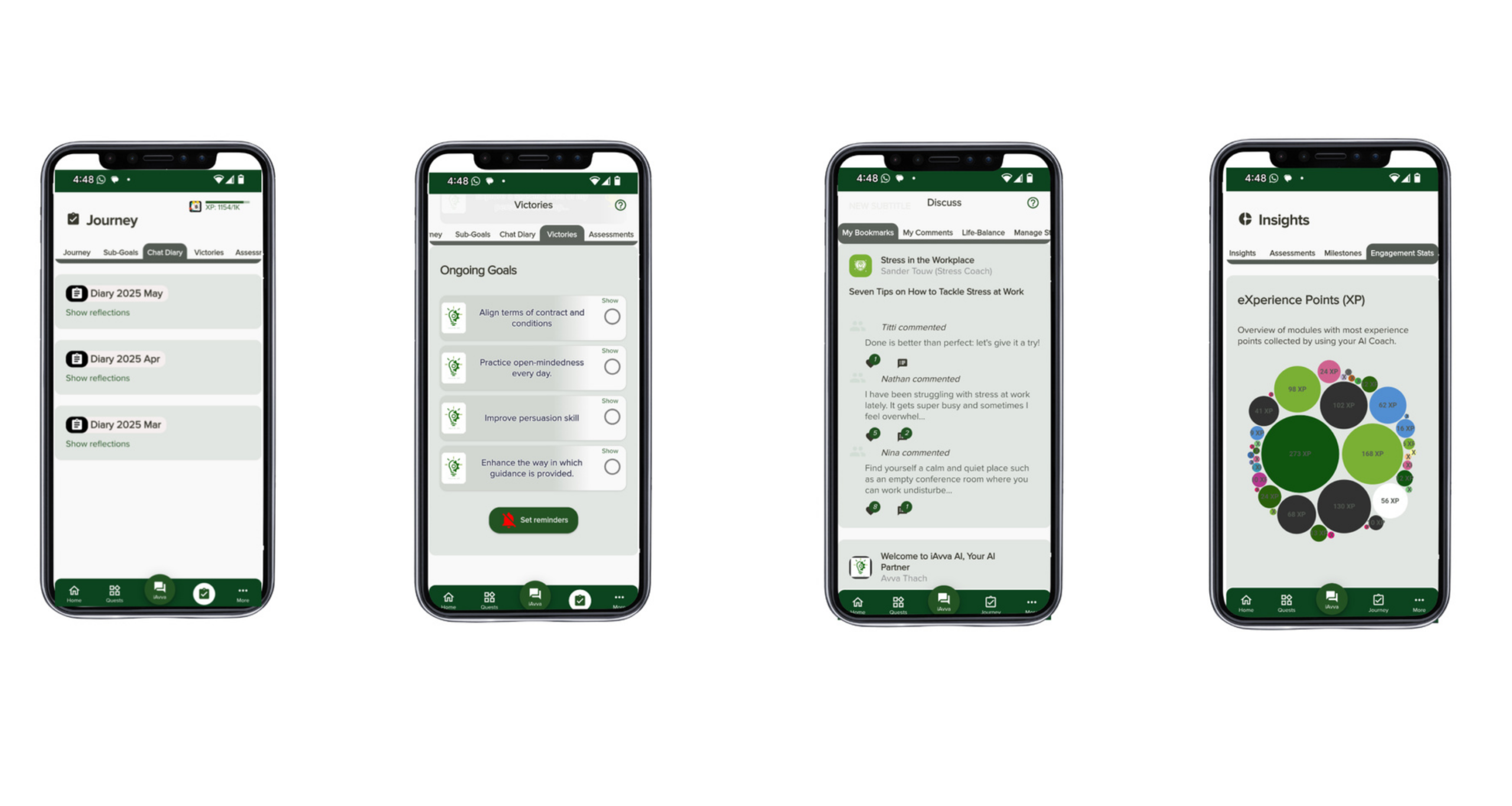
The iAvva AI Coach is a five-minute daily companion for leaders. It brings together neuroscience, positive psychology, and ICF coaching principles in short, structured reflections that fit into a lunch break or commute. Leaders choose voice or text, in any of 19 languages, on web, iOS, or Android. The experience meets them where they actually are, instead of expecting them to carve out hours they do not have.
Underneath, iAvva AI connects each leader’s reflections and actions to their real work. Prompts tie directly to OKRs, current priorities, and live challenges such as difficult feedback, team alignment, or AI changes in workflows. Over time, this creates a rhythm of micro-learning and self-awareness that supports the leadership culture you want, not just the one you have.
For HR and L&D, iAvva AI offers more than a coaching companion. It also provides real-time analytics dashboards that show adoption rates, themes across cohorts, and links between coaching activity and performance metrics. All of this is designed with security and privacy as foundations, including GDPR compliance and neurodiversity-friendly accessibility features. In practical terms, iAvva AI lets you turn the OpenAI era into something your leaders can use every single day, in a way that you can see, measure, and trust.
“What gets measured gets managed. When coaching activity and business outcomes sit on the same dashboard, leadership development stops being a black box.” – Common viewpoint among CHROs
How iAvva AI Uses Advanced AI (Including OpenAI-Level Capabilities) For Ethical, Effective Coaching
Under the smooth surface of the app, iAvva AI uses generative models to create prompts and reflections that feel personal rather than generic. The system takes into account a leader’s role, current goals, and earlier entries to suggest questions that stretch thinking without overwhelming. This is where advanced AI shines: it can shape a slightly different conversation for each person, every time, while still following sound coaching structure.
As leaders use the app, AI summarizes their patterns over time. It can highlight recurring strengths, such as strong delegation or clarity, and point out blind spots, such as delayed feedback or conflict avoidance. These summaries help leaders see themselves more clearly without feeling judged and guide where to focus next.
Natural language processing adds another layer by detecting themes across groups of leaders. For example, HR might see that many managers are reflecting about change resistance, burnout, or giving feedback. Those insights appear in aggregate, without names or sensitive details, so you get a culture-level view without invading personal space.
Ethics and security sit at the core of this design:
- Data is encrypted and governed by strict privacy rules.
- The platform aligns with GDPR and other relevant standards.
- Individual reflections stay in the context of growth and are not meant for evaluation or punishment.
- Guardrails are in place to reduce harmful or biased coaching outputs.
- Prompts are shaped by guidelines that support inclusion, respect, and psychological safety.
In short, iAvva AI uses powerful models but keeps humans, values, and trust at the center.
Strategic Alignment: Connecting Personal Growth To Business OKRs
A common frustration with traditional leadership programs is the gap between personal insight and business results. Leaders may leave a workshop inspired, but it is hard to see how that maps to revenue, productivity, or engagement. iAvva AI addresses this by anchoring reflections and actions directly to your organization’s OKRs.
Within the app, a leader links their personal focus areas to team or business priorities. For example, a manager might decide to improve one-on-one meetings as a way to boost engagement scores. iAvva AI then offers prompts about:
- Planning those meetings
- Asking better questions
- Following up on commitments
all with that target in mind. The result is that each five-minute session nudges real behaviors tied to a known KPI.
A sales leader could connect coaching sessions with pipeline quality or win rates. Prompts might ask them to reflect on how they guide reps, where deals stall, or how they use AI tools in their sales process. Over time, both the leader and HR can see patterns between consistent use of the app, improvements in coaching behaviors, and shifts in numbers such as close rates or forecast accuracy.
For HR and L&D, the platform tracks engagement with prompts, streaks of usage, and the themes leaders work on. You can view correlations between coaching activity and metrics such as retention in key roles, 360° feedback scores, or time-to-productivity for new managers. This helps you show the C-suite that AI implementation is not just tech spend, but a clear driver of performance, based on data coming straight from your people systems.
“When personal growth stories line up with hard metrics, executives stop asking if learning matters and start asking how fast they can scale it.” – Common L&D insight
Scalable Workforce Readiness: Leadership And AI Literacy For The Many, Not The Few
To compete in an AI-shaped market, you need more than a handful of AI-savvy executives. You need broad leadership strength and a workforce that feels confident using AI tools in real work. iAvva AI supports both at scale.
The platform’s multilingual and mobile-first design means you can reach leaders in different regions, time zones, and job types:
- Frontline supervisors, plant managers, or store leaders who rarely sit at a desk can still complete short sessions on their phones.
- Mid-level managers across functions can work in their preferred language with a familiar interface that respects neurodiversity and different learning styles.
- Senior leaders can use reflections to think through AI strategy, change management, and communication.
In larger enterprises, iAvva AI can plug into leadership academies, high-potential pipelines, and manager onboarding. It becomes a thread that runs before, during, and after formal programs, so learning does not stop when the workshop ends. For small and mid-sized businesses, the same platform offers ready-made coaching support without needing a full L&D team or big budgets. Owners and managers receive structured development help while HR stays lean.
Real-time analytics give HR and L&D a living map of usage and themes. Dashboards show:
- Which groups engage most
- Where coaching topics cluster
- How patterns shift over time
That insight can inform your broader AI implementation roadmap, pointing to areas where you need extra training, change support, or process redesign. Instead of guessing where leaders are struggling, you have current, privacy-safe signals that guide your decisions.
Strategic Rationale: Why AI Implementation In People Functions Is Now Non-Negotiable
The race around OpenAI is a sign that AI will shape every major business function. For people functions, the case for AI implementation rests on five main drivers, each with direct impact on your role and your numbers.
Decision Quality And Speed
Talent choices, org design, and learning investments often rely on lagging indicators and local opinions. AI lets you see patterns in turnover, performance, skills, and engagement early enough to act. Instead of waiting for yearly surveys, you can notice team-level risk and support leaders before problems spike.Operational Efficiency
HR and L&D teams carry heavy loads of routine work—tickets, scheduling, basic questions, manual reporting. AI assistants and automation can cut response times and free people to focus on design, coaching, and strategic conversations. Managers gain co-pilots for feedback, goal-setting, and meeting preparation, easing the admin load while raising the quality of interactions.Personalization At Scale
Employees expect the same level of tailored experience they get from consumer apps. AI allows you to move from one-size-fits-all learning to adaptive paths that match each person’s role, goals, and performance patterns. Leadership development follows the same logic, with targeted prompts and exercises shaped by context rather than generic case studies.Risk Management And Compliance
People decisions can carry serious legal and ethical stakes. AI can help monitor data for signs of bias, policy breaches, or risky behavior, and surface alerts early. Properly governed, this does not mean constant surveillance; it means structured, well-documented checks that support fairness, safety, and trust.Employer Brand And Talent Attraction
AI readiness has become a marker of employer brand. Top talent wants to work where tools help them perform, where AI feels safe and thoughtful rather than chaotic. Employers that show visible, ethical use of AI in development and daily work stand out in recruiting and retention.
iAvva AI aligns with each of these drivers. It improves decision quality by giving leaders regular space to reflect and act on data-informed prompts. It raises efficiency by compressing meaningful coaching into five-minute blocks that do not need scheduling or travel. It delivers personalization at scale through adaptive prompts and multi-language support. It supports risk and ethics with privacy-first design and guardrails. And it signals to current and future talent that your organization treats AI as a way to grow people, not only as a cost-saving tool.
A Practical Framework To Implement AI In Your People Systems (Inspired By The Big Tech Playbook)
Big Tech approaches AI with clear stages: define goals, assess readiness, choose platforms, run pilots, and then scale with governance. You can use the same pattern for HR, L&D, and leadership, adapted to your size and context.
Instead of starting with tools, begin with the outcomes you care about—better managers, faster upskilling, more consistent coaching, or higher engagement in critical teams. Then, check how ready your data, systems, and culture are to support those goals. From there, pick a set of platforms that pair horizontal capabilities from major vendors with specialized layers such as iAvva AI for leadership.
Once the pieces are in place, you design focused pilots that test real use cases with clear metrics. Leadership cohorts are often the best starting point, because they sit at the crossroads of culture, performance, and change. As pilots show value, you expand in waves, backed by ethics, governance, and constant feedback. Over time, AI becomes a normal part of how your people systems run, rather than a string of separate experiments.
Tip: Treat every AI initiative like a change program, not just a tech rollout. Communication, training, and sponsorship matter as much as model choice.
Step 1 – Define Outcome-First AI Goals For People Functions
The first trap to avoid is “AI tourism,” where people experiment with tools but never tie them to real business results. To steer clear of this, you start from your strategic priorities and work backward.
If your board is focused on growth, you might define outcomes such as more effective sales leadership or faster onboarding for revenue roles. If productivity and cost are in focus, you might look at manager spans, process bottlenecks, or frequent HR tickets. For transformation programs, you might highlight AI literacy and change-ready leadership as explicit outcomes.
From there, you translate these themes into people goals. You could state that you want to increase the share of effective managers by a certain percentage over 18 months, or raise AI confidence scores by several points across the workforce. You then set SMART objectives for AI implementation, such as:
- Reducing new manager ramp-up time by 30 percent using iAvva AI as part of an onboarding track
- Lifting learning completion rates by a set margin with AI-driven personalization in your LMS
- Raising “my manager supports my growth” scores in engagement surveys
This clarity guides every later choice.
Step 2 – Assess AI Readiness (Data, Infrastructure, Talent, Culture)
Before you scale AI in people systems, you need an honest view of your starting point. A simple readiness check across data, infrastructure, talent, and culture helps you spot both risks and fast paths.
- Data: Are key HR, performance, and learning records accurate, accessible, and governed? Is sensitive information protected? Do your processes align with privacy laws?
- Infrastructure: What does your cloud setup look like? How well can you integrate with services that already offer OpenAI-level capabilities? Are your HRIS and LMS open to API-based connections?
- Talent: Do HR and L&D leaders have enough AI literacy to sponsor projects and hold vendors to account? Do you have access to data and AI expertise in-house, or do you need partners?
- Culture: Do leaders talk about AI as a helpful assistant or a threat? Is experimentation safe? Do people feel able to share both wins and concerns?
Putting this into a simple checklist or scorecard helps you prioritize where to start and what to fix first.
Step 3 – Choose The Right AI Platforms And Partners
Once you know what you want to achieve and where you stand, you can select tools more wisely. Most organizations benefit from a combination of horizontal and specialized platforms.
- Horizontal platforms include your main cloud provider and productivity suite, which likely embed OpenAI-level services such as generative writing or meeting summaries.
- Specialized platforms focus on people-centric needs. iAvva AI is that layer for leadership and self-reflection, adding depth in coaching and behavior change that general tools do not offer.
When you evaluate platforms, you look at:
- Security controls and compliance posture
- Options for data residency and encryption
- Ease of integration with HRIS, LMS, and collaboration tools
- Admin controls over use, access, and configuration
- Evidence of impact in HR, L&D, and leadership use cases
In this stack, iAvva AI plays the role of focused coaching engine that slots into your existing tech but speaks the language of leadership, OKRs, and culture.
Step 4 – Pilot High-Impact Use Cases (Starting With Leadership)
With strategy and tools lined up, you move into pilots. Leadership cohorts are especially effective here because they are visible, motivated, and central to change.
A common pattern is:
- Select one business unit or region.
- Run a three- to six-month pilot of iAvva AI for first-line or mid-level managers.
- Define baseline metrics such as engagement scores, one-on-one frequency, manager confidence, or retention in key roles.
- Integrate iAvva AI into their routines, perhaps linking it to existing programs or performance cycles.
- Support them with light training, communication, and peer-sharing of tips.
Through the pilot, you gather both numbers and stories. You see how often leaders use the app, which themes they work on, and how their teams respond. You frame the pilot clearly as an experiment, not a mandate, so feedback is honest and adoption feels like an opportunity rather than another rule. The aim is to learn: what works, what needs adjustment, and what business effect you see.
Step 5 – Scale, Govern, And Continuously Improve
If pilots show positive outcomes, the work shifts to scaling and governance. You translate early success into a pattern that can roll across functions, regions, or levels without losing quality.
Governance means setting clear AI ethics principles, creating review routines, and defining risk thresholds. You document:
- How data is used and protected
- Which decisions always keep a human in the loop
- How employees can ask questions or raise concerns
- How often you run bias checks and security reviews
You also align with legal and security teams on audits, logging, and incident response.
Scaling often happens in waves. You might expand iAvva AI from one cohort to several, or from one country to global coverage, adjusting content and language along the way. You continue to monitor usage, performance, and outcomes, using dashboards and regular reviews. Feedback from leaders and HR feeds into improvements in prompts, guidance, and integration. Over time, AI-supported coaching becomes part of how your organization runs, and your implementation capability grows stronger with each cycle.
Risk, Ethics, And Trust: Lessons From Big Tech You Must Apply Locally
As Big Tech deploys AI at scale, public debates keep surfacing about bias, safety, privacy, and control. Those stories are reminders that when AI touches people’s lives and careers, risk management is not optional. For HR, L&D, and executives, trust is as important as any model performance number.
There are five major risk areas to keep in view:
Bias And Discrimination
HR data reflects past patterns that were not always fair. Without checks, AI can repeat or reinforce those patterns in hiring, promotion, or evaluation.Transparency And Explainability
When AI tools feel like black boxes, employees and regulators are less likely to accept their influence on people decisions.Privacy And Surveillance Concerns
Employees may worry that every click or comment feeds hidden profiles, or that coaching tools are ways to watch rather than support them.Security Vulnerabilities
Weak controls can expose sensitive HR data to attacks or leaks, harming individuals and reputation.Incorrect Or Misleading Outputs
Hallucinations or wrong recommendations can misguide managers or confuse employees if they are not taught to treat AI with critical thinking.
High-profile incidents at large providers show what can happen when these risks are not managed well. You can learn from those lessons by putting strong safeguards around your own AI implementation. For example:
- Keep humans in the loop for all high-stakes talent decisions. AI can inform, but not replace, a manager’s judgment in hiring, promotion, or performance conversations.
- Run regular bias and fairness reviews on models and processes that influence people outcomes.
- Clearly separate data used for development and support from data used for evaluation.
Clear communication matters just as much. You explain to employees what AI tools you use, what data they touch, and what they will never do. You invite questions and provide channels for feedback and concern. Structured audits and ethics reviews give you ways to test and adjust models and processes over time.
iAvva AI is built with these principles in mind. Its design starts from privacy-by-design, with encrypted data, GDPR alignment, and a focus on self-reflection for growth rather than evaluation or surveillance. Guardrails limit harmful or biased content, and the app encourages leaders to think, not to abdicate judgment. When used this way, AI becomes a trusted helper in leadership, rather than a shadow presence people fear.
“Trust is the currency of AI adoption. Without it, even the best models sit unused.” – Widely shared view among CIOs and CHROs
Conclusion
When Big Tech races to fund OpenAI, the real story is not only about new models. It is about a fresh layer of infrastructure that will shape how work, learning, and leadership operate. That infrastructure is coming into your tools, whether you plan for it or not. Your advantage will not come from training bigger models than Microsoft or running more GPUs than Amazon. It will come from how you choose to implement AI in your people systems.
You are not powerless in this shift. You can stay in the uneasy space where AI decisions happen around you, or you can take a clear stance on outcomes, ethics, and culture. You can decide that AI implementation in HR, L&D, and leadership will serve your people, not the other way around. That means setting goals, picking platforms that reflect your values, and building habits and skills across the workforce.
The same feeling that once signaled you were behind can become your signal to act. You know your culture, your talent, and your strategy better than any lab or vendor. By channeling frontier models through thoughtful tools, you can turn this moment into better managers, stronger teams, and a workforce ready for AI rather than afraid of it.
iAvva AI is designed to be that first or next strategic step. It turns advanced AI into a practical, five-minute daily coaching rhythm that aligns with your OKRs and gives HR and L&D real-time insight. The next move is simple. You can schedule a strategy session to explore where leadership coaching fits into your AI roadmap, launch a small cohort pilot, or weave iAvva AI into an upcoming program. In doing so, you start turning Big Tech’s race into your own quiet, steady advantage.
FAQs
Why Are Big Tech Companies Investing So Heavily In OpenAI Instead Of Building Everything Themselves?
OpenAI and similar labs focus on pushing the edges of large-scale model research and training, which is costly and uncertain work. By investing in these players, Big Tech shares risk while securing access to state-of-the-art capabilities and specialized talent. Partnerships allow them to fold cutting-edge models into their clouds and products faster than if they waited to build every piece internally. They still develop significant AI capabilities on their own, but these investments act as force multipliers, speeding time-to-market and broadening the range of tools they can offer customers.
What Does This Big Tech–OpenAI Race Actually Change For My AI Implementation Decisions?
The funding race means that advanced AI is becoming a standard feature inside the tools your workforce already uses—mail, documents, chat, HR platforms, and learning systems. Barriers to entry for AI implementation are lower because you no longer need to create the core models. At the same time, the ease of access raises the need for stronger governance, strategy, and leadership readiness. Instead of fixating on which model sits under the hood, you now focus on where AI fits in your people systems, how you manage risk, and how you help managers and employees use it thoughtfully.
Do I Need To Use OpenAI Specifically To Get Value From AI In HR And L&D?
You do not need a direct contract with OpenAI to gain value. Many platforms that serve HR and L&D, including iAvva AI, may use OpenAI or comparable models under the surface. What matters more is how those models are applied, how they integrate into your workflows, and how they uphold your standards for security and ethics. When you choose tools, you look less at the brand name of the model layer and more at outcomes, explainability, privacy controls, and how well the platform supports leadership development, learning, and analytics in your context.
How Can I Start AI Implementation In My Organization Without Overwhelming My HR And IT Teams?
A good approach is to begin with one or two focused, high-impact cases rather than trying to cover everything at once. Popular starting points include leadership coaching with iAvva AI, HR service automation, or personalized learning recommendations. You can run a quick readiness check on data, systems, and skills, then choose a partner that handles the technical heavy lifting. From there, you design a small pilot with clear goals and simple metrics, such as manager engagement or ticket response times. Once you see results, you decide how to extend in waves, learning and adjusting along the way.
How Does iAvva AI Protect Employee Privacy And Support Ethical Use Of AI In Coaching?
iAvva AI follows strict privacy and security standards, including GDPR alignment and encryption of personal data. The design focuses on growth and reflection, not surveillance or performance scoring. Individual coaching entries are not meant for evaluation decisions, and aggregate insights shared with HR or L&D do not include personally identifiable information. Guardrails in the system reduce harmful or biased outputs, and the platform is built around principles of fairness, transparency, and human oversight. This gives leaders space to reflect honestly while giving organizations safe, meaningful insight at the group level.
How Do I Prove ROI From AI-Powered Leadership Coaching To My C‑Suite Or Board?
To show return, you start by setting baselines before deploying AI coaching. You measure items such as engagement scores, retention in critical roles, manager effectiveness ratings, or productivity markers tied to specific teams. As leaders use iAvva AI, you track adoption, consistency of use, and recurring themes in coaching. Over time, you compare shifts in these metrics with activity on the platform.
iAvva AI’s analytics help you make these links visible by connecting coaching engagement to outcomes such as:
- Faster ramp-up for new managers
- Improved scores on “my manager” questions in surveys
- Better stability in critical roles or business units
When framed as both risk reduction and performance gain, the case for investment becomes clear to executive stakeholders.













Leave a Reply