



Introduction: The Quiet Fear Behind Every Bold AI Implementation
There is a particular kind of 2 a.m. feeling that does not show up on any dashboard.
The budget is approved, the board is aligned, the press release sounds confident. Yet the mind keeps circling the same question while you stare at the ceiling. The AI implementation plan is in motion, the contracts for cloud and GPUs are signed, but something quieter nags at you. It is less about models and more about people.
That feeling is very real for any leader making big AI bets.
The numbers on the screen show capacity, latency, and utilization. The numbers do not show whether the leadership bench is ready to decide, to explain, and to hold the ethical line when everything is moving fast. Money can secure compute and data center space. It cannot instantly create the leadership habits needed to guide AI implementation at scale.
Anthropic’s plan to build massive AI‑ready data centers makes that tension visible. The company is committing to heavyweight infrastructure, and at the same time, it is bringing in ex‑Google executives who have already run similar systems at hyperscale. That combination—bold physical bets plus leaders who “have seen this movie before”—is not just a Silicon Valley story. It is a preview of what serious AI implementation looks like for any organization, including yours.
Across this article, you will look at Anthropic’s data center ambition, why ex‑Google leadership matters so much, and what this signals for your own AI roadmap. You will see how infrastructure choices, cultural readiness, and leadership development fit together. And you will see how a platform like iAvva AI can act as your leadership engine, so your bold AI plans do not outrun your capacity to lead them.
“AI doesn’t fail because of algorithms. It fails because organizations weren’t ready to make different decisions.”
Key Takeaways
- The biggest constraint on AI implementation is no longer hardware; it is leadership capacity, decision quality, and cultural alignment across the organization.
- Anthropic’s data center strategy shows a pattern that applies to any enterprise: long‑lived AI infrastructure bets demand leaders who understand hyperscale risk, reliability, and ethics.
- Your AI success depends on connecting infrastructure choices—cloud, data centers, tooling—with people choices around leadership models, coaching, culture, and governance.
- You can reduce AI risk by pairing technical roadmaps with a scalable leadership development stack, such as iAvva AI’s AI Coach plus analytics linked to OKRs and real business outcomes.
- HR, L&D, and CIOs share ownership for AI implementation: HR for leadership and culture, L&D for capability building, CIOs for architecture and security, all aligned with the C‑suite.
- A practical framework—objectives, readiness, data, technology and partners, pilots, scale, governance—applies just as much to leadership and culture as it does to code and hardware.
- You do not need Anthropic’s budget to learn from its playbook; you can apply the same principles at smaller scale by using ready‑made AI leadership platforms like iAvva AI.
Anthropic’s Data Center Ambition: What It Signals About The Future Of AI Implementation
When you strip away the headlines, Anthropic’s data center ambition is simple to describe. Advanced AI models demand enormous, predictable compute. Training and serving those models at speed means having tight control over GPUs, storage, networking, and power. That is why Anthropic is investing in AI‑ready data centers and deep partnerships for cloud capacity. They are not treating compute as a casual purchase. They are treating it as core infrastructure.
For your own organization, the scale may be different, but the logic is similar. You might never pour concrete for a data center or negotiate power contracts. Yet you are still locking in the platforms, clouds, and data architecture that your AI implementation will depend on for years. Committing to a primary cloud provider, choosing AI services, or building a central data lake are long‑term infrastructure moves, even if they are abstract rather than physical.
Those decisions come with organizational demands that go far beyond IT. When AI becomes part of your infrastructure, it involves risk, security, ethics, and regulation in a very direct way. Suddenly the CIO, CFO, CHRO, CISO, General Counsel, and Head of L&D all have skin in the game. ESG concerns appear as well, from energy use to responsible AI practices. The question is no longer whether a single pilot works. The question is whether the operating model around AI is ready for real scrutiny.
This is where Anthropic’s story becomes a mirror for your own. Their move is not only “more GPUs.” It is a signal that AI implementation is now an enterprise‑scale discipline that mixes technology, governance, and culture. That is why they reach for leadership talent with deep experience in hyperscale environments. And that is why you need a plan not just for infrastructure, but for the leadership system that will guide it.
As one CIO put it, “Our cloud bill wasn’t the problem. Our ability to lead with that much power at our fingertips was.”
Why Ex‑Google Executives Are Central To Ambitious AI Infrastructure Plays
There is a reason CEOs look at ex‑Google executives when the topic turns to massive AI infrastructure. These leaders have lived inside environments where a few minutes of downtime can trigger headlines, and where AI is not a side project but the nervous system of the business. They understand what it means to design, operate, and improve global data centers, distributed systems, and AI platforms that must work every single day.
The first advantage they bring is technical pattern recognition. Many have managed fleets of data centers across regions, dealt with hardware failures at scale, and built cultures of site reliability engineering. They know how to design for redundancy, monitor complex systems, and respond calmly when something breaks. They have also seen AI and machine learning used at platform scale, powering search, ads, internal tools, and external APIs at once.
The second advantage is cultural. Leaders from environments like Google tend to treat data‑driven decision‑making as normal, not special. They expect observability, dashboards, and postmortems. They are used to continuous improvement loops, where teams regularly ask what went wrong, what went right, and how to adjust. They are also more comfortable with long, capital‑intensive bets where payoff is measured over years, but operational discipline is measured every hour.
If your organization lacks that capability, the risks go beyond slower projects:
- You may lean too hard on vendor promises because there is no one inside who can ask hard, technical questions.
- Your AI strategy may sound impressive but sit on top of weak data foundations or fragmented governance.
- Ethics and change management may fall into gaps between departments, because no leader feels truly accountable for how all the pieces fit together.
You might never have the option to hire ex‑Google leaders. Yet you can still capture the essence of what they represent. You can define the capabilities you need—systems thinking, AI literacy, risk‑aware innovation, calm under pressure—and make those part of your leadership expectations.
With AI‑powered coaching and structured reflection from tools like iAvva AI, you can help your current leaders practice those behaviors daily, rather than hoping they appear on their own. Short, targeted prompts build habits that mirror the best of hyperscale leadership without needing hyperscale headcount.
From Data Centers To Decisions: What Anthropic Teaches You About AI Implementation
It is tempting to see Anthropic’s data center work as a story about hardware. In practice, it is a story about decisions. Someone has to decide how much risk to take on new architectures, when to upgrade, how to balance safety, cost, and speed, and how to explain those choices to boards and regulators. The data center is concrete and metal. The AI implementation behind it is a long chain of human judgment.
Anthropic treats AI infrastructure as a strategic asset, not a side project. They are clear about the outcomes they seek—safer AI models, high performance, and a competitive edge in reliability. They do not appear to be building for the sake of novelty. They are building to support a specific thesis about AI safety and capability. That same discipline can guide your own AI plans, even if your infrastructure lives mostly in the cloud.
Three pillars stand out:
- They define clear outcomes beyond “use AI.”
- They weave governance and safety research into the process rather than bolting it on.
- They bring cross‑functional leadership into the center of the conversation—engineering, security, legal, policy, and people teams all interact around the same goals.
These are not optional extras; they are part of the operating system.
For HR, L&D, and CIOs, the lesson is sharp. Your AI roadmap has to show a visible line between infrastructure decisions and people decisions. Data architecture shapes the quality of people analytics. Analytics shape how you see talent, learning, and leadership potential. Leaders then decide what to do with that view, including how they manage ethics, bias risks, and communication. When those links are weak, AI remains a technical curiosity. When they are strong, AI becomes a real capability.
This is where leadership development moves from “nice to have” to “core infrastructure.” If leaders cannot interpret AI signals, ask good questions, and push back when something feels off, your best hardware will not translate into value. AI‑powered coaching platforms like iAvva AI give you a way to build those muscles at scale. They turn vague ideas such as “act ethically with AI” into practical daily prompts, reflections, and habits across your leadership bench.
iAvva AI: The Leadership Engine Behind High‑Stakes AI Implementation
When you think about AI implementation, it is natural to picture diagrams of systems and data flows. What often gets less attention is an equally important layer: the leadership and reflection infrastructure that sits on top of all that technology. iAvva AI is built to be exactly that. It acts as an always‑on growth companion for your leaders, running alongside your AI stack and data center plans instead of sitting off to the side as a one‑time training program.
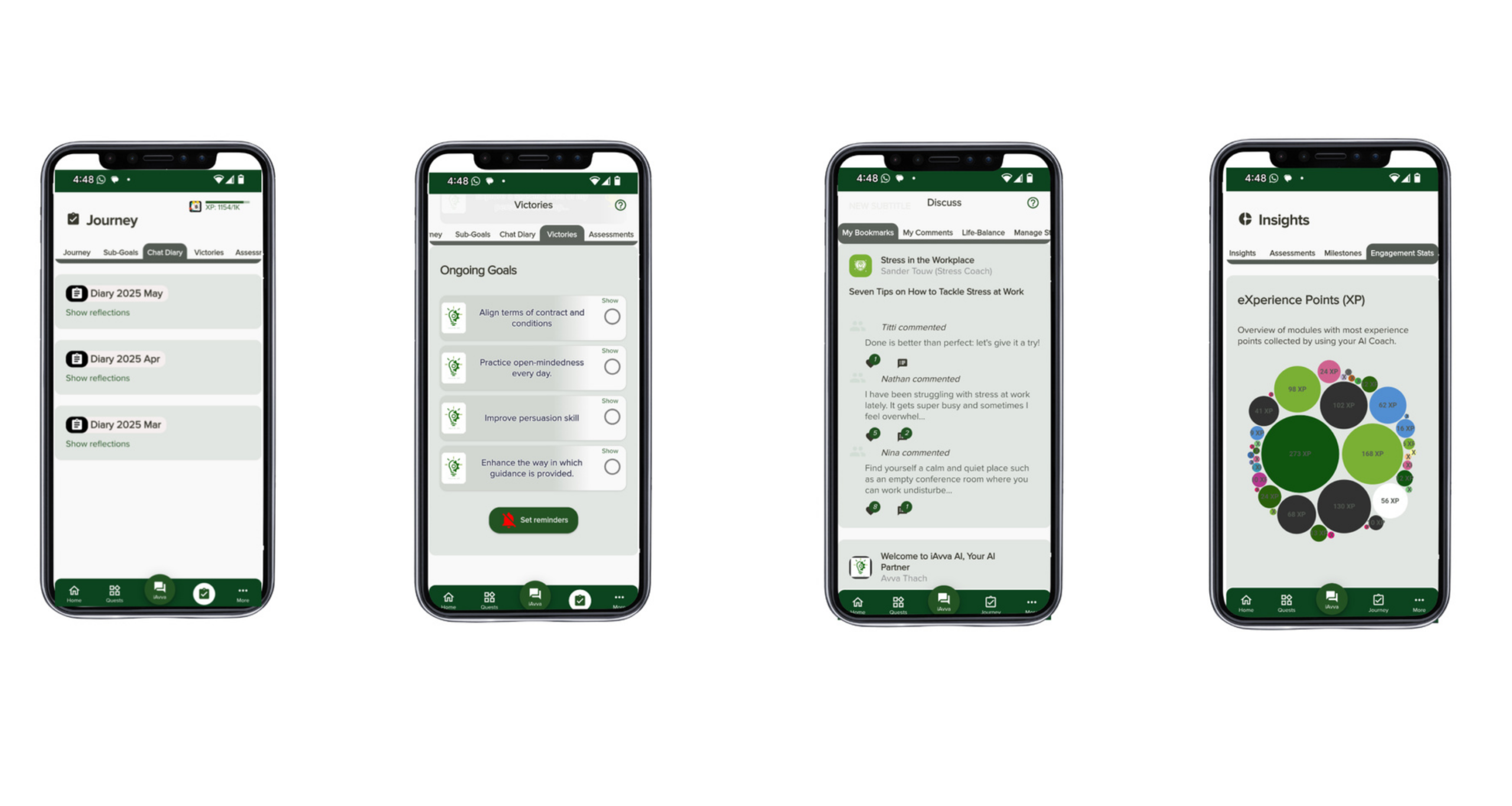
At the heart of iAvva AI is the iAvva AI Coach app. You use it in focused, five‑minute sessions that fit into the real schedule of a busy executive, CIO, or HR leader. In those minutes, you receive targeted prompts grounded in neuroscience, positive psychology, Lean Six Sigma thinking, and ICF coaching principles. You are not reading theory. You are reflecting on actual decisions and trade‑offs in front of you, including AI implementation questions about safety, speed, and people impact.
The app supports both text and audio modes and runs across web, iOS, and Android, so it fits the way you prefer to think. With support for nineteen languages and neurodiversity‑friendly design, it works for global, mixed teams that might include ex‑Google engineers, long‑time operations leaders, and new managers rising during your AI rollout. Everyone gets a consistent, accessible way to build leadership habits without needing to be in the same room or time zone.
Strategically, iAvva AI ties leadership growth directly to your business goals. You can connect reflection themes and personal goals with corporate OKRs, such as:
- Reducing critical incidents in your AI services
- Hitting uptime targets for key platforms
- Growing adoption of new AI‑driven HR tools
Through dashboards, HR and L&D can see engagement patterns, top reflection topics, and behavior trends at an aggregated level, so leadership programs adapt based on actual data rather than guesswork.
Privacy and security match the sensitivity of the work. The platform uses encryption and follows GDPR requirements, with privacy‑by‑design practices suitable for conversations about strategy, ethics, and performance. That matters when leaders are thinking about sensitive trade‑offs around automation, headcount, and data use. You want them to reflect honestly, and that depends on trust in the tool itself.
For scenarios similar to Anthropic’s, iAvva AI gives you specific leverage points:
- When you bring in ex‑Google or other Big Tech executives, you can support their transition into a new culture with focused reflection prompts, helping them balance their prior habits with your present context.
- When CIOs and infrastructure leaders live in a 24/7 world of incident alerts and board updates, the app gives them a structured way to step back, learn from events, and maintain grounded judgment.
- For HR and L&D, iAvva AI offers measurable evidence that leadership development is tied to real AI initiatives instead of floating separately.
“Leadership is infrastructure. If you don’t build it deliberately, your AI programs will rest on sand.”
The Strategic Business Case: Why AI Implementation Fails Without Leadership Maturity
Many AI implementation stories start with excitement and end in frustration. The pattern repeats across industries. An organization funds pilots, buys tools, maybe even experiments with an internal chatbot or predictive model. Results are promising in a small group. Then, somewhere between pilot and scale, things stall. The tools exist, but adoption lags. People do not change how they work. Meanwhile, capital keeps flowing into infrastructure that is underused.
Several common failure modes show up:
- Pilots stay in “purgatory” because no one is willing to change the surrounding processes.
- Data centers or large cloud contracts sit under‑utilized because line leaders do not trust or understand the AI capabilities they now have.
- Employees resist AI‑driven changes when they feel monitored instead of supported.
- Governance gaps appear when questions about bias, transparency, or policy fall between legal, HR, and IT teams.
Underneath these technical symptoms sit leadership and culture. Each key decision about AI—what data to use, what to automate, how transparent to be, how to support people whose roles shift—is a leadership choice. When leaders send mixed signals, such as talking about ethics while quietly rewarding only speed, employees quickly see the gap. Trust drops. Adoption slows. Even good AI tools cannot overcome the drag created by inconsistent behavior at the top.
When leadership maturity is high, the business impact looks very different:
- Regrettable turnover in critical AI roles tends to be lower, because leaders listen, communicate honest trade‑offs, and back up their words with action.
- AI projects move from proof‑of‑concept to value faster because leaders clear roadblocks, sponsor process changes, and explain the why, not just the what.
- Psychological safety remains intact, so teams feel able to surface early warning signals instead of hiding problems.
Structured, AI‑powered coaching plays a key role in moving along that spectrum. When you and your peers engage in regular reflection around questions like “How is this AI project affecting my team?” or “Where am I sacrificing clarity for speed?” you reduce the gap between stated values and actual behavior. iAvva AI supports that rhythm by offering repeated, targeted prompts that keep ethics, inclusion, and evidence‑based thinking on the table, week after week. Leadership development stops being a workshop and becomes an operating habit, which is exactly what large AI bets require.
A Practical AI Implementation Framework, Inspired By Anthropic But Built For Your Organization
A story like Anthropic’s can feel distant if your company has no plans for its own data centers. Yet the underlying AI implementation pattern is very usable. You can adapt it into a simple framework that connects technical and human work, so infrastructure and leadership evolve together instead of pulling apart. Think of it as two tracks running side by side, both required for stable progress.
1. Define Specific AI Objectives
You move beyond “use AI in HR” toward outcomes such as:
- Reduce time‑to‑hire for critical roles by 25 percent
- Improve infrastructure incident response time by 30 percent
- Increase leadership trust scores in teams affected by automation
You tie these to clear OKRs that HR, L&D, and CIOs all recognize, so AI implementation is anchored in shared business language.
2. Assess Readiness Across Technology And Culture
Next, you assess readiness across data, infrastructure, talent, and culture.
- On the technical side, you examine data quality, cloud maturity, and security controls.
- On the human side, you look at leadership and cultural readiness.
This is where iAvva AI can help you run a “soft‑systems” check by revealing common reflection themes, adoption levels, and concerns across leaders. Patterns in the way leaders talk about AI decisions can show where culture will support or resist your plans.
3. Build A Data Strategy For People And Infrastructure
From there, you build a data strategy that spans both people and infrastructure. You:
- Map where your HR data, learning records, engagement surveys, and incident logs live.
- Clarify ownership, privacy rules, and how those inputs will support AI use cases like predictive attrition, targeted leadership development, or reliability analytics.
- Make sure that people data, in particular, is governed with care so employees understand what is used and why.
4. Select Technologies, Platforms, And Partners
With objectives and data foundations clear, you select technologies, platforms, and partners. You choose cloud providers and AI tools that align with your goals and security needs. You also choose leadership platforms.
At this point, you can position iAvva AI as your standard for AI‑powered coaching and leadership development, plugged into the same enterprise architecture that holds your other AI components. It becomes a foundational part of your people stack, not a one‑off experiment.
5. Form A Cross‑Functional AI And Transformation Team
You then form a cross‑functional AI and transformation team that includes CHRO, CIO, Head of L&D, CISO, data science, legal or ethics leads, and business sponsors. This group shares a common reflection space through iAvva AI, using it to surface tensions and learn from decisions together.
Focused pilots follow. You might:
- Run an AI HR assistant pilot while also piloting iAvva AI coaching with infrastructure leaders.
- Track adoption, incident rates, decision quality, and engagement side by side.
6. Scale, Integrate, And Govern
Once pilots meet clear metrics, you deploy and integrate at larger scale. You embed AI tools—and iAvva AI—into daily tools such as Microsoft 365, Teams, Slack, and internal portals, so leaders do not need to go hunting for them. You keep feedback loops running, using usage data, surveys, and reflection insights to refine both AI systems and leadership behavior.
All the while, you govern ethics, risk, and change with a visible committee and clear escalation paths, supported by leadership prompts and dashboards that keep principles in daily view.
“Good AI governance is just good leadership, written down and followed every day.”
Embedding AI Into Leadership Development: How You Can Replicate Anthropic’s Talent Strategy Without Their Headcount
If you accept that AI implementation is as much a leadership topic as a technical one, then leadership development itself needs an update. Traditional programs often bring leaders together once or twice a year for workshops. Those can be useful, but they do not match the pace and complexity of AI‑driven change. Leaders make dozens of small AI‑related choices each week. They need support in those moments, not just in the classroom.
One shift is to use AI‑augmented coaching at scale. Instead of coaching being reserved for a small senior group, every manager and executive gains access to an AI coach through iAvva AI. You can use it for daily reflection on key decisions, both technical and human. For example:
- Before a board review on AI investment, you can run through prompts that clarify your narrative and trade‑offs.
- After an incident postmortem, you can debrief your own reactions and learning, so improvement is personal as well as procedural.
- During a challenging automation rollout, you can reflect on how you are communicating with affected teams.
Another shift is toward personalized leadership journeys. Rather than generic courses, you receive prompts and reflection paths based on your role, business context, and even engagement data. Leaders driving AI implementation might see more prompts around risk communication, ethics, and cross‑functional alignment. Leaders in functions heavily shaped by AI, like customer service or operations, might receive more support around job redesign and coaching their teams through change. The journey evolves with the stage of your AI rollout.
From an HR and L&D perspective, leadership analytics become a quiet superpower. By aggregating and anonymizing reflection data, iAvva AI can help you spot where leaders are struggling. For example:
- You might see frequent themes around uncertainty in one region or one function.
- You might notice that leaders responsible for new AI tools report more tension around fairness or workload.
- You might detect gaps between how senior leadership talks about AI and how middle managers experience it.
You can then design targeted interventions, town halls, or additional resources where they will matter most.
Onboarding high‑caliber external talent is another area where AI‑supported development shines. When you hire ex‑Google or similar executives, you want them to bring their strengths without clashing with your culture. Structured prompts in iAvva AI help them compare how decisions were made in their previous company and in yours, and process any friction without waiting for annual reviews. They gain a private, guided space to integrate, while you gain smoother cultural blending instead of quiet frustration.
Finally, iAvva AI offers specific support for CIOs and infrastructure leaders facing Anthropic‑style pressure. Prompt libraries can focus on:
- Managing incidents and post‑incident reviews
- Balancing innovation with reliability and cost
- Translating technical risk into language that boards and non‑technical peers understand
Over time, those reflections help leaders refine how they show up in crisis, how they explain trade‑offs, and how they keep teams energized without burning them out.
Conclusion
When you look at Anthropic’s data center push, it is easy to focus on the visible parts—the racks, the cooling, the GPU counts, the headlines about ex‑Google leaders joining the team. Yet under all of that sits a quieter truth. AI implementation at that scale is really about who sits around the decision table, how they think, and how they act when tension is high. Infrastructure gives you potential. Leadership decides whether that potential turns into value or into risk.
You might never run a hyperscale data center, but the same pattern touches your work. Cloud contracts, AI tools, new HR systems, and predictive analytics all shape your future. You cannot outsource the maturity of your leadership culture to a vendor or to a single hire from Big Tech. What you can do is build a system that helps your leaders think more clearly, act more ethically, and align more tightly with your AI ambitions.
iAvva AI exists to support that system. By pairing your technical AI roadmap with an AI‑powered coaching platform that runs every day, you give your organization a way to practice the mindset Anthropic is hiring for, even without Anthropic’s budget. You connect OKRs, people decisions, and reflection into one loop, so leadership growth and AI implementation move together instead of drifting apart.
The next move is in your hands. You can start by looking at one critical AI initiative—a new analytics platform, an automation project, a cloud migration that feels “data center‑scale” for your size. Ask whether the leaders around it have the time, tools, and habits to handle the decisions ahead. Then pilot iAvva AI with that group and turn 2 a.m. anxiety into a structured, daily practice of better leadership. The fear that wakes you up can become the signal that it is time to build a more intentional, human‑centered AI future.
“The best AI strategy is a leadership strategy that knows how to use AI well.”
FAQs
Question: How Does Anthropic’s Data Center Strategy Relate To AI Implementation In My Organization?
Anthropic’s approach is a high‑end example of treating AI as core infrastructure instead of a side project. While you may not build physical data centers, you are still making comparable long‑term choices about clouds, platforms, and data architecture. Those choices define what AI you can realistically deploy, how secure it is, and how much it can scale. The same need for cross‑functional leadership, clear governance, and careful risk management applies. You can use Anthropic’s strategy as a lens for your own roadmap by asking whether your infrastructure decisions are matched with equal attention to leadership, culture, and ethics.
Question: Why Do Companies Like Anthropic Hire Ex‑Google Executives For AI Infrastructure Roles?
Organizations like Anthropic look for ex‑Google executives because they bring direct experience with running large, complex systems where AI and infrastructure are mission‑critical. They have operated within cultures that prize reliability, observability, and structured learning from failure. They are also used to making data‑driven decisions under high scrutiny and navigating regulatory and security demands. The good news is that the capabilities they represent—systems thinking, calm crisis leadership, and ethical awareness—can be developed internally. Tools such as iAvva AI help you spread those traits across your own leadership bench instead of relying on a handful of external hires.
Question: What Is The Connection Between AI Implementation And Leadership Development?
Every AI implementation touches decisions about people, customers, and resources. That means leadership behavior, ethics, and communication shape how AI is used, how it is perceived, and how much value it creates. Many AI setbacks come not from faulty algorithms but from poor change management, lack of transparency, or misaligned incentives. When you treat leadership development as part of your AI stack, you build leaders who can interpret AI outputs, explain trade‑offs, and hold trust. AI‑powered coaching platforms such as iAvva AI embed regular reflection around those skills into daily work, making leadership growth part of how you run AI, not just how you talk about it.
Question: How Can iAvva AI Support My AI Implementation Strategy In Practical Terms?
iAvva AI supports your AI implementation by giving leaders a structured way to think through their hardest decisions. The platform delivers short daily reflections linked to your AI‑related OKRs, such as adoption targets, incident rates, or engagement goals. It includes prompt libraries focused on AI ethics, change leadership, and complex trade‑offs, so your leaders are nudged to consider people and culture alongside technical performance. Real‑time analytics allow HR and L&D to see how often leaders engage, which topics surface most, and where additional support is needed. In practice, you can use iAvva AI to prepare leaders for launching an AI HR assistant, to support teams during major infrastructure upgrades, or to help ex‑Big Tech hires integrate smoothly into your organization.
Question: Do Small And Mid‑Sized Businesses Really Need This Level Of AI And Leadership Infrastructure?
Even if you run a smaller organization, the AI‑related bets you make can be just as significant for your future. Choosing an automation platform, rolling out AI‑driven HR tools, or adopting predictive analytics affects jobs, processes, and trust. The risks around fairness, adoption, and culture do not disappear just because your headcount is lower. What changes is how you approach the problem. Instead of building everything yourself, you can plug into ready‑made tools like iAvva AI to gain leadership and coaching capabilities that larger firms might assemble in‑house. Starting with one high‑value AI project and pairing it with a focused iAvva AI pilot gives you enterprise‑grade leadership support without needing an enterprise‑sized team.













Leave a Reply