



Leadership and Coaching Training: Building a Culture of Continuous Growth
Article Overview
Article Type: How-To Guide
Primary Goal: Provide senior HR and L&D leaders with a practical, evidence-based guide to design, launch, and scale an integrated leadership and coaching training program that embeds continuous learning, measures business impact, and leverages AI responsibly
Who is the reader: Senior Vice Presidents of Human Resources, Vice Presidents of Learning and Development, Heads of Organizational Development, and Vice Presidents of AI Transformation at small to midsize enterprises and growth-stage companies who are planning or piloting enterprise learning and AI enablement initiatives
What they know: They understand strategic talent priorities, basic leadership development frameworks, and enterprise learning vendor categories. They may not know how to operationalize coaching at scale, how to integrate AI tools into leadership development responsibly, or how to define a robust ROI and measurement framework for combined leadership and AI training programs.
What are their challenges: They face legacy learning models with low behavioral transfer, limited internal coaching capacity, pressure to show measurable business outcomes, AI adoption uncertainty and ethics concerns, and the need to align leadership development with digital transformation and measurable productivity goals.
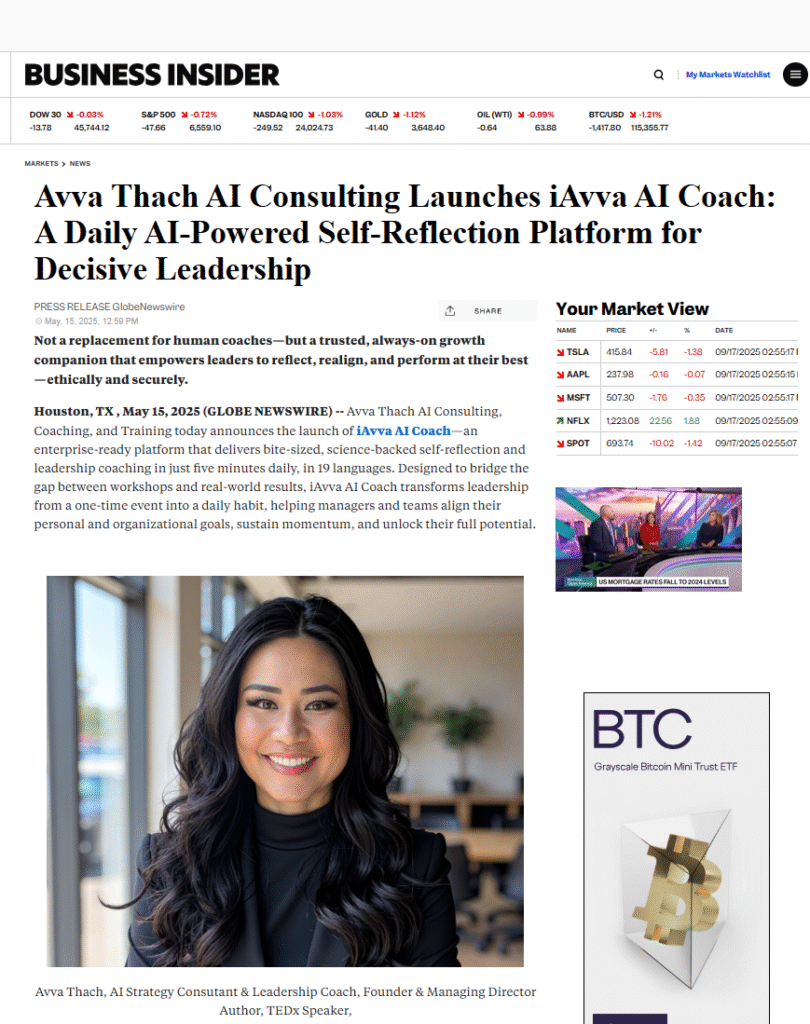
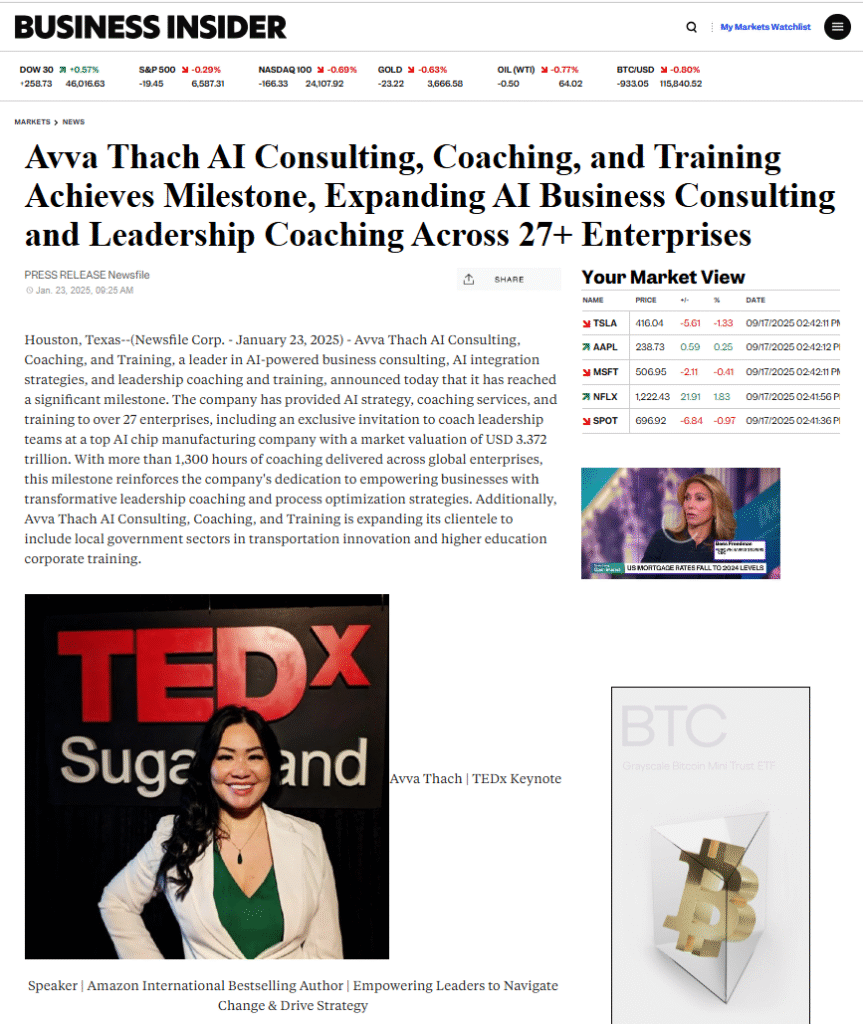
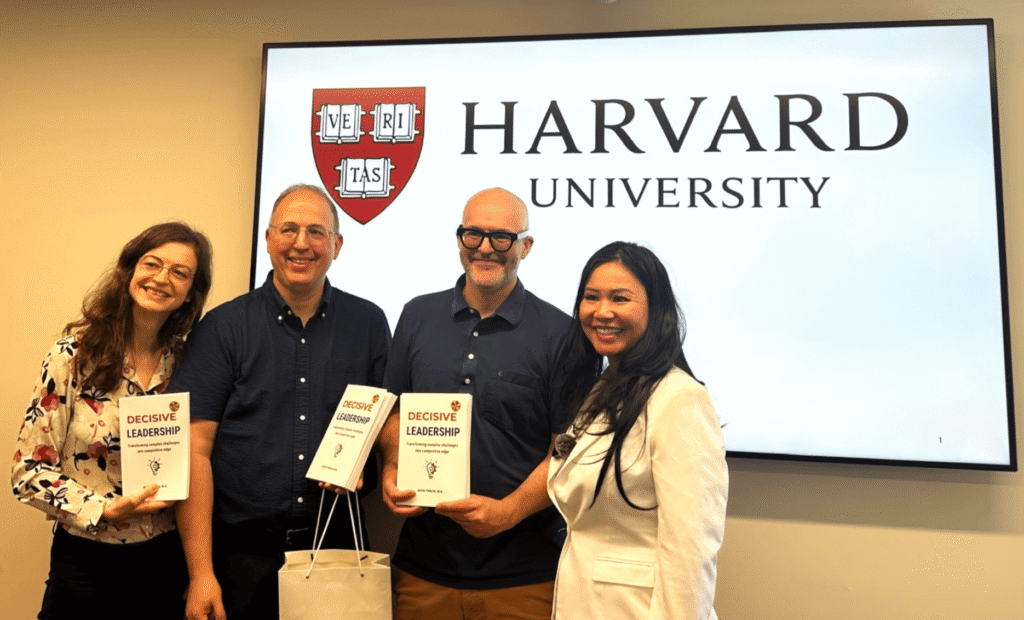
Why the brand is credible on the topic: iAvva AI Consulting and Avva Thach bring combined expertise in AI strategy, leadership coaching, agile transformation, and corporate training. Avva Thach has led enterprise transformations at SolutionsIQ and Accenture, authored Decisive Leadership, delivered a TEDx talk on inclusive AI conversations, and has client success stories spanning healthcare, finance, and product organizations. The practice integrates Lean Six Sigma, Agile, and AI-driven insights to design measurable programs for SMBs.
Tone of voice: Professional, evidence oriented, and actionable. Use formal but accessible language, industry terminology appropriate for senior HR and L&D leaders, concise bullet lists for process steps, and neutral objective framing of options and tradeoffs.
Sources:
- IDC research on digital transformation (IDC)
- PwC research on training and digital transformation (PwC)
- Harvard Business Review articles on AI and leadership (HBR)
- McKinsey research on learning programs and reskilling (McKinsey)
- BetterUp research on coaching impact and behavior change (BetterUp)
Key findings:
- 93 percent of companies report being in some stage of digital transformation, indicating urgency to reskill leaders and frontline teams (IDC)
- 75 percent of companies identify effective training and coaching as essential to successful digital transformation, underscoring the need to pair tech adoption with behavior change (PwC)
- Integrating AI strategies with leadership coaching improves transformation effectiveness by enabling data driven decision making and faster capability development (summarized insights from HBR and McKinsey on AI and leadership)
Key points:
- Make the business case: show how integrated leadership and coaching training drives specific KPIs such as time to competency, employee engagement, retention, and measurable productivity gains
- Design for behavior change: combine cohort learning, one on one coaching, practice labs, and microlearning with clear application moments tied to business priorities
- Use AI as an augment not a replacement: apply AI for diagnostics, personalization, measurement, and coaching augmentation while maintaining human oversight and ethical guardrails
- Measure at multiple levels: use learning metrics, behavior metrics, and business impact metrics with a baseline, control or pilot, and target outcomes
- Create sustainable reinforcement mechanisms: governance, sponsorship, communities of practice, and integration with talent processes
Anything to avoid:
- Overemphasizing technology at the expense of human coaching and habit formation
- Generic, one size fits all programs that ignore role level, function, and AI maturity differences
- Vague claims about impact without baseline data, measurable KPIs, or pilot evidence
- Overly promotional language or vendor name drops unconnected to concrete implementation advice
- Deep technical AI methods discussion that does not translate into leader actions or learning activities
External links:
- https://www.idc.com
- https://www.pwc.com
- https://hbr.org
- https://www.mckinsey.com
- https://www.betterup.com
Internal links:
- Transform Your Leadership: Key Development Strategies for Modern Executives – iAvva AI
- Leading in the AI Era: Essential Skills for Modern Executives – iAvva AI
- Avva Thach AI Consulting, Leadership Coaching, Corporate Training
- Media | Avva Thach AI Consulting | Process Optimization & AI Strategies
- Maximizing Potential: AI Coaching for Success – iAvva AI
Content Brief
This how to guide shows senior HR and L&D leaders how to design and scale leadership and coaching training that creates a continuous growth culture and supports digital and AI transformation. Cover the business case with data driven examples, present a clear assessment approach, spell out program design choices and delivery models, and include practical tools for measurement, piloting, and scaling. The article should balance strategic guidance with operational detail: include sample week by week blueprints, recommended vendor categories and specific platform examples, measurement templates, and governance recommendations. Tone should be neutral, professional, and evidence based, using bullet lists and short callout boxes for sample KPIs, pilot designs, and example scripts. Avoid marketing language; focus on how readers can apply the guidance to their organizations and how to de risk pilots.
1. Business case for integrating leadership and coaching training with AI
- Quantify the problem: use metrics such as skill gaps, time to competency, turnover in high potential cohorts, and change initiative failure rates to create urgency
- Use research and real examples: cite IDC, PwC, McKinsey, and case references like AT&T reskilling efforts, Microsoft emphasis on growth mindset, and Google Project Oxygen manager training as precedents
- Frame expected outcomes: alignment to KPIs such as productivity improvement, speed of decision making, reduction in escalations, retention of top talent, and acceleration of AI adoption
2. Assess current state: leader capabilities and AI maturity
- Run parallel assessments: leadership capability mapping (use Korn Ferry or 360 feedback via Culture Amp or Qualtrics) and AI maturity assessment (use Deloitte or McKinsey AI maturity frameworks)
- Map learning needs by role and level: executive, senior leader, people manager, individual contributor with AI exposure
- Capture organizational constraints: culture, existing L&D tech stack, data availability, privacy and compliance requirements
3. Design an integrated curriculum that drives behavioral change
- Core learning pillars: AI literacy for leaders, coaching skills for managers, decision making with data, psychological safety and change leadership, ethical AI and governance
- Learning modalities: cohort-based workshops, executive coaching, peer coaching circles, role-based microlearning, simulation labs and case studies
- Frameworks and models to include: GROW coaching model, Situational Leadership II, Lean Six Sigma concepts for process improvement, and habit formation techniques for behavior reinforcement
4. Delivery models and recommended vendor types with concrete examples
- High touch human coaching: use providers such as BetterUp or CoachHub for one on one coaching and internal coach certification to build internal capacity
- Technology platforms: recommend LinkedIn Learning, Degreed, Coursera for Business, and Microsoft Viva Learning for content delivery and skill pathways
- AI augmentation tools: use conversation intelligence like Gong for meeting feedback, learning personalization engines in Degreed or EdCast, and coaching assistants that provide practice prompts and microfeedback
5. Coaching at scale: human plus AI design patterns and governance
- Blended coaching model: a tiered approach with certified internal coaches, external coaches for senior leaders, and AI driven micro coaching for routine practice
- Ethics and privacy guardrails: anonymization, consent, data retention policies, and clear boundaries on automated feedback versus human judgement
- Operational model: coach to leader ratios, scheduling cadence, coach certification plan, and integration with talent processes
6. Measurement framework and proving ROI
- Multi level measurement: learning metrics (completion, knowledge checks), behavior metrics (observed practice, 360 changes), and business outcomes (productivity, engagement, retention, revenue impact)
- Sample metrics and targets: baseline time to competency reduced by X percent, manager coaching frequency increased to Y sessions per quarter, eNPS improvement of Z points
- Pilot design to prove impact: run a controlled 12 week pilot with treatment and comparison cohorts, collect baseline and follow up data, and present an ROI model tying leader behaviors to one or two business KPIs
7. Sustaining a culture of continuous growth: governance and rituals
- Leadership sponsorship and cadence: executive sponsor, steering committee, monthly measurement reviews and quarterly learning sprints
- Reinforcement mechanisms: communities of practice, manager scorecards, integrated performance conversations, and learning nudges through LMS or collaboration tools
- Scaling playbook: how to move from pilot to enterprise deployment, with templates for communication, coach onboarding, and success stories to build social proof
8. 12 week sample blueprint for a pilot program
- Week by week breakdown: kickoff and baseline assessment, cohort workshops, weekly microlearning and practice assignments, coaching sessions schedule, mid pilot review, and final measurement and scaling plan
- Roles and responsibilities: sponsor, program manager, learning designer, coaches, IT and data steward
- Deliverables and artifacts: leader capability map, coaching playbook, measurement dashboard, and playbook for scale
Frequently Asked Questions
How do I start if leadership development and AI initiatives are currently separate?
Begin with a joint assessment that maps leadership capability gaps and AI maturity, then design a small cross functional pilot that ties specific leader behaviors to a business metric and uses AI tools for diagnostics and personalized learning.
How long before we see measurable business impact from integrated leadership and coaching training?
Initial behavior changes and leading indicators can appear within 8 to 12 weeks for a focused pilot; measurable business impact typically emerges in 3 to 9 months depending on program scope and the business metric tracked.
Can AI replace human coaches in leadership development?
No; AI excels at diagnostics, personalization, and scalable micro coaching, but human coaches are essential for complex judgment, empathy, and sustained behavior change, so a blended model is recommended.
What are the top privacy and ethics considerations when using AI in coaching?
Ensure informed consent, data minimization, anonymization for analytics, clear use cases for recordings or transcripts, and governance that reserves sensitive judgment calls for human coaches.
Which KPIs best demonstrate ROI for senior leadership and HR stakeholders?
Use a small set of aligned KPIs such as time to competency for critical skills, manager coaching frequency, eNPS or engagement changes, retention of high potential talent, and specific productivity or revenue related metrics.
How many coaches do we need to scale coaching across the organization?
Start with a tiered model: one certified internal coach per 30 to 50 leaders for ongoing development, supplemented by external coaches for senior leaders and AI driven micro coaching to increase reach.
How should we integrate leadership coaching outcomes into performance management?
Integrate coaching progress as part of development goals, include behavioral expectations in performance conversations, and align rewards and recognition with demonstrated behavior change rather than course completion.
“@context”:””,”@id”:””,”@graph”:[],”url”:””,”image”:””,”video”:””,”audio”:””,”dateCreated”:””,”datePublished”:””,”dateModified”:””,”description”:””,”disambiguatingDescription”:””,”identifier”:””,”mainEntityOfPage”:{“@context”:””,”@id”:””,”@graph”:[],”url”:””,”image”:””,”video”:””,”audio”:””,”dateCreated”:””,”datePublished”:””,”dateModified”:
“Start with a tiered model: one certified internal coach per 30 to 50 leaders for ongoing development, supplemented by external coaches for senior leaders and AI driven micro coaching to increase reach.” } }, “How should we integrate leadership coaching outcomes into performance management?”:{“@context”: “”, “@id”: “”, “name”: “Integrate coaching progress as part of development goals”,”acceptedAnswer”: {“#formatType”: “”, “#valueType”: “”,”@value”: “”, “text”: “include behavioral expectations in performance conversations”,”formatType”: “”, “valueType”:
“} “,”align rewards and recognition with demonstrated behavior change rather than course completion. “:” }}}]}]}]}}]}]}]}]}”}}}]}]}













Leave a Reply