




10 Things AI Agents For Productivity Do For Enterprise
Introduction
When IBM reported that its internal use of AI agents created an estimated 4.5 billion dollars in productivity impact, many executives we speak with had the same reaction. This is no longer about experiments. It is about how fast leaders can put AI agents for enterprise productivity to work in real teams, real processes, and real P&L lines.
For years we relied on tools that helped people click faster, search a little better, or manage lists and workflows. Yet according to an MIT report: 95% of generative AI pilots at companies are failing, which shows that technology alone cannot drive transformation. Now a new class of AI agents for productivity in enterprise settings can understand goals, plan multi-step work, call other systems, and complete tasks with minimal human input. They do not just answer questions. They take action.
At the same time, we see something important inside the organizations that get the best results. They do not focus only on tools. They also invest heavily in the people who lead this change. When AI agents take over routine work, leadership quality, decision quality, and culture become the real force multipliers.
In this article we walk through 10 types of AI agents for enterprise productivity, from customer service and IT to finance, HR, and learning. We put iAvva AI first in that list because it focuses on the human side: daily leadership growth, habit formation, and goal alignment. Along the way we connect hard numbers, neuroscience, positive psychology, and ICF-aligned coaching principles to show how technology and leadership growth can move together.
By the end, you will have a clear view of where AI agents can save hours in your week, where they can change entire functions, and how a leadership development agent such as iAvva AI can help your people keep up with the pace of change and turn AI projects into lasting business results.
“AI is the defining technology of our time.” — Satya Nadella, CEO of Microsoft
Key Takeaways
Before we dive into details, it helps to see the big picture of what AI agents can deliver across an enterprise.
AI agents can cut processing time for key workflows by 20 to 80 percent, which frees teams from repetitive work and gives them space for higher-value tasks. Early adopters report faster cycle times, fewer delays, and smoother handoffs between departments. This has a direct impact on revenue, cost, and employee morale.
Customer-facing AI agents now resolve up to 70 percent of support inquiries on their own, with some programs improving time to resolution by more than 25 percent. This reduces pressure on service teams and improves customer satisfaction at the same time. Human agents then focus on complex, relationship-driven issues.
Across IT, HR, finance, and operations, AI agents in enterprise environments allow teams to scale without adding proportional headcount. They provide 24/7 coverage, consistent policy application, and faster response in peak periods. That combination gives early adopters a clear competitive edge.
AI projects that ignore leadership development face higher resistance, slower adoption, and weaker returns. When leaders know how to guide change, communicate clearly, and read data, AI agents deliver far better results. Technology plus human growth is the winning formula.
iAvva AI plays the role of a leadership development agent that sits alongside operational AI tools. The platform builds five-minute daily habits based on neuroscience and ICF principles, aligns leadership goals with OKRs, and gives HR and L&D clear analytics. This links personal growth directly to business performance.
What Are Enterprise AI Agents And Why They Matter Now
When we talk with executives about AI, we draw a simple line. On one side are tools that wait for a command. On the other side are enterprise AI agents that hold a goal, watch the environment, choose actions, and improve with experience. That second group is where the real productivity gains now appear.
An enterprise AI agent is a software entity that can understand natural language, reason about a request, plan several steps, call other systems through APIs, and complete the work. Research on Measuring Agents in Production shows that tracking agent performance in real-world environments requires careful attention to metrics beyond simple task completion. It does not just follow a rigid script. It adapts as it goes, based on rules, data, and prior outcomes. Think of it as a very fast, very patient digital colleague that can sit inside HR, finance, IT, or on every employee’s desktop.
These agents use several technologies together:
- Large language models help them read and write human language.
- Machine learning lets them spot patterns and adjust behavior over time.
- Planning and reasoning modules break a big objective into smaller tasks.
- Tool orchestration modules let them act inside systems like Workday, Jira, Salesforce, or Slack.
- Memory layers let them recall past interactions and keep context over many steps.
Why does this matter now for AI agents for productivity in enterprise organizations?
- Business pressure has increased. Talent is tight, operating models are complex, and customers expect fast, personal service.
- The technology is mature enough to handle real work, not just demos. Gartner expects 60 percent of IT operations to use AI agents by 2028.
- Employees now expect consumer-grade tools at work and are more open to AI helpers than ever before.
There is one more factor that we see in every successful program. Human capability must rise at the same pace as AI capability. Leaders need new skills in data literacy, change management, ethics, and coaching. That is where platforms like iAvva AI add the missing side of the equation: daily leadership growth that supports AI adoption instead of reacting to it.
The Evolution From Traditional Automation To Autonomous Intelligence
To understand where AI agents fit, it helps to step back and see the shift over time. Most enterprises moved from manual work to scripts and macros, then to workflow tools and RPA, then to chatbots and basic assistants. AI agents sit one step beyond all of those.
Early automation worked well for fixed, repeatable tasks such as copying data from one system to another. If a field changed or a screen moved, the bot broke. Chatbots came next and made things friendlier, but they still answered a narrow set of questions and often passed people back to humans or static articles. They did not own goals or move across systems easily.
AI agents change that. They can take a request like “prepare a quarterly sales summary for the West region and send it to the leadership team” and then decide what systems to query, how to clean the data, how to format a summary, and how to route the final message. They handle variations along the way instead of failing at the first surprise.
Here is a simple comparison.
| Capability | Traditional Automation And Chatbots | Enterprise AI Agents |
|---|---|---|
| Task Type | Simple and repetitive | Complex, changing, multi-step |
| Adaptability | Low; breaks on edge cases | High; learns from feedback |
| Decision Style | Pre-set rules only | Goal-driven reasoning |
| Scope | One system or process | Many systems across the stack |
| Interaction | Commands and menus | Natural language, context aware |
There is a useful parallel with leadership growth. Rigid, rule-only leadership styles struggle in fast conditions, just like old automation. Leaders who can sense context, learn, and adjust plans match the way AI agents work. This is one reason we focus so much on adaptive leadership habits inside iAvva AI.
1. iAvva AI Coach – The Leadership Development Agent For Enterprise Productivity

When people hear “AI agents for productivity,” they often think first about bots that reset passwords or read invoices. We start with something different on purpose. iAvva AI Coach is an AI agent that focuses on the people who lead the work, not only on the work itself.
We built iAvva AI as an always-on growth companion for leaders at every level, addressing what researchers call The AI Productivity Paradox where AI tools fail to deliver expected gains without proper leadership and organizational readiness. Rather than a long course that people forget a week later, the app uses five-minute daily reflections to help leaders build steady habits. Each prompt draws on neuroscience, positive psychology, and ICF coaching principles. Over time this shapes how leaders notice patterns, make choices, and respond under pressure.
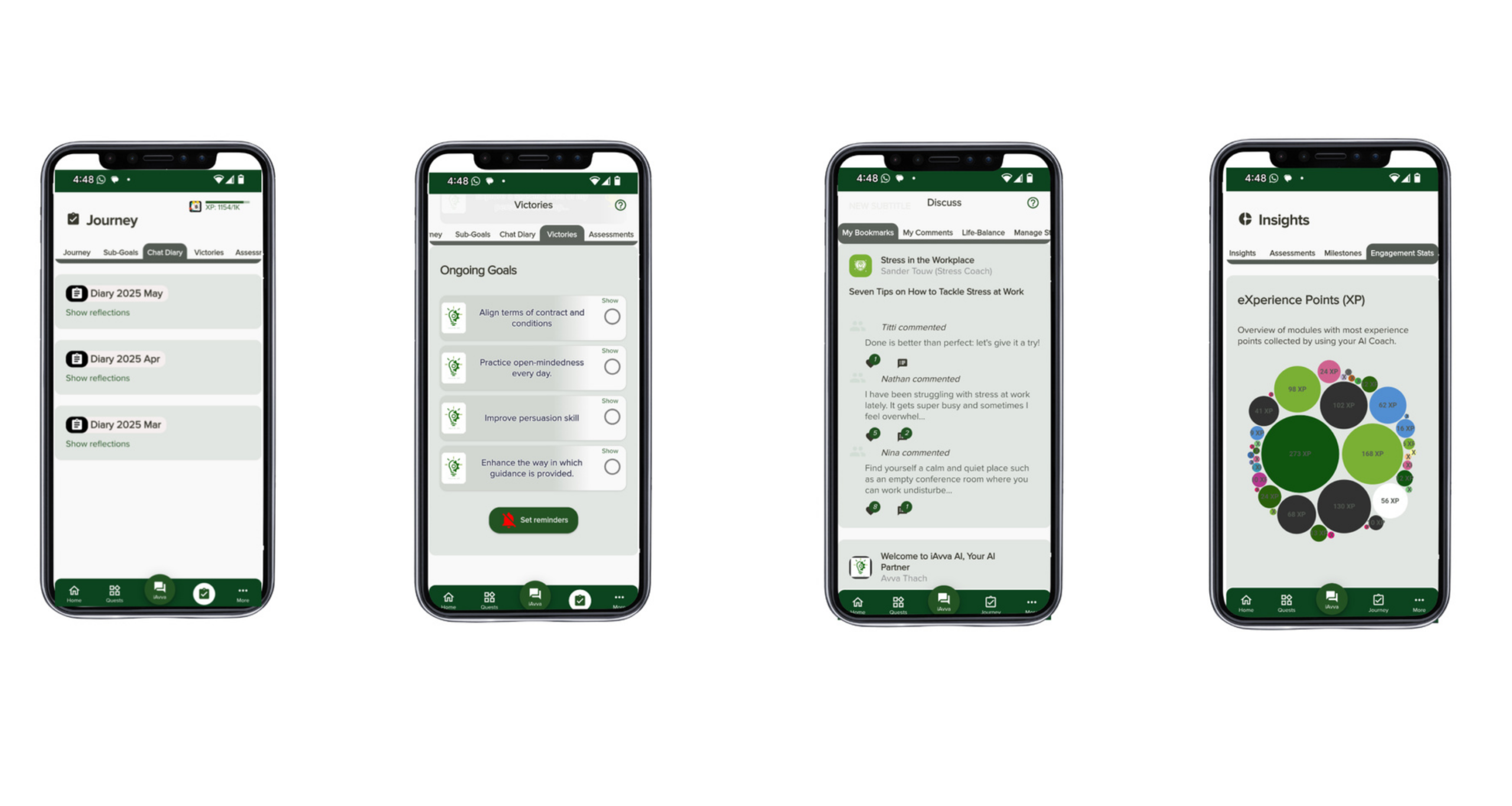
From a product view, iAvva AI is a multilingual app available on web, iOS, and Android in 19 languages. Leaders receive short, focused prompts that match their role, goals, and context. They can respond in text or voice, which makes the experience more natural. The agent reflects their answers back, asks follow-up questions, and nudges them toward clear action.
One feature our enterprise clients value highly is Strategic Alignment. Leaders can connect their personal development goals to company-level OKRs. For example, a manager might work on “holding clearer performance conversations” and link that to a customer satisfaction or retention key result. This keeps growth grounded in real business outcomes, not abstract traits.
On the enterprise side, HR and L&D teams see real-time analytics dashboards. They can track engagement, weekly reflection rates, theme trends, and progress on specific behaviors. This moves leadership development from “we ran a workshop” to measurable data. Early adopters report higher focus, stronger self-awareness, and better follow-through on commitments, which shows up directly in productivity and people metrics.
Because many clients run large, distributed workforces, we designed iAvva AI to work well for different brains and contexts. The experience is neurodiversity-friendly with options for audio or text, simple interfaces, and low cognitive load. All data is encrypted, and the platform is GDPR-compliant, so global teams can use it with confidence.
Most of all, iAvva AI helps solve the problem that traditional coaching does not scale for thousands of leaders. Human coaches remain vital for deep work, but an AI coaching agent can support leaders every single day, regardless of time zone, budget, or job grade. That is a major step for enterprises that want AI agents for productivity that include both process gains and human growth.
How iAvva AI Drives Enterprise Productivity Through Leadership Growth
When we look at productivity data across clients, one pattern stands out. Better tools help, but better leadership multiplies everything. A small shift in how a leader sets priorities, gives feedback, or designs meetings can ripple across dozens or hundreds of people. That is the lever iAvva AI focuses on.
Daily reflections help leaders slow down just long enough to notice what they are doing. Questions might explore how they made a tough decision, how they handled a conflict, or how they aligned a team on goals. This builds mental habits tied to ethical and effective leadership, not just tactical skill. Over time, leaders report less rework, fewer misaligned projects, and faster agreement among stakeholders.
Self-awareness has a direct link to decision fatigue. When leaders know their patterns, they waste less energy fighting them in the dark. iAvva AI prompts them to clarify what matters today, what they can delegate, and what they can stop. That clarity reduces the messy middle of half-decisions and stalled work, which often slows teams down more than any single tool gap.
Because iAvva AI ties personal goals to OKRs, leaders see how their growth maps to business results. For instance, a sales leader working on coaching skills might connect that habit to win-rate or ramp time for new reps. HR and L&D can then see progress in both the human behavior and the metric. This closes the loop between leadership development and enterprise productivity.
Common use cases include:
- Onboarding new managers.
- Preparing high-potential employees for bigger roles.
- Supporting remote or hybrid team leaders who rarely see their people in person.
In each case, the agent complements human coaching and training, not replaces it. We like to say “people plus AI” instead of “people versus AI.” Organizations that roll out AI agents without this human support often face more resistance, more confusion, and lower ROI.
“Leadership is not about being in charge. It is about taking care of those in your charge.” — Simon Sinek
Why HR And L&D Leaders Choose iAvva AI For Scalable Leadership Development
Many HR and L&D leaders tell us a similar story. They know coaching works, but it does not scale. They know workshops can inspire, but behavior often fades. Budgets are tight, yet the demand for better leadership grows every quarter. iAvva AI exists to bridge that gap.
Traditional executive coaching can cost thousands of dollars per person per year. That is feasible for a small senior group, but not for hundreds of managers. With iAvva AI, organizations use a subscription model that lets them serve large groups with a fraction of that spend. They can still pair key leaders with human coaches while giving everyone day-to-day AI support.
Deployment is straightforward. iAvva AI integrates with existing HR systems for user provisioning and, where helpful, can connect with performance management or OKR tools. Most clients start with a small pilot group, measure engagement and impact, then expand. Because the experience lives on devices people already use, training time is short.
From a reporting view, HR and L&D finally get clear visibility into program impact. Dashboards show usage patterns, common growth themes, and links to business goals. This helps CLOs, CHROs, and CFOs have more grounded conversations about the value of leadership development and where to invest next.
Culturally, iAvva AI helps build a coaching culture at scale. When leaders practice reflection daily, they are more likely to ask good questions of their teams, listen deeply, and support growth in others. The multilingual and neurodiversity-friendly design also means that global teams feel included rather than forced into a single learning style.
Most important, iAvva AI does not replace existing learning programs. It sits beside workshops, mentoring, and on-the-job experiences as a steady guide. That is why we see ourselves as a strategic partner in AI-enabled change, not just a technology vendor.
2. Customer Service AI Agents – Autonomous Support At Scale

Customer service has been one of the first places where AI agents for productivity in enterprise settings show visible, measurable impact. Volume is high, questions repeat, and customers expect instant help. This makes the field a natural match for autonomous agents.
Modern customer service AI agents can work across email, chat, and voice channels. They read a message, detect intent and tone, check previous interactions, and then either answer the question or take action. For common issues like password resets, order tracking, or basic troubleshooting, they can handle the entire case without a human.
What sets these agents apart from older chatbots is context. They do not just look for keywords. They use language understanding to interpret messy questions, follow threads across several messages, and adapt if the customer changes direction. They can also spot signs of frustration or confusion and change their style or escalate to a human at the right moment.
Some programs add proactive support. For example, an agent might notice repeated failed login attempts, a stalled checkout, or a pattern in error codes. It can then reach out with help or guidance before the customer starts a ticket. Over time this reduces inbound volume and lifts satisfaction scores.
IBM’s internal tools offer one reference point. An AI-driven service agent there handled about 70 percent of inquiries on its own, while cutting average resolution time by around 26 percent. We see similar patterns across other large companies, with agents taking the heavy, routine work while humans focus on complex emotional or technical cases.
The Business Impact Of Autonomous Customer Support
For finance and operations leaders, the case for customer service AI agents is very concrete. Support centers are expensive to staff and manage. Even small efficiency gains can move the needle on cost and service levels.
When an AI agent resolves most tier-one requests, leaders can handle the same volume with fewer full-time agents or can grow volume without matching headcount growth. That does not mean removing people overnight. It often means slowing new hiring, reducing overtime, and redeploying experienced staff to higher-value work such as complex case handling, quality review, or customer success roles.
The 24/7 availability of AI agents also removes the need for heavy night and weekend staffing in many regions. Companies no longer pay shift premiums just to answer simple questions. The agent covers the front line, and humans triage exceptions on on-call schedules or from core locations.
Another gain comes from consistency. AI agents apply policies the same way every time. They do not forget a step in identity checks or miss a required disclosure. This reduces compliance risk and rework from inconsistent answers.
Faster response and resolution tend to lift customer satisfaction and Net Promoter Scores. Satisfied customers stay longer, buy more, and refer others. Over time, this shows up as higher customer lifetime value, which matters as much as direct cost savings.
3. IT Operations And Cybersecurity AI Agents – Proactive Infrastructure Management

IT teams live with constant pressure. Systems must stay up, incidents must resolve quickly, and security threats never stop. At the same time, hiring experienced engineers and analysts is hard. AI agents for productivity in enterprise IT help teams stay ahead rather than just react.
Modern IT operations agents monitor servers, networks, applications, and logs in real time. They look for outliers in performance, error rates, or behavior. When they spot a pattern that often comes before an incident, they can alert an engineer, suggest a fix, or trigger a script to correct the issue before users notice.
These agents do more than raise tickets. They can investigate root causes by correlating data across systems, checking recent changes, and comparing with historical incidents. In some setups they can roll back a bad deployment, restart services, or scale resources on their own.
In DevOps, AI agents assist with testing, performance monitoring, and code suggestions. They can run test suites, flag likely bugs, recommend configuration changes, and even offer code improvements for efficiency or security. This gives developers more time for design and review work.
The talent angle is important. With AI agents doing the heavy log review and first-wave diagnosis, scarce experts can focus on deeper engineering problems. Gartner expects 60 percent of IT operations to use AI agents by 2028, which gives a sense of how central this model will soon be for enterprise IT.
Cybersecurity In The Age Of AI Agents
Security teams face a volume of data that no human group can parse manually. Network traffic, endpoint logs, cloud events, identity data, and more all carry signals of potential attacks. AI agents are well suited to watch this stream in real time.
Security agents can learn normal patterns of behavior for users, devices, and applications. When they see something outside that norm, such as unusual access patterns or data movement, they flag it or take action. In serious cases, an agent can isolate a device, block a connection, or disable an account while a human reviews the case.
Speed matters a lot here. Many attacks move in minutes. Human-only teams can miss early signs or respond too slowly. AI agents help by reacting faster and handling a large part of the triage. They can also lower false positives by using more context, which reduces alert fatigue for security analysts.
Over time, agents learn from past incidents. When analysts mark an alert as benign or serious, the agent refines its models. This makes future detection sharper without manual rule tuning. Of course, strong security leadership and governance remain vital. Leaders must set clear guardrails, review how agents act, and keep humans in charge of final accountability.
4. HR And Talent Management AI Agents – Personalizing The Employee Experience

HR teams are under pressure to do more with the same or smaller headcount: hire faster, support people better, and keep them growing. AI agents for productivity in enterprise HR can relieve much of the transactional load while improving employee experience.
In recruitment, agents can screen resumes, match profiles to job requirements, and even run first-round chat interviews. They can ask standard questions, score answers, and pass the strongest candidates to human recruiters. This shortens time-to-hire and widens the pool without adding recruiters.
During onboarding, AI agents guide new hires through forms, policy reviews, and training steps. They remind people of pending tasks, answer common questions, and nudge them to meet key stakeholders. This makes the first weeks smoother and reduces manual follow-up by HR staff.
For ongoing support, HR agents act as always-available help desks. Employees can ask about benefits, pay cycles, time-off rules, or internal policies and receive instant, accurate answers. IBM’s AskHR, for example, handles more than 80 HR tasks and has supported over 2.1 million conversations each year, which shows how large the impact can be.
Some platforms now use agentic AI for career planning and development guidance. They match employees’ skills, interests, and performance data with internal roles and learning content. This helps people see clear paths forward and find learning that fits those paths.
The more HR agents handle routine work, the more human HR professionals can focus on strategic issues such as workforce planning, culture, and leadership pipelines. This is where tools like iAvva AI pair nicely: HR agents take care of transactions, while iAvva AI grows the leaders who shape engagement and retention.
Measuring The ROI Of AI-Powered HR Operations
To justify investment, HR and finance leaders need clear numbers. AI-powered HR operations make that easier.
Key impact areas include:
Time saved per HR professional. When agents answer most basic questions and process many simple requests, HR staff can handle more complex cases in the same workday. Some teams report freeing several hours per person per week.
Time-to-hire. Agents pre-screen candidates and move them through early steps faster, which means fewer lost candidates and lower vacancy costs. Better matching can also raise new-hire quality, though that needs careful measurement and bias checks.
Onboarding costs. Automated guidance reduces errors in paperwork, missed training, and back-and-forth emails. New hires become productive faster, which matters for revenue roles in particular.
Employee satisfaction. When questions get fast, accurate replies, frustration drops. That can lower turnover, especially in the first year.
Compliance risk also drops. HR agents follow policy and legal rules the same way every time. They do not skip a disclosure or misinterpret a clause when tired. This supports audits and reduces the chance of legal issues.
When we connect this with leadership development, the story gets stronger. Better HR processes plus better leaders almost always mean higher engagement, stronger culture scores, and better performance. That is why many of our clients pair HR process agents with iAvva AI for leadership growth.
5. Finance And Procurement AI Agents – Intelligent Financial Operations

Finance teams handle high volumes of structured data, strict rules, and tight deadlines. That makes them prime candidates for AI agents for productivity in enterprise finance and procurement.
In accounts payable, agents can read invoices, match them to purchase orders and receipts, and flag mismatches. They can route exceptions to the right people and learn from how those cases resolve. In expense management, agents check reports against policy, spot likely fraud or errors, and approve clean claims automatically.
For financial planning and analysis (FP&A), AI agents bring data from many systems into one view. They can run forecasts, compare scenarios, and highlight drivers of variance. Instead of spending days gathering data and building basic models, analysts can focus on judgement, storytelling, and decision support.
Compliance is another strong use case. Agents can monitor transactions for patterns that might signal money laundering, bribery risk, or policy breaches. They do this with far more consistency than manual sampling. Alerts then go to human compliance officers for review.
One public example comes from IBM, which used AI to study and reduce its internal IT costs. This work helped generate around 600 million dollars in savings since 2022. In procurement, Dun & Bradstreet reported up to 20 percent time savings on some procurement tasks after introducing AI for vendor evaluation and risk analysis.
Strategic Financial Planning With AI Agents
As AI agents take over more tactical work, finance teams have more space to act as strategic advisers. Agents can help here as well.
They can gather and synthesize data from sales, operations, HR, and external markets to provide a full picture for planning. Leaders can ask questions in natural language, such as “What happens to cash flow if we increase headcount in sales by 10 percent next year?” and receive clear scenario outputs.
AI agents can also spot cost optimization opportunities by comparing spend patterns across units, vendors, or regions. They might flag unusual trends in travel, software licensing, or overtime and suggest areas for review.
Real-time dashboards give finance leaders and other executives faster visibility into key metrics. Instead of waiting for monthly closes and static reports, they see near real-time information and can act sooner.
Importantly, agents can translate complex data into plain language and visual summaries for non-financial leaders. This helps general managers, HR leaders, and others make better choices without deep accounting knowledge.
All of this places a higher premium on financial literacy among leaders. Tools serve up the data and scenarios, but humans still choose. That is why we see many clients use iAvva AI to build leaders’ comfort with numbers, risk, and trade-offs alongside deploying finance agents.
6. Manufacturing And Supply Chain AI Agents – Operational Excellence At Scale
Manufacturing plants and global supply chains involve many moving parts: machines, materials, people, and partners across countries. Small issues in one area can spread quickly. AI agents for productivity in enterprise operations help manage that complexity.
In production planning, agents can analyze demand forecasts, current orders, inventory levels, and material lead times. They then suggest or set production schedules that balance throughput, quality, and cost. If a big order arrives or a machine goes offline, the agent can re-plan in near real time.
For predictive maintenance, agents read sensor data from equipment to spot signs that a part may fail. Rather than waiting for a breakdown, they propose maintenance during planned downtimes. This reduces unexpected stoppages and extends machine life.
Supply chain agents manage flows across suppliers, warehouses, and transport routes. They can adjust orders based on real-time sales, delays, or risks. For example, if a key port backs up or a supplier misses targets, the agent can suggest alternate routes or vendors.
IBM Consulting shared that using AI across its global supply network, which includes more than 2,000 suppliers in 170 countries, helped the company find over 361 million dollars in supplier savings in three years. That came from better risk spotting, smarter sourcing, and more precise demand planning.
Building Resilient Supply Chains With AI Agents
Recent years have shown how fragile many supply chains can be. Weather, political events, health crises, and demand spikes can all cause disruption. AI agents can help leaders build more resilient, adaptive networks.
These agents can watch many variables at once: weather forecasts, shipping lane data, supplier performance, commodity prices, and local news. When they see risk building in one area, they alert planners and suggest actions. That might include raising safety stock, shifting orders, or finding backup suppliers.
During an event, agents can re-route shipments and adjust production plans based on the latest information. They can also model trade-offs between speed and cost, such as choosing air freight over sea in a pinch.
Over time, agents learn from each disruption. They compare what actually happened to their earlier predictions and tune their models. This means future responses improve without manual rule-writing.
Inventory optimization is another gain. With better demand forecasting and lead-time insight, agents can help avoid both stockouts and excess stock. That frees working capital while keeping customers satisfied.
Even with strong AI support, supply chain leadership remains a human skill game. Leaders still weigh risks, set policies, and manage partners. AI agents give them a clearer picture and better options, but the final calls rest with people who can see wider business impacts.
7. Data Analysis And Business Intelligence AI Agents – Democratizing Insights
Many enterprises collect huge volumes of data but struggle to make it useful for everyday decisions. Dashboards exist, yet only a small group of specialists feels comfortable using them deeply. AI agents for productivity in enterprise analytics change that pattern.
With natural language interfaces, employees can ask questions in plain speech. A sales manager might ask, “Which three products grew the most in the Northeast last quarter?” The agent turns that into the right query, runs it against the data warehouse, and returns a clear answer, often with a chart.
Agents can also monitor key performance indicators in the background. When a metric moves outside expected ranges, they notify the right owners. This might include sudden drops in conversion rates, spikes in returns, or shifts in employee attrition. Instead of waiting for a monthly review, leaders hear about issues as they form.
Reporting becomes far easier. Rather than manually pulling numbers, building slides, and writing commentary, a BI agent can prepare a draft report on a schedule. Analysts and leaders then review, adjust messaging, and add nuance.
This turns data from a passive store into an active intelligence partner. It also encourages more data-driven decisions at all levels, not only at the top or inside the analytics team. Of course, this assumes underlying data is clean and well-governed, a point we cover later.
From Data Overload To Actionable Intelligence
Many leaders tell us they feel drowned in data but starved for insight. There are too many dashboards, too many reports, and not enough clear summaries. AI agents can help cut through that noise.
These agents can synthesize information from CRM, ERP, HR systems, web analytics, and external data. They look for patterns that a human might miss, such as subtle correlations between service levels and churn in a specific segment.
By handling data gathering and first-pass analysis, agents save analysts and leaders hours each week. Instead of downloading CSV files and matching columns, people can start from a refined view and spend their time on “What do we do now?” rather than “What is going on?”
AI agents also reduce analysis paralysis by offering direct recommendations. They might say, “Based on the data, three actions stand out: adjust pricing in Region A, increase marketing spend in Channel B, and review staffing in Team C.” Leaders can accept, modify, or reject these suggestions, but the starting point is much clearer.
Visualization support helps too. Agents can build charts and tables that suit executive preferences, then explain them in plain language. This makes board packs and leadership reviews faster to prepare and easier to understand.
“Without data, you are just another person with an opinion.” — W. Edwards Deming
When combined with leadership development on data literacy, these tools raise the bar on decision quality across the entire organization.
8. Workflow Automation And Project Management AI Agents – Orchestrating Complex Processes
Modern work rarely sits inside one team or one system. New hires need actions from HR, IT, and finance. Product launches touch marketing, sales, support, and operations. Email and chat threads often hide critical steps and deadlines. AI agents for productivity in enterprise workflows help bring order to this chaos.
Unlike traditional workflow tools that follow rigid rules, AI agents can listen to natural language requests, understand the goal, and then choose the best path through multiple systems. An employee might say in chat, “I need access to the new analytics tool for my team.” The agent can create requests, route them for approval, trigger provisioning, and confirm completion, all without manual coordination.
Project management agents act like smart assistants for project leads. They can schedule meetings based on participants’ calendars, create agendas from previous notes, track decisions and action items, and send reminders. They can also scan project data to flag risks, dependencies, or slippage before they become serious.
By sitting inside tools such as Slack, Teams, Jira, or Asana, these agents reduce context switching. People spend less time juggling tabs and more time on the content of their work. Communication overhead drops because the agent keeps track of who must do what by when.
This kind of orchestration becomes even more powerful in multi-agent setups, which we cover next.
Multi-Agent Orchestration For Enterprise-Wide Processes
A single agent can handle many tasks, but some enterprise processes are so broad that it helps to have multiple specialized agents working together. An orchestrator coordinates their efforts, much like a conductor with an orchestra.
Take employee onboarding as an example. An HR agent creates the employment record and triggers documents. An IT agent sets up accounts and devices. A finance agent enrolls the person in payroll and benefits. A facilities or workplace agent arranges access badges and seating. The orchestrator tracks the whole flow, passing data between agents and checking that all steps complete.
For the new hire, this looks simple. They receive a clear checklist, friendly messages, and a smooth first week. For HR and IT, it removes dozens of emails and spreadsheets.
Gartner predicts that by 2026 many enterprises will run in multi-agent environments like this, where groups of agents coordinate across functions such as procurement, finance, HR, and customer success. The productivity gains are not just additive. When agents coordinate, they remove delays and errors that sit between departments.
Leaders in this setting need strong skills in systems thinking and cross-team collaboration. They are no longer only managing one process. They are guiding a web of human and AI actors that depend on each other. This is another area where daily leadership support from iAvva AI can make a big difference.
9. Sales And Marketing AI Agents – Intelligent Revenue Operations
Revenue teams care about speed, focus, and personalization. There are more leads than any team can follow deeply, more content than any rep can remember, and more channels than any one marketer can manage. AI agents for productivity in enterprise sales and marketing help here in several ways.
On the sales side, agents can score and prioritize leads based on fit and behavior. They look at firmographics, engagement signals, and past deal data to suggest which prospects deserve attention today. This keeps reps focused on the highest-impact work.
Agents can also draft personalized emails, call scripts, and follow-up notes that reflect each prospect’s context. Instead of sending generic sequences, reps gain targeted outreach with far less effort.
In CRM, agents keep data cleaner by suggesting updates, filling gaps, and flagging stale records. They can also surface opportunity signals, such as customers who show signs of churn risk or cross-sell interest.
Marketing agents analyze campaign performance across channels, suggest budget shifts, and test creative variants. They can generate new content ideas based on what has worked before and help match messages to segments more precisely.
Account-Based Marketing And Sales Alignment Through AI
Sales and marketing alignment has been a long-standing headache in many organizations. AI agents can help by creating a shared view of accounts and activity.
By unifying data from marketing automation, CRM, website behavior, and product usage, an AI agent can show which accounts are truly engaged. It can suggest coordinated actions, such as a marketing touch followed by a sales call, at the right time.
Lead scoring also improves. Rather than static rules, AI agents update scores based on live behavior and past outcomes. They then pass qualified leads to sales at the right stage, reducing both early and late handoffs.
Agents can track touches over the full account life cycle, which makes attribution and ROI clearer. Both teams see which campaigns, messages, and channels contribute to pipeline and closed deals.
They can also spot upsell and cross-sell opportunities by comparing product usage and patterns across accounts. This helps revenue teams focus on the right conversations at the right moment.
Leaders in this space benefit from strong coaching skills. With AI doing much of the tactical work, managers must focus more on skill building, mindset, and strategy for their teams. Platforms like iAvva AI help those leaders grow into that role.
10. Learning And Development AI Agents – Continuous Skill Building At Scale
Skill gaps are one of the main reasons enterprises explore AI today. New tools arrive faster than people can keep up, and roles change quickly. AI agents for productivity in enterprise learning and development bring structure and personalization to this challenge.
These agents can map each role to a set of skills and competencies, then compare that with employee profiles. They draw from performance data, assessment results, and self-reported interests to spot gaps. From there, they recommend personalized learning paths that match both the role and the person’s career goals.
Content delivery becomes smarter too. Agents can suggest microlearning modules at the right moment, such as a short lesson before a key task or meeting. They can nudge people to review material they are likely to forget, based on spaced repetition science.
Tracking and reporting are built in. L&D agents monitor progress toward certifications, compliance modules, and internal badges. They notify managers when team members lag or excel, which supports more targeted coaching.
These agents can also integrate with performance management systems, linking development activities to objectives and feedback. That makes it easier for leaders to see which skills drive real outcomes, not only completion rates.
iAvva AI fits into this picture as a specialized leadership development agent. While general L&D agents manage skills and content across many topics, iAvva AI focuses on how leaders think, act, and relate. Together they give enterprises a complete learning stack: one part for broad skills, one part for deep leadership habits.
Why Leadership Development Requires A Specialized Approach
Leadership development is not the same as teaching a software tool or a new process. It touches identity, emotion, ethics, and long-term behavior. That is why it needs a focused, purpose-built approach rather than generic e-learning.
Key leadership competencies include self-awareness, emotional intelligence, strategic thinking, and the ability to hold tough conversations. These do not grow much from passive video watching or quiz completion. They grow through reflection, practice, feedback, and repetition.
Neuroscience shows that lasting behavior change comes from small, repeated actions that wire new patterns in the brain. Daily reflection is one of the simplest ways to create those patterns. iAvva AI uses this science, along with positive psychology and ICF-aligned coaching methods, to guide leaders through short, meaningful check-ins.
Traditional learning platforms can assign content about leadership, but they often stop at ideas. iAvva AI stays with leaders as they try those ideas in real situations, then reflect on what worked and what did not. This closes the loop between theory and practice.
In plain terms, general L&D agents teach skills, while iAvva AI shapes how leaders think and behave day to day. Because leadership quality touches every business outcome—strategy, culture, execution, ethics—this specialized support has a large ripple effect on enterprise productivity.
How AI Agents Integrate With Your Existing Technology Stack
Many leaders worry that adding AI agents will create yet another layer of complexity. In practice, modern AI agents for productivity in enterprise environments are designed to sit on top of your current stack and make it feel simpler, not more chaotic.
Most agents connect to systems such as ServiceNow, Jira, Workday, Salesforce, Slack, and Microsoft Teams through APIs and pre-built connectors. Once connected, they can read and write data, trigger workflows, and perform actions in those tools on behalf of users. This means employees can stay in familiar interfaces while agents handle the heavy lifting in the background.
An orchestration layer often coordinates multiple agents. For example, a “request access” intent might call a catalog agent to understand the request, an IT agent to check license availability, a security agent to check policy, and a messaging agent to confirm completion. The user experiences one smooth flow in chat.
Security and permissions carry over from your existing identity systems. Agents act within the rights of the user who invokes them. If a manager has access to certain HR data, the agent can read that data for them. If not, it cannot. This keeps access control consistent.
Single sign-on and user authentication usually rely on the same standards you already use, such as SAML or OAuth. This keeps login experiences simple and reduces the need for new accounts or passwords.
Data integration matters too. Many organizations use Master Data Management or data fabric tools to present clean, unified records across CRM, ERP, HR, and other systems. AI agents perform best when they read from this consistent layer rather than many conflicting sources.
Change management still matters. Leaders need to explain how agents fit into daily work, what changes, and what stays the same. But from a technical point of view, well-designed agents act as a friendly front door to systems you already own.
Security, Governance, And Compliance In Enterprise AI Deployments
For CIOs, CISOs, and risk leaders, no AI discussion is complete without security and governance. Enterprise-grade AI agents address these topics from the ground up.
Permission models usually inherit from existing systems. Agents cannot see or do more than the user is allowed to do. This limits the blast radius of any mistake and keeps sensitive data restricted.
Every action an agent takes can be logged with time stamps, user context, and details of the request and response. These audit trails support internal reviews and external compliance checks. They also help teams debug issues and improve agent behavior over time.
Serious vendors support standards such as GDPR and SOC 2 and respect data residency requirements. Data is encrypted in transit and at rest. Clients can often choose where their data is stored and how long it is retained.
Governance frameworks define which tasks agents may perform autonomously, which need human approval, and which stay fully manual. They also spell out how to handle errors, disputes, and model updates. Monitoring tools show how often agents act, where they succeed, and where they struggle.
In regulated industries, explainable AI is important. Leaders must understand, at least at a high level, why an agent made a certain recommendation or decision. This may involve simple rule summaries, model cards, or traceable reasoning steps.
All of this places new demands on leadership. Executives must understand enough about AI to ask the right questions, set the right guardrails, and model responsible use. Daily leadership development through platforms such as iAvva AI helps build that capability.
The Critical Role Of Data For An AI-Ready Foundation
There is a simple rule we repeat often. AI agents are only as helpful as the data they depend on. If data is messy, missing, or scattered, agents will make poor choices, break flows, or lose user trust.
Poor data quality shows up in multiple ways. Employees receive wrong answers, wrong approvals, or outdated information. Customers are greeted with old contact details or mismatched offers. Dashboards do not match reality, which leads teams to argue about numbers instead of solving problems.
To support AI agents for productivity in enterprise settings, organizations need to unify data across CRM, ERP, HRIS, support tools, and more. This includes deduplication, standard naming, and clear keys that link records across systems. Without this, agents may treat one customer as three, or one employee as two.
Data cleansing and enrichment are ongoing efforts, not one-time projects. Many enterprises now adopt Agentic Master Data Management (MDM) platforms that use AI helpers to keep records clean and aligned. These systems become the “source of truth” that agents call.
Real-time or near real-time synchronization is also vital. If an agent bases decisions on yesterday’s inventory, it can accept orders you cannot fill. If HR data lags, it may give former employees access or block new ones.
Strong data governance defines who owns which data sets, who can edit them, and how changes are tracked. Access control protects sensitive fields such as salary, health data, or personal identifiers. Data lineage tools show where each data point came from and how it has been changed.
Building this foundation takes executive support and cross-functional cooperation. It is not just an IT project. It is a central part of any serious AI strategy.
Preparing Your Organization For AI Agent Deployment
Before rolling out AI agents, it pays to check how ready your data environment is. We often guide clients through a simple checklist.
Run a data quality audit across key systems. Look for duplicates, missing fields, inconsistent formats, and obvious errors. Sample records manually to see what front-line users actually face.
Identify silos and integration gaps. Note where data must be exported and re-imported between tools, or where teams maintain separate spreadsheets to work around system limits.
Define or refresh data governance policies. Clarify who owns each data domain, how changes are requested, and how conflicts are resolved. Give these owners real authority.
Consider investing in MDM or data fabric layers that can present unified views to AI agents and analytic tools. Document data models, fields, and relationships in simple data dictionaries so humans and agents can work from the same map.
Implement ongoing data quality monitoring. Set thresholds and alerts for error rates or missing values so teams can fix problems before they spread.
Align your data roadmap with your AI roadmap. If you want agents to help in customer service first, then prioritize data quality and integration for customer and support systems. This focus leads to quicker wins and clearer ROI.
Strategic Implementation For Your Roadmap To AI Agent Success
Deploying AI agents for productivity in enterprise organizations is not just about picking a tool and switching it on. It touches processes, roles, culture, and customer experience. We encourage clients to treat it as a strategic change program with clear stages.
Executive sponsorship sits at the center. When C-level leaders, especially the CEO, CHRO, CIO, and CFO, actively back the program, it gains budget, attention, and staying power. Cross-functional steering groups help align priorities and avoid fragmented efforts.
A phased approach works best. Many organizations start with a pilot in one or two high-impact areas, measure results, refine their model, and then expand. Clarity on success metrics is key from day one. Without that, even good results can be hard to prove.
Change management cannot be an afterthought. Employees need to understand what AI agents will do, what will change in their roles, and how they can grow. This is where leadership development comes back into the picture. Leaders must communicate clearly, listen to concerns, and show by their actions that AI is here to support people, not to punish them.
At iAvva AI, we also support clients with AI strategy and leadership consulting. We help define where agents fit, where human leadership must adapt, and how to measure the combined impact of technology and coaching.
Phase 1: Define Clear Use Cases And Measurable Objectives
The first phase is about focus. It is easy to get excited about AI in the abstract and spread efforts too thin.
Start by listing concrete business problems, not technologies. For example, “Reduce time to resolve internal IT tickets,” “Improve first-contact resolution in customer support,” or “Shorten time-to-productivity for new managers.”
Look for processes that are high-volume, repetitive, and error-prone. These often deliver the fastest wins because small gains per case add up quickly. Also consider where employees feel the most frustration or waste time on low-value tasks.
Define success metrics for each use case. These may include time saved, cost reduction, error rates, satisfaction scores, or revenue impact. Set baseline measures before you introduce agents so you can see real change.
Make sure these objectives align with broader company strategy. Involve frontline employees in shaping the use cases. They know where the real pain lives and will spot flaws in any design that looks good only on a whiteboard.
Create a simple scorecard that combines financial and non-financial benefits, and share it widely so everyone knows what you are aiming for.
Phase 2: Assess Infrastructure, Choose Technology, And Build Capabilities
With target use cases in hand, the next step is to look at your current infrastructure and skills.
Assess data readiness. Can an AI agent access clean, timely data for the chosen processes? If not, what needs to change first? This may involve integration work, data cleanup, or adding an MDM layer.
Review your existing platforms. Many vendors now offer built-in agent features or low-code agent builders. Decide whether you can build on what you have, need to add a platform, or need a mix. Consider time-to-value, total cost of ownership, and internal expertise.
Decide where to build, buy, or partner. For some standard use cases, pre-built applications work well. For others, especially where you want differentiation, custom or semi-custom agents may be better.
Identify skills gaps in IT, data, and business teams. Plan training and upskilling for both technical and non-technical staff. This includes AI basics, prompt design, monitoring, and ethical considerations.
Importantly, invest in leadership capabilities as well. As agents arrive, managers need support to redesign roles, set expectations, and support their teams. This is where weaving iAvva AI into the program brings clear value.
Phase 3: Design For Human-Agent Collaboration And Governance
In phase three, the focus shifts to how humans and agents will work together and how you will control that partnership.
Define escalation rules. For each use case, decide when the agent acts alone, when it must ask a human, and when a human stays fully in charge. For example, a customer refund above a certain amount may always require human approval.
Create feedback loops so humans can correct or guide agents easily. This might be thumbs-up / thumbs-down ratings, quick comments, or structured review steps. Agents should learn from these signals.
Assign roles for “agent managers” or product owners. These people oversee agent performance, watch for drift, and coordinate updates. They sit at the intersection of business, IT, and data.
Build monitoring dashboards that show key metrics such as volume, success rates, error rates, and time saved. Review them regularly in leadership meetings.
Set out clear ethics and responsibility guidelines. Define what data agents may use, how they must handle privacy, and how bias risks are checked. Include diverse voices in design reviews to catch blind spots.
Finally, help leaders grow the skills needed to manage hybrid teams of humans and AI. Daily coaching and reflection through iAvva AI can build that capacity over time.
Phase 4: Execute Change Management And Continuous Improvement
Even the best-designed agents will fail if people do not adopt them. Phase four keeps the spotlight on human experience and learning.
Communicate early and often. Explain the why, what, and how of AI agents. Be clear about which tasks may go away, which will change, and which new opportunities may appear. Avoid vague promises and be honest about uncertainties.
Address fears about job loss with empathy. Show examples of how agents free people from drudge work so they can move into more interesting roles. Back this with real reskilling and redeployment plans, not only words.
Invest in training so employees feel confident using agents. This includes how to ask good questions, how to spot problems, and how to give feedback.
Create champions in each department who can support peers, share tips, and feed insights back to the project team. Celebrate small wins to build momentum.
Track adoption, satisfaction, and performance against the KPIs you set in phase one. When something is not working, adjust quickly and explain what you are changing.
Treat the whole program as an ongoing cycle of learn, adjust, and improve. iAvva AI can support leaders on this path by keeping change management and communication skills front of mind each day.
“Culture eats strategy for breakfast.” — Peter Drucker
Overcoming Common Challenges And Avoiding Implementation Pitfalls
No serious AI program runs without bumps. Acknowledging the likely issues in advance helps teams avoid disappointment and react calmly when problems arise.
One common challenge is the skills gap. Many IT and business teams do not yet feel confident with AI concepts, data pipelines, or monitoring. This can slow projects or lead to poor designs. Training and simple, hands-on pilots help close this gap.
Another risk is building rigid AI systems that copy old workflows rather than rethinking them. If agents simply follow brittle rules, they will fail when conditions change, much like old RPA bots. Good design leaves room for learning, overrides, and exceptions.
“Tool sprawl” is another trap. Because new AI tools are easy to buy and deploy, teams may add many small, disconnected agents. This creates confusion, extra maintenance, and security risk. Central governance and shared platforms help avoid this.
Data quality remains the most frequent failure point. When agents give wrong answers due to bad data, employees lose trust quickly and may stop using them. That is why we place so much emphasis on data foundations.
Change fatigue also plays a role. Many employees feel tired of new tools and processes. If AI feels like “one more thing” rather than a help, adoption will lag. Leaders must show, not just tell, how agents remove pain and support growth.
Finally, unrealistic timelines or expectations can sour support. Agents are powerful, but they are not magic. Clear scopes, phased rollouts, and open learning help keep expectations grounded.
Managing Change Resistance And Cultural Shift
Resistance to AI is normal and often reasonable. People worry about job security, control, and fairness. If leaders ignore these feelings, they grow stronger underground.
Start by recognizing that resistance can signal important risks or gaps. Listen carefully to concerns from frontline staff. They often spot issues that designers missed, such as edge cases or unfair impacts.
Use empathetic, plain language when you explain changes. Avoid vague claims. Share specific examples of how agents remove painful tasks or give people more time for meaningful work.
Involve employees in design and testing. Invite them to try early versions, give feedback, and see their ideas reflected in the final system. This builds ownership and trust.
Create visible quick wins where agents save time or remove annoying steps. Highlight these stories in internal channels, and give credit to the teams involved.
Encourage leaders to share both successes and failures openly. When something goes wrong, treat it as a learning moment rather than a blame event. This builds a culture where experimentation feels safe.
Invest in leadership development focused on change skills: communication, coaching, emotional intelligence, and resilience. iAvva AI is designed to build these muscles day by day, which helps organizations adapt to AI faster and with less drama.
Enterprises with strong, supportive leadership cultures tend to adopt AI agents faster, with better results and less friction.
The Future Of Work With The Multi-Agent Enterprise
Looking ahead a few years, we expect many organizations to run on networks of collaborating agents rather than isolated tools. Gartner predicts that by 2026 many enterprises will operate in multi-agent environments that manage key functions together.
In this future state, a customer success agent might notice a client’s usage dropping and signal a sales agent to check in. A billing agent might pause an invoice while a service issue is open. A supply chain agent might talk with a sales forecasting agent to adjust production after a big deal closes.
Work shifts from hard-coded workflows to orchestrated intelligence, where agents and humans share goals and coordinate actively. Productivity gains grow faster because delays between departments shrink and decisions happen earlier, with better information.
Human roles change as well. Routine tasks shrink, while strategic, creative, and relational work grows. People spend more time designing products, building partnerships, solving novel problems, and caring for customers and employees.
The winners in this world will not simply be those who buy the most AI tools. They will be the organizations that invest in both agents and people, building data foundations, strong governance, and deep leadership capability. They will pair operational AI with leadership development agents such as iAvva AI to keep their managers learning and adapting.
This future is not distant science fiction. Many of the pieces already exist. The question is how fast leaders choose to assemble them in thoughtful, people-centered ways.
Preparing Your Workforce For The AI-Enabled Future
To prepare a workforce for this shift, we focus less on specific tools and more on enduring human skills.
These include:
- Critical thinking, to question AI outputs, spot weak logic, and avoid blind trust.
- Creativity, to combine tools, processes, and insights in new ways.
- Emotional intelligence, to support teams through uncertainty and mixed emotions.
- Complex problem-solving, to weigh values, trade-offs, and social impacts that AI cannot fully judge.
- Communication and storytelling, to turn AI insights into shared understanding and coordinated action.
- Learning orientation, to keep picking up new skills and ideas as tools change.
Organizations need ongoing upskilling and reskilling programs rather than one-time trainings. This includes technical topics, but also softer skills and mindset work. Continuous learning cultures reward curiosity, reflection, and experimentation.
Psychological safety becomes more important as people test new human-agent workflows. Leaders must create spaces where employees can ask questions, admit mistakes, and suggest changes without fear.
Career paths also change. Some jobs shrink, others appear. New roles, such as agent manager, AI ethicist, or human-AI interaction designer, will grow. Planning for these paths helps reduce fear and gives employees hope and direction.
Leadership development sits at the base of all of this. With iAvva AI, we help leaders practice the adaptive mindset, reflection habits, and coaching skills needed for fast-moving, AI-rich environments. Organizations that invest in their people alongside technology will have an easier time attracting and keeping top talent.
Why Leadership Development Is The Missing Piece In Your AI Strategy
When we review AI plans across companies, a pattern keeps coming back. Slide decks cover tools, vendors, data, and timelines in detail. They often say little about who will lead differently once agents are live.
Technology on its own does not shift culture, decision quality, or trust. If leaders cling to old habits, hide from data, or avoid hard conversations, AI agents cannot fix that. In some cases they even make problems worse by speeding up poor decisions.
AI-era leadership needs specific competencies. Leaders must align AI projects with strategy, read and question data, and manage risk. They must handle the human emotions around change, from fear to excitement. They must think about ethics, fairness, and long-term impact, not only short-term gains.
Change management for AI is not optional. Agents will reshape tasks, reporting lines, and success measures. Without clear communication and support, employees may resist, stall, or quietly route around the new tools. Strong leaders explain why changes matter, listen to feedback, and adjust plans when needed.
Employee engagement also sits in leaders’ hands. People will only try new tools and share ideas if they feel respected and safe. If they fear that every mistake with an AI tool will be punished, they will stay quiet.
All of this means coaching and leadership programs must grow in step with AI rollouts. Traditional models that reach only the top few percent of leaders are not enough. Organizations need scalable, daily development that reaches managers across levels and regions.
That is why we built iAvva AI. Our platform gives enterprises a specialized leadership development agent that supports thousands of leaders with short, science-based reflections. It ties personal growth to OKRs, provides analytics to HR and L&D, and fits into busy schedules. Combined with operational AI agents, it helps organizations see real, sustained gains from their AI investments.
The Leadership Competencies Critical For AI-Enabled Organizations
To make this more concrete, we often use a simple set of leadership competencies tailored for the AI age.
Strategic thinking means seeing how AI projects link to long-term goals, not just short-term wins. Leaders must decide where agents make sense, where humans must stay central, and how to balance innovation with stability.
Ethical decision-making covers fairness, transparency, privacy, and societal impact. Leaders must weigh who benefits, who may be harmed, and how to keep trust with employees and customers.
Change leadership is the ability to guide teams through frequent shifts. This includes setting a clear case for change, listening deeply, removing obstacles, and staying calm under pressure.
Data literacy means understanding what data can and cannot tell you, how to read AI-generated insights, and how to ask good questions. Leaders do not need to be data scientists, but they must converse comfortably with data.
Emotional intelligence helps leaders notice their own reactions and those of others. This supports healthier discussions about fears, hopes, and trade-offs as AI spreads through the organization.
Collaboration skills now include working with cross-functional teams and AI agents. Leaders must design workflows where humans and agents complement each other and avoid turf wars around tools.
Learning agility is the habit of picking up new skills, trying new ideas, and course-correcting fast. In AI-rich settings, this is more valuable than any fixed knowledge set.
Systems thinking helps leaders see how changes in one part of the business ripple across the rest. AI agents often touch many functions at once, so this view is vital.
iAvva AI supports these competencies through daily reflections and prompts. For example, OKR alignment questions help build strategic thinking. Ethics prompts build moral awareness. Reviews of past decisions improve learning agility. Over time, this steady practice shapes leaders who can guide AI programs with confidence and care.
Conclusion
AI agents are moving from experiment to everyday reality across the enterprise. From customer support and IT operations to finance, HR, supply chain, sales, and learning, AI agents for productivity in enterprise organizations are already cutting cycle times, reducing errors, and freeing people from repetitive work.
In this article we covered ten major categories of agents, along with data and examples from early adopters. We saw how customer service agents can resolve most inquiries on their own, how IT agents can prevent incidents and spot threats, how finance agents can find hundreds of millions in savings, and how supply chain agents can reduce disruption. We also saw how L&D and analytics agents bring learning and insight closer to every employee.
The message is clear. Enterprises that act now and act wisely gain a real edge. They reduce costs, move faster, and create better experiences for customers and employees. Those that wait risk watching competitors pull ahead.
At the same time, success depends on more than tools. Data quality, security, governance, and change management all matter. Above all, leadership development is the thread that ties everything together. Without capable, ethical, and adaptive leaders, AI projects stall or misfire.
iAvva AI exists to support this human side of AI adoption. As a leadership development agent grounded in neuroscience and ICF principles, the platform helps thousands of leaders build daily habits that match the speed and scale of AI change. When organizations invest in both operational agents and leadership growth, they see stronger, more lasting returns.
If you are ready to move from talk to action, start with a focused pilot. Pick a few high-impact use cases, assess your data, and define clear metrics. In parallel, give your leaders the support they need through tools like iAvva AI. The future of work is not man versus machine. It is people and AI, working together, with leadership setting the tone.
FAQs
Question 1: What Is The Difference Between AI Agents And AI Assistants?
AI assistants are usually reactive tools. They respond when a user gives a direct command or question and often complete a single, simple task, such as searching for a file or answering a common question. They rarely act on their own or manage multi-step work.
AI agents are proactive and goal-driven. You give them an objective, and they plan and execute several steps across different systems to reach that goal. For example, an AI agent could gather data from multiple tools, create a report, send it to a team, and set a follow-up meeting. Assistants act like smart search bars, while agents act like digital colleagues who can own parts of a process.
Question 2: How Much Do Enterprise AI Agents Cost To Implement?
Costs for enterprise AI agents vary widely based on scope, complexity, and the chosen approach. There are license fees or subscription costs for the agent platform, plus implementation and integration work to connect agents with your systems. Training, change management, and ongoing support add to the picture.
Pre-built agents for standard use cases are often more affordable upfront and faster to deploy. Custom agents or large-scale programs can require higher initial investment but may deliver more strategic value. Many organizations see payback within 12 to 18 months through time savings, headcount avoidance, and error reduction. Hidden costs, such as data preparation and leadership development, should also be included in your total cost of ownership view. Platforms like iAvva AI use subscription models that make budgeting more predictable and let you scale as adoption grows.
Question 3: Are AI Agents Secure Enough For Enterprise Use?
Yes, when designed and managed correctly, enterprise AI agents can meet high security standards. They usually respect existing permissions and access controls, which means an agent can only see and do what the invoking user is allowed to do. Data is encrypted in transit and at rest, and serious vendors support compliance frameworks such as GDPR and SOC 2.
Security is not a one-time setup. Organizations should run regular security audits, penetration tests, and reviews of agent behavior. They also need clear governance for what tasks agents may perform autonomously and how incidents are handled. At iAvva AI, for example, we use encrypted communications and GDPR-aligned practices to keep leadership development data safe while still giving HR and L&D meaningful analytics.
Question 4: Will AI Agents Replace Human Workers?
This is one of the most common and most human questions we hear. AI agents will change jobs, but that does not mean they simply erase them. In many cases agents take over narrow, repetitive tasks such as data entry, basic ticket handling, or simple reporting.
As that work shifts, new tasks and roles appear. People spend more time on complex cases, relationships, design, and creative problem solving. History shows that major technology waves often change the shape of work rather than remove it entirely. The key is how organizations support upskilling and reskilling so employees can move into higher-value roles.
Leaders play a big part here. When they use tools like iAvva AI to grow their change and coaching skills, they can guide teams through role shifts with honesty and care. Organizations that combine AI deployment with strong people development tend to see better outcomes and less fear.
Question 5: How Long Does It Take To See ROI From AI Agent Implementation?
Time to ROI depends on the use case, but many organizations start seeing visible benefits within a few months. Simple, high-volume processes such as password resets, invoice matching, or common HR questions can show time savings and cost reductions quickly.
Larger, cross-functional use cases may take longer to design and refine, but they often deliver bigger payoffs. The fastest paths to ROI come from clear goals, good data, and strong leadership support. When you pair operational AI agents with leadership development platforms such as iAvva AI, you improve both the speed and the depth of returns, because people and technology move forward together.














Leave a Reply