





AI Transformation
Introduction
Most executives can name at least one competitor already using AI to move faster, cut costs, or personalize customer experiences. At the same time, very few feel confident that their own organization has the AI leadership needed to keep up. The pressure is real, and the gap between awareness and action widens every quarter.
This tension shows up in a simple paradox. Boards and C-suites agree that AI will shape the next decade of business performance, yet many teams still ask where to start, who should lead, and how to bring people along without breaking trust. The hard truth is that AI challenges are rarely only about tools or models. They are about leaders who know how to connect AI to strategy, people, and daily work.
One line captures this new reality with sharp clarity.
“AI will not replace humans. Humans with AI will replace humans without AI.”
– Karim Lakhani, Harvard Business School
That quote is not about data scientists. It is about AI leadership at every level, from the C-suite setting direction to midlevel leaders running teams and projects.
In this article, we walk through what AI Leadership really means, why it now drives competitive advantage, and how to grow it across an entire organization. We break down a four-stage maturity model, the special role of midlevel leaders, the human fears that slow AI adoption, and the ethical questions every leader must face. Along the way, we translate ideas into practical moves that HR, L&D, IT, and business leaders can put to work this quarter.
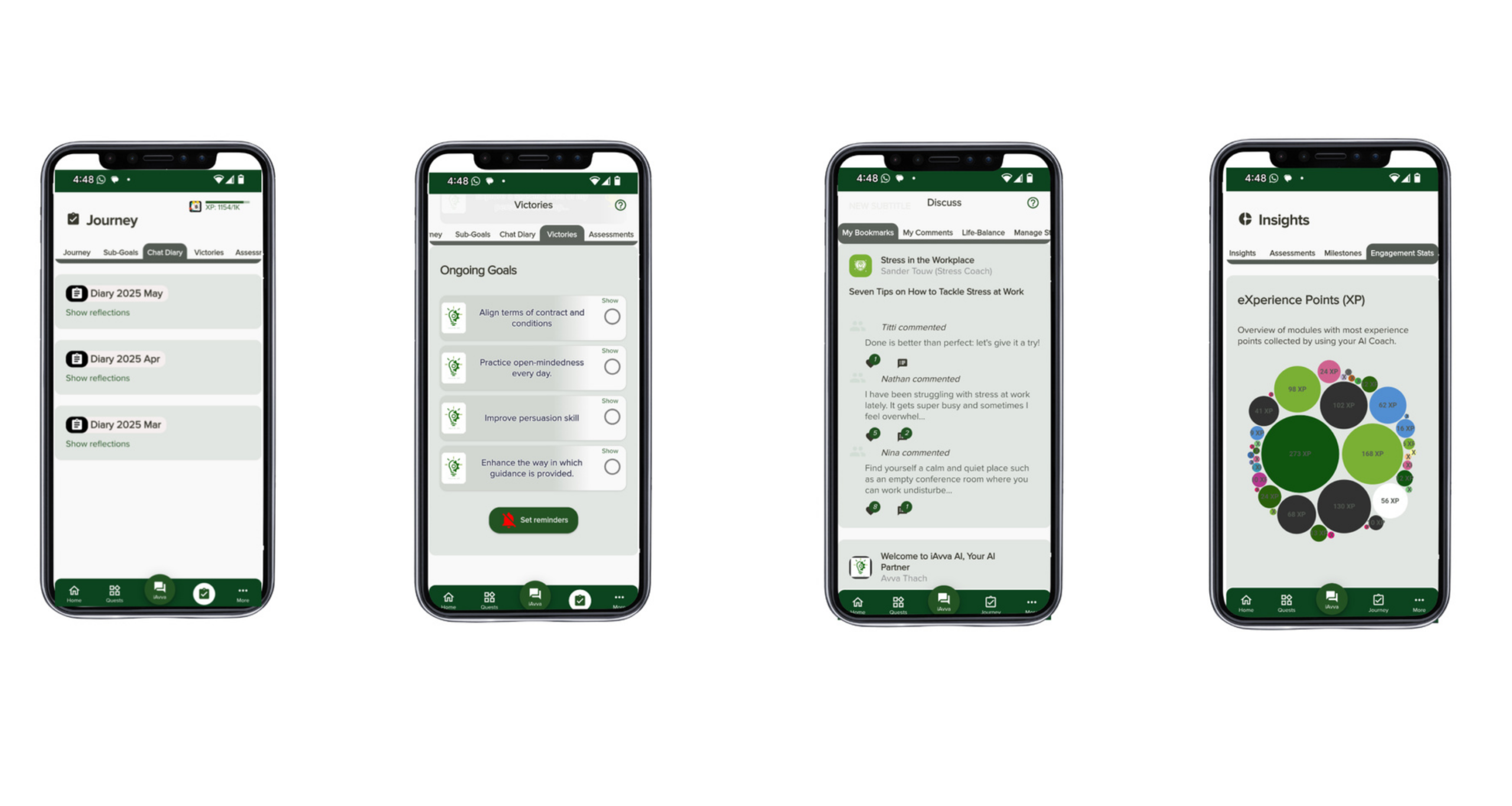
At iAvva AI, we sit right at this intersection of AI strategy and human development. Our AI Coach platform combines neuroscience, positive psychology, and ICF coaching principles to build better daily habits for leaders in just five minutes a day, in 19 languages. By the end of this guide, the path from “AI is important” to “our leaders are ready” will feel far more concrete, and you will see how an approach like iAvva AI can support that shift in a measurable, human-centered way.
Key Takeaways
This quick summary gives the main ideas for readers who need the headline points before going deeper.
- AI leadership is a strategic discipline that connects AI to business goals, culture, and daily work. Leaders do not need to code, but they do need to ask sharp questions, set clear direction, and build teams that mix technical and business strength.
- Midlevel leaders carry most of the real weight of AI change and often lack support. When organizations invest in this group through focused training, coaching, and clear decision rights, AI projects move faster and adoption sticks.
- A four-stage maturity model makes AI leadership development concrete. Leaders move from basic literacy, to an AI-first mindset, to scaling skills, and finally to strategic foresight where AI informs big bets and business model shifts.
- Human reactions such as fear, distrust, and change fatigue block AI more than technology does. Leaders who build psychological safety, communicate with empathy, and show real examples of humans plus AI wins see higher engagement and stronger business results.
- AI should improve decision-making, not replace it. The best leaders use AI for analysis and prediction, then add context, ethics, and people judgment before committing to a path.
- Ethical AI leadership means active work on bias, fairness, transparency, privacy, and accountability. Clear governance, broadly representative teams, and ongoing audits are now core leadership tasks, not “nice to have” extras.
- Scalable leadership development platforms like iAvva AI give organizations a way to grow AI leadership at scale through microlearning, daily reflection, and OKR-aligned habits, while giving HR and L&D teams real-time insight into progress.
What Is AI Leadership? Redefining Leadership For The AI Era
When we talk about AI leadership, we are not talking about leaders who write code or tune models. We are talking about leaders who treat AI as a central part of strategy, operations, and culture rather than a side project in IT. In simple terms, AI leadership is the ability to guide people and business results in a world where AI is woven into daily work.
The biggest misconception is that AI leaders must be technical experts. They do not. Their primary job still centers on growth, risk, customers, and people. What changes is the set of tools they use and the questions they ask. Instead of asking “Can we automate this?” as a one-off, they ask “Where can AI help us decide, create, and serve better than we did last year?”
A key shift inside AI leadership is moving from “AI as tool” to “AI as partner.” In the tool mindset, AI is a fancy calculator used from time to time. In the partner mindset, AI sits inside workflows for sales, support, finance, HR, and product. Leaders design work so that AI handles pattern recognition at speed while humans bring judgment, empathy, and creativity.
The core responsibility of an AI-focused leader is to bridge the gap between what AI can do and what the business must achieve. That means:
- Understanding, at a high level, the types of problems AI can help with.
- Aligning those opportunities with strategic goals and clear business outcomes.
- Backing teams as they test and refine new ways of working.
- Noticing where AI should not be used because risk, values, or fairness would suffer.
Compared with older “digital projects,” AI leadership is less about buying software and more about guiding human plus machine collaboration. Traditional change efforts often centered on rolling out a new system. AI-centered work asks leaders to rethink how decisions are made, how teams learn, and how work is shared between people and algorithms.
Effective AI leaders focus less on having every answer and more on assembling the right mix of skills. They bring data experts, product owners, HR, and operations into the same room and keep everyone focused on outcomes such as faster cycle times, fewer errors, and better customer experiences. They also keep an eye on ethics, privacy, and psychological safety along the way.
At iAvva AI, we see this broader role every day. Our AI Coach App is built to help leaders grow the mindset and behaviors needed for this new style of leadership through daily reflection, feedback loops, and OKR alignment, rather than through one-off workshops that fade after a few weeks.
Why AI Leadership Matters: The Competitive Imperative
The gap between organizations with strong AI leadership and those without it is no longer academic. It shows up in earnings calls, customer churn, and time to market. Research, including studies on Artificial Intelligence and the role of leadership, points in the same direction: companies that apply AI at scale tend to grow revenue faster and manage costs better than peers that move slowly.
“AI is the new electricity.”
– Andrew Ng, AI researcher and entrepreneur
The advantage shows up in several clear areas:
- Sharper decisions. AI-guided decisions outpace those made only by human analysis. When leaders can see demand patterns, supply risks, and customer behavior in near real time, they shift budgets, adjust prices, or launch campaigns faster.
- Freed-up capacity. AI removes repetitive tasks, which leaves more energy for creative work, relationship building, and problem solving.
- Faster innovation. Product teams can test more ideas with less effort. Marketing teams can draft and refine campaigns in hours rather than days. Operations teams can simulate changes before touching the real system.
The leader’s role is to decide which experiments matter, support them, and turn the best ones into new standards.
Customer expectations keep rising as well. Buyers now compare every interaction to the most seamless experience they have had anywhere. AI-backed personalization, smart routing in support, and predictive service all help here, but only if leaders connect those capabilities to a clear promise about service quality, data use, and trust.
There is also a strong talent angle. Skilled employees want to work for organizations that take AI seriously and offer growth in this area. When leaders show a thoughtful AI agenda, with clear ethics and upskilling paths, they signal that the company is thinking ahead. When they ignore AI or treat it as a buzzword, high performers notice and may leave for places that feel more future-ready.
The compounding effect of early AI leadership investments is easy to miss. The first year may look modest: a few process gains, some faster reports, maybe a pilot in customer support. Over time, however, these early wins build data, skills, and confidence that feed the next wave of use cases. Late movers not only start from behind; they also lack the internal experience that early movers have already built.
Across HR, L&D, IT, and business lines, the pattern is consistent. The main bottleneck is not access to technology but access to leaders who can set a clear vision, bring people with them, and manage risks with care. Scalable development platforms such as iAvva AI exist to close that gap by helping thousands of leaders build AI leadership habits in small, daily steps rather than through rare events.
The Core Responsibilities Of AI-Driven Leaders
Once we accept that AI leadership is a strategic discipline, the next question is simple: what exactly should leaders do differently? The answer spans four areas—strategy, culture, operations, and collaboration—with ethics running through all of them.
AI-driven leaders focus on:
- Strategy. They define how AI links to the business story. They identify a small number of priority themes (for example, faster customer response or better demand planning) and connect those to concrete metrics. They also decide where to place early bets, how to fund them, and how to track return on investment in ways that finance teams respect.
- Culture. They shape how people feel about AI at work. They talk openly about both promise and limits, share success stories that feature humans plus AI together, and acknowledge fears instead of brushing them aside. It becomes normal to learn new tools, admit when something is confusing, and adjust based on feedback.
- Operations. They work with their teams to weave AI into daily workflows rather than bolt it on at the edges. That might mean redesigning a sales process so that AI suggests next best actions, or updating a hiring flow so that AI screens for patterns while humans still make final calls. They also model smart AI use in their own calendars, reports, and communications, understanding The Role of AI in transforming operational workflows.
- Collaboration. AI work cuts across IT, data science, legal, HR, and every business function. Effective leaders bring these groups together frequently, translate jargon into plain language, and help each person see their role in the shared goal. They also build external networks to learn from peers facing similar challenges and to sense new risks or methods early.
- Ethics. They keep fairness, privacy, and accountability on the table whenever a new system is discussed. They ask who could be harmed, whose voice is missing, and how people can question or appeal AI-supported decisions. This is not only about avoiding fines or bad press. It is about staying aligned with the values that employees and customers expect.
Platforms like iAvva AI help leaders turn these responsibilities into habits. Through short, daily prompts tied to real goals and OKRs, our AI Coach App nudges leaders to think about how they set direction, share stories, adjust workflows, and check themselves on ethics. Over time, those small reflections add up to more confident, grounded AI leadership across the organization.
The Critical Role Of Midlevel Leaders In AI Transformation
When people talk about AI change, they often picture visionary CEOs or brilliant data scientists. In practice, midlevel leaders are the ones who make or break AI efforts. They sit between strategy and the front line, which means they translate big ideas into daily work, and they hear the honest concerns that rarely reach the boardroom.
Research on the Influence of Leadership on human-AI collaboration shows how underused this group often feels. Only about half of midlevel leaders say their creativity and ideas are tapped in major change efforts. That matters because these leaders manage the teams that must adopt new tools, change processes, and deliver results while still hitting today’s numbers. If they are not on board, projects stall or never move beyond pilot mode.
Midlevel leaders play four standout roles during AI change:
- Translators. They turn high-level AI strategy into concrete steps for their teams. They break broad goals into clear tasks, connect use cases to local metrics, and explain how new tools will show up in daily routines. Because they work close to operations, they can also spot when a plan from headquarters clashes with reality and suggest better options.
- Educators. They help team members build skill and confidence with new tools. They do not need to be the top expert, but they do need to point people toward good training, answer first questions, and model a learning mindset. When a team sees their manager trying a new AI tool, sharing what works, and laughing about mistakes, they are more likely to try themselves.
- Advocates. They shape how people feel about AI. They listen to worries about job security or fairness, bring concerns to senior leaders, and share real examples where AI made work easier or more meaningful. Because team members trust them more than distant executives, their words carry greater weight in shaping attitudes.
- Opportunity spotters. They notice small but powerful ways AI can help. A midlevel leader in customer service might see a pattern in call topics that a chatbot could handle. A plant manager might see a chance to use predictive maintenance models on a set of machines. These insights often never appear in slide decks without someone in the middle pointing them out.
Despite this importance, midlevel leaders often juggle tight targets, limited time, and little formal support for AI work. They may be told to “lead change” without training, slack in their schedule, or clear authority to change processes.
Organizations can shift this by offering targeted training, protected time for experimentation, and clear decision rights. Recognizing and rewarding midlevel leaders who move AI projects from talk to real impact also sends a strong signal about what matters.
iAvva AI was designed with this group strongly in mind. Our AI Coach App acts as an always-on companion that fits into a busy calendar, asking five-minute reflective questions that help midlevel leaders connect AI goals to their own leadership style. Over weeks and months, this kind of support gives them the strength, clarity, and language needed to guide teams through demanding AI change.
The AI Leadership Maturity Model: A Four-Stage Developmental Path
Teaching AI leadership as a single “training event” rarely works. Leaders are at different starting points, face different pressures, and absorb new ideas at different speeds. A maturity model gives structure to this messy reality and helps everyone see progress as a path, not a one-time leap.
In our work with clients, four stages show up again and again. First is basic literacy, where leaders learn what AI is and is not. Second is mindset, where they start to view AI as a partner rather than a threat. Third is scaling, where they gain the skills to move beyond pilots. Fourth is strategic foresight, where AI feeds into long-range decisions and bold moves.
Each stage builds on the one before it. Leaders who skip the first stage often feel lost in jargon later. Leaders who skip mindset work may understand AI concepts yet drag their feet because of quiet fear or doubt. By naming the stages, we reduce shame. It is normal, for example, that some functions sit in stage two while others are already in stage three.
A simple way to picture the model is in this table.
| Stage | Main Focus | Signs You Are Here |
|---|---|---|
| Stage 1 | Basic AI literacy and shared language | Leaders ask clear questions about AI basics and can explain them simply to others. |
| Stage 2 | AI-first mindset and experimentation | Teams try AI tools in daily work and talk openly about wins and misses. |
| Stage 3 | Skills for scaling AI across teams | Cross-functional projects move from pilot to production with clear measures. |
| Stage 4 | Strategic foresight and self-disruption | AI insights show up in long-term planning and new business models. |
Organizations can assess where their leaders sit through surveys, interviews, and data on how AI is actually used in projects and decisions. Support should then match the stage. A leader just starting out needs simple, clear guidance, while a leader in stage three may need advanced training in AI project governance and cross-functional steering.
Progress through the stages is never automatic. It depends on deliberate practice, reflection, feedback, and the right support systems such as training, coaching, peer networks, and safe spaces for experiments. Platforms like iAvva AI help by aligning daily prompts and microlearning content with this four-stage path, so leaders keep moving forward in small, steady steps.
Stage 1: Building Foundational AI Knowledge
Stage one of AI leadership is about literacy, not mastery. The goal is for leaders at every level to understand the basics well enough to hold meaningful conversations with experts, make choices about projects, and explain AI decisions to their teams. They do not need to write code or tune models, but they do need to know what is possible, what is risky, and what common words mean.
Many leaders feel quiet anxiety at this stage. They worry they “should already know this” or that they must turn into data scientists to stay relevant. Naming this fear helps, because it is simply not true. What matters is a working grasp of several core ideas and how they show up in the business.
Several concept areas matter most early on:
- Data analytics is the starting point because AI runs on data. Leaders should know how data is collected, cleaned, and combined, and why poor data quality leads to bad decisions even with clever models. When they understand this link, they are more likely to invest in better data practices instead of chasing flashy tools.
- Machine learning can stay at a conceptual level for most leaders. They need a sense of how algorithms learn from historical patterns, how models can drift over time, and why training, testing, and monitoring matter. This helps them ask good questions about reliability and fairness when teams present AI results.
- Generative AI and large language models (LLMs) now touch writing, coding, design, and more. Leaders should understand where these tools shine, where they make confident mistakes, and how prompts shape outputs. This knowledge lets them set realistic expectations and choose safe, high-impact use cases first.
- Cybersecurity and privacy take on new weight when AI systems rely on large data sets. Leaders should know the kinds of new risks AI introduces, such as data exposure or model misuse, and what controls, policies, and training are needed to reduce those risks.
- Ethics, bias, and transparency are not abstract topics. Leaders must grasp how biased data can lead to unfair outcomes and why audit, documentation, and explainability matter for trust with employees, customers, and regulators.
This stage should stay grounded in real business use cases. Rather than long theory-heavy lectures, leaders learn better from short examples tied to sales, marketing, operations, finance, or HR.
They also need help sorting signal from noise, because AI news moves fast. Curated reading lists, internal briefings, and short videos can all help leaders stay current without feeling buried.
At iAvva AI, we build stage one competence through microlearning and daily reflection. Short prompts invite leaders to connect a basic AI idea to a real decision, project, or meeting that day. Over time, this pattern turns abstract concepts into practical AI leadership skills grounded in the leader’s actual work.
Stage 2: Building An AI-First Mindset
Once leaders understand the basics, the next challenge is how they think and feel about AI. Stage two is all about mindset. An AI-first mindset treats AI as a natural productivity partner, not a threat or a one-off add-on. It turns “I guess we have to use AI” into “Where could AI help us do this better?”
Several traits show up in an AI-first mindset. Curiosity comes first. Leaders with this mindset enjoy trying new tools and asking, “What happens if we use this on our weekly report or customer emails?” They are comfortable with some ambiguity and see learning as a process rather than a test they must pass on the first try.
These leaders are also willing to question long-held workflows. Instead of defending a ten-step process because “we have always done it this way,” they ask whether AI could remove steps, reduce handoffs, or shrink waiting time. At the same time, they respect guardrails around ethics, privacy, and quality.
The biggest blocker to this mindset is fear, especially fear of job loss. Many employees and some leaders secretly wonder if AI will replace them. An AI-first mindset does not deny this concern. Instead, it reframes AI as a way to remove low-value tasks so people can focus more on creative, relational, and strategic parts of their roles.
Leaders at this stage must also adjust their own habits. It is not enough to tell teams to “use AI more.” They need to show how they themselves use AI to summarize long documents, prepare for meetings, explore options, or test ideas. When people see their manager experimenting in public, sharing what went wrong, and adjusting, they get permission to do the same.
High levels of experimentation are a marker of progress in stage two. Teams run small, low-risk trials with AI in real work, compare AI-supported and traditional methods, and share what they learn. The learning comes not only from wins but also from failures, as long as those failures are analyzed and shared rather than hidden.
Psychological barriers also surface here. Some people fear looking “stupid” in front of peers, while others feel tired after many past change programs. Leaders need patience and empathy, plus simple ways for people to try AI with little pressure.
Strategies such as starting with small wins, celebrating early adopters, and sharing user stories go a long way. Over time, many tiny mindset shifts add up to a culture that leans toward opportunity instead of fear when new AI tools appear.
iAvva AI Coach is built for exactly this kind of shift. Neuroscience-based prompts help leaders notice their reactions to AI, confront unhelpful beliefs, and design small experiments for themselves and their teams. By checking in daily, leaders strengthen an AI-positive mindset that supports AI leadership at scale.
Stage 3: Honing Advanced AI-Specific Skills For Scale
Stage three is where AI leadership moves from pockets of experimentation to broad impact. Leaders at this stage focus on scaling what works across functions, regions, and customer segments. To do that, they need a blend of technical and leadership competencies that go beyond basic literacy.
On the technical side, AI projects require careful project management. Timelines depend not just on coding but on data access, data cleaning, model training, testing, and integration with existing systems. Leaders must plan for iteration, because AI models rarely work perfectly on the first try, and teams need time to adjust based on feedback.
Choosing vendors and platforms is another key skill. Leaders should know how to compare different AI offerings, read between the lines of marketing claims, and ask questions about data use, model updates, support, and long-term fit. They must spot warning signs around security, ethics, or unrealistic promises.
Integration skills matter as well. Adding AI to a process means more than dropping a new tool in the middle. Leaders must work with IT and operations to align data flows, user interfaces, and training. They also need plans for monitoring performance and handling exceptions when the AI system is unsure or off target.
Measuring and explaining return on AI investments is part of stage three too. Leaders define clear success metrics before projects start, such as reduced handling time, higher conversion, or fewer errors. They track these over time, compare them with baselines, and tell the value story in language that finance and executives care about.
Leadership competencies for scale are just as demanding:
- Cross-functional collaboration. AI projects touch legal, security, HR, business lines, and customer-facing teams. Leaders must create shared goals, mediate conflicts, and keep everyone aligned when pressure rises.
- Change management. Scaling AI can trigger fear, confusion, or resistance at wider scale. Leaders need plans for communication, training, feedback, and adjustment. They must spot pockets of resistance early and deal with them through dialogue, support, and, sometimes, firm decisions.
- Business storytelling. Another aspect of AI leadership at this stage is building solid business cases that move beyond vague claims. Leaders show how an AI initiative links to the company’s strategy, what risks exist, how those risks will be handled, and what kind of payback period is realistic.
- Governance through dedicated AI governance platform capabilities. As usage spreads, ethical and governance frameworks grow more important, with platforms like ModelOp: Enterprise Al Lifecycle providing structured approaches to enterprise AI management. Leaders help create and enforce policies about data use, bias checks, documentation, and human oversight for high-risk tasks. They also make sure accountability for AI outcomes is clear, not fuzzy.
Organizations that do stage three well often build internal communities of practice where project teams share patterns, templates, and lessons. This avoids repeating the same mistakes and speeds up new efforts.
iAvva AI supports this stage through a mix of AI strategy work and daily coaching. Our consulting helps leaders design scalable AI roadmaps and governance, while the AI Coach App keeps individual leaders focused on cross-functional collaboration, change moves, and clear storytelling about impact. That mix makes large-scale AI work more disciplined and more human.
Stage 4: Leading With Confidence And Strategic Foresight
Stage four is the peak of AI leadership maturity. Leaders here use AI not only to improve current operations but also to sense and shape the future of their business. They move from reacting to change toward anticipating it and, in some cases, driving it.
Strategic foresight in the AI era starts with wide and steady sensing. Leaders use AI tools to scan market data, customer feedback, competitor moves, scientific papers, and policy signals. Instead of occasional big studies, they rely on continuous streams of insight that highlight weak signals and new patterns.
These leaders also think beyond the walls of their own firm. They look at how AI is shifting customer expectations across industries, how supply chains might change, or how new regulations could create openings or threats. They ask what role their organization could play in that wider picture five or ten years from now.
Scenario planning becomes a regular practice. With AI, leaders can simulate many “what if” paths: a new entrant changes prices, a regulation bans a practice, or a new technology makes a current product less attractive. Teams explore how the business would respond in each case, which reduces surprise and speeds action when some part of a scenario becomes real.
A bold feature of stage four AI leadership is the willingness to disrupt one’s own current success. Leaders recognize that clinging too tightly to today’s cash cows can set the stage for tomorrow’s decline. Guided by AI-driven insight and human judgment, they test new business models, pricing structures, channels, or partnerships, even if it means short-term discomfort.
Balancing optimization and innovation is part of the art here. Leaders still care about efficiency gains from AI in present operations. At the same time, they allocate resources to more experimental bets that may become tomorrow’s core. Many use a portfolio view that includes core improvements, adjacent plays, and more radical options.
Common barriers to strategic foresight include short-term financial pressure, fear of cannibalizing existing products, and organizational habits that punish experiments that do not pay off quickly. Overcoming these barriers demands a clear narrative from the top, supportive governance, and leaders who are willing to explain and defend long-term choices.
Diverse perspectives strengthen foresight. Leaders who invite voices from different regions, functions, age groups, and backgrounds are more likely to question assumptions and avoid groupthink. AI can help by surfacing patterns and anomalies, but humans still need to challenge one another, ask “what if we are wrong,” and rethink plans when new evidence appears.
Reflection and synthesis skills play a big part at this level. With so much data and many opinions, leaders must step back, make sense, and connect dots without getting lost. iAvva AI’s daily reflection model helps by giving leaders structured moments to consider how recent signals relate to their strategic goals and personal leadership habits. In this way, personal growth and organizational foresight stay in sync.
The Human Side Of AI Transformation: Overcoming Resistance And Fear
Technology is rarely the main barrier to AI change. Human emotion is. Fear, doubt, and past experience often slow or block AI projects even when the business case looks strong. Good AI leadership takes these feelings seriously instead of treating them as “soft” or unimportant.
Resistance to AI is a normal human response. Many people worry that AI will take their job or make them less valuable. Others fear they will not be able to learn the new tools fast enough and will be judged as weak. Some doubt the fairness of AI decisions or feel uneasy about machines making choices that affect people’s lives.
There are deeper layers as well. When decisions are driven by AI models, some employees feel they are losing control or autonomy. Past failed change efforts can leave “scar tissue,” so workers think, “We have seen big programs come and go, and they just made our lives harder.” Media stories about job loss and dystopian futures add to the unease.
Understanding these worries is the first step toward easing them. Leaders must show respect for people’s feelings, even if some fears are based on rumors or worst-case stories. Dismissing concerns with a quick “It will be fine” closes doors. Acknowledging them with “I hear that this is scary, let’s walk through it together” opens them.
Practical steps help reduce fear:
- Transparent communication about where AI will and will not be used matters a lot. When people know that AI will help with drafting reports but not decide who is fired, anxiety drops.
- Clarity about data use, privacy, and appeal paths for AI-supported decisions builds trust.
- Reframing AI as support for better work rather than a silent judge is powerful. Leaders can share clear examples where AI removed boring tasks or allowed people to spend more time with clients, students, or patients.
Involving employees in AI design and roll-out changes the mood. When people help decide which tasks to automate and how tools fit into their day, they feel less like change is being done to them and more like they are shaping it. Peer champions who share honest stories about their first awkward steps and later gains add social proof that learning is possible.
Leaders also need to watch for change fatigue. Many organizations have gone through multiple restructures, system roll-outs, and process overhauls. Adding AI on top, without adjusting other demands, can push people past their limit. Thoughtful pacing, clear priorities, and removing old work to make space for new learning matter here.
Midlevel leaders sit in a hot zone for fear. They worry about their teams, their own roles, and pressure from above. Supporting them with coaching, safe spaces to discuss doubts, and concrete tools for conversations makes a large difference in how change feels on the ground.
iAvva AI’s approach is human-centered for this reason. Our prompts invite leaders to reflect on how their people might feel, how well they have communicated, and where they need to show more empathy or clarity. By growing these inner skills, we help leaders guide their teams through AI change with compassion and steady AI leadership.
Bridging The Skills Gap: Technical Expertise And Learning Strategies
Alongside fear, a second major barrier to AI adoption is a simple skills gap. Many employees and leaders feel they lack the technical understanding or practical know-how to use AI tools well. When people feel unprepared, they avoid new tools or use them on the surface without tapping real value.
The gap shows up in several ways:
- Some workers are unfamiliar with basic AI terms and ideas, so they feel lost in discussions.
- Others know the concepts but do not know how to apply AI to their specific roles, such as customer service, operations, finance, or HR.
- Many are unsure how to judge whether AI outputs are trustworthy or how to write prompts that improve quality.
Data literacy is another missing piece. AI thrives on data, yet many people are not comfortable reading charts, understanding distributions, or questioning data sources. Without that comfort, they either trust AI blindly or ignore it, instead of holding a balanced, informed view.
Learning needs also vary widely. A software engineer, a call center agent, a plant supervisor, and an HR business partner each use AI differently. Generic training sessions that mix everyone together often leave many bored or confused. Role-based examples and practice make learning stick much better.
Effective learning strategies for AI leadership and workforce skill building share a few traits. They are targeted, frequent, hands-on, and supported over time:
- Role-specific training shows people how AI connects to the tasks they do daily. A marketing manager, for example, might learn how to use AI for audience segmentation and creative draft work. A recruiter might learn how to screen resumes faster while still applying human judgment for fairness.
- Microlearning breaks content into short pieces that fit into busy schedules. Instead of a single long workshop, learners get five to ten minutes of focused content and reflection each day or week. This pattern fits the way the brain learns and makes new habits more likely to stick.
- Experiential learning gives people safe ways to test AI on real tasks. Instead of watching a demo, they log into tools, run experiments, and compare results. Communities of practice and peer groups add social learning, where people share tips, templates, and warnings.
- Clear learning paths help people see progress from basic to advanced. A path might start with simple literacy, move into applied use cases, then address advanced topics such as prompt design or AI-supported analytics. Tracking progress and celebrating milestones turns learning into a visible achievement.
Scalability is a real challenge for large or global organizations. They must upskill hundreds or thousands of people, often across time zones and languages, while respecting neurodiversity and different learning styles. Traditional in-person sessions struggle here.
Leaders need to model learning by showing that they too are students of AI. When senior people attend sessions, share what they learned, or talk about how they used AI this week, it reduces stigma and signals that learning is for everyone, not just junior staff.
iAvva AI addresses these needs with a multilingual, mobile-first platform that fits into daily work. Our AI Coach App blends microlearning with reflection so leaders do not just absorb facts but turn them into new behaviors. With support for 19 languages and neurodiversity-friendly features such as voice and text modes, organizations can grow AI leadership and AI fluency across global teams in a practical, respectful way.
Creating A Culture Of Experimentation And Psychological Safety
AI adoption is, by nature, experimental. There are few fixed playbooks, many unknowns, and a lot of trial and error. For this reason, psychological safety is the bedrock under strong AI leadership. Without it, people hide mistakes, avoid new tools, and wait for someone else to go first.
Psychological safety means that people believe they can speak up, ask questions, and try new things without fear of being punished or mocked. It matters in all kinds of work, but it becomes even more important with AI because the tools are new and expectations shift quickly.
Experimentation around AI carries special risks and feelings. People will make mistakes as they learn prompts, misinterpret outputs, or pick poor use cases. Some tests will waste time. Some will fail. If the culture treats any failure as a career hit, the learning stops.
At the same time, leaders often push for fast results from AI investments. They want quick proof of value, which is understandable. The art is to balance urgency with space for learning. Saying “fail fast” in slides is easy. Creating an environment where people can actually try and fail without harm is much harder.
“Psychological safety is not about being nice; it’s about giving candid feedback, openly admitting mistakes, and learning from each other.”
– Amy Edmondson, Harvard Business School
Several practical moves help build a safe-to-fail culture:
- When leaders share their own AI experiments, including missteps, teams see that trying and learning is allowed. A director who says, “I asked the tool for this report, the first version was poor, here is how I adjusted,” sends a strong social signal that perfection is not expected from day one.
- Giving explicit time and resources for AI exploration shows that it is real work, not a side task for evenings. Teams might have a weekly slot where they test tools on real tasks, document what they learn, and share outcomes with others. This reduces the sense that curiosity is “extra” and instead makes it part of the job.
- Celebrating instructive failures turns them into assets. When a team shares a trial that did not work and explains why, others learn and avoid repeating the same pattern. Leaders can ask “What did we discover?” instead of “Why did this fail?” and thank people for the insight.
- Clear boundaries help as well. People should know which areas are open for experiments and which involve high risk and need stricter control. For example, playing with AI to draft internal emails might be wide open, while using AI in safety-critical settings would demand heavy oversight.
It is also vital to separate experimentation from performance evaluation. If people believe that every test may hurt their rating, they will only attempt “safe” moves that add little value. Leaders should be explicit about how AI pilots factor into reviews and make sure behavior matches the stated policy.
Strong AI leadership here means reacting well when an experiment goes wrong. Instead of blame, leaders show curiosity. Instead of anger, they focus on process. This kind of response builds trust over time, whereas a single harsh reaction can undo months of safety building.
Research on high-performing teams, such as Google’s Project Aristotle, shows that psychological safety is a top factor in success. AI work fits the same pattern. Teams that feel safe to speak up and test ideas learn faster, spot issues earlier, and innovate more.
iAvva AI supports leaders in building this culture. Our AI Coach prompts ask leaders to reflect on how they responded to a recent mistake, whether they invited input, or how they can make space for experiments in the coming week. By growing clarity, courage, and consistency one day at a time, leaders create the conditions where AI experiments can flourish.
Using Collective Intelligence: The Power Of Peer Networks And Collaboration
No single leader, team, or company can keep up with every new AI method, tool, or risk alone. The pace of change is too high and the field too broad. That is why collective intelligence has become a core advantage in AI leadership.
In some organizations, knowledge about AI sits in silos. A data science group may know one set of tools, marketing another, and operations a third. People hold their tips close, thinking that knowledge is power. This mindset slows progress and leads to repeated mistakes.
Peer networks and collaboration push in the opposite direction. When leaders share what is working, where they stumbled, and how they solved problems, everyone gains. Learning that took one company months can help another team move faster in weeks.
The benefits of peer collaboration are wide:
- Learning speeds up as teams borrow patterns and templates from others rather than starting from zero each time.
- Common pitfalls, such as ignoring data quality or forgetting to plan for change management, are easier to avoid when peers tell honest stories.
- Exposure to different industries and regions opens fresh ideas about new use cases.
Collaboration happens both inside and outside the organization. Internally, cross-functional AI squads bring IT, data, legal, HR, and business unit staff together around shared goals. Communities of practice create spaces where interested people trade prompts, dashboards, and lessons. Reverse mentoring, where younger or more tech-comfortable employees coach senior leaders on AI tools, can also shift both skill and culture.
Externally, leaders gain from curated peer groups, industry alliances, and executive forums focused on AI. Gatherings such as The AI-Driven Leadership Collective bring together leaders who share their playbooks, missteps, and governance models. In such circles, each member’s insight becomes fuel for others, and the whole network moves forward faster.
Some leaders worry about sharing too much in external forums. The key is judgment. Topics such as ethics, regulation, and basic project patterns are often safe and helpful to discuss broadly. Exact pricing models, secret algorithms, or sensitive client data stay inside the firm. Clear ground rules and nondisclosure agreements can help.
Reciprocity is also important. Networks thrive when members both give and receive. Leaders who share their experiences, not just their wins but also the hard lessons, build stronger ties and gain more support when they need it.
From a business view, organizations that foster rich collaboration tend to innovate faster and scale AI more smoothly. They waste less time repeating known errors and pick up new practices sooner.
At iAvva AI, we think of our role not only as a platform provider but as a connector. Our clients learn from aggregate patterns in our analytics and from stories shared in safe settings, without exposing any confidential data. This kind of quiet cross-learning strengthens AI leadership across many firms at once.
AI-Assisted Decision-Making: Faster, Smarter, Better
Decision-making sits at the heart of leadership. Every budget shift, product launch, hire, or policy change is a decision. AI does not remove this responsibility, but it can change how leaders reach decisions, often for the better.
Traditional decision-making has clear limits. Humans can only digest so many reports, dashboards, and documents. Cognitive biases, such as confirmation bias or anchoring, shape which facts we notice and how we interpret them. Time pressure pushes leaders toward familiar patterns, even when new conditions call for a different response.
With strong AI leadership, organizations use AI systems to process volumes of data that far exceed human capacity. Models can scan customer behavior, supply chain data, social media signals, sensor readings, and more. They can spot patterns, correlations, and early warning signs that a human might miss altogether.
AI also helps leaders look ahead rather than only backward. Predictive models estimate how demand might shift, which customers are likely to churn, or where a breakdown might occur. Scenario tools allow leaders to test how different choices could play out before committing resources.
Real-time updates are another benefit. AI systems can monitor operations or markets continually and surface alerts when certain thresholds change. This supports quicker, more focused attention to areas that need it most.
Still, AI does not replace human judgment. The best pattern to follow is augmented intelligence, where AI does the heavy data work and humans provide context, values, and final choices. AI may suggest that a certain group of customers seems “unprofitable,” for example, but a leader might know they are key to long-term strategy or brand strength.
Healthy AI leadership in decision-making includes several habits:
- Leaders question AI outputs rather than accepting them blindly. They ask how the model was trained, which data it used, and where it might be biased.
- They compare AI recommendations with domain knowledge from experts on the ground.
- They guard against automation bias, the human tendency to trust computer-generated suggestions more than we should.
- They keep humans in the loop for high-stakes calls, such as hiring, credit, medical choices, or safety decisions, even when AI offers a clear opinion.
Areas where AI can add particular value include resource allocation, demand forecasting, risk assessment, fraud detection, and detailed customer segmentation. In each case, models can handle more variables and combinations than human minds, but people still decide how to act on the insights.
Data literacy is a core skill here. Leaders must know enough to judge whether data is solid or shaky, what an error margin means, and when a result is too surprising to act on without more checking.
At iAvva AI, we help leaders build these habits through guided reflection. Prompts encourage them to think about a recent decision, how data and AI were used, what biases might have been at play, and how they might improve the process next time. Over time, this reflection builds sharper, more conscious AI leadership in decision-making.
Ethical AI Leadership: Navigating Bias, Fairness, And Accountability
As AI spreads into hiring, lending, healthcare, policing, and many other areas, ethical questions move from the edges to the center of AI leadership. Leaders cannot treat ethics as a side topic for lawyers or compliance teams. The way AI is designed and used can affect real lives, reputations, and long-term trust.
One major issue is bias and fairness. AI models learn from historical data. If that data contains bias against certain groups, the model can repeat or even amplify that bias. This has shown up in hiring tools that favor resumes from certain schools, lending models that treat some neighborhoods unfairly, and health systems that under-diagnose certain patients.
Ethical AI leadership requires that teams test models for biased outcomes and adjust as needed. That can mean using more varied data, changing model features, or even deciding that AI should not be used for certain decisions at all. It also means having people from different backgrounds involved in designing and reviewing AI systems so blind spots are less likely.
Transparency and explainability form a second pillar. Many powerful AI models are complex and hard to interpret. Yet employees and customers have a reasonable expectation to understand how important decisions are made. Leaders must push for systems and methods that can be explained in plain language, especially where decisions affect access to jobs, money, or services.
Privacy and data security are another major concern. AI thrives on large amounts of data, often including personal or sensitive information. Leaders need clear policies about what data is collected, how long it is kept, how it is protected, and how people can request changes or deletion. Compliance with rules such as GDPR and CCPA is the baseline, not the goal line.
Accountability is the last pillar that ties the others together. When an AI system makes a harmful or wrong call, someone must answer for it. Ethical AI leadership refuses to hide behind phrases such as “the algorithm did it.” Instead, leaders set up clear ownership for each AI system, with logs, documentation, and appeal routes for those affected by its decisions.
Balancing speed and ethics is not easy. Some argue that heavy ethical checks will slow innovation. Experience shows the opposite in the long term. AI systems that ignore fairness, privacy, or transparency often trigger public backlash, legal action, or internal revolt. Fixing those problems later costs more than building guardrails from the start.
Practical steps for ethical AI governance include:
- Clear, values-based principles for AI use.
- Cross-functional ethics boards and regular audits.
- Training for employees who design, select, or use AI so they know the risks and their duties.
- Simple channels for reporting worries about AI behavior so problems are caught early.
The idea of ethics by design ties it all together. Instead of checking ethics only at the end, teams bake fairness, privacy, and accountability into design choices from day one. They ask who might be harmed, what consent is needed, how explanations will be shared, and how people can challenge decisions.
iAvva AI takes these matters seriously. Our AI Coach platform follows strict privacy standards, including GDPR alignment and encryption, and is designed with neurodiversity and accessibility in mind. We never want leaders to feel watched or scored. Instead, we create a safe reflection space that supports ethical growth and wise AI leadership.
Organizations that treat ethics as central, not optional, are better positioned to earn long-term trust from customers, employees, and regulators. In a world where AI touches more and more decisions, that trust becomes a powerful competitive asset.
FAQs
What Is AI Leadership In Simple Terms?
AI leadership is the practice of guiding people and business results in a setting where AI tools are part of daily work. It means using AI to support smarter decisions, better services, and stronger teams while staying true to values and ethics. Leaders focus on questions, goals, and people, while AI handles much of the analysis.
Do Leaders Need Technical Or Coding Skills To Lead AI Work Well?
Most leaders do not need to code, but they do need basic literacy in AI concepts and data. This helps them talk with experts, spot risks, and explain decisions to others. The strongest AI leaders surround themselves with good technical partners and focus on vision, culture, and judgment.
How Can A Small Or Mid-Sized Business Start Building AI Leadership?
A practical first step is to grow AI literacy among key leaders and midlevel managers. From there, pick one or two focused use cases with clear value, such as sales forecasting or support ticket triage, and run small pilots. Tools like iAvva AI Coach can support this by giving leaders daily prompts to link AI ideas to their own work.
How Long Does It Take To Shift Culture Toward AI-Positive Thinking?
Culture does not change overnight, but steady, visible steps can move it in months rather than years. Leaders who model learning, communicate clearly, and share both wins and lessons create momentum. Adding microlearning and reflection, instead of relying only on big events, keeps the change alive day by day.
Where Does iAvva AI Fit With Our Current L&D Programs?
Think of iAvva AI as a layer that makes your existing programs stickier and more measurable. Workshops and courses start the conversation, while our AI Coach App keeps leaders practicing new habits in five minutes a day. Real-time analytics connect this daily work to business OKRs so HR and L&D teams can see impact across the organization.
Is AI Coaching Safe For Employee Data And Privacy?
Data safety is a core design principle for iAvva AI. Our platform uses encryption and follows strict privacy standards such as GDPR, and we avoid collecting more information than needed for growth and insight. Leaders reflect in a space that is secure and focused on development, not surveillance.
Conclusion
AI is changing how organizations compete, but technology alone does not decide who wins. The real edge comes from AI leadership that connects algorithms to strategy, people, ethics, and daily work. Leaders who can do this across all four maturity stages help their companies move faster, stay fair, and keep learning.
We have explored how AI leadership redefines the leader’s role, why midlevel managers matter so much, and how a clear maturity model can guide development. We looked at the human side of AI, from fear and resistance to skills gaps and psychological safety, and at the growing weight of ethical questions around bias, privacy, and accountability.
For HR, L&D, IT, and business executives, the next step is action, not theory. That might mean assessing where your leaders sit on the four-stage model, picking a few high-impact use cases, and creating real space for experiments and learning. It also means giving leaders the tools and support they need to grow new habits, not just new knowledge.
iAvva AI exists to make that growth practical and scalable. With our AI Coach App and strategy support, we help leaders around the world build better daily habits, align with business OKRs, and turn AI from a buzzword into a lived practice. When humans grow alongside AI, organizations do more than survive the next wave of change; they write the rules for what comes next.
















Leave a Reply