





Digital Transformation Leadership – 7 Proven Strategies To Drive Success
Introduction
A lot of organizations spend millions on new platforms, analytics tools, and AI pilots, only to see adoption stall a few months later. The technology works on paper. The slide decks look perfect. Yet day‑to‑day behavior barely changes. That is the real test of digital transformation leadership.
Research shows that 88% of organizations have adopted or are planning a digital‑first business strategy. That sounds impressive, but anyone who leads people through change knows the harder truth. Buying technology is easy. Shifting mindsets, habits, and ways of working while still running the business is the hard part.
From conversations I have with HR directors, CIOs, and business unit leaders, a pattern keeps appearing. The failed efforts rarely collapse because of the software or the hardware. They stall because leadership teams underestimate the human side of change, treat transformation as an IT project, and hope that one launch event and a few training sessions will be enough.
The data tells a different story. Projects with effective change management are seven times more likely to hit their objectives than those without it. That gap is not about tools. It is about how leaders communicate, sponsor, coach, measure, and model new behaviors.
In other words, digital transformation is far more about people than it is about code. Leaders who treat it that way are the ones who turn big bets on technology into real business results. Leaders who do not tend to see resistance, confusion, and wasted investment.
In this article I will share seven proven strategies that I see high‑performing organizations use to make digital transformation leadership real. They cover both the strategic side (vision, sponsorship, data, AI) and the human side (change management, communication, culture, coaching). I will also show how iAvva AI combines AI strategy with daily, neuroscience‑based coaching to make these strategies practical and scalable for organizations with 50 to 5,000 employees. By the end, there will be a clear playbook to move from PowerPoint plans to measurable impact.
Key Takeaways
Effective digital transformation leadership starts with a clear understanding that change is organizational, not just technical. The seven strategies in this article help leaders link technology choices with culture, behavior, and measurable business outcomes. When leaders frame transformation this way, it becomes easier to explain the “why,” earn trust, and keep people engaged through disruption.
Research shows that projects with strong change management are seven times more likely to succeed. That success does not come from one big program. It comes from consistent sponsorship, structured methods like ADKAR, and leaders who practice small, daily habits that support change. Platforms such as iAvva AI exist to make those habits easier to build at scale.
Modern leaders must shift from product thinking to platform and network thinking. That means seeing value in connections between customers, partners, and employees, not only in the core product itself. It also means treating data, AI, and analytics as shared capabilities across the business rather than as isolated tools in one department.
AI literacy and continuous learning are now leadership essentials. Leaders do not need to become data scientists, but they do need to understand where AI creates value, how to manage risk, and how to reskill teams. Frameworks like the Prosci 3‑Phase Process and the ADKAR model give a repeatable way to guide people through this kind of change.
The most effective programs measure what matters. They connect leadership behaviors, training, and communication to OKRs and ROI. iAvva AI, for example, links daily reflection and coaching to business goals, then surfaces real‑time analytics so HR, L&D, and executives can see how leadership growth is affecting performance.
Understanding Digital Transformation – Beyond Technology Implementation
When I talk about digital transformation with executives, many still think first about cloud migrations, new ERPs, or AI pilots. Those steps matter, but they are only one part of a much wider shift. True digital transformation touches how a company operates, how it earns revenue, how it serves customers, and how its people think and work together.
Digital transformation means using digital tools to redesign processes, business models, and culture so the organization can move faster and serve customers better. It covers back‑office automation, frontline experiences, and the way leaders make decisions. It is closer to rewiring a company’s nervous system than to installing a new software module.
Five pillars sit underneath any serious effort. There is technology integration, which covers the tools themselves. There is process improvement, focused on speed and quality. There is business model change, such as subscriptions or platforms. There is customer experience, where personalization and omnichannel service come in. Finally, there is cultural change, which affects how people respond to risk, learning, and collaboration.
The numbers show why this matters. With almost nine out of ten organizations moving toward digital‑first strategies, simply buying similar tools no longer creates an edge. What separates winners and laggards is how fast leaders can align structures, incentives, and skills around those tools.
Consider what Nike did with its digital business, or how organizations partner with Digital Transformation Services Providers to accelerate their journey. Rather than just putting products online, the company built apps and membership programs that connect directly with consumers. Digital channels moved from being a side project to becoming over a quarter of total revenue. That shift happened because leaders treated digital as a new way of doing business, not just as a web store.
The lesson is clear. Technology enables change, but leadership turns that potential into adoption and results. Without clear digital transformation leadership, even the best tech stack can sit underused while competitors race ahead.
The Five Pillars Every Leader Must Master
For leaders, the five pillars of digital transformation are a practical checklist. Each area reveals where the organization is modernizing and where old habits still hold it back. When I assess a company’s efforts, I look at all five together rather than in isolation.
Here is a simple comparison that often sparks good discussion in executive workshops.
| Pillar | Traditional Approach | Digitally Focused Approach |
|---|---|---|
| Technology Integration | Stand‑alone systems for each department, limited data sharing | Cloud‑based platforms with shared data and clear integration across functions |
| Process Improvement | Manual workflows, email chains, paper approvals | Automated workflows, clear standards, and real‑time visibility on work in motion |
| Business Model | One‑time product sales with limited services | Recurring revenue, platforms, and data‑driven services |
| Customer Experience | Channel‑by‑channel service with inconsistent information | Seamless experience across channels with personalization based on real data |
| Cultural Change | Risk‑averse, siloed, low tolerance for experimentation | Curious, collaborative, and supportive of testing new ideas and learning fast |
As a quick self‑check, leaders often reflect on a few questions for each pillar:
- For technology, they ask whether systems still trap data in silos.
- For process, they ask which workflows still rely on spreadsheets and email attachments.
- For business models, they look at how much revenue still depends on one‑off deals.
- For customer experience, they review how often customers repeat the same information across channels.
- For culture, they consider how people react when someone suggests a different way of working.
If one pillar looks far weaker than the rest, that is usually where digital transformation leadership needs to focus first.
Why Leadership Makes Or Breaks Transformation
Most failed digital programs do not fail because the code did not work. They fail because people did not change how they worked. Prosci’s research is clear on this point. Projects with strong change management are seven times more likely to meet or beat their goals than those with weak or absent change management.
Employees rarely resist just for the sake of it. They push back when they do not understand why change is needed, cannot see what it means for them personally, or feel they are being asked to learn new skills without support. In that situation, even clever technology quickly becomes yet another tool they avoid.
That is why transformation leaders must be fluent in two languages at once. One is the language of technology, data, and business models. The other is the language of human behavior, motivation, and learning. When leaders ignore either side, performance suffers.
“Culture eats strategy for breakfast.” — Peter Drucker
Poor leadership during transformation shows up as stalled adoption, burnout, cynicism, and lost market share. Strong leadership shows up as clear direction, honest two‑way communication, realistic pacing, and a culture that treats change as normal work rather than as a one‑off disruption. The rest of this article focuses on the competencies and habits that support the second path.
The Modern Digital Transformation Leader – Essential Competencies And Responsibilities
Every organization structures the digital transformation leader role a little differently. The title might be Chief Digital Officer, CIO, CTO, or a business unit head with a special mandate. In practice, the label matters less than the skills and responsibilities the person carries.
At its core, this role connects what is technically possible with what will create value for customers and the business. It means spotting where digital tools can improve current operations and where they can enable entirely new offerings or revenue streams. It also means guiding people through uncertainty as roles shift, new skills appear, and old habits lose their power.
I have seen many organizations stumble because they assumed this role was “an IT thing.” They gave it to a brilliant technologist without enough authority, or they gave it to a strategist without enough feel for data and systems. The leaders who succeed usually display a balance across three areas.
First, they have a clear strategic vision for how digital can support the company’s goals. Second, they understand technology well enough to challenge vendors and internal teams. Third, they show strong people leadership, especially under pressure. Together, these three capabilities form the core profile for digital transformation leadership.
At the same time, the day‑to‑day work for these leaders is broad. They shape roadmaps, manage budgets, track KPIs, meet with sponsors, review change plans, and remove obstacles for project teams. They are also the ones people look to when tough trade‑offs need to be made. Holding that mix of strategy and execution is demanding, which is why systematic support and coaching matter so much.
The Three Core Competencies Of Transformation Leaders
The best digital transformation leaders I know keep returning to three core strengths. These are not “nice to haves.” They are what carry a transformation through the messy middle.
Strategic vision comes first. This is the ability to see how technology, customer expectations, and competitive moves are reshaping the market before those changes fully hit. Leaders with strong vision do not chase every new tool. Instead, they connect specific digital moves with clear business goals, such as entering a new segment, improving margins, or locking in customer loyalty. They can explain not only what the organization should do, but also what it should stop doing.
Technological expertise is the second piece. Transformation leaders do not need to code, but they do need to understand the strengths and limits of AI, cloud services, data analytics, and other major tools. This helps them cut through vendor buzzwords, ask hard questions about architecture, and make smart trade‑offs between building and buying. It also helps them keep up with how fast capabilities shift, so they can adapt plans instead of locking into yesterday’s assumptions.
Strong leadership skills complete the set. This includes clear communication, steady stakeholder management, and the emotional resilience to lead through resistance and setbacks. These leaders listen carefully, frame change in ways that matter to different groups, and build coalitions across functions. They do not hide from tough conversations, and they stay visible when projects hit bumps.
Which of these three competencies is your greatest strength? Which needs the most development? Many clients I work with use iAvva AI to work on these skills through short, daily reflection prompts that link personal goals with transformation priorities.
Daily Responsibilities And Strategic Accountabilities
Digital transformation leadership sounds grand, but much of it shows up in specific tasks that repeat every week. When I help organizations write role descriptions or hiring profiles, I often use a simple checklist of accountabilities.
Strategic planning is a central part of the role. The leader keeps the digital roadmap current, aligns it with company strategy, and adjusts priorities as new information appears. This work involves regular discussions with the C‑suite and board, where the leader needs to connect initiatives to revenue growth, cost control, or risk reduction in clear terms.
Data‑driven decision making runs through all transformation efforts. The leader pushes teams to base choices on real metrics rather than on opinion or hierarchy. That includes setting up dashboards, reviewing adoption and performance data, and changing course when evidence shows that an approach is not working.
Change management is not something the leader can hand off entirely to HR. They partner closely with change practitioners to sponsor communication plans, support manager training, and remove roadblocks that create resistance. When people complain that they “do not know what is going on,” that is a signal for the leader to step in.
Project management oversight is also part of the job, even when there is a PMO. The leader reviews timelines, risk logs, and interdependencies across initiatives. They help teams make trade‑offs when time, scope, or budget pressures arise, always with an eye on the bigger picture.
Cross‑functional collaboration may be the most time‑consuming task. The leader meets regularly with IT, operations, finance, HR, marketing, and business units to align plans and deal with overlaps. This prevents digital efforts from fragmenting into disconnected pilots.
Resource allocation and performance monitoring link all of this to outcomes. The leader steers budgets and people toward the highest‑impact work, tracks KPIs, and reports progress to sponsors. They treat transformation as an investment that must show returns, not as an endless cost center.
These responsibilities demand both top‑down authority and bottom‑up trust. Without both, even well‑designed strategies struggle.
Strategy #1 – Build Unshakeable Executive Sponsorship And Strategic Alignment
If I had to choose one predictor of digital transformation success, it would be the quality of executive sponsorship. Technology can be fixed, and processes can be redesigned. Without active and steady backing from senior leaders, though, even the best plan stalls.
Prosci’s research shows a direct link between sponsor effectiveness and project outcomes. When sponsors are visible, consistent, and aligned, teams move faster and with more confidence. When sponsors are passive or divided, every decision takes longer, and resistance has more room to grow.
Digital transformation leadership cannot work in isolation. The appointed leader needs a coalition of executives who stand behind the change, explain it in their own words, and protect time and budget when pressure rises. That coalition needs to hold over several years, not just at kickoff.
One of the most common patterns I see is enthusiastic support at the start, followed by slow disengagement. Senior leaders get pulled back into quarterly fires. They send deputies to steering committees. They stop talking about the transformation in their own meetings. The rest of the organization notices this drift immediately.
On the other hand, when sponsors stay present, answer hard questions, and resolve cross‑functional conflicts, they send a powerful signal. People believe that the change is real, that leaders will stay the course, and that it is safe to invest personal energy in new ways of working.
The good news is that sponsorship can be strengthened. Transformation leaders can coach sponsors, give them clear expectations, and set up routines that keep alignment alive. iAvva AI can support this by nudging sponsors with daily prompts tied to key behaviors, such as communicating vision or removing obstacles.
The Three Dimensions Of Effective Sponsorship
Effective sponsors do three things consistently. When one of these dimensions is weak, the impact of the sponsor drops sharply, even if their title is impressive.
Active participation is the first dimension. Strong sponsors show up regularly to steering meetings, not just to the launch event. They review progress, make decisions quickly, and ask questions that keep teams focused on outcomes. They also attend town halls, record messages, and visibly use new tools themselves. This shows that the change matters enough to compete with their many other priorities.
Coalition building is the second. No single sponsor can carry a transformation across a complex organization. Effective sponsors talk with their peers, align on priorities, and help resolve conflicts when two departments want different things. They work through disagreements privately and then present a united message in public, which reduces confusion and mixed signals for managers and staff.
Direct communication is the third. People want to hear from real leaders, not only from project managers or internal newsletters. Strong sponsors explain why the change matters, how it links to company purpose, and what risks the company faces if it stands still. They repeat this message in their own words, over time, and they back it up with visible actions such as resource decisions.
A simple table that I use with sponsors during coaching sessions looks like this.
| Behavior Area | Effective Sponsor Behavior | Ineffective Sponsor Behavior |
|---|---|---|
| Participation | Attends key meetings, engages with content, makes timely calls | Delegates attendance, skims updates, avoids tough choices |
| Coalition Building | Aligns peers, resolves disputes, presents one clear direction | Allows competing messages, avoids conflict, stays neutral |
| Communication | Speaks directly to staff, shares personal stake, stays visible | Signs one email, stays silent, lets others carry the story |
As a transformation leader, I often walk through this table with sponsors and agree on two or three specific behaviors to practice over the next quarter.
Achieving Strategic Alignment Across Business Functions
Even with good sponsorship, many organizations still treat digital initiatives as side projects. The IT team runs a program. Operations has its own list. HR does something different on skills. Without alignment around shared business goals, these streams can even work against each other.
The most practical way I have found to create alignment is through OKRs or a similar goal framework. Every major digital initiative should connect clearly to one or more company‑level objectives. That might be revenue growth, cost reduction, customer satisfaction, or employee engagement. The link must be specific, not vague.
For example, a manufacturing company I worked with tied its factory digitization program to clear quality and downtime OKRs. That meant every sensor, dashboard, and training activity had to show how it would reduce defects or unexpected stoppages. When questions arose about scope, leaders used those OKRs to decide.
Platforms like iAvva AI help at the personal level. Its Strategic Alignment feature connects individual leadership goals with organizational OKRs. A plant manager working on “coaching my team through the new maintenance system” can link that to the quality OKR. That connection makes it easier to see how daily leadership habits contribute to the wider transformation.
When digital efforts share visible links to core business goals, they stop feeling like “extra work” and start feeling like the way the company now wins.
Strategy #2 – Master The Art And Science Of Change Management
Digital transformation leadership lives or dies on the people side of change. New tools matter, but if teams do not use them as intended, the promised ROI never appears. That is where structured change management comes in.
Many executives still see change management as a mix of common sense, town halls, and a few email updates. They think that if the strategy is sound, people will naturally get on board. Research and lived experience both say otherwise. Roughly 70% of large‑scale change efforts fall short of their goals.
Prosci’s data shows that projects with strong change management are seven times more likely to succeed. That is a huge multiplier. It comes from having a method to guide how people are informed, trained, supported, and recognized over time.
Digital transformation leadership should therefore treat change management as a core discipline, just like project management or cybersecurity. It has methods, tools, and best practices. It has clear roles for sponsors, managers, and change practitioners. It has stages, such as preparing the approach, managing the change, and sustaining outcomes.
This is also where iAvva AI adds value. It gives leaders a way to build their own change skills through daily reflection. For example, a prompt might ask, “Who on your team is most anxious about this week’s change, and what will you do to check in with them?” Over time, these small questions shift how leaders think and act.
Why 70% Of Transformations Fail – The Change Management Gap
The high failure rate for transformation efforts is not a mystery when you look closely at what goes wrong. The same themes appear again and again when I review stalled programs.
Many employees never fully understand why the change is happening. They hear a few high‑level phrases about “becoming digital” or “staying competitive,” but they do not see a clear link to their own work. When people cannot connect the dots, they hold back their effort or wait to see whether this program will fade like earlier ones.
Leadership support is often too shallow. Sponsors appear at the kickoff, then disappear. Middle managers receive slide decks but little help on how to coach their teams. Without real modeling from leaders, people conclude that the change is optional.
Communication tends to be heavy at the start and light later on. Organizations send out glossy emails and run town halls, but they do not give enough space for two‑way questions, concerns, and feedback. People then make up their own stories in the gaps.
Training can be rushed or treated as a one‑time event. Staff attend a class or watch a video, then are expected to perform at full speed on a new system the next week. When frustration rises, they create workarounds.
Reinforcement is rare. Once a system is live, the project team moves on, and leaders stop talking about it. Old habits creep back, and the company loses much of the expected value.
Prosci’s research makes it clear that when organizations invest in structured change management, they see far better outcomes and avoid wasting large technology investments.
The ADKAR Model – Your Framework For Individual Change
One of the most practical tools I use with leaders is the Prosci ADKAR model. ADKAR stands for Awareness, Desire, Knowledge, Ability, and Reinforcement. It describes the five outcomes each person needs to reach for a change to stick.
Awareness is the first step. People need a clear understanding of what is changing and why. That includes the business reasons, the risks of standing still, and the high‑level vision. Leaders build awareness through town halls, direct messages, and sharing market data in plain language. A common mistake is to assume that one announcement is enough.
Desire comes next. Awareness does not guarantee that people want to participate. Desire grows when employees understand what is in it for them, feel involved in the design, and trust that leaders will support them. Leaders increase desire by listening to concerns, showing empathy, and linking the change to values that matter to staff. Mandates without motivation often lead to quiet resistance.
Knowledge is about knowing how to change. This covers new processes, systems, and behaviors. Training, documentation, and job aids all help here. The frequent gap is that organizations run one round of training close to go‑live and then expect people to remember everything, without refreshers or practice time.
Ability is different from knowledge. It means people can actually perform the new behaviors at the required level. Ability grows through hands‑on practice, access to coaching, and time to improve. Leaders often underestimate how long this takes, assuming that a single class or tutorial will produce mastery.
Reinforcement keeps the change in place over the long term. Recognition, rewards, feedback loops, and corrective actions all contribute. When reinforcement is weak, people often slip back to old habits because they are easier or feel safer.
This table can help you diagnose where individuals or groups are stuck.
| ADKAR Element | Signs Of Progress | Common Gaps | Helpful Actions |
|---|---|---|---|
| Awareness | People can explain why the change matters in their own words | Rumors, confusion, or “I have no idea why this exists” | Repeat key messages, share market data, invite questions |
| Desire | Staff show interest, ask how to get involved | “This is extra work,” passive resistance | Discuss personal benefits, involve employees in pilots, address fears |
| Knowledge | People describe new steps and system flows | Many “how do I do this” questions, errors | Offer training, quick guides, and FAQs, spread subject‑matter experts |
| Ability | Work gets done correctly with the new methods | Frequent workarounds, complaints about speed | Provide coaching, allow practice time, adjust workload temporarily |
| Reinforcement | New behavior feels normal and is recognized | Drift back to old processes, inconsistent use | Celebrate wins, track metrics, hold leaders accountable |
iAvva AI fits neatly into this framework at the leadership level. Its daily reflection questions and prompts are designed to raise awareness, build desire, strengthen knowledge and ability, and support reinforcement for leaders themselves. For example, a week of prompts might focus on handling resistance, while another focuses on coaching skills. This makes the ADKAR ideas concrete and scalable, whether a company has 50 leaders or 5,000.
Strategy #3 – Design And Execute A Strategic Communications Plan
Communication during digital transformation is not just about keeping people informed. It is about shaping how they think, feel, and act. A well‑designed communication plan helps people move from surprise and anxiety toward clarity and engagement.
In many organizations, communication around change is ad hoc. Teams send emails when they remember. Leaders mention the project on stage when they have time. Different groups hear different stories. This patchwork approach leaves space for rumors and fear.
A strategic communication plan treats messaging as a managed process. It defines who needs to hear what, from whom, through which channels, and when. It connects messages directly to the stages of change people are going through.
One important insight from Prosci research is that 58% of employees prefer to hear about the personal impact of a change from their direct supervisor, not from a senior executive. Senior leaders are still vital, but they are not the only important voices. Frontline managers must be part of the plan.
Digital transformation leadership also has to account for channel fatigue. Email alone is not enough, and large town halls can be intimidating. A smart plan uses a mix of live and recorded formats, written and verbal messages, and one‑way and two‑way channels.
Finally, communication needs to be inclusive. Many companies now have global teams with different languages and working patterns. iAvva AI helps here by supporting 19 languages and both audio and text formats, which lets leaders reach people in ways that suit their preferences.
The Five Essential Components Of Your Communications Plan
When I help teams design a communication plan for a major change, we walk through five core components. Skipping any of these tends to create gaps later.
Audience segmentation means mapping every group touched by the transformation. This includes senior executives, middle managers, frontline staff, contractors, and sometimes customers or partners. For each group, the team notes where they are located, what work they do, and what concerns they are likely to have. This prevents important groups from being missed or treated as an afterthought.
Key messages by audience ensure that what people hear speaks directly to their reality. Senior leaders need clear information on strategy, risk, and return. Middle managers need to understand how their teams will be affected and what role they will play in supporting change. Frontline employees want to know what will change in their daily work, how they will be supported, and what happens if they struggle.
Communication channels and frequency must be intentional. A good plan uses town halls, team meetings, email, intranet posts, chat platforms, and short videos in a balanced way. Messages are spaced so that people stay informed without feeling overwhelmed. Important updates are repeated in different formats, because not everyone reads or hears the same thing.
Messenger strategy addresses who delivers which messages. The CEO or a business unit head is usually the right person to describe the vision and urgency. Functional leaders talk about how the change fits their area. Direct supervisors handle detailed conversations about how tasks or roles will shift. Choosing the right messenger increases trust and impact.
Feedback mechanisms close the loop. Surveys, focus groups, office hours, and anonymous questions all give people ways to speak up. The communication team then responds, either directly or by adjusting plans. When people see their questions reflected in later updates, they feel heard rather than talked at.
Treat this as a living document. Track which messages landed well, which channels people actually used, and where confusion lingered, then adjust the plan along the way.
Overcoming Communication Barriers In Distributed Teams
Many organizations now run with a mix of office, hybrid, and remote workers spread across regions or countries. That reality adds complexity to any communication plan.
Time zones alone can make live meetings hard. If one region always has to join at odd hours, people start to disengage. Language differences add another layer, especially when leaders speak in a second or third language. A lack of informal hallway chats also means rumors can grow unchecked in remote teams.
To tackle these barriers, I often suggest a few practices:
- Record key messages from senior leaders as short videos that people can watch when convenient.
- Provide subtitles or translated versions for major languages in the workforce.
- Ask regional or site leaders to host follow‑up sessions where local questions can be discussed in more depth.
Tools also matter. Digital collaboration platforms can host Q&A channels, polls, and feedback threads that stay open after big announcements. At the same time, it is important not to overload people with too many tools, so the plan should be simple and clear.
iAvva AI brings an extra layer of support here. Because it works in 19 languages and offers both audio and text, leaders and employees can reflect in the language and format that suits them best. Its neurodiversity‑friendly design, with simple interfaces and short daily interactions, makes it easier for people with different learning and processing styles to engage.
One global manufacturer I worked with used an AI‑powered leadership platform to give consistent development prompts to managers across more than 40 countries. Even though they used different languages and worked in different time zones, leaders were reflecting on the same weekly themes, which created a shared vocabulary for change.
Strategy #4 – Empower Employees Through Training, Coaching, And Continuous Support
A common mistake in digital transformation leadership is to treat training as a checkbox. People attend a one‑day workshop, maybe pass a quick quiz, and then the project team assumes they are ready to perform at full speed on new systems or processes.
Real life does not work that way. Knowing what to do is not the same as being able to do it under pressure, while juggling normal workloads. The ADKAR model makes this clear by separating Knowledge and Ability. Both need attention.
Research on learning suggests that about 70% of development happens through hands‑on experience, 20% through interactions with others, and 10% through formal training. That does not mean training is unimportant. It means training alone is not enough.
To support adoption, employees need a mix of structured learning, on‑the‑job practice, peer support, and easy access to help. They also need managers who can coach them through dips in confidence and performance. Without that scaffold, even motivated employees may fall back into old methods.
This is where the idea of learning in the flow of work becomes powerful. Instead of large, rare training events, people receive smaller, timely pieces of learning embedded in their daily tasks. iAvva AI reflects this principle for leaders. Five minutes a day is enough to think about a current challenge, respond to a prompt, and reset intentions before stepping into meetings.
Building A Comprehensive Learning System
When I help clients design learning for a transformation, I encourage them to think of a learning system rather than a single program. Different methods serve different purposes at different times.
| Learning Modality | Primary Purpose | Best Timing | Examples |
|---|---|---|---|
| Formal Training | Build shared baseline knowledge | Before major process or system changes | Instructor‑led workshops, virtual classes, e‑learning modules, certifications |
| On‑The‑Job Learning | Turn knowledge into practical ability | During pilots and early rollout | Shadowing, job rotation, supervised practice on real tasks, pilot teams |
| Social And Peer Learning | Share tips and build confidence | Throughout the change | Communities of practice, mentoring, peer circles, cross‑functional projects |
| Continuous Micro‑Learning | Keep skills fresh and build new habits | Daily or weekly | Short videos, quick reference guides, daily prompts from tools like iAvva AI |
Formal training lays the foundation. It sets common language and covers key concepts. On‑the‑job learning then lets people apply that knowledge with guidance. Social learning allows them to swap tricks, ask questions without fear, and see that others are facing similar challenges. Micro‑learning keeps topics alive and helps new behaviors stick.
Different employees will respond better to different combinations. Someone who loves self‑study might move quickly through e‑learning and job aids. Someone else might gain confidence mainly through mentoring and practice. A thoughtful learning system gives people several paths to mastery.
Developing Managers As Change Coaches
In every successful transformation I have seen, frontline and middle managers play a central part. Employees watch their direct manager more closely than any slide deck from head office. If that manager is calm, informed, and supportive, teams tend to adapt. If that manager is confused, cynical, or silent, teams hesitate.
Yet many organizations give managers very little help in this role. They brief them on what is changing but do not teach them how to coach people through change. Managers are left to figure it out alone, on top of their normal responsibilities.
I like to apply the ADKAR lens to managers themselves. First, managers need deeper Awareness of the change than their teams, including trade‑offs and risks. Second, they need personal Desire to support it, which grows when leaders involve them early and treat their concerns seriously. Third, they need Knowledge about both the content of the change and basic coaching skills. Fourth, they need Ability, which comes from practice, feedback, and sometimes role‑play. Finally, they need Reinforcement, through recognition and support from their own leaders.
A simple coaching conversation pattern can help managers feel less overwhelmed:
- Listen.
- Empathize.
- Inform.
- Support.
- Follow up.
The manager listens fully to the employee’s concern, shows genuine understanding, shares accurate information about the change, offers specific support such as training or practice time, and then checks back later.
iAvva AI supports managers by giving them space to reflect on real situations. A prompt might ask, “Which team member struggled most with yesterday’s change, and what can you do differently in your next check‑in?” Over time, these small reflections build coaching muscle.
The best change coaches ask thoughtful questions instead of jumping straight to answers. When managers learn to do that, employees feel more ownership of their own adjustment, and resistance tends to fall.
Strategy #5 – Implement Data-Driven Decision Making And Performance Monitoring
One of the most important shifts in digital transformation leadership is moving from opinion‑based decisions to evidence‑based ones. Without clear metrics, it is almost impossible to know whether a transformation is on track or whether adjustments are needed.
There is an old saying that what gets measured gets managed. In the context of transformation, that means leaders must track more than technical go‑lives. They need to measure adoption, behavior change, and business outcomes. Only then can they make good decisions about scaling, course corrections, or stopping certain efforts.
A balanced measurement approach looks at three layers. The first is technology performance, such as system uptime and response times. The second is people and change, such as adoption rates and proficiency levels. The third is business outcomes, such as revenue, cost, or customer satisfaction.
A common pitfall is to track only activity metrics. For example, counting how many people attended training but not whether their performance improved. Another is to focus only on lagging indicators, such as year‑end financial results, without looking at leading signals along the way.
Real‑time or near‑real‑time data also help leaders spot issues early. If a dashboard shows that one region has much lower adoption than others, the transformation team can investigate and offer extra support. Tools like iAvva AI contribute here by providing live views of leadership development engagement and progress across the organization.
Defining Your Transformation KPIs – Technology, People, And Business
When defining KPIs, I encourage clients to choose a small set in each category that they can track consistently. More is not always better. Clarity and follow‑through matter most.
| Metric Category | Example KPIs | Sample Target | Measurement Frequency |
|---|---|---|---|
| Technology Performance | System uptime, response time, successful integrations | Uptime above 99.5%, key integrations stable | Weekly or monthly |
| User login rates, feature usage | 80% of target users active weekly | Weekly | |
| People And Change | Training completion, proficiency scores | 95% completion, average score above agreed level | Per cohort or monthly |
| Employee engagement, resistance indicators | Engagement stable or rising, low workaround use | Quarterly | |
| Manager coaching activity, leadership growth measures | Regular 1:1s held, improvement in self‑awareness and focus | Monthly | |
| Business Outcomes | Revenue from new channels, cost savings, productivity | Targets tied to business case | Monthly or quarterly |
| Customer satisfaction scores, error rates | NPS or CSAT upward trend, fewer defects | Monthly or quarterly |
Technology metrics show whether systems are stable and being used. People metrics show whether staff understand, accept, and can apply new ways of working. Business metrics show whether all this effort is paying off in real terms.
It is also helpful to distinguish leading indicators from lagging ones. For example, training completion and early adoption are leading signs that business results may follow. Cost savings or revenue gains are lagging signs that confirm whether the strategy worked.
Baseline measurements are vital. Before you roll out a new tool or process, capture current performance. That way, you can compare before and after and avoid confusing correlation with causation.
iAvva AI adds an extra dimension to people metrics. It tracks engagement with daily coaching prompts, shifts in self‑reported focus and productivity, and progress against individual goals. HR and L&D teams can then show executives how leadership development is moving, not just whether programs ran.
Building Your Analytics And Reporting Infrastructure
Defining KPIs is one step. Leaders also need a way to collect, analyze, and share data without creating a reporting burden that crushes teams.
Most organizations use a mix of business intelligence platforms and custom dashboards. The key is to pull data from core systems into a single view where leaders can see technology, people, and business indicators together. Manual spreadsheets should be the exception, not the rule.
Reporting rhythms matter. Many companies use daily or weekly dashboards for operations, biweekly reviews for project teams, and monthly reviews for executives. Whatever cadence you choose, make sure the data is accurate and that someone clearly owns each metric.
Privacy and ethics are part of this picture, especially when tracking employee behavior or learning. Be transparent about what you measure and why. Focus on patterns and team‑level trends, not on micro‑tracking individuals.
iAvva AI helps HR and L&D leaders by providing ready‑made dashboards that show engagement and development at the team and organizational level. That saves time and gives a clear line of sight between leadership growth and transformation health.
As a simple rule, automate data collection where you can, and reserve human effort for interpreting what the data means and deciding what to do next.
Strategy #6 – Build Organizational Agility And An Innovation Culture
Digital transformation is not a one‑time event. It is an ongoing way of working. Technologies, customer expectations, and regulations will keep shifting. Organizations that treat transformation as a temporary project risk falling behind as soon as the project team disbands.
That is why digital transformation leadership must focus on agility and innovation, not just on delivery. Agility does not mean chaos. It means the ability to respond quickly and thoughtfully to new information without endless approval loops.
Traditional hierarchical structures, with rigid departments and long chains of command, can slow this response. Decisions pile up at the top. Frontline staff see problems but cannot act. New ideas get trapped in silos.
More adaptable organizations, by contrast, use cross‑functional teams, clearer decision rights, and simple routines like sprints and retrospectives. They encourage people to test ideas in small ways, learn fast, and share lessons.
Culture is just as important as structure. People need to feel safe to question old methods, suggest experiments, and admit when something did not work. They also need ongoing chances to build digital skills, not just once at the start of a big program.
iAvva AI supports this kind of culture by nudging leaders to reflect daily on how they respond to mistakes, how they support experimentation, and how they model learning.
Transforming Organizational Structure For Agility
Shifting structure can sound daunting, but it often happens in practical steps rather than in dramatic reorganizations. The aim is to reduce friction and speed up learning.
Breaking down functional silos is a good starting point. Many organizations create cross‑functional teams that own a product or customer segment end to end. These teams include people from IT, operations, marketing, and sometimes finance or HR. They share goals, such as customer satisfaction or cycle time, which encourages collaboration instead of turf protection.
Adopting agile methods helps teams deliver value in smaller, more frequent increments. Instead of long projects with a single big launch, work is broken into sprints. Teams hold short daily check‑ins, demonstrate progress regularly, and run retrospectives to discuss what to improve. This rhythm makes it easier to respond to feedback.
Decentralizing decision‑making empowers those closest to the work. Clear decision rights spell out which choices teams can make on their own and when they must escalate. When people do not have to wait weeks for approvals, they can fix issues and test ideas more quickly, while still staying aligned on larger principles.
Building dynamic networks of teams allows the organization to adjust capacity. Teams form around priorities and may change shape as needs evolve. Digital collaboration tools make it easier for people across sites or departments to work together in real time.
This comparison often helps leaders explain the shift.
| Aspect | Traditional Organization | Agile‑Oriented Organization |
|---|---|---|
| Structure | Rigid departments, many layers | Cross‑functional teams with clear shared goals |
| Decision‑Making | Centralized at top levels | Delegated where possible with clear guardrails |
| Planning | Long cycles, detailed upfront plans | Short cycles, plans reviewed and adjusted frequently |
| Learning | Post‑mortems at end of large projects only | Regular retrospectives, continuous small improvements |
Agility still needs a clear strategy. Structure should serve that strategy by making it easier, not harder, to act on it.
Fostering A Culture Of Continuous Learning And Experimentation
Structure alone cannot deliver agility. People also need a culture that supports trying new things and learning from them. That culture starts with leadership behavior.
Creating psychological safety is essential. When leaders admit their own mistakes, invite questions, and respond calmly to bad news, they send a signal that honesty is valued more than perfection. Over time, this encourages employees to raise concerns early and suggest improvements.
Institutionalizing experimentation gives people permission to test ideas. Some organizations set aside small budgets or time blocks for innovation projects. Others run structured pilots, where teams try a new approach on a limited scale, measure results, and then decide whether to expand or stop. Celebrating “intelligent failures” that produced clear learning can be just as important as celebrating wins.
Promoting digital literacy across the enterprise turns technology from a specialist topic into a shared language. This goes beyond tool training. It includes explaining core concepts in AI, data, automation, and platforms in ways that non‑technical staff can grasp. Providing easy access to learning resources, internal talks, and peer groups helps.
Building feedback loops keeps learning alive. Teams can run regular retrospectives after sprints or projects. Customer feedback can flow directly to teams who can act on it. Employee input can shape process changes. The more quickly feedback turns into visible adjustments, the more people are willing to keep offering it.
“We learn more from ten small tests than from one large bet that takes a year to assess.” — Innovation Leader, Global Enterprise
iAvva AI reinforces this mindset by asking leaders to reflect on recent experiments, what they learned, and how they shared that learning with their teams.
One tech company I worked with introduced a monthly “learning review” where teams presented both successful and unsuccessful experiments. Over time, the number of experiments grew, and the fear around failure dropped. Performance improved as well, because teams stopped hiding problems and started solving them in the open.
Strategy #7 – Use AI And Emerging Technologies Strategically
AI has moved from research labs and niche applications into the center of many business conversations, fundamentally Transforming work in the digital age across every industry and function. For digital transformation leadership, AI is no longer a distant topic. It is a practical tool that can change how work is done, how decisions are made, and how customers are served.
At the same time, there is a lot of noise around AI. Some leaders feel pressure to “do something with AI” without a clear view of why. Others worry about job loss, bias, and control. Both reactions are understandable.
The key is to see AI as part of a broader strategy, not as a magic fix. Leaders need to understand enough about AI to spot sound use cases, ask good questions, and manage risks. They also need to prepare their organizations to work alongside AI, not in fear of it.
AI comes in several forms. There is automation that handles repetitive tasks. There are models that predict outcomes based on patterns in data. More recently, there are generative tools that can create text, images, and code. Each type can help in different parts of the business.
iAvva AI is one example of AI applied thoughtfully. It does not replace human coaches. Instead, it augments them by offering consistent, daily support to many more leaders than a team of human coaches could reach alone.
Understanding AI’s Strategic Impact Across Your Business
To use AI well, leaders need to look at where it can create the most value. I often group use cases into three main areas.
Productivity and efficiency are the most obvious. AI can automate data entry, process documents, route support tickets, and optimize schedules. In supply chains, it can improve demand forecasts and route planning. In shared services, it can handle routine inquiries, freeing people to work on more complex cases. These applications often show clear, measurable savings.
Innovation and insight is the next area. AI can sift through large data sets to find patterns humans would miss. It can suggest which customers are most likely to respond to a new offer, which machines are likely to fail soon, or which combinations of features drive the highest satisfaction. Used well, this can feed product design, marketing, and operations with richer information.
Decision‑making support is the third. AI tools can help leaders test scenarios, estimate risks, and see possible outcomes under different assumptions. This does not remove human judgment but gives it a better factual base. Dashboards that combine AI predictions with clear visualizations can be especially helpful in fast‑moving markets.
One simple way to organize thinking is to create a matrix with business functions on one axis and these three AI applications on the other. For each cell, leaders can brainstorm possible use cases, then rate them on impact, feasibility, and alignment with strategy. High‑impact, high‑feasibility cases that fit current priorities become early candidates for pilots.
It is also wise to consider whether to build AI capabilities in‑house or use existing platforms. Building can give more control but often requires heavy investment in talent and infrastructure. Using platforms can be faster and cheaper for many use cases. iAvva AI, for example, offers AI‑driven coaching without requiring clients to build their own conversational models or analytics engines.
The key test for any AI initiative is simple. Does it clearly support customer value, employee effectiveness, or business performance? If that link is fuzzy, it may be better to wait or to refine the use case.
Preparing Your Organization For AI Integration
AI adoption is not only a technical project. It is also a people and governance project. I encourage leaders to think across four fronts.
Building data infrastructure is a foundation step. AI systems need accurate, timely data. That means cleaning up data quality issues, integrating key sources, and setting rules for how data is collected and used. Clear data ownership and simple governance structures help avoid both chaos and paralysis.
Upskilling the workforce is essential. All employees need a basic understanding of what AI can and cannot do in their context. Those in roles likely to be reshaped by automation may need more focused reskilling, such as moving from manual processing work to exception handling, customer advising, or system supervision. Some staff will move into specialist roles such as data engineering or model monitoring. iAvva AI can support leaders through this by prompting them to think about which skills their teams will need next and how to start building them.
Addressing ethical and governance concerns keeps AI use sustainable. Leaders need clear guidelines on avoiding bias, protecting privacy, and explaining AI‑assisted decisions. An internal review group or ethics board can help oversee high‑impact use cases. Compliance with data protection rules and industry regulations must be planned in from the start rather than bolted on later.
Managing the human side of AI is where many projects succeed or fail. People worry about being replaced or monitored. Leaders should communicate early and often about how AI will be used, what roles will change, and what support will be offered. They should involve employees in designing and testing AI tools where possible, so staff feel like partners rather than subjects.
When employees see AI improving their work experience—reducing tedious tasks, giving better information, or opening new career paths—they are more likely to support it. Tools like iAvva AI can demonstrate this positive pattern, showing that AI can be human‑centered, ethical, and genuinely helpful.
Integrating iAvva AI Into Your Digital Transformation Strategy
Knowing what to do in digital transformation leadership is one thing. Turning that knowledge into daily behavior across hundreds or thousands of leaders is another. This is where many organizations hit a wall.
Human coaching and in‑person programs are powerful, but they do not scale easily. Most companies cannot give every manager a personal coach, especially across multiple regions and shifts. Even when they can, it is hard to keep development tightly linked to current transformation goals and OKRs.
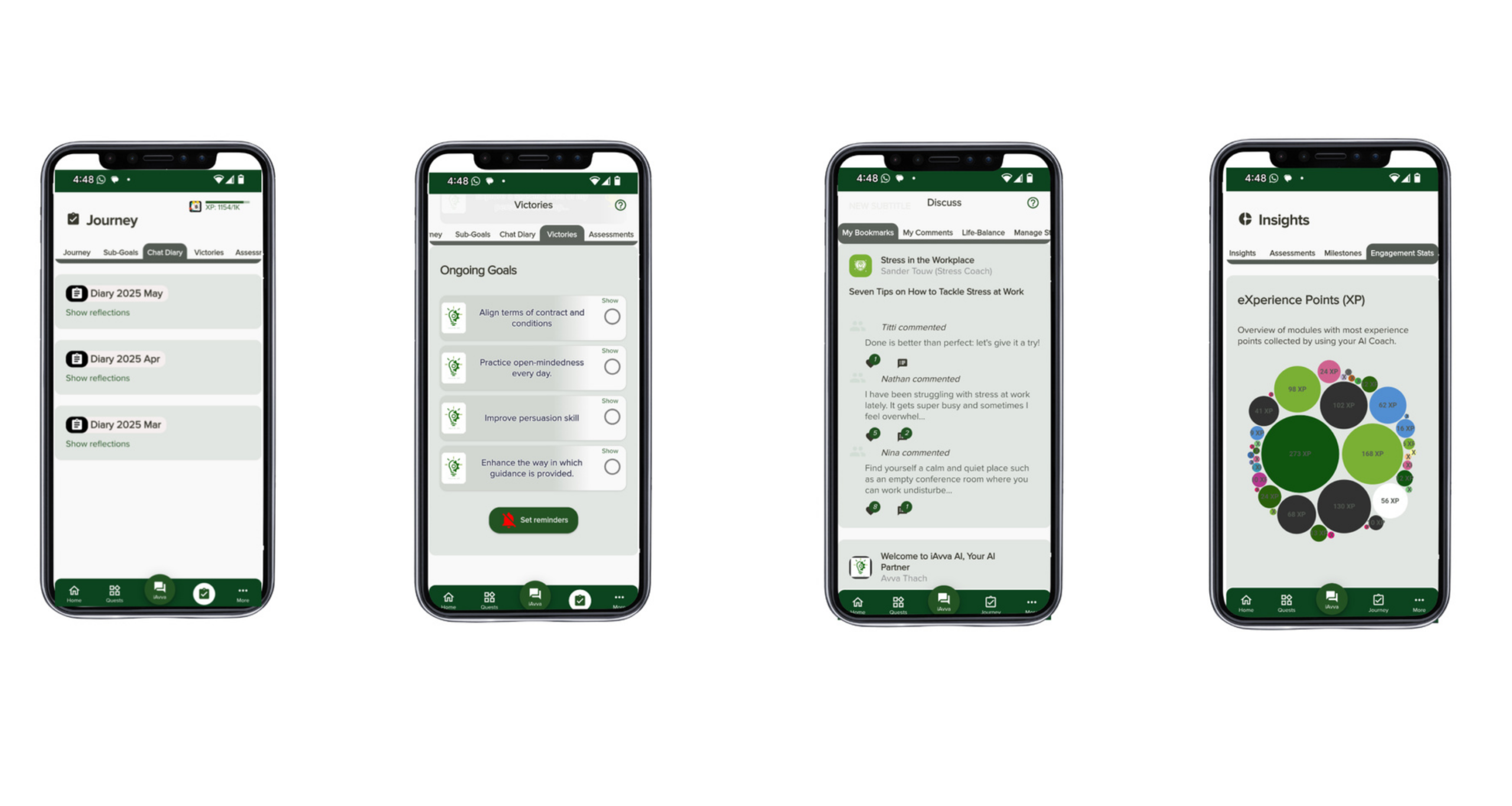
iAvva AI was created to fill that gap. It combines AI strategy with an AI coaching platform that acts as an “always‑on growth companion” for leaders. Interactions take about five minutes a day through web, iOS, or Android, using either voice or text. The platform supports 19 languages and is designed with neurodiversity in mind, so more people can engage comfortably.
Under the hood, iAvva AI draws on neuroscience, positive psychology, and ICF coaching principles. That means the questions it asks are not random. They are crafted to build habits of self‑awareness, focus, ethical decision‑making, and follow‑through—habits that matter directly for digital transformation leadership.
For HR and L&D teams, iAvva AI offers real‑time analytics that connect leadership development to business outcomes. Engagement rates regularly exceed 60% weekly, far higher than many traditional e‑learning programs. Dashboards show who is engaging, what themes are resonating, and how progress links to organizational OKRs.
In short, iAvva AI helps organizations move from one‑off workshops to continuous, measurable development that supports all seven strategies described in this article.
How iAvva AI Enables Each Of The Seven Strategies
Strategy #1 – Sponsorship And Alignment
iAvva AI helps executive sponsors and senior leaders align their personal growth with company OKRs. For example, a sponsor may set a goal around “communicating the transformation vision weekly,” which the platform then supports with targeted prompts. Over time, leaders see how their own behaviors reinforce or weaken strategic alignment.Strategy #2 – Change Management Discipline
The platform guides leaders through their own ADKAR process. It raises Awareness by asking them to reflect on why change matters now, builds Desire by connecting change to their personal values, deepens Knowledge and Ability through scenario‑based questions, and supports Reinforcement through ongoing check‑ins. This creates leaders who are more ready to support change in their teams.Strategy #3 – Strategic Communication
iAvva AI can reinforce communication skills across global, distributed workforces. Because it works in 19 languages and offers both audio and text, leaders can practice key conversations in the language they use with their teams. Prompts might focus on explaining “what this means for you” messages or on listening more actively in remote meetings.Strategy #4 – Training, Coaching, And Support
Five‑minute daily interactions turn formal training into lived behavior. After a workshop on a new system or process, iAvva AI can ask leaders how they will coach their teams this week, what obstacles they expect, and how they plan to respond. This micro‑learning keeps knowledge fresh and supports managers in their role as change coaches.Strategy #5 – Data‑Driven Decisions
HR and L&D teams can use iAvva AI analytics dashboards to see engagement patterns, common themes, and progress over time. This helps them adjust programs based on evidence, show impact to the C‑suite, and connect leadership development more clearly to transformation KPIs around engagement, productivity, and change adoption.Strategy #6 – Agility And Innovation Culture
The content in iAvva AI is grounded in positive psychology and ICF coaching principles, which support experimentation, reflection, and learning. Prompts often ask leaders to review recent experiments, consider how they reacted to failure, or plan small tests. This nudges leaders toward the kind of mindset that supports an agile, learning‑oriented culture.Strategy #7 – Strategic AI Use
iAvva AI itself is a working example of AI applied in a human‑centered way. When leaders experience AI as a helpful coach rather than as a threat, it becomes easier for them to imagine similar patterns in their own areas. The platform also prompts leaders to think through AI use cases, risks, and readiness, building their confidence to guide AI projects.
Across these seven connections, a pattern emerges. iAvva AI does not replace human leaders or coaches. It amplifies their effect by keeping development steady, personalized, and connected to what the business is actually trying to achieve.
Real Impact – Measurable Outcomes For Your Organization
Early users of the iAvva AI Coach App report noticeable gains in focus, self‑awareness, and productivity. Leaders describe being more intentional in meetings, clearer in their communication, and quicker to follow through on commitments. These are exactly the behaviors that support strong digital transformation leadership.
For HR and L&D leaders, the platform provides hard data instead of relying only on feedback forms. They can see how many leaders are engaging weekly, which themes they are working on, and how this correlates with changes in engagement or performance metrics. That makes it much easier to demonstrate the value of leadership development programs to the C‑suite.
Business leaders benefit from the tight link between personal goals in the app and organizational OKRs. When a transformation objective is to improve customer response times, for example, leaders can set and track coaching goals that support this. Progress is visible in one place rather than scattered across notes and spreadsheets.
In short, iAvva AI helps organizations move leadership development from a cost that is hard to justify to an investment with clear, measurable returns that support digital transformation.
Conclusion
Digital transformation leadership is not about buying the newest technology or running the flashiest pilot. It is about guiding people, processes, and structures through deep change while keeping the business healthy. That requires clear strategy, strong sponsorship, disciplined change management, thoughtful communication, real learning support, solid metrics, agile structures, and a smart approach to AI.
The seven strategies in this article give a practical roadmap. Build unshakeable executive sponsorship and align every initiative to meaningful business goals. Treat change management as a core discipline, not an afterthought. Make communication strategic, not random. Give employees and managers the training, coaching, and support they need. Use data to steer and adjust. Shape structures and culture so the organization can adapt, not freeze. And apply AI where it truly serves customers, employees, and performance.
No single workshop or memo can deliver all this. It takes steady, daily leadership behavior across many people. That is where tools like iAvva AI come in. By combining AI coaching with real‑time analytics and OKR alignment, it helps leaders practice the habits that make transformation stick.
The next step is simple. Choose one strategy from this list that feels most urgent for your organization. Put a small, concrete experiment in place within the next month. As you learn from that, expand to the other strategies and consider how an AI‑powered coaching platform could support your leaders along the way.
FAQs
What Is Digital Transformation Leadership?
Digital transformation leadership is the practice of guiding an organization through major changes driven by digital technologies. It goes beyond managing IT projects to include strategy, culture, processes, and people. Leaders in this area connect technology choices to business goals, help employees adapt, and keep efforts aligned with measurable outcomes.
Who Should Own Digital Transformation In An Organization?
The formal owner is often a C‑level leader such as a Chief Digital Officer, CIO, or business unit head, but success depends on shared ownership. The CEO and executive team must sponsor the work, while functional leaders and managers bring it to life in their areas. HR and L&D play a key role in building the skills and behaviors needed across the organization.
How Does iAvva AI Support HR And L&D Leaders Specifically?
iAvva AI gives HR and L&D leaders a way to scale high‑quality leadership development without needing a coach for every manager. It delivers short daily coaching interactions to leaders, aligned with organizational priorities, and then provides analytics showing engagement and progress. This helps HR and L&D demonstrate clear impact on transformation goals and adjust programs based on real data.
Is An AI Coaching Platform A Replacement For Human Coaches And Training Programs?
No. An AI coaching platform such as iAvva AI is designed to complement, not replace, human coaches and formal training. Human coaches still handle deep, complex work and sensitive topics. iAvva AI fills the gaps between those sessions with daily practice, reflection, and reinforcement. It also reaches leaders who might never have access to individual coaching due to cost or location.














Leave a Reply